
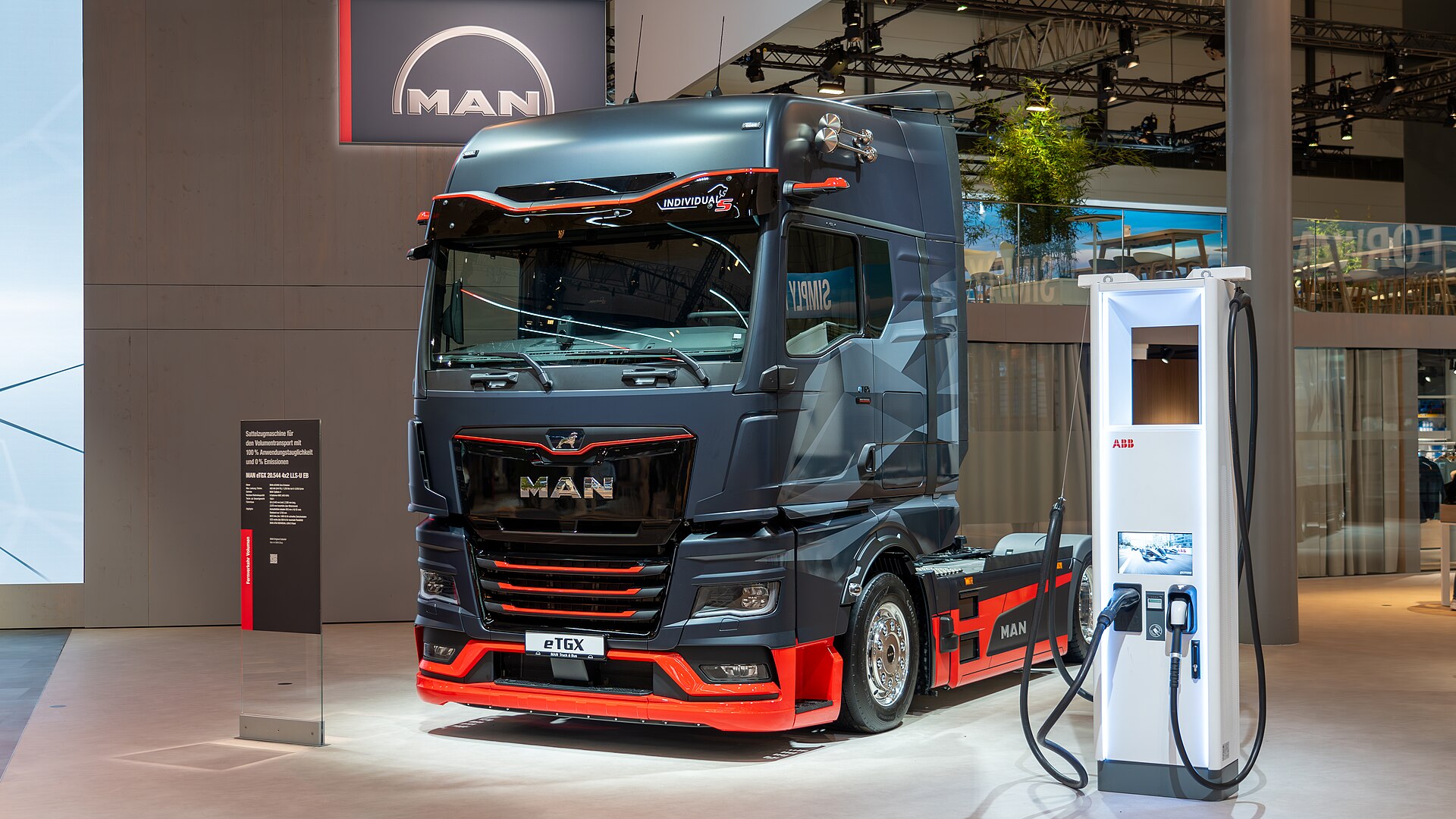
When MAN started series production of the eTGX in Munich in 2025, the question was whether a century-old diesel plant could build electric trucks at volume. The answer arrived quickly: roughly 1,300 electric trucks in the first year, rolling down the same line as their diesel siblings.
The engineering picture
- Modular batteries: LFP packs configurable from about 240 to 560 kWh, letting operators pay for exactly the range their routes need.
- Range: around 500 km for a typical tractor configuration — up to about 570 km in the most favourable semi spec, and further still in chassis configurations with maximum battery fit.
- Power: up to 544 hp (400 kW), with the driveability that makes electric tractors quietly addictive for drivers.
- Charging: prepared for the megawatt era, with high-power charging positioning it against the Mercedes-Benz eActros 600 and Volvo’s FH Aero Electric.
Why the modularity matters
MAN’s bet is that operators do not want one big battery — they want the right battery. A regional distribution tractor that never exceeds 300 km per day should not carry (or finance) 560 kWh of cells. Configurable capacity turns the battery from a fixed cost into a spec decision, exactly like choosing an engine and axle ratio in the diesel world.
The competitive picture
With the eActros 600 established, Volvo’s new generation arriving and Scania opening MCS-ready order books, the European electric long-haul market now has four serious players shipping real volume. For buyers, that means something new: choice, and the price pressure that comes with it.
Sources: electrive, MotorWatt EV Database, Otomotiv Ajansı
Cover photo: MarcelX42 via Wikimedia Commons, CC BY-SA 4.0
.jpg)