
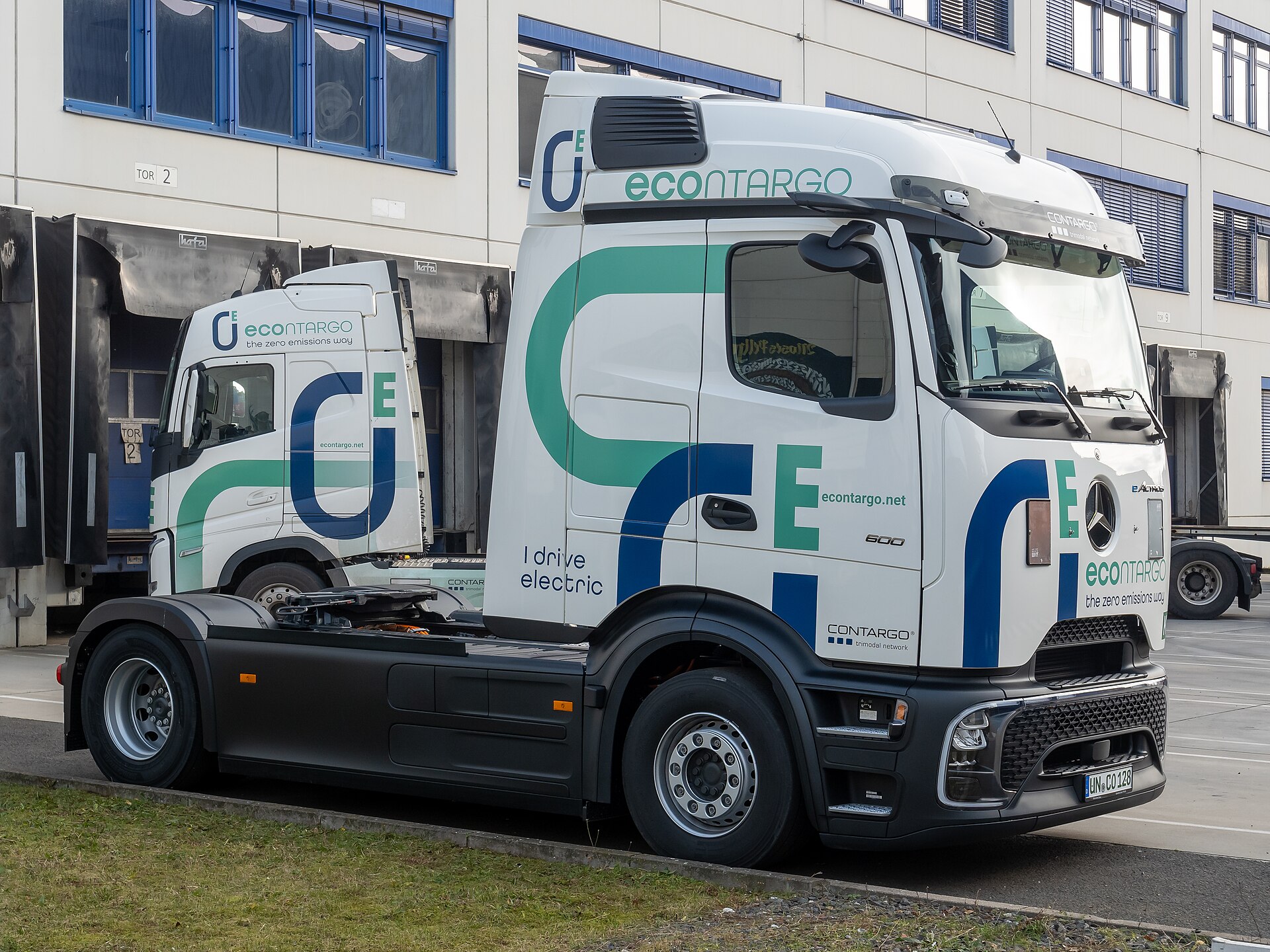
When people argue about whether battery-electric long-haul trucking is real, the Mercedes-Benz eActros 600 is usually the truck they point at. It has become the reference point against which every new electric tractor is measured — for good reason.
The headline numbers
- Battery: three lithium iron phosphate (LFP) packs totalling around 621 kWh of installed capacity.
- Range: roughly 500 km on a single charge at typical long-haul loads — enough to cover a full EU driving shift between breaks.
- Charging: prepared for the Megawatt Charging System (MCS); a 20 to 80% charge takes on the order of half an hour at a megawatt-class charger.
- Drive: an integrated e-axle delivering 400 kW continuous and up to 600 kW peak output.
Why LFP matters
Mercedes chose LFP chemistry over nickel-based alternatives for a simple commercial reason: cycle life. LFP packs tolerate deep, frequent charging cycles with slower degradation — the batteries are designed to outlast the typical first life of the tractor itself. For a fleet buyer, that changes the residual value conversation entirely.
The catch — and it is not the truck
With around 500 km of range and half-hour megawatt charging, the vehicle itself fits neatly into European driving-time rules: drive, charge during the mandatory break, drive again. The constraint is public megawatt charging coverage, which is still being built out along the core corridors. Fleets running depot-to-depot with predictable routes can already make the maths work; fully flexible tramp traffic will take longer.
The bottom line
The eActros 600 answered the range question convincingly enough that the industry conversation has moved on — to charging networks, electricity pricing and TCO. That, more than any spec sheet number, is its real achievement.
Sources: Mercedes-Benz Trucks, MotorWatt EV Database
Cover photo: Matti Blume via Wikimedia Commons, CC BY-SA 4.0
.jpg)