
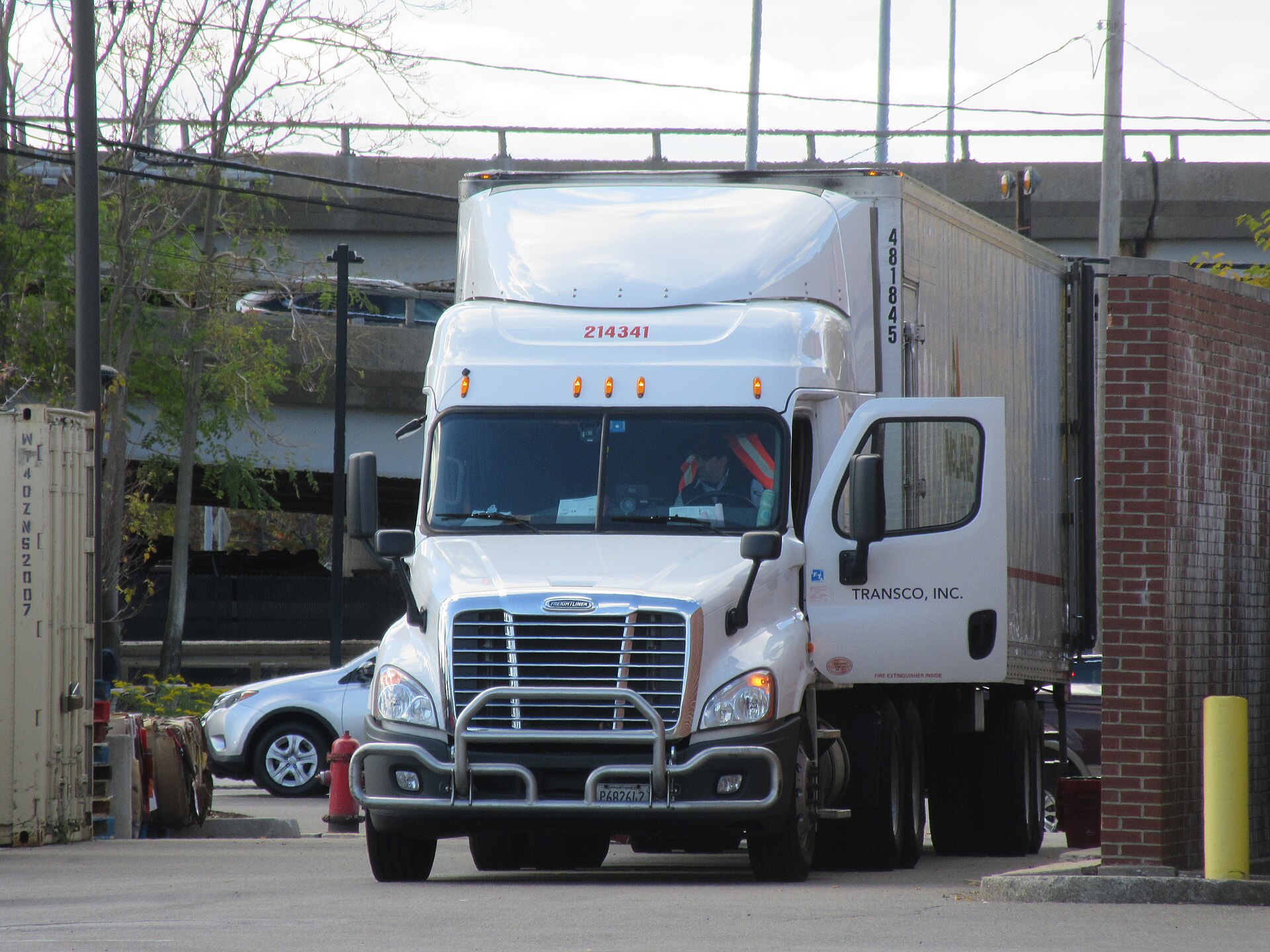
“18-wheeler” is the American nickname for the most common heavy road-freight combination on earth: a tractor unit pulling a semi-trailer. The name comes from a simple count — but the engineering behind those eighteen wheels is what lets one driver move 40 tonnes safely across a continent.
Where the eighteen wheels are
- Steer axle (2 wheels): the single front axle of the tractor.
- Drive axles (8 wheels): two powered rear axles on the tractor, each with dual wheels — four tyres per axle.
- Trailer axles (8 wheels): two axles under the semi-trailer, again with dual wheels.
Two plus eight plus eight makes eighteen. Different configurations exist — a lighter 6×2 tractor, a three-axle trailer — but the classic 6×4 tractor plus tandem-axle trailer is the shape the nickname captures.
Tractor and trailer: two machines, one vehicle
The tractor carries the engine, cab and driveline. The semi-trailer has no front axle — it rests its front end on the tractor through the fifth wheel, a greased steel coupling that carries the load and lets the combination pivot. “Semi” refers to the trailer being only semi-supported by its own wheels.
What holds it together — and stops it
Every axle runs air brakes fed by the tractor’s compressor, connected through the red and yellow “suzie” lines. Because the whole combination stops on compressed air, a healthy air system is safety-critical — the symptoms of a weak one are covered in our air-pressure diagnosis guide. Load is limited by the weight ratings explained in our GVWR and payload guide.
Same machine, different names
What the US calls an 18-wheeler or semi, the UK calls an articulated lorry or “artic,” Australia calls a semi-trailer or prime mover, and Germany calls a Sattelzug. The regional weight limits and dimensions differ, but the anatomy — tractor, fifth wheel, semi-trailer, air brakes on every axle — is shared worldwide.
Cover photo: Jason Lawrence via Wikimedia Commons, CC BY 2.0
