Pallet sizes and dimensions: Euro pallet, other EPAL pallets and the ISO 6780 sizes
The EPAL Euro pallet is 800 x 1,200 x 144 mm and weighs approx. 25 kg. EPAL's other pallets, the CP1 to CP9 pallets, the six ISO 6780 sizes including 48 x 40 in, and the markings.
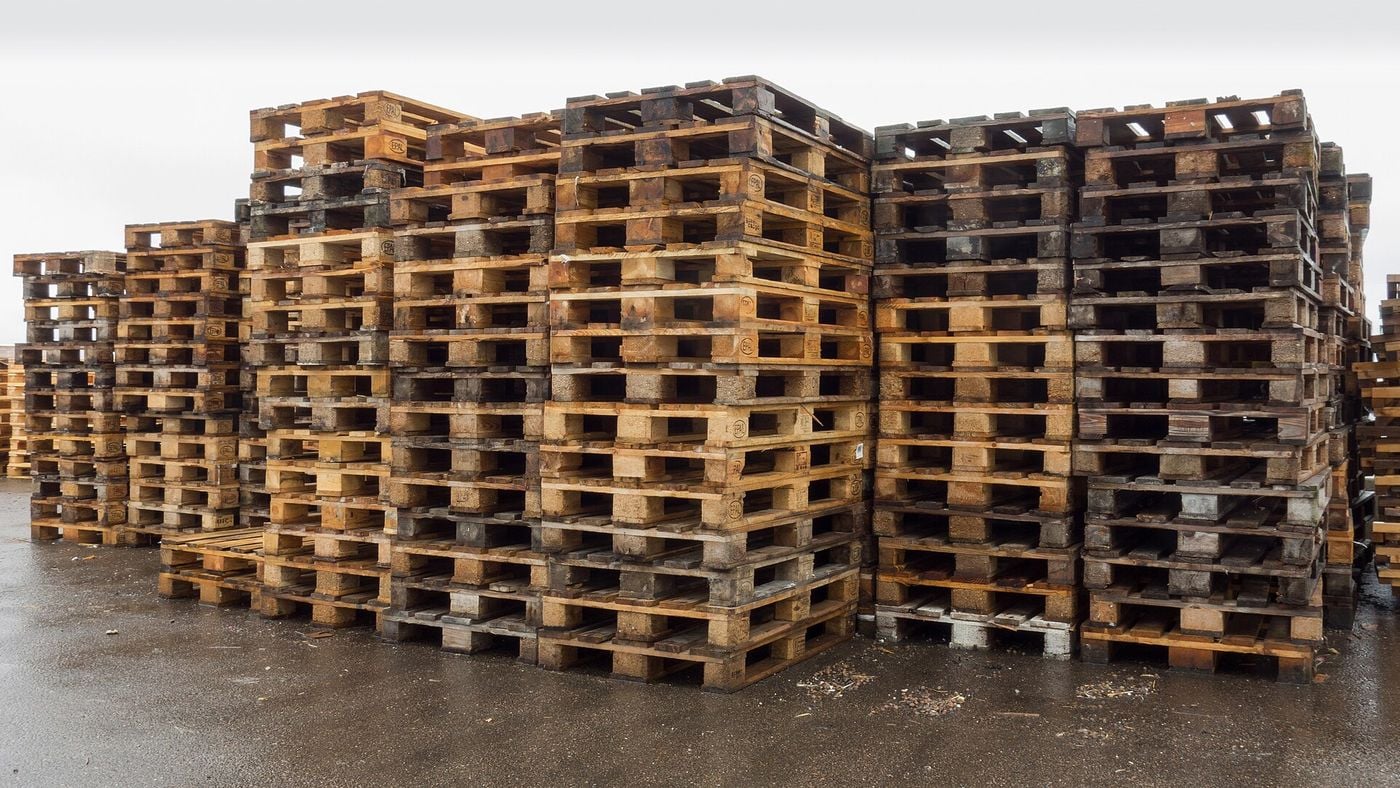
A Euro pallet is 800 mm long, 1,200 mm wide and 144 mm high. These are the dimensions the European Pallet Association (EPAL) gives for its EPAL Euro pallet, also called EPAL 1, together with a weight of approx. 25 kg and a safe working load of 1,500 kg; EPAL says the pallet is mainly used in Europe. EPAL also publishes the dimensions of the EPAL 2 and EPAL 3 pallets, which share a 1,000 x 1,200 mm footprint, of two half pallets of 800 x 600 mm, of a box pallet and of nine CP pallets, CP1 to CP9. The international standard ISO 6780:2003 lists six plan dimensions for flat pallets in intercontinental materials handling: 1,200 x 800 mm, 1,200 x 1,000 mm and 1,219 x 1,016 mm, the last of them 48 x 40 inches, and the squares of 1,067, 1,100 and 1,140 mm.
Status as at 28 October 2026. Read on that day: EPAL’s pages for the Euro pallet, the Euro pallet QR and the CP1 and CP6 pallets, its overviews of all EPAL load carriers and of the CP pallets, its Euro pallet data sheet PB 05/2025 and its pages on the exchange system, quality and ISPM 15. Read on 14 October 2026: EPAL’s pages for the EPAL 2, EPAL 3, EPAL 6 and EPAL 7 pallets, the box pallet and the CP2 to CP5 and CP7 to CP9 pallets, the preview pages of ISO 6780:2003 and the BSI catalogue record of EN 13698-1.
The EPAL pallets
EPAL’s product pages for the six pallets in the table below give the dimensions, length first, the weight and the loads; for the Euro pallet the length is 800 mm and the width 1,200 mm.
| Pallet | Length x width x height | Weight | Safe working load | Bottommost pallet in a stack, max. |
|---|---|---|---|---|
| EPAL Euro pallet (EPAL 1) | 800 x 1,200 x 144 mm | Approx. 25 kg | 1,500 kg | 5,500 kg |
| EPAL 2 | 1,200 x 1,000 x 162 mm | Approx. 35 kg | 1,250 kg | 4,250 kg |
| EPAL 3 | 1,000 x 1,200 x 144 mm | Approx. 30 kg | 1,500 kg | 4,500 kg |
| EPAL 6 half pallet | 800 x 600 x 144 mm | Approx. 9.5 kg | 750 kg | 1,500 kg |
| EPAL 7 half pallet | 800 x 600 x 163 mm | Approx. 9.5 kg | 500 kg in shelving racks or transport with a forklift truck | 1,500 kg |
| EPAL box pallet | Inside 1,200 x 800 mm, height 970 mm | 70 kg if produced after 2011, 85 kg before | 1,500 kg if produced after 1990, 900 kg before | 6,000 kg (bottommost box pallet) |
The EPAL 2 and EPAL 3 have the same footprint. EPAL lists the EPAL 2 as 1,200 mm long and 1,000 mm wide and the EPAL 3 as 1,000 mm long and 1,200 mm wide, and the two differ in height, weight, safe working load and construction. EPAL’s two half pallets, the EPAL 6 and the EPAL 7, both measure 800 x 600 mm; the EPAL 7’s safe working load of 500 kg is given for shelving racks and for transport with a forklift truck.
The box pallet’s 1,200 x 800 mm are inside dimensions. It is built as a steel lattice framework with four boards and two hinged panels and has a loading capacity of 0.75 m³. Its weight and safe working load depend on when it was made: 70 kg if produced after 2011 and 85 kg before, and a safe working load of 1,500 kg if produced after 1990 and 900 kg before.
The ISO 6780 sizes
ISO 6780:2003, Flat pallets for intercontinental materials handling — Principal dimensions and tolerances, is the second edition of the standard, dated 1 December 2003, in a corrected version of 15 April 2004. Its Table 1 gives three rectangular plan dimensions and its Table 2 three square ones, each in millimetres and in inches.
| Shape | Metric | Imperial |
|---|---|---|
| Rectangular | 1,200 x 800 mm | 47.2 x 31.5 in |
| Rectangular | 1,200 x 1,000 mm | 47.2 x 39.4 in |
| Rectangular | 1,219 x 1,016 mm | 48 x 40 in |
| Square | 1,067 x 1,067 mm | 42 x 42 in |
| Square | 1,100 x 1,100 mm | 43.3 x 43.3 in |
| Square | 1,140 x 1,140 mm | 44.9 x 44.9 in |
The standard gives the regional use of these sizes in its Annex A. A note to Table 1, which also applies to Table 2, says that the plan dimensions describe pallet sizes only and do not suggest or imply preferred pallet lengths or preferred pallet widths as defined in ISO 445. The manufacturing tolerances on the plan dimensions are +3/-6 mm (clause 4.1.3). A second note to Table 1 links the dimensions of sawn-timber pallets to a specified moisture content and gives 23 °C ± 2 °C as the measuring temperature for plastics.
The Euro pallet’s 800 x 1,200 mm and the 1,000 x 1,200 mm of the EPAL 2 and EPAL 3 are both on the ISO list. The construction of 800 x 1,200 mm flat wooden pallets has a European standard of its own, EN 13698-1:2003, Pallet production specification — Construction specification for 800 mm x 1200 mm flat wooden pallets. BSI publishes it as BS EN 13698-1:2003, dated 9 July 2003, and listed it as current on 14 October 2026.
The CP pallets
EPAL lists nine CP pallets, CP1 to CP9, on a page of their own. For each, the product page gives the three dimensions and the number of boards, blocks and nails; it gives no weight, no safe working load and no stacking load.
| Pallet | Length x width x height | Boards | Blocks | Nails |
|---|---|---|---|---|
| CP1 | 1,000 x 1,200 x 138 mm | 15 | 9 | 81 |
| CP2 | 800 x 1,200 x 138 mm | 13 | 9 | 60 |
| CP3 | 1,140 x 1,140 x 138 mm | 15 | 9 | 81 |
| CP4 | 1,100 x 1,300 x 138 mm | 15 | 9 | 87 |
| CP5 | 760 x 1,140 x 138 mm | 13 | 9 | 60 |
| CP6 | 1,200 x 1,000 x 156 mm | 20 | 9 | 84 |
| CP7 | 1,300 x 1,100 x 156 mm | 22 | 9 | 96 |
| CP8 | 1,140 x 1,140 x 156 mm | 28 | 12 | 116 |
| CP9 | 1,140 x 1,140 x 156 mm | 24 | 9 | 102 |
The CP3, CP8 and CP9 have the 1,140 x 1,140 mm plan dimension that ISO 6780 lists among its square sizes. EPAL’s CP1 and CP6 pages give a thickness of 18 to 20 mm for the deck and bottom boards of the CP pallets, with stringers up to 22 and 24 mm, and list a CP type marking among the markings.
How the EPAL pallets are built
| Pallet | Boards | Blocks | Nails | Other parts |
|---|---|---|---|---|
| EPAL Euro pallet (EPAL 1) | 11 | 9 | 78 | – |
| EPAL 2 | 17 | 9 | 133 | – |
| EPAL 3 | 13 | 9 | 84 | – |
| EPAL 6 half pallet | 13 | 9 | 69 | – |
| EPAL 7 half pallet | 13 | 3 | 42 | 6 steel angle brackets of 3 mm, 21 tubular rivets |
| EPAL box pallet | 4 | – | – | 2 hinged panels, steel lattice framework |
EPAL’s data sheet for the Euro pallet, edition PB 05/2025, describes its materials as 11 boards of quality timber, 9 blocks of wood chip or solid wood and 78 nails, produced according to the EPAL Technical Regulations. Its dimension drawing gives the height as 144 mm with a tolerance of +7/-0 mm. EPAL’s design rules for the Euro pallet set a board thickness of 22 to 24 mm, with stringers up to 25 mm; stringers may not be made of poplar, and the bottom boards are chamfered on the upper edge of both long sides. The positions of the 78 nails are fixed to keep the pallet diagonally rigid, each nail at least 20 mm from the edges of the components, and every nail carries a head marking of two letters. The data sheet describes the Euro pallet as accessible from all four sides.
Markings and ISPM 15
EPAL’s data sheet lists the markings of the Euro pallet block by block:
- Left- and right-hand corner blocks: EPAL in an oval.
- Middle block: the IPPC rectangle with the IPPC ear of wheat, the country code, the pallet producer’s IPPC number and HT for heat treatment, and the EPAL ID number with the producer’s licence number and the date of production, year and month.
- One of the middle blocks only: the EPAL control staple, which EPAL’s product page lists as mandatory.
- Repaired pallets: a repair marking nail on one of the middle blocks, with the EPAL logo and the repairer’s licence number.
ISPM 15 is the International Standard for Phytosanitary Measures No 15, adopted under the International Plant Protection Convention (IPPC). Since 1 January 2010 all newly produced EPAL Euro pallets have been heat treated in accordance with it, and EPAL lists the IPPC marking as mandatory for EPAL pallets from that date. Under EPAL’s Technical Regulations all EPAL-licensed production and repair operations have had to comply with ISPM 15 since 2010. A treated Euro pallet is recognisable by the branded markings on both central blocks of its long sides, and EPAL’s Euro pallet page states that treating EPAL Euro pallets with methyl bromide is prohibited.
The EPAL Euro pallet QR
The EPAL Euro pallet QR has the same specifications as the Euro pallet: 800 x 1,200 x 144 mm, approx. 25 kg, a safe working load of 1,500 kg, 11 boards, 9 blocks and 78 nails. It adds a QR code of 50 x 50 mm on the right-hand corner blocks, with a nine-digit alphanumeric serial number in plain text to the right of the code; no two QR pallets share a code. The code is inkjet-printed, a marking method EPAL introduced in 2019. On 28 October 2026 EPAL’s questions and answers described printing the QR code as an option, with no obligation for producers, and the QR pallets as fully exchangeable in the open EPAL pallet pool.
The EPAL pool in figures
EPAL’s page on its exchange system gives more than 650 million EPAL Euro pallets and 20 million EPAL box pallets in circulation; the list of key facts on the same page gives more than 625 million Euro pallets and 20 million box pallets in the open exchange pool. EPAL’s quality page names three inspection companies that work independently of EPAL: Bureau Veritas, China Certification & Inspection Group (CCIC) and Timber Products Inspection (TP). The page says that all licensed production and repair operations are inspected without prior notice and gives over 25,000 unannounced quality inspections a year.
Pallets on the trailer floor
How many of these pallets fit on a semi-trailer floor, and in which layout, is set out in how many pallets fit in a trailer. The pallet calculator runs the count for other trailers, swap bodies, containers and vans, and the loading metre calculator turns pallets into loading metres. The cartons per pallet calculator starts from a pallet’s footprint and height and gives the cartons it carries up to a set load height. The dimensions of the semi-trailers themselves are covered in semi-trailer dimensions.
Quick answers
- What are the dimensions of a Euro pallet?
- 800 x 1,200 mm and 144 mm high. EPAL gives the EPAL Euro pallet (EPAL 1) a length of 800 mm, a width of 1,200 mm, a weight of approx. 25 kg and a safe working load of 1,500 kg; it is built from 11 boards, 9 blocks and 78 nails. When laden Euro pallets are stacked on a solid, even surface, EPAL limits the load on the bottommost pallet to 5,500 kg.
- What is the difference between an EPAL 2 and an EPAL 3 pallet?
- Both have a 1,000 x 1,200 mm footprint. EPAL lists the EPAL 2 as 1,200 mm long, 1,000 mm wide and 162 mm high, approx. 35 kg, with 17 boards, 133 nails and a safe working load of 1,250 kg, and the EPAL 3 as 1,000 mm long, 1,200 mm wide and 144 mm high, approx. 30 kg, with 13 boards, 84 nails and a safe working load of 1,500 kg.
- How big is a half pallet?
- EPAL's two half pallets, the EPAL 6 and the EPAL 7, both measure 800 x 600 mm and weigh approx. 9.5 kg. The EPAL 6 is 144 mm high with a safe working load of 750 kg. The EPAL 7 is 163 mm high and has six steel angle brackets, 21 tubular rivets and a safe working load of 500 kg in shelving racks or transport with a forklift truck.
- What are the ISO standard pallet sizes?
- ISO 6780:2003 lists six plan dimensions: three rectangular, 1,200 x 800 mm, 1,200 x 1,000 mm and 1,219 x 1,016 mm (48 x 40 inches), and three square, 1,067 x 1,067 mm, 1,100 x 1,100 mm and 1,140 x 1,140 mm. The manufacturing tolerances on these dimensions are +3/-6 mm, and Annex A of the standard gives the regional use of each size.
- What do the markings on a Euro pallet mean?
- In EPAL's data sheet, the left- and right-hand corner blocks carry EPAL in an oval. The middle block carries the IPPC mark with the country code, the producer's IPPC number and HT for heat treatment, and the EPAL ID number with the producer's licence number and the year and month of production. One middle block has the EPAL control staple, and a repaired pallet carries a repair marking nail with the EPAL logo and the repairer's licence number.
Sources
- EPAL Euro pallet (EPAL 1): specifications, markings, ISPM 15 and design features (web page, read 28 October 2026) — European Pallet Association e.V. (EPAL)
- EPAL Euro pallet 800 x 1,200 mm, product data sheet PB 05/2025 EN: facts and figures, markings and dimension drawing — European Pallet Association e.V. (EPAL)
- Load carriers overview: dimensions and safe working loads of the EPAL pallets (web page, read 28 October 2026) — European Pallet Association e.V. (EPAL)
- EPAL 2 pallet: specifications (web page, read 14 October 2026) — European Pallet Association e.V. (EPAL)
- EPAL 3 pallet: specifications (web page, read 14 October 2026) — European Pallet Association e.V. (EPAL)
- EPAL 6 half pallet: specifications (web page, read 14 October 2026) — European Pallet Association e.V. (EPAL)
- EPAL 7 half pallet: specifications (web page, read 14 October 2026) — European Pallet Association e.V. (EPAL)
- EPAL box pallet: specifications (web page, read 14 October 2026) — European Pallet Association e.V. (EPAL)
- EPAL CP pallets: dimensions of the CP1 to CP9 pallets (web page, read 28 October 2026) — European Pallet Association e.V. (EPAL)
- EPAL CP1 pallet: specifications, markings and design features (web page, read 28 October 2026) — European Pallet Association e.V. (EPAL)
- EPAL CP2 pallet: specifications (web page, read 14 October 2026) — European Pallet Association e.V. (EPAL)
- EPAL CP3 pallet: specifications (web page, read 14 October 2026) — European Pallet Association e.V. (EPAL)
- EPAL CP4 pallet: specifications (web page, read 14 October 2026) — European Pallet Association e.V. (EPAL)
- EPAL CP5 pallet: specifications (web page, read 14 October 2026) — European Pallet Association e.V. (EPAL)
- EPAL CP6 pallet: specifications, markings and design features (web page, read 28 October 2026) — European Pallet Association e.V. (EPAL)
- EPAL CP7 pallet: specifications (web page, read 14 October 2026) — European Pallet Association e.V. (EPAL)
- EPAL CP8 pallet: specifications (web page, read 14 October 2026) — European Pallet Association e.V. (EPAL)
- EPAL CP9 pallet: specifications (web page, read 14 October 2026) — European Pallet Association e.V. (EPAL)
- EPAL Euro pallet QR: specifications and markings (web page, read 28 October 2026) — European Pallet Association e.V. (EPAL)
- EPAL Euro pallet QR: questions and answers (web page, read 28 October 2026) — European Pallet Association e.V. (EPAL)
- The exchange system that works worldwide (web page, read 28 October 2026) — European Pallet Association e.V. (EPAL)
- ISPM 15: protection of international ecosystems (web page, read 28 October 2026) — European Pallet Association e.V. (EPAL)
- Quality assurance: quality inspection key facts (web page, read 28 October 2026) — European Pallet Association e.V. (EPAL)
- ISO 6780:2003 Flat pallets for intercontinental materials handling — Principal dimensions and tolerances, second edition, corrected version of 15 April 2004: preview pages, clause 4 with Tables 1 and 2 — ISO (sample via iTeh Standards), 1 Dec 2003
- BS EN 13698-1:2003 Pallet production specification — Construction specification for 800 mm x 1200 mm flat wooden pallets: catalogue record (read 14 October 2026) — BSI, 9 Jul 2003