segments
Semi-trailer dimensions: the rules behind the 13.6-metre deck
Krone and Schmitz Cargobull both publish a 13,620 mm curtainsider deck. The rule behind it is Annex I 1.6 of Council Directive 96/53/EC, and it is a kingpin measurement rather than a length limit.
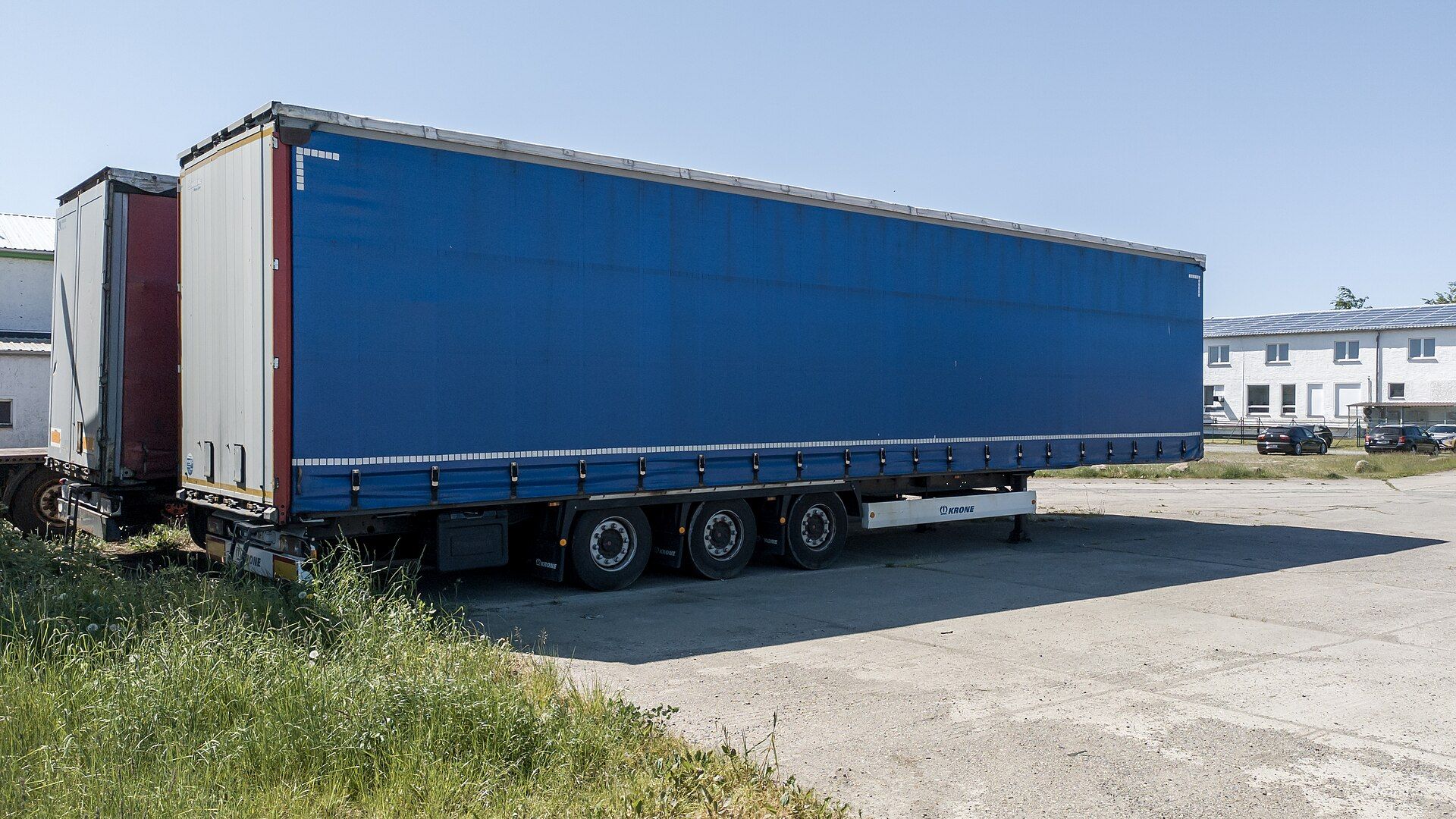
Two curtainside semi-trailers built in different factories, parked side by side, have decks that line up. Krone publishes a load compartment length of 13,620 mm for the Profi Liner. Schmitz Cargobull publishes an internal body length of 13.62 m for the S.CS Universal. That number appears in no European regulation. What the regulation supplies is a boundary, and the reason a buyer cannot simply order a longer deck is that the boundary is drawn in a place most people never look: at the kingpin, rather than at either end of the trailer.
The dimensions half of a directive you already half know
Council Directive 96/53/EC is usually quoted for weights, and the weight side of it — gross figures, axle limits, the bands that depend on axle spacing — is covered separately in truck weights, GVW and GCW. The title of the instrument draws a distinction that decides this article. It lays down the maximum authorized dimensions in national and international traffic, and the maximum authorized weights in international traffic. Weight limits are a rule about crossing borders. Dimension limits are not.
Article 4(1)(a) says so in the negative: member states shall not authorise the normal circulation within their territories of vehicles or vehicle combinations for the national transport of goods which are not in conformity with the characteristics set out in points 1.1, 1.2, 1.4, 1.5, 1.6, 1.7, 1.8, 4.2 and 4.4 of Annex I. Article 4(2) lists what a member state may let through at home — points 1.3, 2, 3, 4.1 and 4.3 — and the only dimensional item on that permissive list is height. Length and width sit on the forbidden list. That asymmetry is the starting point for why national weight rules diverge across Europe while trailer decks do not. It is not the whole of it, because Article 4(4) opens a door in the other direction for purely national work, and that door is described further down.
| Annex I point | Limit | What it measures |
|---|---|---|
| 1.1 | 12.00 m | Maximum length, motor vehicle other than a bus |
| 1.1 | 12.00 m | Maximum length, trailer |
| 1.1 | 16.50 m | Maximum length, articulated vehicle |
| 1.1 | 18.75 m | Maximum length, road train |
| 1.2 | 2.55 m / 2.60 m | Maximum width; 2.60 m for superstructures of conditioned vehicles or conditioned containers or swap bodies transported by vehicles |
| 1.3 | 4.00 m | Maximum height, any vehicle |
| 1.5 | 12.50 m / 5.30 m | Swept circle a moving vehicle or combination must turn within: outer and inner radius |
| 1.6 | 12.00 m | Maximum distance from the axis of the fifth-wheel king pin to the rear of a semi-trailer |
| 4.4 | 2.04 m | Maximum horizontal distance from the axis of the king pin to any point at the front of the semi-trailer |
Point 1.6 is the rule that decides the deck
Most people reach for the 16.50 m in point 1.1 when asked why trailers are the length they are. It is the wrong number. The 16.50 m is a limit on the articulated vehicle — tractor and semi-trailer together — so it depends on which tractor is coupled, where the fifth wheel sits on it, and how long its cab is. A trailer builder cannot design to a figure that changes with the customer’s truck.
Point 1.6 does not change. It fixes a maximum of 12.00 m from the axis of the fifth-wheel king pin to the rear of the semi-trailer, and it is measured entirely on the trailer. Point 4.4 closes the other end: the distance measured horizontally between the axis of the king pin and any point at the front of the semi-trailer must not exceed 2.04 m. Because it catches any point at the front, that limit works as a radius about the kingpin, which is what keeps a turning trailer clear of the cab. Between them the two points describe an envelope of 14.04 m — our arithmetic, a sum printed in neither the Directive nor any maker’s brochure — inside which the whole body has to fit.
The destination inside that envelope is 13,620 mm, and it is published rather than deduced: Krone quotes it for the Profi Liner, Schmitz Cargobull quotes 13.62 m for the S.CS Universal, and Kögel quotes 13,620 mm as the clear loading length of every Kögel Cargo except its two extended EuroTrailer variants. The Directive does not name the figure and no manufacturer sets out how it was arrived at. Both ends of the story are therefore documented — 14.04 m of legal room, 13.62 m of usable deck — and the difference between them is a matter of structure, tolerance and commercial habit that nobody involved has put on paper.
The envelope also explains what a longer body listing means. Schmitz Cargobull’s own technical data for the S.CS Universal gives two internal body lengths, 13.62 m and 15 m, alongside an internal width of 2,480 mm and 34, 37 or 40 Euro pallet spaces. A 15 m body is longer than the 14.04 m envelope computed above, so on our reading it cannot be an Annex I vehicle. Whatever legal basis a deck that long has, it is not Annex I, and the Great Britain regime set out at the end of this article shows what one such basis looks like: a loading area permitted up to 15.65 m, and a list of conditions attached to it.
A machine carrier answers the same envelope from the other direction, by lowering the deck rather than lengthening it: Nooteboom gives the MCOS a load floor adjustable from 810 to 1030 mm and publishes no overall length for it at all.
Standard and mega are the same trailer in plan view
The most common misreading in a trailer specification is that a mega trailer is a bigger trailer. It is not. Krone gives the Mega Liner a clear side length of 13,620 mm and a clear side width of 2,480 mm — the same two figures as the Profi Liner. Everything that differs is vertical.
The Profi Liner has a front construction height of 125 mm and an unloaded fifth coupling height of 1,050 to 1,200 mm, with a clear side height of 2,600 to 2,700 mm. The Mega Liner has a front construction height of 80 mm and a coupling height of 960 to 1,160 mm. Krone supplies the Mega Liner with two neck heights, 80 and 50 mm, and states the mechanism plainly: with a tractor unit at a coupling height of 915 mm the 50 mm neck permits an internal height of 3,000 mm — a figure Krone qualifies “UK, roof beam” — and with tractor units at a coupling height of 885 mm the 80 mm neck permits the same 3,000 mm.
That is the practical consequence of Annex I 1.3. The 4.00 m overall height is fixed, so internal volume can only be won by moving the floor down, and the floor can only come down if the tractor’s fifth wheel is low enough to accept the trailer’s neck. A mega trailer is therefore a joint specification of two vehicles rather than a trailer option, which is why the axle configuration of the tractor and the trailer’s own bogie both belong in the same conversation. Tare weight follows: Krone’s published dead weight is 5,940 kg for the Profi Liner and 6,350 kg for the Mega Liner, and the first of those two vehicles has a record of its own at Krone Profi Liner.
Width behaves the same way. Both makers quote 2,480 mm inside against the 2.55 m outside limit of point 1.2, which leaves 70 mm of structure across the whole vehicle — again our arithmetic. Curtain, rave and side wall all have to be found inside that, which is why internal width does not vary between makers either.
The exceptions the Directive writes for itself
The Directive is explicit about where it bends, and the bends read differently once they are quoted in the direction they were drafted. Article 4(3) is a restriction rather than a grant: vehicles or vehicle combinations which exceed the maximum dimensions may only be allowed to circulate on the basis of special permits issued without discrimination by the competent authorities, or of similar non-discriminatory arrangements agreed with them case by case, and only where those vehicles carry or are intended to carry indivisible loads. Article 4(5) allows member states to let vehicles incorporating new technologies or new concepts carry out certain local transport operations for a trial period, with the Commission informed. Article 5 is a survivor of the old regime and still names both of the points this article turns on: articulated vehicles put into circulation before 1 January 1991 which do not comply with points 1.6 and 4.4 are deemed to comply for the purposes of Article 3 if they do not exceed a total length of 15.50 m.
Article 4(4) reaches into the subject most directly, and it is the one most easily quoted by halves. Its first limb is the derogation itself: member states may allow vehicles or vehicle combinations used for transport which carry out certain national transport operations that do not significantly affect international competition in the transport sector to circulate in their territory with dimensions deviating from points 1.1, 1.2, 1.4 to 1.8, 4.2 and 4.4 of Annex I. That range covers 1.6, and 4.4 is named outright, so the two points this article is built on are the express subject of a national derogation. Its second limb is the test, and an operation qualifies if one of two conditions is fulfilled: either it is carried out in a member state’s territory by specialized vehicles or specialized vehicle combinations in circumstances in which they are not normally carried out by vehicles from other member states, the Directive’s own example being operations linked to logging and the forestry industry; or the member state also permits motor vehicles, trailers and semi-trailers complying with Annex I to be used in such combinations as to achieve at least the loading length authorized in that member state, so that every operator may benefit from equal conditions of competition. The second condition is the modular concept. Both are bounded to national operations, and both are permissions addressed to member states rather than specifications a buyer can order.
Two later insertions show how carefully the drafting distinguishes the length points from each other. Article 10c allows the maximum lengths in point 1.1, subject where applicable to Article 9a(1), and the maximum distance in point 1.6 to be exceeded by 15 cm for vehicles or vehicle combinations engaged in the transport of 45-foot containers or 45-foot swap bodies, empty or loaded, provided the road leg is part of an intermodal transport operation. Article 8b, which permits rear aerodynamic devices, relieves point 1.1 only: it names point 1.6 nowhere, it requires the vehicle to go on complying with the swept circle of point 1.5, and it requires that any exceeding of the maximum lengths shall not result in an increase in the loading length. Article 9a does the same at the front for cabs delivering improved aerodynamic performance and safety — point 1.1 relieved, point 1.5 preserved, no increase in load capacity — the pair of allowances examined in aerodynamic cabs and the length rules, and the reason the current generation of truck cabs has the nose it has. When the legislator intends to relieve point 1.6, it says point 1.6.
What a longer deck actually costs to obtain
Great Britain is outside the Directive and shows what the alternative looks like. The Road Vehicles (Authorisation of Special Types) (General) (Amendment) Order 2023 made longer semi-trailers a recognised category of special vehicle rather than a normal one. Its length requirements move exactly the measurement this article is about: the longitudinal distance from the axis of the kingpin to the rear must not exceed 14.05 m, the distance from the foremost part of the loading area to the rear must not exceed 15.65 m, and the overall length of an articulated vehicle including one must not exceed 18.55 m.
The conditions attached are the interesting part. Such a trailer must have a minimum of three axles, one of which must be capable of steering. Where the combination’s maximum authorised weight exceeds 38,000 kg it must carry an on-board weighing device. A load must not have a rearward projection. And, save for a diversionary route where use of the established route is prohibited by another enactment or the operator reasonably expects unreasonable traffic delays from an accident or other obstruction, it may not be used on a road other than an established route, meaning one covered by a written route plan and a written risk assessment. Even that carve-out is fenced: the diversion is unavailable where an alternative established route or a fresh route plan is reasonably practicable, and where the cause is a prohibition it runs for seven days. In Great Britain a longer deck is not an option box on an order form; it is a separate legal category with operating obligations behind it.
The number is on the plate
Every vehicle in scope and complying with the Directive has to carry one of the three proofs listed in Article 6(1), and where that proof takes the form set out in point (a) it includes a plate relating to dimensions. Among the data on it are the distance (a) between the front of the motor vehicle and the centre of the coupling device, with minimum and maximum values where the fifth wheel has several coupling points, and the distance (b) between the centre of the coupling device of the semi-trailer — the kingpin — and its rear, again with minimum and maximum values where the device has several coupling points. That second figure is point 1.6 made checkable, and the min/max provision is why an adjustable kingpin plate has to be plated across its range rather than at one setting. Article 6(2) requires the proof of compliance to be altered if the vehicle’s characteristics stop matching it.
Enforcement is lighter here than on weights, and deliberately so: under Article 6(4) a vehicle carrying proof of compliance may be subject to random checks on weights, but to checks on dimensions only where there is a suspicion of non-compliance.
The revision of the Directive has not landed. The Commission proposed it in July 2023, Parliament adopted a position in March 2024 and the Council agreed a general approach on 4 December 2025, with trilogue negotiations opening on 9 December 2025 and no adopted text yet. Until one exists, the deck length is the fixed term in the equation. What a buyer is really choosing between is height, tare, bogie position and body type — the ground covered in trailer types, and set out figure by figure for one worked example in the Schmitz Cargobull S.KO COOL SMART record — and not a single millimetre of load length.
Quick answers
- How long is a standard European semi-trailer?
- Krone publishes a load compartment length of 13,620 mm for the Profi Liner and Schmitz Cargobull publishes an internal body length of 13.62 m for the S.CS Universal. The figure is an industry convention; it appears in no EU rule.
- Which rule decides semi-trailer deck length?
- Annex I point 1.6 of Council Directive 96/53/EC: the maximum distance between the axis of the fifth-wheel king pin and the rear of a semi-trailer is 12.00 m. Point 4.4 adds that the distance measured horizontally between the axis of the king pin and any point at the front of the semi-trailer must not exceed 2.04 m, which works as a radius about the kingpin rather than a fore-and-aft setback.
- Can a longer semi-trailer be ordered for domestic work only?
- Not as an ordinary purchase. Article 4(1)(a) of 96/53/EC requires member states not to authorise the normal circulation of national goods vehicles that fail points 1.6 and 4.4. Article 4(4) then lets a member state allow certain national transport operations that do not significantly affect international competition to circulate with dimensions deviating from points 1.1, 1.2, 1.4 to 1.8, 4.2 and 4.4 — but that is a permission the state grants, not an option on an order form.
- What is the difference between a standard and a mega semi-trailer?
- Height, not length. Krone publishes 13,620 mm of internal length for both the Profi Liner and the Mega Liner. The Mega Liner's coupling height is 960 to 1,160 mm against the Profi Liner's 1,050 to 1,200 mm, and its front construction height is 80 mm against 125 mm.
- How wide and how tall may a semi-trailer be in Europe?
- Annex I 1.2 sets 2.55 m width, or 2.60 m for superstructures of conditioned vehicles or conditioned containers or swap bodies transported by vehicles. Annex I 1.3 sets 4.00 m height for any vehicle. Width is one of the points member states may not relax under Article 4(1)(a); height is one they may under Article 4(2).
Sources
- Council Directive 96/53/EC, consolidated text of 14 August 2019 — Annex I and Articles — EUR-Lex, European Union
- Council Directive 96/53/EC — Annex I: maximum weights and dimensions — legislation.gov.uk (The National Archives)
- Council Directive 96/53/EC — Articles 3, 4, 6, 8b, 9a and 10c — legislation.gov.uk (The National Archives)
- Profi Liner — technical data — Fahrzeugwerk Bernard Krone GmbH & Co. KG
- Mega Liner — technical data — Fahrzeugwerk Bernard Krone GmbH & Co. KG
- S.CS UNIVERSAL curtainsider semi-trailer — technical data — Schmitz Cargobull AG
- The Road Vehicles (Authorisation of Special Types) (General) (Amendment) Order 2023, article 4 — legislation.gov.uk (The National Archives)
- Review of the Council Directive 96/53/EC — Legislative Train Schedule — European Parliament
- KÖGEL CARGO — product detail, vehicle variants — Kögel Trailer GmbH