Schmitz Cargobull
Schmitz Cargobull S.KO COOL SMART
A 39,000 kg permissible total, a 7,960 kg tare and a 27,000 kg bogie rating are three different figures. What Schmitz publishes for its reefer box semi-trailer, and what it does not.

Model overview
The weights and dimensions above belong to the S.KO COOL SMART EXECUTIVE PLUS with a 13.4 m internal body; Schmitz publishes none for the 14.7 m and 16.8 m bodies it also sells, and the pallet figures 33 / 36 / 41 are those three lengths rather than three options for one trailer. Tare is published as 7,960 kg +/- 3% and should not be quoted as an exact figure. Nor should the dimensions: Schmitz prints every length, width and height in that table — and both coupling heights — with "approx." in front of the value, and only the wheelbase 7,600 mm, the axle spacing 1,310 mm, the front overhang 1,600 mm and the ride height 410 mm are given clean. The integers here are the maker's approximate figures with the qualifier stripped by the schema, and none of them will bear a millimetre-level argument. Loading length here is the internal body length (L) of 13,410 mm; the same table gives a usable body length (LN) of 13,315 mm. Schmitz publishes two insulation figures and they are not interchangeable: 0.33 W/m²K for the COMPLETE version in the S.KO brochure and on both EXECUTIVE PLUS sheets, and "a k-value from 0.295 W/m²K from series production" in the current IAA brief information for the S.KO COOL. Both are the maker's own k-values, not a tested ATP K coefficient. The ATP class is FRC or FNA depending on application and equipment options. Axle count is not a published figure — see the comment block at the head of this file for how "tri-axle" was arrived at.
Schmitz Cargobull’s own company timeline dates this trailer in one line: “2018 — S.KO COOL SMART”. It is a Sattelkoffer, a box semi-trailer — a rigid, self-supporting insulated body rather than a curtain — built for temperature-controlled freight and sold with the maker’s own S.CU refrigeration unit on the front bulkhead. It is the first refrigerated semi-trailer to get a record of its own on this site, and the vehicle several of these articles have described in the abstract.
One qualification comes before any figure. Schmitz sells the S.KO COOL SMART with three internal body lengths — 13.4, 14.7 and 16.8 m, with 16.5 and 17.8 m and a 3 m-interior MEGA on request — and publishes weights and dimensions for exactly one: the EXECUTIVE PLUS package on the 13.4 m body, on 385/65 R 22.5 tyres. Everything below belongs to that configuration. That table appears three times in the maker’s documents — English and German brief information sheets, and HTML on the UK site — and all three agree.
One more thing about that table, because it governs every dimension quoted below. Sixteen of its twenty-six rows are printed with “approx.” in front of the value — that count is ours, taken row by row off the maker’s own sheet: all four lengths, all three widths, the body and overall heights, the rear loading height, the rear door aperture and both coupling heights. Only the wheelbase (R) 7,600 mm, the axle spacing (W) 1,310 mm, the front overhang (F) 1,600 mm and the ride height 410 mm are given clean, alongside the five weights and the tyre size. The dimensions below are the maker’s approximate figures, and an approximate figure will not carry a millimetre-level argument.
Three weights, three different questions
The weights on a trailer specification are not variations on one number. Four appear in the table and each answers something different.
Tare — 7,960 kg. What the trailer weighs empty: the only one a buyer cannot change after build, and every kilogram of it is payload spent on structure. Schmitz prints it with a tolerance, “+/- 3%”, which the record above has no field for. At that tolerance the real band runs from 7,721 to 8,199 kg — our arithmetic on the maker’s own tolerance, printed in no document.
Permissible total — 39,000 kg. What the loaded trailer may weigh.
Payload — 31,040 kg. Schmitz’s own subtraction, printed beside the other two and exact against them.
Axle unit load — 27,000 kg, Aggregatlast in the German original: what the bogie is rated at, which is not the total.
Semi-trailer load — 15,000 kg, Sattellast: what the coupled trailer imposes on the tractor’s fifth wheel. That is the tractor’s side of the deal, and it has to be read against the coupling’s own plate — the U value discussed in kingpin and fifth wheel — before a pairing is sound. The published coupling heights, approx. 1,140 mm unloaded and approx. 1,115 mm loaded, say which tractors this trailer sits level on.
Now add the last two. A bogie rated at 27,000 kg under a coupling imposing 15,000 kg accounts for 42,000 kg — three tonnes more than the trailer may itself weigh. That addition is ours and appears in no document, and the mismatch is not an error: component ratings are ceilings for each part in isolation, the plated total a ceiling for the whole. Reading one as the other is the confusion gross vehicle and gross combination weights exists to unpick.
What the bogie is rated at is not what the road allows
Council Directive 96/53/EC caps the sum of the axle weights on a tri-axle of a trailer or semi-trailer by the distance between the axles: Annex I 3.3.1 sets 21 tonnes where that distance is 1.3 m or less, and Annex I 3.3.2 sets 24 tonnes where it is over 1.3 m and up to 1.4 m. Schmitz publishes an axle spacing of 1,310 mm. Reading one against the other — our reading, not a statement by the maker or the legislator — puts the bogie in the second band, at 24 tonnes, against a component rating of 27,000 kg. Article 4(2) leaves member states free to authorise national circulation outside the Annex I weight points, so the gap is not a fault: it is the difference between what the running gear can carry and what a road will accept, the distinction axle configurations turns on.
The deck, and the envelope it has to fit
The table gives four lengths for one trailer and none is interchangeable with another: 13,600 mm overall, 13,550 mm external overall, 13,410 mm internal body and 13,315 mm usable body. The record above carries the internal body length as the loading length, because that is the one a pallet plan is drawn against. The wheelbase — kingpin to bogie centre — is 7,600 mm, the internal body height 2,650 mm here against a family range of 2,350–3,050 mm, and the unloaded rear loading height 1,279 mm. Pallet capacity is published as 33 / 36 / 41 Euro pallets or 26 ISO pallets — three body lengths rather than three options for one trailer, so on the 13.4 m body the answer is 33.
Width is the interesting dimension. Schmitz publishes a body width, overall, of approx. 2,600 mm, and Annex I 1.2 of the same Directive allows 2.60 m only for superstructures of conditioned vehicles or conditioned containers or swap bodies transported by vehicles, against 2.55 m for all vehicles except those. That extra 50 mm is not an entitlement of reefers as a class. Article 2 of the same Directive defines a conditioned vehicle as one whose fixed or movable superstructures are specially equipped for the carriage of goods at controlled temperatures and whose side walls, inclusive of insulation, are each at least 45 mm thick — and Schmitz publishes no side wall thickness for this trailer in any document read for this record. So the published width sits exactly on the higher limit, it is an approximate figure at that, and whether this trailer is inside the definition that grants the higher limit cannot be settled from the maker’s sheets. Internal width is approx. 2,460 mm, with 2,490 mm offered as an optimised loading volume option that the product page attributes to “the adapted side wall thickness” — inside an unchanged overall width, that means thinner walls, which is our reading of the maker’s phrase and not a statement by Schmitz.
Height runs the other way, and there the qualifier decides the sentence. Schmitz publishes an overall unloaded height of approx. 4,009 mm at the front and approx. 4,008 mm at the rear; Annex I 1.3 caps height at 4.00 m for any vehicle. Nine millimetres on a figure the maker itself calls approximate is not a compliance finding in either direction, so the trailer’s height has to be read off its own plate rather than off the brochure. What the Directive does say is that height is one of the Annex I points — 1.3 is named in Article 4(2) — a member state may authorise otherwise in national traffic, while width under 1.2 is in the Article 4(1) list it may not. The rules behind all of it are set out in semi-trailer dimensions, written without a vehicle to hang them on.
Body, floor and load securing
The box is Schmitz’s FERROPLAST panel, and it is certified rather than merely described. It carries DIN EN 12642 Code XL as standard, the reinforced-body certification that changes what a roadside cargo check expects of the securing inside it and the reason load securing treats an XL body as a different starting position. The multifunctional floor — optional equipment, and marked as such in the brochure’s interior legend, where the alternative is the barley grain floor it is benchmarked against — is rated R12 to DIN 51130 for slip resistance and TÜV-certified for its coefficient of friction to VDI 2700, the input the friction half of any securing calculation rests on. The optional double-decker system carries a TÜV-certified load securing system: the brochure says cargo can be form-locked using three beams with 9,000 daN, and separately gives each beam a load-bearing capacity of 1,000 kg at 8 kg empty weight. Those are two different ratings and neither is a conversion of the other. A certification, a friction rating and a restraint rating against a named model is what the box and reefer entries in the trailer type table have lacked.
By the classifying test set out in trailer brakes and EBS — the mass a semi-trailer’s own axles put on the ground, not its plated total — this is an O4. That is our reading; no Schmitz document read here names a category.
The cold chain, and what Schmitz will not certify
Two claims are easy to run together here, and Schmitz keeps them apart. The first is the ATP class. Schmitz states that its trailers comply with ATP class FRC or FNA depending on the application and equipment options, and the S.KO brochure adds that the S.KO COOL SMART is certified for the ATP FRC class by TÜV Süd and Germanischer Lloyd. The TrailerConnect CTU control unit, with a certified digital TCI temperature recorder to DIN EN 12830, is supplied as standard in the S.KO COOL SMART — the recording duty set out in refrigerated transport arriving pre-fitted. Article 3(3) of Directive 96/53/EC belongs alongside it: member states may require conditioned vehicles to carry an ATP certificate.
The second is insulation, where the figure is the maker’s own rather than a test result — and there are two of them. The S.KO brochure and both EXECUTIVE PLUS sheets give 0.33 W/m²K, attached specifically to the COMPLETE version, which the brochure footnotes as available only with a brand-name refrigeration unit fitted ex-factory; the current IAA brief information for the S.KO COOL gives “a k-value from 0.295 W/m²K from series production”. Neither is a tested ATP K coefficient, and the treaty thresholds quoted in the refrigerated transport article must not be read as measured on this vehicle.
What we could not confirm
The axle count is not a published figure. No Schmitz document opened for this record prints one, so the numeric field is empty and the configuration reads “tri-axle” instead. What supports it is converging maker text rather than a count: one axle spacing and one axle unit load in the table, the brochure’s ROTOS running gear “with self-steering axle as the third axle”, the ROTOS page’s note that smaller 370 mm brake discs make the chassis 50 kg lighter on a semi-trailer with three axles, and a 2023 press release calling the electric sibling a three-axle semi-trailer. That is a reading, labelled as one.
No cooling capacity is published. The S.CU brochure was read in full and carries no cooling output at any evaporating temperature. Its only output figure is a maximum motor output of 19 kW for the diesel drive, which is a different thing.
No emission class is shown. The Stage V compliance Schmitz publishes belongs to that same diesel drive, and in an emission field it would read as a Euro class for a vehicle with no engine.
Nothing found mentions ADR, in either the S.KO brochure or the product page, so this is the contrast case for the ADR trailer article rather than an illustration of it.
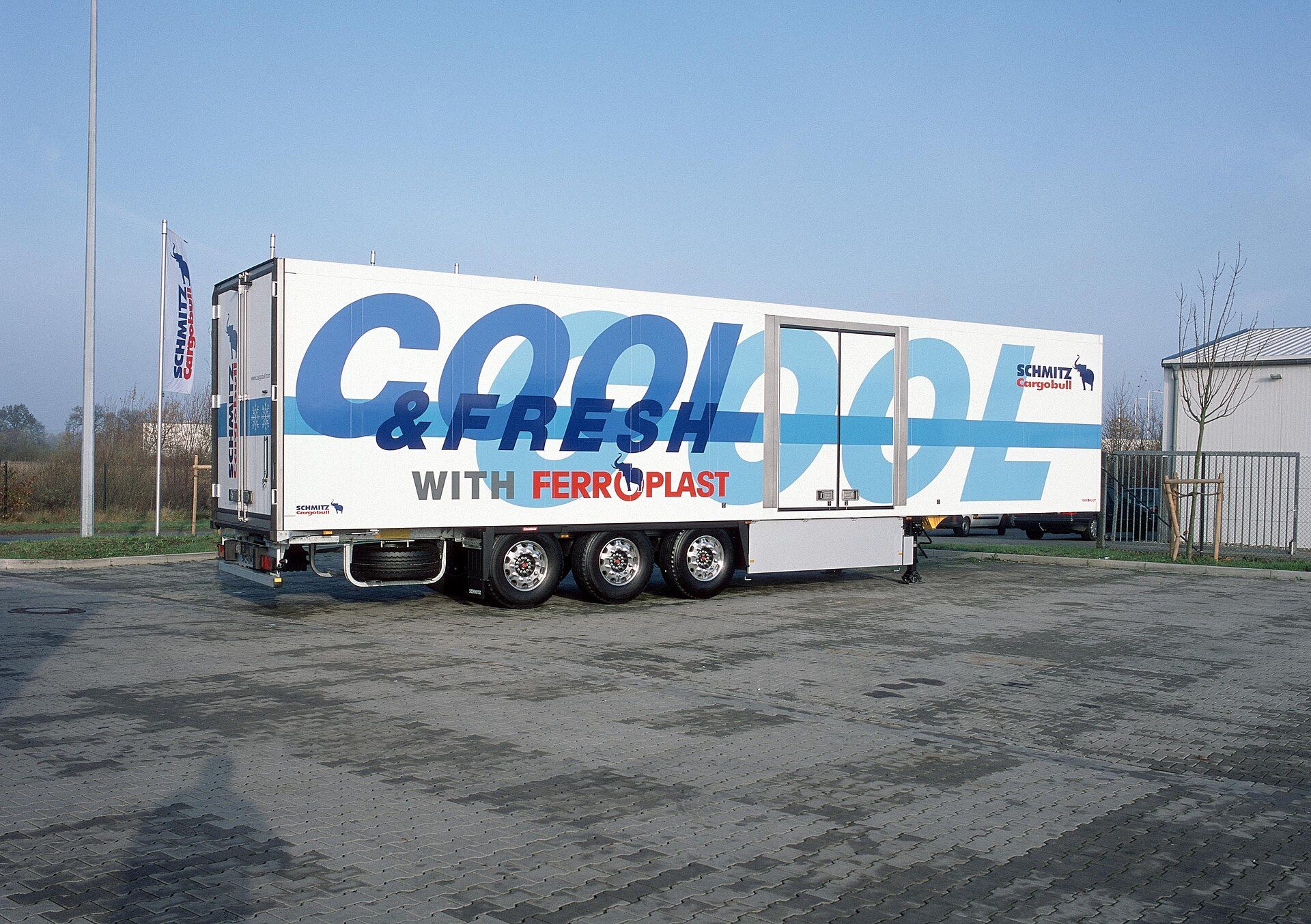
The photograph is not of this generation. No image of an S.KO COOL SMART could be confirmed on Wikimedia Commons; the cover shows a Schmitz Cargobull three-axle FERROPLAST insulated box semi-trailer photographed in 2012.
Who this trailer is right for
It suits an operator running temperature-controlled distribution who wants the body, the refrigeration unit, the telematics and the service contract from one supplier — the argument of the EXECUTIVE PLUS package, and the reason that is the only configuration fully specified. It suits a fleet buying on total cost rather than purchase price, because what Schmitz publishes is insulation, certification and service coverage rather than performance. It is the wrong trailer for a haulier who loads from the side, and for anyone whose payload plan needs the tare exact rather than within three per cent.
Where it sits against its rivals
The Krone Cool Liner is the direct comparison, and the one this site has opened documents for in the trailer types article; Chereau and Lamberet compete from France on the same ground. No figure-by-figure table is offered here, because one needs each maker’s published data for a named configuration and this record has that for Schmitz alone. What can be compared is what each puts on paper: from Schmitz, a full weights and dimensions table for one package, a body certification, a floor friction rating and two insulation figures — and no cooling capacity at all.
Buying used
Weigh the trailer. Tare cannot be recovered after purchase, the published 7,960 kg carries a three per cent tolerance in the maker’s own document, and a repaired or re-floored box is heavier than the sheet says. Everything the trailer will ever earn is the difference between that weight and the plate.
Read the plate rather than the brochure, and read all of it: permissible total, axle unit load and imposed load are three separate entries and a trailer can be derated on any one of them. Check that the ATP certificate is current and in the right class for the work, because the class belongs to the certificate and its expiry rather than to the body. Then look at the floor and the door seals before anything mechanical — on a reefer they are the wearing parts that decide both the securing calculation and the running cost of the unit. The discipline of any used purchase holds here: paperwork and load-bearing structure first, the badge last.
Compared with
- Krone Cool Liner
- Chereau
- Lamberet
Sources
- S.KO COOL SMART EXECUTIVE PLUS — brief information, Technical Data table — Schmitz Cargobull AG
- S.KO COOL SMART EXECUTIVE PLUS — technical data, as published on the maker's UK site — Schmitz Cargobull UK Ltd
- S.KO COOL SMART box semi-trailer — technical data, certificates and body options — Schmitz Cargobull AG
- Council Directive 96/53/EC — Annex I: maximum weights and dimensions, consolidated text of 14 August 2019 — legislation.gov.uk (The National Archives)
- Council Directive 96/53/EC — Articles 1, 2, 3 and 4 — legislation.gov.uk (The National Archives)
- S.KO COOL SMART EXECUTIVE PLUS — Kurzinformation, Technische Daten (S.KO-COOL-FLY-DE1-9248-2518) — Schmitz Cargobull AG
- S.KO COOL — refrigerated freight application page, technical data and certificates — Schmitz Cargobull AG
- S.KO box semi-trailers — product brochure, 28 pages — Schmitz Cargobull AG
- S.CU semi-trailer refrigeration unit — product brochure, 12 pages — Schmitz Cargobull AG
- The S.KO COOL box body semi-trailer — brief information (IAA edition) — Schmitz Cargobull AG
- Company history — the 2018 entry for the S.KO COOL SMART — Schmitz Cargobull AG
- ROTOS axles and running gear — Schmitz Cargobull AG
- Type approval granted for the S.KOe COOL fully-electric reefer semi-trailer — Schmitz Cargobull AG (press office)