segments
Aerodynamic cabs and the EU length rules
Directive 96/53/EC caps an articulated vehicle at 16.50 m. Articles 8b and 9a let an aerodynamic cab or a rear device exceed it, on the condition that the extra length buys no load.
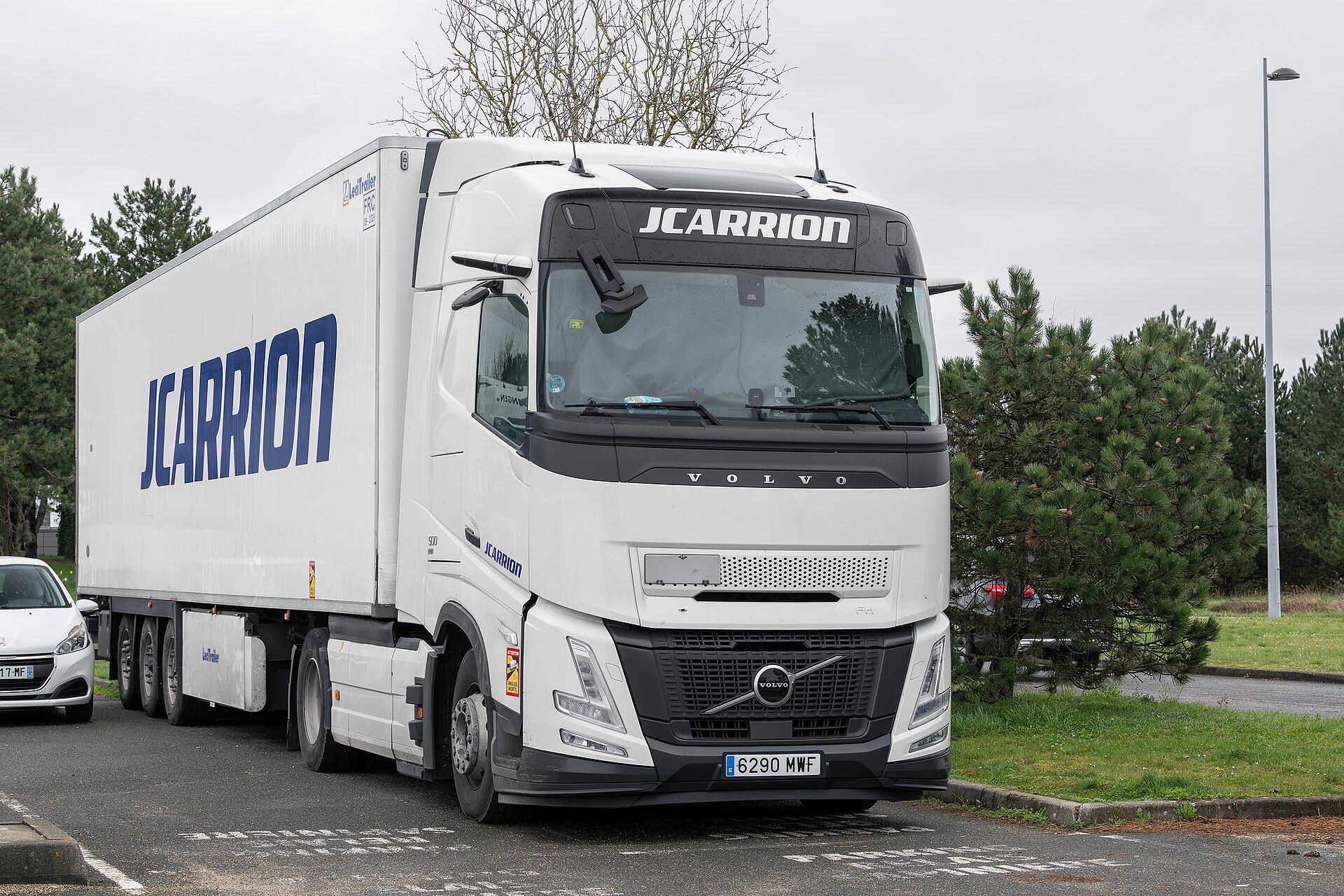
Volvo says the front of the FH Aero cab has been extended by 24 centimetres versus the regular Volvo FH. DAF describes a new cab with a 160 mm elongation at the front. Mercedes-Benz says the airflow on the Actros L ProCabin meets a front end extended by 80 millimetres. Of the three, only DAF says under what authority. The provision that lets a cab grow past the legal maximum attaches a condition in the same breath — that the exceeding shall not result in an increase in load capacity — and it is that condition, on our reading, that keeps the extra centimetres from turning into extra deck. Both halves come from one place: the rule that permitted the longer nose, and the limit written into it.
The lengths are a table, not a principle
Council Directive 96/53/EC sets the dimensions, and it says whom they bind before it says what they are. Article 1(1)(a) applies the dimension rules to motor vehicles in categories M2 and M3 with their category O trailers, and to motor vehicles in categories N2 and N3 with their O3 and O4 trailers; Article 1(3) puts articulated buses comprising more than one articulated section outside the Directive altogether. Annex I heads point 1 “maximum authorized dimensions for the vehicles referred to in Article 1(1)(a)”, and that point, in the consolidated text of 14 August 2019, is a list of those vehicle types with a figure against each. A van is not in it.
| Vehicle or combination | Maximum length |
|---|---|
| Motor vehicle other than a bus | 12.00 m |
| Trailer | 12.00 m |
| Articulated vehicle | 16.50 m |
| Road train | 18.75 m |
| Articulated bus | 18.75 m |
| Bus with two axles | 13.50 m |
| Bus with more than two axles | 15.00 m |
| Bus + trailer | 18.75 m |
Point 1.2 sets width at 2.55 m, or 2.60 m for the superstructures of conditioned vehicles and conditioned containers or swap bodies. Point 1.3 sets height at 4.00 m for any vehicle. Point 1.5 adds the manoeuvring test that every one of those vehicles has to pass: a motor vehicle or combination in motion must be able to turn within a swept circle of 12.50 m outer radius and 5.30 m inner radius.
Unlike the weight side of the same annex — covered in truck weights, GVW and GCW — which binds international traffic, these dimensions reach domestic work too. Article 4(1)(a) forbids member states to authorise the normal circulation of national goods vehicles that do not conform to points 1.1, 1.2, 1.4, 1.5, 1.6, 1.7, 1.8, 4.2 and 4.4; Article 4(1)(b) does the same for national passenger transport against points 1.1, 1.2, 1.4a, 1.5 and 1.5a. What Article 4(1) shuts, though, is normal circulation, and the paragraphs beneath it name the ways round. Article 4(3) lets vehicles or combinations that exceed the maximum dimensions circulate on special permits issued without discrimination, or on similar non-discriminatory case-by-case arrangements, where they carry or are intended to carry indivisible loads. Article 4(4) lets a member state authorise dimensions deviating from points 1.1, 1.2, 1.4 to 1.8, 4.2 and 4.4 for certain national transport operations that do not significantly affect international competition — the paragraph that defines and permits the modular concept, and so the legal basis for the long national combinations that a reader of the table would not expect to exist. Article 4(5) allows local trials of vehicles incorporating new technologies or new concepts that cannot comply with the Directive. And Article 4(7) let member states keep pre-existing buses exceeding points 1.1, 1.2, 1.5 and 1.5a on the road until 31 December 2020, a window that has since closed. The table reaches domestic work, but Article 4 does not leave it airtight.
Two doors cut in that table in 2015
Directive (EU) 2015/719 inserted two articles into 96/53/EC, and they are not symmetrical.
Article 9a(1) covers the front, and it states its purpose first: improving energy efficiency, in particular the aerodynamic performance of cabs, as well as road safety. Vehicles or combinations which fulfil the requirements laid down in Article 9a(2) and which comply with the type-approval framework may exceed the maximum lengths in point 1.1 provided their cabs deliver improved aerodynamic performance, energy efficiency and safety performance; they must still comply with point 1.5; and any exceeding of the maximum lengths shall not result in an increase in the load capacity of those vehicles.
Article 8b(1) covers the rear, with the same opening aim of improving energy efficiency. Vehicles or combinations equipped with aerodynamic devices meeting the requirements laid down in Article 8b(2) and (3), and which comply with the type-approval framework, may exceed the maximum lengths in point 1.1 to allow the addition of such devices at the rear; they must still comply with point 1.5; and any exceeding of the maximum lengths shall not result in an increase in the loading length. Neither derogation is available to a vehicle that simply carries the hardware.
The two conditions are not the same. The cab article protects load capacity; the rear-device article protects loading length, and the type-approval rules below enforce them differently. What the legislator was buying is stated plainly in recital 2 of Decision (EU) 2019/984: improved cab aerodynamics was impossible under the maximum length restrictions of 96/53/EC without reducing the vehicle load capacity, so a derogation was introduced.
The two allowances did not switch on together
Member states had to transpose Directive (EU) 2015/719 by 7 May 2017. As adopted, Article 9a(3) then delayed the cab allowance to three years after transposition or application of the necessary type-approval amendments — a date nobody could put in a diary. Decision (EU) 2019/984 removed the uncertainty in two moves: it replaced Article 9a(3) with “Paragraph 1 shall apply from 1 September 2020”, and it required the Commission to provide for type-approval of such vehicles by 1 November 2019.
Article 8b(5) still carries the conditional form: paragraph 1 applies from the date of transposition or application of the necessary amendments and after the adoption of the implementing acts under Article 8b(4). Those implementing acts exist. Commission Implementing Regulation (EU) 2019/1916, of 15 November 2019, lays down the operational rules for rear devices, and Commission Implementing Regulation (EU) 2020/349, adopted on 2 March 2020, amended it because, in the Commission’s own words, its terms were, in respect of operational conditions in certain urban or interurban areas, not consistent with Article 8b(3) of the Directive. The correction was that narrow: the amending Regulation replaced one paragraph, Article 3(1), and its own title carries the same qualifier.
The framework the Directive names has been repealed
Both Article 8b(2) and Article 9a(2) require approval “within the framework of Directive 2007/46/EC”. That Directive is no longer in force. Article 88 of Regulation (EU) 2018/858 repealed it with effect from 1 September 2020 and provides that references to it shall be construed as references to the Regulation. The date is the same one Article 9a(1) started to apply on.
The technical layer underneath moved twice more. Commission Regulation (EU) 2019/1892 wrote the first type-approval requirements for elongated cabs and aerodynamic devices into Regulation (EU) No 1230/2012; Article 18 of Regulation (EU) 2019/2144 then repealed 1230/2012, along with Regulation (EC) No 661/2009 and a list of others, with effect from the date that Regulation itself applies, which its Article 19 fixes at 6 July 2022; and the requirements now live in Commission Implementing Regulation (EU) 2021/535, applicable from that date. A reader following only the names printed in the consolidated Directive arrives at a repealed instrument.
What an elongated cab actually has to satisfy
The operative provision is Annex XIII, Part 2, Section D of Regulation (EU) 2021/535, which covers categories N2 and N3 and sets the ordinary maximum length at 12.00 m. Point 1.4.1 then opens the door: where the front fascia of the cab location — including all external projections such as chassis, bumper, wheel guards and wheels — fully conforms to the parameters of the three-dimensional envelope, and the length of the loading area does not exceed 10.5 m, the vehicle may exceed that maximum length.
That is how “no increase in load capacity” is made checkable: the condition attaches to the body rather than to the vehicle. Section A of the same annex defines the length of the loading area as the distance from the foremost internal point to the rearmost internal point of the cargo area, measured horizontally in the longitudinal plane of the vehicle — a measurement that presupposes a cargo area. On our reading of point 1.4.1, a tractor unit therefore has nothing to measure between, and the cap bites on rigids, where 10.5 m fixes where the body stops however far forward the cab reaches. The Regulation does not say that in terms; it is the conclusion the definition forces, and it is ours.
The envelope itself is geometry, and the Regulation’s own cross-reference does not land on it. Point 1.4.1 sends the reader to “Section I”. Section I of that annex is headed “Aerodynamic devices and equipment crash test”: a horizontal force of maximum 4,000 N ± 400 N applied consecutively to two points on the rearmost outer edge of a rear device, with nothing in it about rake or taper. The parameters are in Section J, headed “Three-dimensional cab envelope”, and Section J closes by pointing back the other way — a cab failing its conditions “does not conform to parameters of the three-dimensional envelope as referred to in point 1.4.1. of Section D”. The two provisions cite each other across a mismatched letter, and on our reading it is the letter in point 1.4.1 that is wrong; a reader who follows the citation to check it should expect to land in the crash test.
Section J reads as follows. An assessment zone is taken across the maximum width of the cab, 200 mm deep rearward from the cab’s most forward point at 2,000 mm or less above the ground, bounded below at ground level and above at 2,000 mm. Within it, a plane inclined rearward from the vertical by 3 degrees is rotated around a base line at 1,000 mm, and no point of the front fascia may lie forward of it. Two more vertical planes are set at 20 degrees each side of the longitudinal median plane — 40 degrees apart — and no point of the fascia may lie outward of them. Rake and taper, stated as angles: the rounded nose is not a styling choice but the shape that fits inside those planes.
The cab still has to bring the vehicle around the swept circle in point 1.5, which is a wheelbase and axle configuration question rather than a bodywork one. And Article 9a(2)(b) names vulnerable road users and the reduction of drivers’ blind spots among the things the Commission had to weigh — the concern that later arrives as a dated obligation among the mandatory driver assistance systems.
Rear devices hinge on 500 mm
Section D treats a rear device as ignorable for the determination of length, then imposes conditions in two tiers. Devices at or below 500 mm in the in-use position and devices above it share the same core: they shall not increase the usable length of the loading area; they shall be type-approved in accordance with the Regulation, which points 1.3.1.1.1 and 1.3.1.2.1 require in the same words on either side of the threshold; they must lock in both the folded and the in-use positions; folded at standstill they must not exceed the maximum authorised width by more than 25 mm on each side or the length by more than 200 mm, and that 200 mm is permitted only from at least 1,050 mm above the ground so the vehicle stays usable in intermodal transport; and an operator must be able to move them with a manual force not exceeding 40 daN. Above 500 mm, strength tests are added: 200 daN ± 10 per cent applied statically at a maximum pressure of 2.0 MPa, up, down, left and right in use and again rearward when folded, without the locking system releasing. The 500 mm line is the Directive’s own: Article 8b(2) requires a device exceeding that length to be type-approved before being placed on the market, and says nothing about shorter ones. The implementing Regulation that now carries the detail requires approval of both tiers, so a 400 mm boat-tail is no less an approved part than a 900 mm one.
The wording tracks the vehicle class rather than being written once. For N2 and N3 vehicles and for category O trailers the device shall not increase “the usable length of the loading area”. For M2 and M3 the same sentence in Section C reads “the overall usable cargo space”. A coach tail is measured against the luggage bay; a trailer tail against the deck.
Use is regulated separately. Under Implementing Regulation (EU) 2019/1916 the devices must be closed where special attention is necessary — while manoeuvring, reversing or parking, when parked, and while loading or unloading — and throughout intermodal transport, where they must not protrude more than 25 mm each side and the total width including them must not exceed 2,600 mm. Defective or malfunctioning devices must be kept closed or, where possible, immediately removed. As amended by Regulation (EU) 2020/349, member states may prohibit circulation with devices deployed in urban or interurban areas where speed limits are 50 km/h or less and vulnerable road users are likely to be present.
What the makers spent the allowance on
The published lengths are all at the front, and the percentages published beside them do not measure the same thing. Volvo puts the FH Aero nose 24 centimetres ahead of the standard FH. Separately, it says the truck can cut up to 5 per cent in energy consumption and emissions, and credits that to improved aerodynamics together with new technologies such as its Camera Monitor System — cameras in place of exterior mirrors, which is not a length-allowance measure at all — with a footnote making the result depend on driving speed, use of cruise control, vehicle specification, load, topography, the driver’s experience, maintenance and weather. DAF lists a 160 mm elongation at the front of its New Generation cab, plus 330 mm of extra length at the rear of the cab on the XG and XG+ for interior space, and claims 10 per cent improved fuel efficiency for the generation as a whole. Mercedes-Benz extended the ProCabin front end by 80 millimetres and puts up to three per cent in fuel savings down to its aerodynamic measures taken collectively. One figure covers aerodynamics plus new technology, one covers a whole vehicle generation, one covers a set of aerodynamic measures. None of them is the return on the nose.
None of the three names 96/53/EC by number, but DAF names the source of its freedom plainly: its release says the European Commission has introduced new masses and dimensions regulations, describes the New Generation as fully aligned with their objectives, says the XG and XG+ take maximum benefit from them, and describes the front end as combining the design with the regulatory envelope. Volvo and Mercedes-Benz describe the shape without naming an instrument. It is the same shape in all three, and it is the shape the Directive and Regulation (EU) 2021/535 permit — the differences between the cab families are differences in how each maker spent a common allowance, and they land straight in running cost per kilometre.
What it looks like on the paperwork
An elongated cab is declared, not inferred. On an N2 or N3 vehicle, Regulation (EU) 2021/535 requires the manufacturer to place the symbol ‘96/53/EC ARTICLE 9A COMPLIANT’ on the statutory plate, below or beside the mandatory inscriptions and outside the rectangle enclosing them, in characters not less than 4 mm high, and to repeat the text under “remarks” in the certificate of conformity so it reaches the registration papers. The addendum to the EU type-approval certificate in Part 3 of the same annex carries three separate yes/no boxes — Article 8b, Article 9a, and Article 10b, the alternatively fuelled and zero-emission weight allowance — and a vehicle can hold any combination of them.
One length is untouched by all of this. Neither Article 8b nor Article 9a names Annex I point 1.6, the 12.00 m from the fifth-wheel kingpin to the rear of a semi-trailer that actually decides the deck a buyer gets. Only Article 10c names 1.6, and only to allow 15 cm more for 45-foot containers and swap bodies in intermodal operations. The nose grew; the deck did not move.
Quick answers
- Why can an aerodynamic cab be longer than the legal maximum?
- Article 9a of Council Directive 96/53/EC, inserted by Directive (EU) 2015/719, lets vehicles whose cabs deliver improved aerodynamic performance, energy efficiency and safety performance exceed the maximum lengths in Annex I point 1.1. The article adds that any exceeding of the maximum lengths shall not result in an increase in the load capacity of those vehicles.
- Does a longer cab cost the operator load length?
- No, and it may not add any either. For N2 and N3 vehicles, Annex XIII Part 2 Section D point 1.4.1 of Commission Implementing Regulation (EU) 2021/535 allows the extra length only where the length of the loading area does not exceed 10.5 m and the front fascia conforms to the three-dimensional cab envelope.
- When did the aerodynamic cab rule start to apply?
- 1 September 2020. Article 9a(3) originally set the date at three years after transposition of the type-approval amendments; Decision (EU) 2019/984 replaced that with a fixed date and required the Commission to provide for type-approval by 1 November 2019.
- How long may a rear aerodynamic device be?
- Article 8b(2) of Directive 96/53/EC requires devices exceeding 500 mm in length to be type-approved before being placed on the market, but under Regulation (EU) 2021/535 a device on either side of that threshold must be type-approved in accordance with that Regulation. On M2 and M3 buses, N2 and N3 goods vehicles and category O trailers, a device of either size when folded at standstill may exceed the maximum authorised length by no more than 200 mm and the width by no more than 25 mm on each side.
- What marking does an elongated cab carry?
- On an N2 or N3 vehicle, Regulation (EU) 2021/535 requires the manufacturer to add the symbol '96/53/EC ARTICLE 9A COMPLIANT' to the statutory plate, in characters not less than 4 mm high, and to repeat the text under 'remarks' in the certificate of conformity.
Sources
- Council Directive 96/53/EC, consolidated text of 14 August 2019 — Articles 4, 8b, 9a, 10c and Annex I — EUR-Lex, European Union
- Directive (EU) 2015/719 amending Council Directive 96/53/EC — EUR-Lex, European Union
- Decision (EU) 2019/984 on the time limit for the special rules on maximum length for aerodynamic cabs — EUR-Lex, European Union
- Commission Implementing Regulation (EU) 2021/535 — Annex XIII, masses and dimensions — EUR-Lex, European Union
- Commission Implementing Regulation (EU) 2019/1916 on the use of rear aerodynamic devices — EUR-Lex, European Union
- Commission Implementing Regulation (EU) 2020/349 amending Implementing Regulation (EU) 2019/1916 in respect of operational conditions in certain urban or interurban areas — EUR-Lex, European Union
- Regulation (EU) 2018/858 on the approval and market surveillance of motor vehicles — Article 88 — EUR-Lex, European Union
- Commission Regulation (EU) 2019/1892 amending Regulation (EU) No 1230/2012 as regards elongated cabs and aerodynamic devices — EUR-Lex, European Union
- Regulation (EU) 2019/2144 on type-approval requirements as regards general safety — Articles 18 and 19 — EUR-Lex, European Union
- The Volvo FH Aero is here — a new benchmark for energy efficient heavy-duty trucks — Volvo Trucks
- DAF is starting the future with New Generation XF, XG and XG+ — DAF Trucks N.V.
- Mercedes-Benz Actros L ProCabin: focus on aerodynamics, efficiency and driver comfort — Daimler Truck Newsroom