Truck axle configurations: what 4x2, 6x2, 6x4 and 8x4 mean
The first number counts wheel positions and the second the driven ones, so a 6x2 has three axles with one driven, while a 6x4 drives both rear axles.
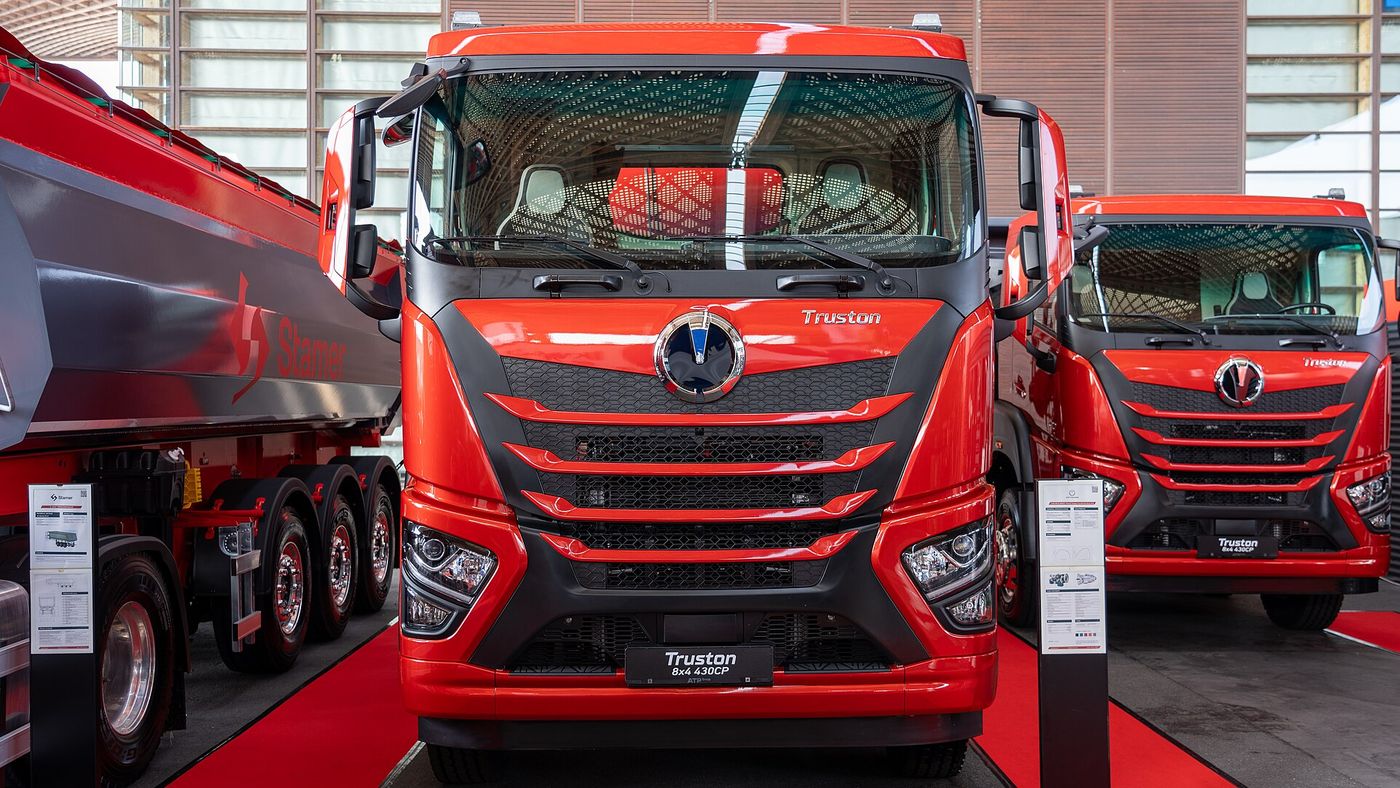
A truck’s axle configuration is the shortest honest description of what it can do. Two numbers, sometimes a third: wheel positions in total, then driven positions, then steered positions. Twin tyres count as one position, so a 4×2 tractor with dual wheels on the drive axle has four positions and not six. Engine, cab and gearbox can be specified around a job or lived with when they are wrong for it. The configuration cannot: it fixes what the vehicle may legally weigh, where it can find traction and what it costs to run empty, and nothing changes it once the chassis is built.
Reading the notation
The first number is wheel positions, the second is driven positions, and a slash with a third number gives steered positions. So 6×2/2 is a three-axle vehicle with one driven axle and only the front axle steered; 6×2/4 is the same three axles with four steered positions: the front axle plus a second steered axle. The formula does not say where that second steered axle sits: on the Mercedes-Benz 6×2/4 NLA it trails behind the drive axle, while Scania captions its 6×2/4 tractor “6x2 twin-steer”.
The letters after the formula are each maker’s shorthand for where the extra axle sits and what it is shod with. Mercedes-Benz publishes the definitions on its own model pages. On the Actros L, 6×2/2 VLA is a three-axle vehicle with a rigid leading axle and a driven rear axle; 6×2/4 NLA has a driven rear axle with a steered trailing axle behind it; 6×2 ENA carries a single-tyred rigid trailing axle. VLA is the leading axle, ahead of the drive axle; NLA is the trailing axle, behind it.
Other makers describe the same hardware in different words. Renault Trucks draws three separate 6×2 tractor profiles on the T — trailing axle, pusher axle and steering pusher axle — in one chassis table. The Volvo FMX’s rear suspension table writes “pusher” and “tag” for the two positions; Scania keeps the numeric suffixes on the S-series, where 6×2/2, 6×2/4 and 6×6 all appear. The vocabulary changes; the hardware does not.
What the rules actually constrain
Directive 96/53/EC sets the weights a member state has to accept in international traffic, and reading a configuration against it is most of the buying decision.
Axles first: 10 tonnes on a single non-driving axle, 11.5 tonnes on a driving axle. Then whole vehicles: 18 tonnes for a two-axle rigid, 25 tonnes for a three-axle rigid — 26 tonnes where the driving axle has twin tyres and air suspension or an equivalent suspension, or where each driving axle has twin tyres and no axle exceeds 9.5 tonnes — and 32 tonnes for a four-axle rigid with two steering axles under the same conditions.
For combinations, an articulated vehicle on five or six axles is 40 tonnes. The exception every container operator knows is 44 tonnes, allowed for a three-axle tractor with a two- or three-axle semi-trailer carrying containers or swap bodies up to 45 feet in intermodal transport; a two-axle tractor in the same role is held to 42 tonnes. Alternatively fuelled vehicles are allowed up to 1 tonne of extra weight for the fuel technology, zero-emission vehicles up to 2 tonnes.
One clause decides more about configuration than any of the weights. Directive 96/53/EC requires that the weight borne by the driving axle or axles “must not be less than 25 % of the total laden weight” of the vehicle or combination, when used in international traffic. That is a traction requirement rather than a payload one, and it is the reason a liftable axle cannot simply be raised whenever the driver would prefer less rolling resistance.
4×2: the long-haul default
Two axles, one driven, and the lightest tare in the range. Pulling a three-axle semi-trailer it makes a five-axle combination at 40 tonnes, with the trailer’s tri-axle carrying most of the load and the tractor’s single drive axle staying inside its 11.5 tonne limit. Fewer axles mean fewer tyres to buy and less rolling resistance, which is why most international long-haul fleets in Europe run them. The semi-trailer’s own deck length is fixed independently of the tractor, which is what lets any tractor in a fleet couple to any trailer in it.
It stops working when the load is dense enough to push weight forward onto the tractor — bulk tankers, steel, some beverage work — or when the coupling puts more on the fifth wheel than one axle can legally take, a figure that comes from the trailer’s kingpin load rather than the coupling. It is also the configuration under most pressure from electrification: the extra 2 tonnes allowed for zero-emission technology raises the permitted combination weight but not the 11.5 tonne cap on the drive axle. The same two axles do the other half of the work as a rigid, where the choice is narrower still: the Volvo FL is sold as a 4×2 or a 4×4 and nothing else, so the configuration question is answered before the specification starts.
6×2: a third axle that carries but does not drive
A 6×2 adds an axle to carry weight, not to transmit torque. That buys axle-load headroom and payload without the tare and driveline losses of a second driven axle, and it is the standard answer wherever a 4×2 runs out of legal capacity before it runs out of power.
Four variables sit inside the label. Position: a leading (pusher) axle sits ahead of the drive axle and shifts load forward, while a trailing (tag) axle sits behind it and lengthens the wheelbase. Steering: a steered trailing axle cuts tyre scrub and turning circle, which matters on multi-drop and regional work far more than it does on motorways. Tyres: single-tyred axles save weight, twin-tyred ones carry more. And lift: a liftable axle can be raised when the truck runs light, though the 25% traction rule and the axle-load limits govern when it has to come back down. Refuse trucks are a common case: several makers offer 6x2 refuse chassis with a steered rear or tag axle, as set out in refuse collection vehicles.
The trade runs both ways. A third axle is tare weight and rolling resistance carried every kilometre, empty ones included, and it buys legal capacity some loads never call on. Fleets running consistently heavy take it without argument; fleets running half their kilometres empty should do the arithmetic first.
6×4: when both rear axles have to drive
Both rear axles driven, with cross-axle and inter-axle locks. This is traction rather than payload: site access, unmade ground, sustained gradients, and the higher gross combination weights that follow. On the MAN TGX, MAN UK’s May 2022 chassis specifications give a design and UK-legal gross train weight of 44,000 kg for the 6×4 tractor against 40,000 kg for the 4×2 — a combination-weight figure, not the tractor’s own plated weight.
You pay for it in tare weight, in a second differential’s losses — a tandem group is certified as a drive-through axle plus a matching single one, as the axle ratio and final drive rules set out — and in fuel on every motorway kilometre where the traction is not needed. Specifying 6×4 for a truck that will live on made roads is an expensive way to be cautious.
8×4: the four-axle rigid
Four axles, two driven, and usually two steered at the front — which is why the formula is normally written 8×4/4. This is rigid-chassis work: tippers, concrete mixers, hook-loaders, cranes. The 32 tonne ceiling in Directive 96/53/EC is what the body and the payload have to be designed around.
Mercedes-Benz lists the whole family on its construction range: the Arocs model page heads twelve configurations, among them 8×2/4 ENA and 8×4 ENA, 8×4/4, and the all-wheel-drive 8×6/4 and 8×8/4 for genuinely difficult ground. The distinction between an 8×4 and an 8×8 is not a marketing one — it is whether the vehicle has to move on a site nobody has prepared for it. Iveco splits its T-Way line-up on exactly that line: 6×4 and 8×4 rigids and the 6×4 articulated under partial wheel drive, 4×4, 6×4×4, 6×6 and 8×8 under all-wheel drive, with different brakes and different wheelbases on each side of it. The same question is asked two axles down: the Mercedes-Benz Atego is listed in 4×2 and 4×4 and in nothing else, and its 4×4 is a separate vehicle with its own published fording depth, gradeability and axle loads rather than a traction option added to the road chassis. Bus makers count axles instead of lettering them: Otokar publishes no wheel formula at all for the four-axle 21-metre Kent XL, only the type and rated capacity of each axle in turn.
Matching the configuration to the work
International long-haul on made roads at standard weights: 4×2. Dense or heavy loads, tanker work, anything that loads the fifth wheel hard: 6×2, with the axle position and steering chosen for the manoeuvring the route demands. Site access or heavy haulage: 6×4. Rigid construction bodies: 8×4 — the Volvo FMX is listed in ten configurations from 4×2 to 10×6 and shows how far the range extends once the vehicle leaves the tarmac, and MAN’s own chassis table for the TGS covers thirteen wheel formulae, including an 8×4-4 tridem and the all-wheel-drive 8×6 and 8×8 that MAN marks for tipper bodies only.
What to check on a used chassis
Read the plate, not the brochure. A vehicle may be registered at less than its technical maximum, and the plated figure is what an enforcement officer works from. If the tractor is authorised to tow an O3 or O4 trailer it also carries braking obligations towards the trailer, which are set out in trailer brakes and EBS.
Confirm what a liftable axle does under load, and that its controls behave the way the seller describes. Whether the truck may legally run with that axle raised depends on the traction rule and on the axle loads at that moment, not on the driver’s preference.
Then check the configuration against the work you have rather than the work the last operator had. A 6×4 bought cheaply out of a construction fleet makes a poor long-haul tractor, and nothing turns it into a 4×2.
The axle load calculator shows how the position of a load on a two-axle rigid splits its weight between the front and rear axles.
Quick answers
- What do the numbers in a truck’s axle configuration mean?
- The first number is the total wheel positions, the second the driven positions, and a third after a slash the steered positions — so 6×2/4 is a three-axle vehicle with one driven axle and four steered positions. Twin tyres count as one position, so a 4×2 with dual drive wheels has four positions, not six.
- What is the EU weight limit for a four-axle rigid truck?
- Directive 96/53/EC sets 32 tonnes for a four-axle rigid with two steering axles where the driving axle has twin tyres and air suspension or an equivalent suspension, or where each driving axle has twin tyres and no axle exceeds 9.5 tonnes. Single axles are capped at 10 tonnes non-driving and 11.5 tonnes driving, regardless of the gross figure.
- Why can’t a liftable axle stay raised whenever the driver wants?
- Directive 96/53/EC requires that the weight borne by the driving axle or axles "must not be less than 25 % of the total laden weight" of the vehicle or combination, when used in international traffic. That is a traction requirement, so a liftable axle has to come back down when the load or the traction rule needs it, not when rolling resistance would be lower with it up.
- What is the difference between 6×2 and 6×4?
- A 6×2 adds a third axle that carries weight but is not driven — extra axle-load capacity without a second driveline. A 6×4 drives both rear axles for traction on site access, unmade ground and higher combination weights, at the cost of tare weight, driveline losses and fuel on every motorway kilometre.
Models in this article
Sources
- Council Directive 96/53/EC laying down maximum authorised dimensions and weights (consolidated text, 14 August 2019) — EUR-Lex, Publications Office of the European Union
- Actros L — technical data, model overview and wheel arrangements — Mercedes-Benz Trucks
- Arocs — model overview and wheel arrangements — Mercedes-Benz Trucks
- S-series specifications — Scania UK