segments
Kingpin and fifth wheel: what makes a tractor and a semi-trailer compatible
Coupling class, the D value, the imposed load U and the coupling height are the four figures that decide whether a tractor will pull a given semi-trailer, and where each one is found.
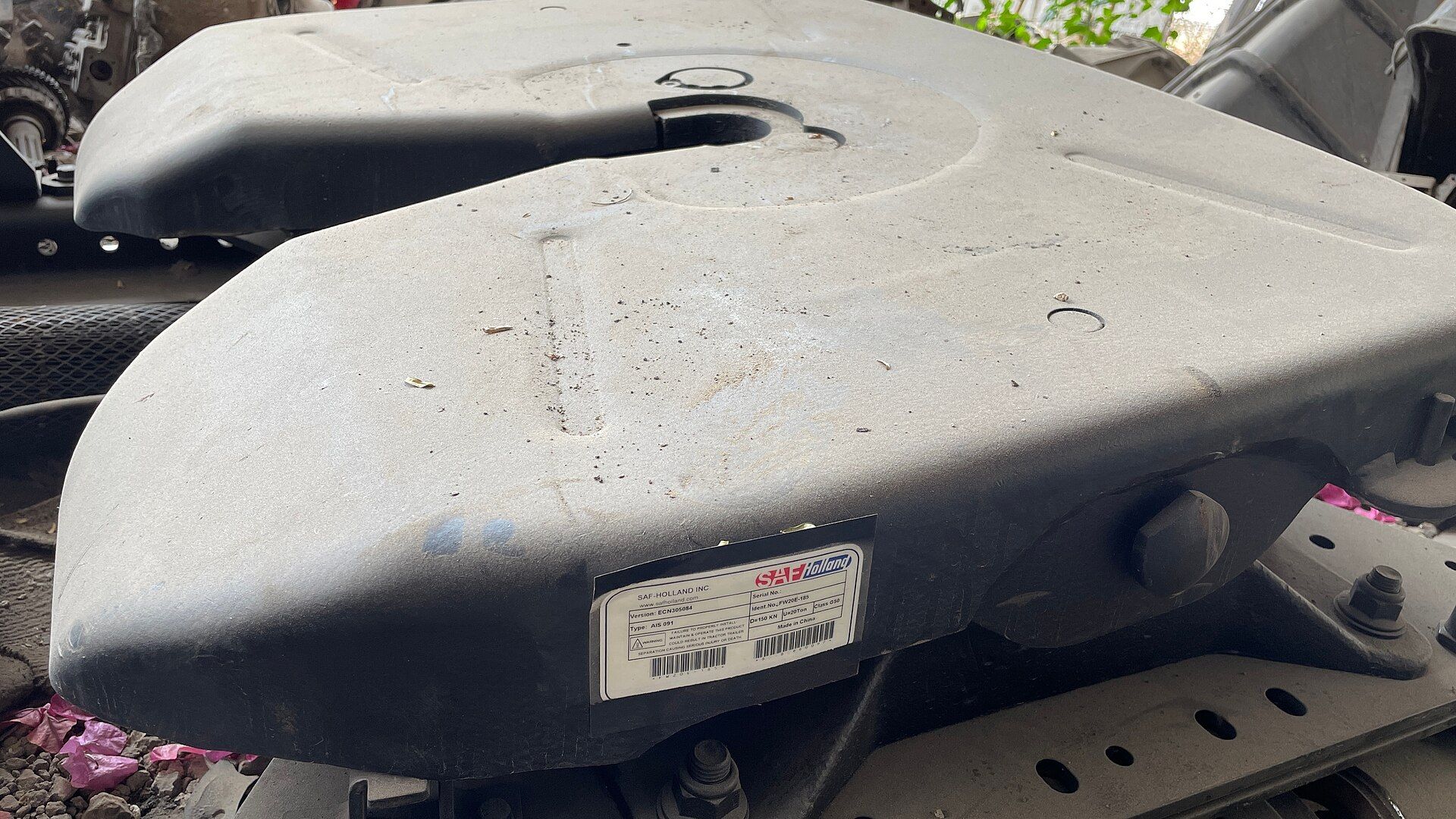
A tractor and a semi-trailer bought from different sellers are two halves of one machine, and whether they make a working combination is settled by four figures. None of them is the gross weight. Three of them are stamped on metal and the fourth is measured with a tape.
The four are the coupling class, the D value in kilonewtons, the imposed vertical load U in tonnes, and the coupling height in millimetres. A combination can be legal on weight, correctly plated at both ends, and still be the wrong pairing because the fourth number falls outside the band the trailer was built for.
Where the class letters come from
The classification everyone still uses was written into Directive 94/20/EC, and that directive is no longer the operative instrument. EUR-Lex gives its end of validity as 31 October 2014: Article 19 of Regulation (EC) No 661/2009 repealed it, in a list of forty-nine directives, with effect from 1 November 2014. That regulation has since been repealed in its turn — Article 18 of Regulation (EU) 2019/2144 repeals it from that regulation’s date of application, which Article 19 sets at 6 July 2022, and EUR-Lex gives 661/2009’s end of validity as 5 July 2022. Annex I to Regulation (EU) 2019/2144, the list of UN Regulations referred to in its Article 4(2), carries entry 55 — mechanical coupling components of combinations of vehicles, 01 series of amendments, OJ L 153, 15.6.2018, p. 179 — against vehicle categories M, N and O. That is where these requirements went. Nothing below is a statement of current type-approval law: the definitions are quoted from the repealed directive because its consolidated text of 1 July 2013 is openable, and the current text of UN Regulation No 55 is not reproduced, because it could not be opened.
Annex I, Section 1.3.7 split fifth wheel couplings into Class G 50, standard fifth wheel couplings 50, and Class G 50-X, non-standard fifth wheel couplings 50. Section 1.3.8 did the same on the trailer side: Class H covered fifth wheel coupling pins, and the only class it enumerated was H 50-X, the non-standard one. Class H 50 itself was described elsewhere — Annex V 8.1 tied it to ISO 337, and Annex VI 4.8.2 gave the cylindrical part of a Class H 50 pin a diameter of 50,8 mm, the two-inch kingpin in the units the workshop actually uses.
Section 2.1.11 explained what the word standard was buying: standard coupling devices conformed to standard dimensions and standard characteristic values as given in the directive, and they were interchangeable within their class, independent of type and manufacturer. Section 2.1.12 defined the non-standard classes as devices of Classes A to J which did not fall under that classification but which could nonetheless be connected to standard devices of the relevant classes. Interchangeability across a mixed pool was designed in, at a stated size and for a stated load.
The class letters survived the move intact, which is why they are still what you read on the hardware. JOST describes its JSK 37 C as suitable for 2” king pins (class G50) as per ECE R55-01, DIN 74080 and ISO 337, and for steering wedges as per ECE R55-01 and DIN 74085; every variant in that data sheet’s table carries the approval number E1 55R-01 0116.
The D value is a formula, not a rating
D looks like a strength rating. It is the output of a calculation about one particular pair of vehicles, which is a different thing entirely.
Annex I 2.1.18 defined the D-value as the theoretical reference force for the horizontal force between towing vehicle and trailer, taken as the basis for horizontal loads in the dynamic tests. For fifth wheel couplings on towing tractors and vehicles of comparable type, D in kilonewtons is g multiplied by 0,6 · T · R, divided by T + R − U. The symbols were defined in the same section: T is the technically permissible maximum mass in tonnes of the towing vehicle, R the technically permissible maximum mass in tonnes of the semi-trailer, U the fifth wheel imposed vertical load in tonnes, and g the acceleration due to gravity, assumed as 9,81 m/s². JOST publishes the identical formula in its own catalogue.
Put real numbers through it. Take an assumed tractor plated at 18 tonnes — the tractor mass is ours; the 39 tonnes and the 12 tonnes below are Krone’s — under a 39-tonne semi-trailer imposing 12 tonnes on the fifth wheel, and the formula gives 91,8 kN. Assume 26 tonnes for the tractor instead and the same trailer gives 112,6 kN. Both outputs are our arithmetic, in neither document, and so are the two tractor masses that went into them.
The shape of the formula matters more than either answer. As R grows, D approaches 0,6 · g · T and stops — 105,9 kN for an 18-tonne tractor, 153,0 kN for a 26-tonne one, again our arithmetic on our own assumed masses. It is the tractor’s own permissible mass, not the trailer’s, that sets the ceiling on the horizontal reference force. Set those two ceilings against the 150 kN that the repealed directive required a standard coupling to be tested for and the point falls out: the lighter tractor cannot reach that figure with any trailer at all, and the heavier one passes it. D becomes a live question as tractor mass rises, not as trailer mass does. Which tractor mass applies follows from the axle configuration and from how the gross figures were plated.
The V value belongs to a different vehicle entirely
Annex I 2.1.19 defined the V-value as the theoretical reference force for the amplitude of the vertical force between towing vehicle and centre axle trailers having a maximum mass exceeding 3,5 tonnes. It was calculated from an equivalent vertical acceleration — 1,8 m/s² with air suspension or equivalent, 2,4 m/s² otherwise — the length of the trailer’s loading area and the theoretical drawbar length.
Every term there belongs to a drawbar combination. Section 2.1.20 defined a centre-axle trailer as one whose axles sit close to its centre of gravity such that only a small vertical load, not exceeding 10 % of the maximum mass of the trailer or 1 000 kg, whichever is the lesser, is transmitted to the drawing vehicle. A semi-trailer does the opposite: it deliberately puts many tonnes on the towing vehicle. V is not a semi-trailer parameter, and quoting it in a semi-trailer specification is a category error rather than a rounding one.
U is the figure the purchase actually turns on
The decision is settled by manufacturer data rather than by any directive. Krone publishes, for the Profi Liner SDP 27 eLB50-CS, a fifth-wheel load of 12,000 kg, an axle load of 27,000 kg, a permissible total weight of 39,000 kg, a dead weight of 5,940 kg and a technically possible payload of approximately 33,060 kg. Two consistency checks fall out of that table and are ours: 12,000 plus 27,000 is the 39,000 kg gross, and 39,000 less the 5,940 kg tare is the 33,060 kg payload. The 12 tonnes is the figure to carry into the coupling conversation, because it is what the trailer hands the tractor when it is fully loaded; the rest of that trailer’s record, including the coupling height band it expects, is the Krone Profi Liner page.
Kögel steps the same figure against hardware rather than publishing a single value: on the Kögel Cargo the 90 mm frame neck is rated at a technically feasible fifth-wheel load of 12,000 kg for two-axle tractors, the 120 mm neck at 15,000 kg for three-axle tractors and the reinforced neck of the Nordic variant at 18,000 kg, with the axle-unit rating unchanged at 27,000 kg throughout.
Set it against what a standard coupling was built for. Annex V 7.10.2 required standard fifth wheel couplings to be suitable for and tested for a D-value of 150 kN and a value of U of 20 tonnes. What manufacturers build today is a separate observation, and this page can only report the two instances it opened: the SAF-Holland type plate photographed at the top reads D=150 KN, U=20 Ton, Class G50, and JOST’s selection tables for the JSK 37 C and JSK 37 CW list a D value of 152 kN and an imposed load U of 20 t against every order number in both ranges. Two products are not a regime, and what UN Regulation No 55 requires of a standard coupling today is not stated here.
| Figure | What it describes | Where it is written |
|---|---|---|
| Class | G 50 or G 50-X on the tractor, H 50 or H 50-X on the trailer | Coupling type plate; trailer kingpin plate |
| D value, kN | Reference horizontal force for the pair of vehicles | Coupling type plate; calculated from T, R and U |
| U, tonnes | Vertical load the coupling accepts from the kingpin | Coupling type plate; trailer data sheet as fifth-wheel or kingpin load |
| Coupling height, mm | Where the trailer expects the tractor’s plate to sit | Trailer data sheet; measured on the tractor |
A 12-tonne kingpin load under a 20-tonne coupling leaves a wide margin, and for ordinary European work that is the whole of the answer. Machinery transport is where the margin narrows: the Nooteboom MCOS semi low loader is published at an 18.0 t fifth-wheel load on five of its six types. It closes in two places: dense trailers that load the neck hard, and tractors whose own plating cannot absorb 12 tonnes through the fifth wheel without exceeding a drive axle limit. Which of the two binds first — the coupling’s U, or the axle underneath it — is settled by the tractor’s plating, and not by anything written on the coupling.
The height band is the number people measure last
Krone quotes the SDP 27’s unloaded fifth coupling height as a band rather than a value: 1,050 to 1,200 mm. Read as a requirement on the tractor rather than as a property of the trailer, it is the most useful line on the sheet, because a tractor whose fifth wheel sits outside it is the wrong tractor whatever the plates say. Too low and the trailer noses down; too high and the deck runs nose-up, which shows up first as an interior height the trailer body no longer delivers. Not every maker states the band the same way: Schmitz Cargobull publishes two for the S.KI SOLID tipper semi-trailer, 1,140 to 1,265 mm laden and 1,170 to 1,295 mm unladen, so the vehicle that has to fit both is the loaded one.
The adjustment happens at the tractor. JOST lists the JSK 37 C in four heights, H = 150, 185, 250 and 300 mm, and Table 7 of 94/20/EC divided standard fifth wheel couplings into six sizes, G 50-1 to G 50-6, by an H dimension running in bands from 140–159 mm to 240–260 mm. Setting the product heights against the directive’s bands is our comparison and not JOST’s: 150 mm falls in the first band, 185 mm in the third and 250 mm in the sixth, while the 300 mm version sits above the 240–260 mm top band, outside every size the directive drew. A repealed size table and a live product range no longer describe the same ground. Annex VII 2.5.1 constrained how the assembly was built up: Class G 50 couplings were not to be mounted directly on the vehicle frame unless the vehicle manufacturer permitted it, and had to be fixed to the frame by means of the mounting plate, following the installation instructions of the vehicle or coupling manufacturer. Height is a chassis, mounting plate and coupling decision taken together, and it is independent of the cab above it: the cab decides who will drive the truck, the frame decides what it can couple to.
What the coupling has to let the trailer do
Annex V explained why a coupling that fits can still be the wrong one. Sections 7.4.1 and 7.4.2 set the minimum free movement with the pin engaged: ±90° about the vertical axis, which 7.4.1 expressly did not apply to fifth wheel couplings with positive steering, and simultaneously ±12° about the horizontal axis transverse to the direction of travel, an angle the directive noted does not necessarily cover off-road use. Section 7.4.3 was a ceiling rather than a floor — rotation about the longitudinal axis of up to ±3° was permitted, and a fully oscillating fifth wheel coupling was allowed to exceed that, provided its locking mechanism could restrict the rotation back to ±3°. Section 7.5 required the locking mechanism to secure the pin two positive ways, the first of them engaging automatically at coupling-up. Annex VI 4.6.2.2 then set the test that describes the failure people actually fear: for Class G 50 standard fifth wheel couplings, and for comparable couplings for the same coupling pin diameter, there was to be no separation of the coupling pin from the coupling under a lifting force of g · 2,5 · U. The safety factor is in the test, not on the plate.
Buying and running a mixed pool
For a used buyer the sequence is short. Read the coupling’s type plate — JOST places it on the side of the coupling plate, and says the permissible load data for its couplings is on the type plate or in its product catalogue — and record class, D and U. Take the trailer’s kingpin load and height band from the manufacturer’s data sheet rather than from the seller, and measure the tractor’s fifth wheel height. Then check the kingpin load against U and against the tractor’s own axle plating, which for a three-axle tractor is a different conversation from a two-axle one — the reason a Scania S-series is sold in six axle configurations rather than one.
For a fleet the same four figures become a table. The lowest U among the couplings and the highest kingpin load among the trailers have to be compared rather than averaged, and the narrowest overlap of the height bands is the real interchangeability of the pool. Annex VI 1.6 made the underlying point: the characteristic values D, S, V and U on which the tests were based had to be taken from the manufacturer’s application for type-approval. They were declared values, specific to one device, and that is still what a plate in a yard records — figures for the coupling it is bolted to, not for a class of hardware.
Quick answers
- What does Class G50 on a fifth wheel coupling mean?
- Class G 50 was the designation in Directive 94/20/EC — repealed with effect from 1 November 2014 — for a standard fifth wheel coupling, and Class H 50 the matching coupling pin on the semi-trailer, whose cylindrical part Annex VI 4.8.2 gave a diameter of 50,8 mm. Annex I 2.1.11 stated that standard devices were interchangeable within their class, independent of type and manufacturer. Mechanical coupling components are now covered by UN Regulation No 55, listed in Annex I to Regulation (EU) 2019/2144.
- How is the D value of a tractor and semi-trailer calculated?
- For fifth wheel couplings, Annex I 2.1.18 of Directive 94/20/EC — repealed with effect from 1 November 2014 — gave D in kN as g multiplied by 0,6 · T · R and divided by T + R − U, where T is the tractor's permissible maximum mass in tonnes, R the semi-trailer's, U the imposed vertical load on the fifth wheel in tonnes and g is 9,81 m/s². JOST publishes the same formula in its own catalogue.
- Does a semi-trailer have a V value?
- No. Annex I 2.1.19 of the repealed Directive 94/20/EC defined the V value only for centre-axle trailers with a maximum mass exceeding 3,5 tonnes. It is a drawbar parameter, and a semi-trailer does the opposite of a centre-axle trailer: it puts many tonnes on the towing vehicle rather than the small vertical load 2.1.20 described.
- How much kingpin load can a standard fifth wheel coupling carry?
- Twenty tonnes was the figure in Directive 94/20/EC, repealed with effect from 1 November 2014: Annex V 7.10.2 required standard fifth wheel couplings to be suitable for and tested for a D-value of 150 kN and a value of U of 20 tonnes. Mechanical coupling components are now covered by UN Regulation No 55, listed in Annex I to Regulation (EU) 2019/2144, and its text is not reproduced here. JOST's current selection table for the JSK 37 C lists an imposed load U of 20 t against every order number; on any individual coupling, read the plate in front of you.
- What fifth wheel height does a standard curtainsider semi-trailer need?
- Krone publishes an unloaded fifth coupling height of 1,050 to 1,200 mm for the Profi Liner SDP 27 eLB50-CS. Read as a requirement on the tractor rather than as a property of the trailer, that band is what the tractor's own fifth wheel height has to fall inside.
Sources
- Directive 94/20/EC — consolidated text of 1 July 2013 (no longer in force; end of validity 31 October 2014) — EUR-Lex (Publications Office of the European Union)
- Directive 94/20/EC — consolidated PDF, 1994L0020 — EN — 01.07.2013 — 003.001, the UK-published copy of the same consolidated text — legislation.gov.uk (The National Archives)
- Regulation (EC) No 661/2009 — Article 19: Repeal (no longer in force; end of validity 5 July 2022) — EUR-Lex (Publications Office of the European Union)
- Regulation (EU) 2019/2144 — Article 18 (repeal), Article 19 (date of application) and Annex I: list of UN Regulations — EUR-Lex (Publications Office of the European Union)
- Profi Liner — technical data, type SDP 27 eLB50-CS — Fahrzeugwerk Bernard Krone GmbH & Co. KG
- Fifth wheel couplings · JSK 37 C and JSK 37 CW — data sheets and selection tables, catalogue pages 56–57 — JOST-Werke (Truck & Trailer catalogue)
- D-value standard — calculation for fifth wheel couplings — JOST-Werke (Truck & Trailer catalogue)
- Type plate — general information on fifth wheel couplings — JOST-Werke (Truck & Trailer catalogue)
- KÖGEL CARGO — product detail, vehicle variants — Kögel Trailer GmbH