Scania
Scania S-series
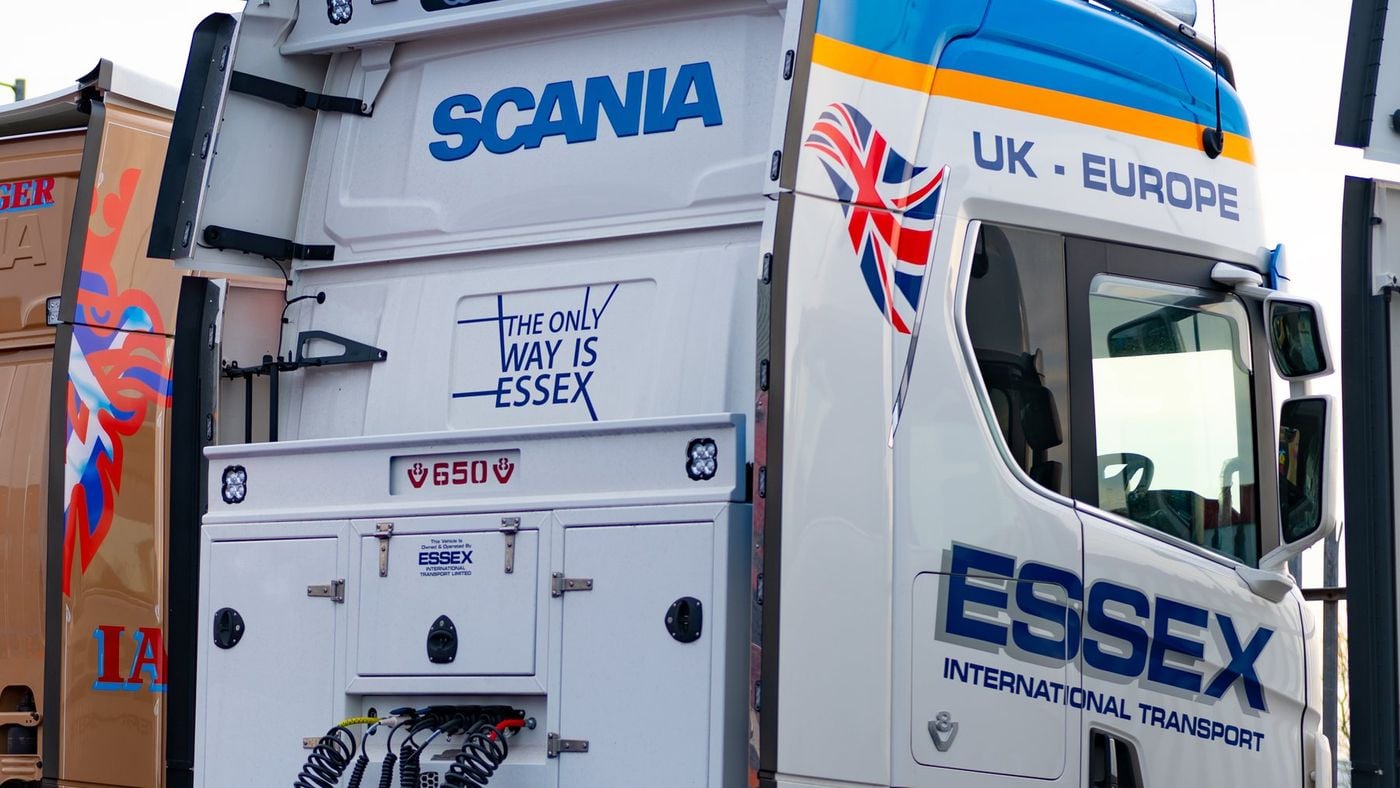
The Scania S-series is the flat-floor cab launched in 2016, in S-sleeper normal and highline, with 13-litre engines from 370 hp and the V8 up to 770 hp.
- 2016—
- 7 configurations
- 272–566 kW
- Euro 6
.jpg)
Model overview
- Segment
- Long-haul tractor
- Produced
- 2016—
- Axle configurations
- 7 (4x2…)
- Emission
- Euro 6
- Transmission
- Scania Opticruise G25 / G33 / G38, 14-speed, up to 8 reverse; range-change 8 and 8+1-speed; range-splitter 12 and 12+2-speed
Axle configurations: 4x2 · 4x4 · 6x2 · 6x2/2 · 6x2/4 · 6x4 · 6x6
Engine families
- Power
- 309–412 kW
- Torque
- 2300–2800 Nm
- Rated speed
- 1800 rpm
- Power
- 272–397 kW
- Torque
- 1900–2700 Nm
- Power
- 302 kW
- Torque
- 2000 Nm
- Rated speed
- 1900 rpm
- Power
- 390–566 kW
- Torque
- 2800–3700 Nm
The S-series is Scania’s flat-floor cab. Scania launched it in August 2016, together with the R-series, as its new truck generation, and Scania’s corporate milestones page says the S-series replaced the former Top-line cab. Scania’s annual report for 2016 says the new generation was produced alongside the old one in Södertälje in the latter part of that year, and its year-end report says the first deliveries of the new range to customers were made in the fourth quarter. Neither sentence names the S-series on its own; they are what the 2016 in the table rests on. In September 2026 Scania announced Scania Dynamic, an update for the R- and S-series, set out under its own heading below.
On the engine side, Scania UK’s specifications page says an S-cab can be fitted with a 13- or 16-litre engine, and the group S-series page gives every S cab version it lists a powertrain range of 370 to 770 hp. The same UK page also carries a short block on a 9-litre engine at 280, 320, 340 and 360 hp, but none of its emission tabs has a 9-litre table, so the table here has no 9-litre row. Scania’s documents on the engines and on the rear axle do not all say the same thing, so this page reads them row by row.
Cab
Scania’s S-series page describes the cab as designed for long-distance driver comfort, with a flat floor and no engine tunnel, and lists two cab lengths. The S-sleeper normal is 3,690 mm high without air deflectors, with “200mm” (front wall to rear wall) printed for the cab floor and 1.85 m of standing height; its lower bed is 80 cm to 1 m wide and extendable, or 80 cm wide fixed, 2 m long with a further 20 cm extender available, in foam, Bonnell or pocket-spring mattress options, and its upper bed is 60 cm wide with a 12 cm thick Bonnell spring mattress, 2 m long, with a safety net. The S-sleeper highline is 3,950 mm high without air deflectors, with the same “200mm” cab floor entry and 2.07 m of standing height, the same lower bed options, and an upper bed that is either the 60 cm Bonnell bed or an 80 cm wide bed with a 15.5 cm thick pocket-spring mattress and an integrated ladder; both upper beds are 2 m long with a safety net. Scania lists both cab lengths against the same engine range, 420 to 560 hp on the 13-litre and 530 to 770 hp on the 16-litre.
The same page describes a high-mounted cab giving the driver a view of the road ahead, with a low dashboard and low side windows for wide visibility angles, copious storage space, a reclining seat, an integrated fridge/freezer, and a climate control system with integrated auxiliary heaters and the option of a ventilated seat. It also describes the cab front design, roof and side air deflectors as aerodynamically optimised to reduce fuel consumption, with the side skirts placed higher and worked in with the cab’s swage lines.
Scania Dynamic update (2026)
Scania announced Scania Dynamic in a press release of 14 September 2026, calling it “a comprehensive truck update for R- and S series”. The release and Scania’s group overview page describe the update for both series together, so the items below are Scania Dynamic items; a sentence that rests only on the group page for the Dynamic S-series says so. On energy, the release says total energy consumption is reduced by “around 2 percent” “in this step”, depending on vehicle specification and operation, and that for combustion vehicles lower energy consumption “can mean reduced fuel use”. The group Dynamic S-series page words it differently: its headline figure reads “Up to 2% increased energy efficiency”, and its FAQ credits “small improvements on many parts of the truck” with “up to 2% better energy efficiency”. The two wordings are quoted as printed; neither text says which vehicle, cycle or earlier version the percentage is measured against. The release says the updates contribute to lower energy consumption, improved driver comfort and a more dynamic vehicle experience “across powertrains”, and the Dynamic S-series page says the Dynamic S-series “can be ordered with electric or combustion engines”; its FAQ answers the question whether one can configure a Dynamic S-series by pointing to a waiting list, and none of the three Scania texts read for this record gives an order, production or delivery date. They give no engine, gearbox, axle or weight figure, so this record adds none, and they do not say whether the update changes the cab dimensions, engine list or gearbox list given elsewhere on this page.
The release credits the energy figure to exterior updates that reduce air drag, including digital rear-view mirrors, side skirt extensions, a front that supports Increased Vehicle Dimension legislation, redesigned A-pillars and new door handles. The group Dynamic S-series page also lists aerodynamic wheel covers, described as reducing turbulence around the wheels, and its FAQ names redesigned headlamps among the aerodynamic features and calls the door handles flush door handles. In the release, the digital rear-view mirrors have two full-HD screens, one on the driver side and one on the passenger side; views can be set to standard, zoom and wide-angle modes, and the screen includes vertical adjustable reference lines with measurements. The release says the camera lenses are positioned for natural dirt protection and include heating to help prevent fog, ice and snow. The front is described in the release as one “that supports Increased Vehicle Dimension legislation” and on the Dynamic S-series page as “the updated IVD (Increased Vehicle Dimension) front”; the overview page’s “Updated grille” entry says a facelift on the front hatch improves looks and energy efficiency “all while meeting IVD requirements”. Scania names no legal text and gives no length for the new front, so this record states neither; the EU rules on cab length allowances are covered in aerodynamic cabs and the EU length rules.
Inside the cab, the release describes a new colour scheme, new textiles for the beds, rear wall and ceiling, and updated seat upholstery. It gives the curtains as 100 percent recycled and the wall and ceiling panels as containing 70 percent recycled material. The seat range, it says, has been developed in response to new safety regulations concerning headrests, while improving ergonomics and comfort; Scania does not name the regulations. An 800 mm reclining bed is listed as an option in the release, with a back section that can be adjusted up to 60 degrees; the Dynamic S-series page adds a flexible locking position and says the bed reclines out of the way on the passenger side.
The release says interior lighting has been expanded into several performance levels, from functional white lighting to Ambient+ with multiple solid colours and themes, such as the northern light; the Dynamic S-series page names Aurora Veil and Cosmic Glow as selected themes that create an animated multi-dimensional lighting experience. The Dynamic S-series page says the updated surround sound system has two additional speakers in the top level. A magnetic wireless charger provides 15 W charging power and keeps the phone in place, according to the release, and a glove hanger tray in the external storage compartment allows wet or dirty gloves to be stored outside the cab; the Dynamic S-series page describes that compartment as ventilated, with insert trays and drying racks.
The release says the updated headlamps give improved visibility in dark conditions through an extended high-beam range, a wider and brighter beam and better low-beam comfort, and it describes an automatic high beam that provides lighting “without disturbing other road users”. The Dynamic S-series page calls them updated LED headlamps that come with the new optimised front design, providing an improved light range. The driver-assistance functions named in the release and on the group pages are set out under Safety and driver-assistance systems below.
Engines
Scania UK’s S-series specifications page gives each Euro 6 engine step its output in horsepower and torque in newton-metres, an applicable-fuels value (Diesel/HVO, Diesel/HVO/Biodiesel, Diesel/HVO/FAME or Gas, depending on the step), the emission technology, and an engine PTO torque rating, with an engine designation beside every row of its 16- and 13-litre tables. The engine rows in the table above follow its Euro 6 tab. The kilowatts, displacements and rated speeds come from dated Scania brochures, press releases and data sheets, named row by row below — largely the same documents behind the Scania XT record.
The Super 13-litre runs at 420, 460, 500 and 560 hp and 2,300 to 2,800 Nm, all under Twin SCR and an engine PTO torque rating the UK page gives as “up to 1000Nm” for every step. The UK page’s applicable-fuels column reads Diesel/HVO for the 420 and 560 hp steps and Diesel/HVO/FAME for the 460 and 500 hp steps. Scania’s Super 13-litre brochure, Edition 2021.10, gives 12.74 litres, six cylinders in line, 309 to 412 kW and 1,800 rpm on all four steps. The same brochure also describes the engine’s own power take-off option, separate from the Opticruise gearbox PTO programme under Transmission below: a new engine- driven power take-off (ED-PTO) solution, offering a wider choice of interface options including hydraulic pump applications, with reduced drag losses and increased power up to 238 kW. Scania’s Super powertrain page credits the engine with up to 8 percent lower fuel consumption than “the previous 13-litre”. The S-series specifications page also describes an optional compression release brake system on the Super 13-litre, giving it “high-performance, auxiliary engine braking capacity up to 350 kW”.
The 13-litre is listed in the same Euro 6 tab, with five diesel steps — 370, 410, 450, 500 and 540 hp, at 1,900 to 2,700 Nm, all under SCR and an engine PTO torque rating the UK page gives as 600 Nm for every step. The UK page’s applicable-fuels column reads Diesel/HVO for the 370 hp step and Diesel/HVO/Biodiesel for the 410, 450 and 500 hp steps; the 540 hp step’s column also reads Diesel/HVO. Scania’s press information of 16 August 2019 gives 12.7 litres, six cylinders and 272 to 397 kW for those five steps. No rated speed is shown, because Scania’s documents give two. The 2019 press information and Scania’s French Euro 6 engine data sheets, dated 19 October 2020, give 1,800 r/min for DC13 162 to 166. Scania’s release of 7 December 2017 gives 1,900 r/min for the 370, 410, 450 and 500 hp steps under DC13 149, 141, 148 and 155, and the 2018 UK construction brochure, which puts the S-series engines at 370 to 730 hp, also gives 1,900. The UK page names DC13 163, 164, 165 and 166 for the 410 to 540 hp steps, all rated at 1,800 r/min in the 2019 and 2020 documents. For 370 hp it shows OC13 101, the designation the same table gives the gas engine, so it publishes no diesel designation for that step.
The 13-litre gas engine in the UK page’s table, OC13 101, has a row of its own. The UK page lists it inside its 13-litre table at 410 hp and 2,000 Nm, with exhaust gas recirculation where the diesel steps use SCR, a Fuel column reading Gas, and the same 600 Nm engine PTO torque rating as the 13-litre diesel steps. The 2020 data sheets describe it on a separate sheet as a spark-ignition engine of 12.7 litres and six cylinders in line, rated 302 kW at 1,900 r/min, and the 2018 brochure gives the same 302 kW, 1,900 r/min and 2,000 Nm. Kept apart from the diesel steps, its rated speed, stated for that one designation, can be shown.
It is not Scania’s latest gas engine. A Scania UK press release of 8 December 2023 announced two new 13-litre biogas engines, OC13 103 at 420 hp (311 kW) and 2,100 Nm and OC13 104 at 460 hp (340 kW) and 2,300 Nm, both at 1,900 r/min, and called them a refinement of the previous generation of 13-litre gas units. The release does not name a cab series, and the S-series specifications page still lists only OC13 101, so the table carries no row for the newer two.
The 16-litre V8 on the Euro 6 tab is DC16 120, 121, 122 and 123: 530, 590, 660 and 770 hp at 2,800 to 3,700 Nm, all under SCR and an engine PTO torque rating the UK page gives as 800 Nm for every step. The UK page’s applicable-fuels column reads Diesel/HVO for the 530, 660 and 770 hp steps and Biodiesel/Diesel/HVO for the 590 hp step. Scania’s V8 brochure, Edition 2025.02, gives 16.4 litres and 390 to 566 kW, with a rated speed of 1,900 r/min on the lower three steps and 1,800 r/min at 770 hp, so the row shows no single figure. The 2018 brochure’s V8 steps are different — 520, 580, 650 and 730 hp — and this row does not cover them.
Transmission
Opticruise G25, G33 and G38 head the UK page’s gearbox section: a 14-gear spread including super crawler and overdrive, and a planetary gear in place of a reverse gear, which the UK page says enables eight gears for reversing at speeds up to 30 km/h. On the G25 and G33 that is not the standard fit: Scania’s Opticruise brochure for those two, Edition 2023.04, gives four automated-shift reverse gears as standard, with eight in total as an option. The same page describes the Opticruise platform’s fully automated clutch control as giving precision manoeuvring and smoother gear changes, and credits new variable oil volume and oil spray lubrication, a compact cast-aluminium housing that cuts component weight by up to 75 kg, and an extended oil change interval, together with around 1 percent fuel savings over the previous platform. It also states that the Opticruise G33 is available with all V8 engines up to 660 hp as well as with the 500 and 540 hp 13-litre engines. With the Opticruise gearbox, the same page describes a PTO programme with nine performance steps, saying the higher torque and gear ratio improve bodywork-equipment performance and that the higher gear ratio allows lower engine speeds, for lower noise and reduced fuel consumption. The UK page also lists range-change gearboxes with 8 and 8+1 speeds and range-splitter gearboxes with 12 and 12+2, and says Opticruise is available for all of the range-splitter boxes. How the automation works is in automated manual transmissions.
Axles, suspension and brakes
Scania UK’s S-series page lists seven tractor wheel formulas — 4x2, 4x4, 6x2, 6x2/2, 6x2/4, 6x4 and 6x6 — which are the ones this record carries. Scania captions the 6x2/2 as a 6x2 pusher and the 6x2/4 as a 6x2 twin-steer; the captions are not formulas of their own. The page’s rigid list has fourteen formulas, ending with 10x4*6, captioned 10x4 rear-steer. Chassis heights are given per formula, from extra low to high on the 4x2 tractor. The tractor list is the UK page’s: the heavy-haulage brochure’s S-cab examples include an A8x4/4, an A8x6/4 and an A10x4*6, none of them on it. The notation is explained in axle configurations explained.
Scania’s S-series page states what each type of rear axle gear can master or manage, given as gross vehicle and train weight, not as a weight for the model:
- single driven, single reduction: up to 78 tonnes, gear ratios from 1.95 to 5.57;
- single driven, hub reduction: up to 80 tonnes, ratios from 3.80 to 7.18;
- tandem driven, single reduction, the RB662 + R660 tandem gear: up to 80 tonnes, ratios from 2.92 to 4.88;
- tandem driven, hub reduction: up to 210 tonnes, ratios from 3.52 to 7.63.
The same section states that the R756 rear axle is made to master a wide range of vehicle operations up to 53 tonnes GTW, with a gear ratio from 1.95 to 4.11; this too is a figure for the axle, not for a truck.
Scania’s S-series page also describes the improved cab and powertrain suspension as reducing vibration, together with enhanced positioning and improved air suspension on the front axle, which it says also improves handling and stability. On braking, the UK gearbox page states that Scania’s gearboxes can be fitted with the Scania Retarder, and that the retarder fitted to the G33 delivers 4,700 Nm of torque at a propeller-shaft speed below 600 rpm; no retarder torque figure is given for the G25 or G38. The compression release engine brake fitted to the Super 13-litre, up to 350 kW, is described under Engines above.
Dimensions and weights
Scania publishes no gross vehicle or gross combination weight for the S-series as a model, and both fields are empty. What the UK page gives instead is what each type of rear axle gear can master or manage, set out above under Axles, suspension and brakes.
Scania’s Heavy Haulage Vehicles brochure of 2025 gives higher figures for adapted vehicles. Its opening passage describes the V8, the automatic 14-speed heavy-duty gearbox and hub-reduction rear axles, then says its reinforced three-, four- and five-axle chassis and heavy-haulage adapted trucks and tractors can handle gross train weights of up to 250 tonnes. Its wheel configurations all have three axles or more, and it calls them all capable of up to 250 tonnes. It gives its cab options as P, G, R and S, and its power options as running from 13-litre six-cylinder engines up to the 770 hp V8. Two of its S-cab examples, the 660 S A6x4 NA and the 770 S A8x4/4 NB, are given gross train weights of up to 250 tonnes, and the brochure lists both with the 770 hp V8, the first under a 660 name; a third, the 660 S A10x4*6 NB, which the brochure calls an adapted five-axle tractor, is given up to 150 tonnes and a gross vehicle weight of up to 45. Scania Australia’s construction page ties the figure to the drivetrain: the V8 range with up to 770 hp, with an Opticruise gearbox and automatic clutch, “can handle GTWs up to 250 tonnes in standard mode”. These are figures for those examples and set-ups, not for the model. None of these documents says how 250 tonnes relates to the UK page’s 210.
None of these figures is the plated weight of a particular truck; the distinction between ratings and plated weights is set out in gross vehicle and gross combination weight.
The cab dimensions Scania publishes for the S-series — the two cab heights, the cab floor entry, standing heights and bed sizes — are set out above under Cab; no overall vehicle length, width, wheelbase or turning circle is published for the S-series as a model on the pages read for this record.
Fuel and AdBlue
The S-series specifications page describes Scania’s Twin-SCR system, with dual AdBlue dosing, as giving a continuously higher reduction of exhaust emissions. It gives no fuel tank or AdBlue tank capacity for the S-series, and this record carries neither.
Safety and driver-assistance systems
Scania’s S-series page describes integrated lighting — position lights and extra lights built into the cab — as part of the basic configuration, and says this is intended to improve both appearance and safety without a negative effect on aerodynamics.
The group Dynamic S-series page, part of the Scania Dynamic update described above, lists seven safety and driver-assistance systems as included: Safe stop assist, Forward distance alert, Vulnerable Road User braking – side (VRUBS), Moving Off Inhibit, Door Cycling Adult, Speed Sign Cruise Control (SSCC) and Curve Speed Cruise Control (CSCC). It gives no description of Moving Off Inhibit or Door Cycling Adult. It describes safe stop assist as bringing the vehicle to a safe stop if the driver suddenly becomes unable to drive, in a 3-step sequence of signalling and braking to standstill that can be overridden at any time by pressing the brake or accelerator pedal. It says the forward distance alert indicates short distance to the vehicle in front on the driver display, sorts out oncoming traffic and stationary or fixed objects, and adjusts the time gap automatically according to the adaptive cruise control. Separately, it says that with its low side and front sensors the automatic emergency brake system helps avoid or reduce the impact of collisions in intersections or pedestrian crossings, without linking that system to one of the seven names. It also says the adaptive cruise control adjusts the speed according to detected speed signs and detects curves for an optimised and safe speed. Of Speed Sign Cruise Control and Curve Speed Cruise Control, the press release says they “support the driver rather than replace driver responsibility”. Scania’s overview page for Scania Dynamic, which covers the R- and S-series together, also lists a “360° area view camera”, described as helping the driver keep an eye around the truck when manoeuvring. Which advanced systems EU rules require on new trucks and buses, and from when, is set out in mandatory driver assistance systems.
Equipment and options
Beside the cab equipment set out above under Cab, the UK specifications page describes the Opticruise PTO programme, with nine performance steps for bodywork equipment, under Transmission. Its gearbox section also states that Scania’s gearboxes can be fitted with the Scania Retarder as a fitment option, covered under Axles, suspension and brakes.
Euro 6 in the table, Euro 5, 4 and 3 on the page
The engine rows follow the UK page’s Euro 6 tab, and the emission class is given as Euro 6 because that is all the tab says — no sub-step; the sub-steps are set out in Euro 6 and Euro 7 explained. The same page carries Euro 5, Euro 4 and Euro 3 tabs, and an Electric tab this record does not cover. The Euro 5 and Euro 4 tabs list 16-litre engines at 520 and 620 hp and 13-litre steps that include 380 and 440 hp; the Euro 3 tab lists a 560 hp 16-litre and 360, 410 and 460 hp 13-litre engines, all marked without SCR. The page does not say where those are offered.
Source notes
Scania publishes no weight for the model. Its UK S-series page gives rear axle gear capacities as gross vehicle and train weights: up to 78 t single driven single reduction, 80 t single driven hub reduction, 80 t tandem driven single reduction and 210 t tandem driven hub reduction. Its 2025 heavy-haulage brochure gives up to 250 t for reinforced three- to five-axle chassis and heavy-haulage adapted trucks and tractors, and both S examples it rates at 250 t have the 770 hp V8; Scania Australia’s construction page ties 250 t to the V8 with an Opticruise gearbox and automatic clutch “in standard mode”. No rated speed is shown for the 13-litre diesel, rated at 1,800 or 1,900 rpm depending on its designation, or for the V8, at 1,900 rpm on the lower three steps and 1,800 rpm at 770 hp.
Quick answers
- Which engines are available in the Scania S-series?
- The record for the Scania S-series covers these engine families: Scania Super 13-litre (12.74 l), Scania 13-litre (12.7 l), Scania 13-litre gas · OC13 101 (12.7 l), Scania 16-litre V8 · 530/590/660/770 hp (16.4 l). Output spans 272–566 kW and 1900–3700 Nm.
- What axle configurations does the Scania S-series come in?
- 4x2, 4x4, 6x2, 6x2/2, 6x2/4, 6x4, 6x6.
- What emission standard does the Scania S-series meet?
- Euro 6.
- When did production of the Scania S-series start?
- Production of the Scania S-series started in 2016.
- Which transmission does the Scania S-series use?
- Transmission: Scania Opticruise G25 / G33 / G38, 14-speed, up to 8 reverse; range-change 8 and 8+1-speed; range-splitter 12 and 12+2-speed.
Scania models on this site, side by side
| Segment | Produced | Axle configurations | Power | Torque | |
|---|---|---|---|---|---|
| Scania P-series | Distribution | 14 configurations | 162–368 kW | 1000–2650 Nm | |
| Scania R-series | Long-haul tractor | 2016— | 7 configurations | 206–566 kW | 1350–3700 Nm |
| Scania S-series | Long-haul tractor | 2016— | 7 configurations | 272–566 kW | 1900–3700 Nm |
| Scania XT | Construction | 2017— | 14 configurations | 162–566 kW | 1000–3700 Nm |
Articles that mention the Scania S-series
- Automated manual transmissions in heavy trucks
- Buying a used truck: what to check before you commit
- Kingpin and fifth wheel: what makes a tractor and a semi-trailer compatible
- kW, hp and Nm: how to read a truck's power figures
- LNG and bio-LNG trucks: engines, range, refuelling and CO2
- What is HVO? Renewable diesel in trucks and buses
- Who builds trucks in Europe
More Scania on this site
Sources
- S-series specifications — engines by emission level, gearboxes, rear axle gears, axle configurations — Scania
- S-series — cab dimensions, bed dimensions and driver-comfort features — Scania
- New Scania Dynamic strengthens driver focus and energy efficiency (press release, 14 September 2026) — Scania
- Dynamic S-series truck — aerodynamics, cab comfort, driver assistance and FAQ — Scania
- Scania Dynamic — overview of the R- and S-series update — Scania
- Scania S-series trucks — Scania
- Super Powertrain — Scania
- Scania Super 13-litre engine (brochure, Edition 2021.10) — Scania
- Scania adds a 540 hp version to its 13-litre engine range (press info, 16 August 2019) — Scania
- Scania introduces a 7-litre family for improved efficiency and reduced weight (press release, 7 December 2017, with technical data for the DC07, DC09, DC13 and DC16 Euro 6 engines) — Scania
- Construction: technical specifications and options — tailored strength for heavy duty (UK brochure, Edition 2018.01) — Scania
- Moteurs Euro 6 NTG — engine data sheets dated 19/10/2020 (Scania bodybuilder documentation, France) — Scania
- The Scania V8 Range (brochure, Edition 2025.02) — Scania
- Scania Heavy Haulage Vehicles (brochure, Edition 25MC037, 2025) — Scania
- The launch of a new truck generation (news, 2016) — Scania
- 2016: Launch of New Generation trucks (corporate milestones) — Scania
- The Scania Report 2016 — Annual and Sustainability Report (Report of the Directors, production and environment) — Scania
- Scania Year-end Report January–December 2016 — Scania
- Scania Opticruise Gearbox G25 & G33 (brochure, Edition 2023.04) — Scania
- High Five: Scania's new biogas engines have just got greener (press release, 8 December 2023, with data for OC13 103 and OC13 104) — Scania
- Construction transport — section 'Heavy haulage trucks' (Scania Australia) — Scania