LNG and bio-LNG trucks: engines, range, refuelling and CO2
LNG and bio-LNG trucks burn the same methane in spark-ignited or HPDI engines, with ranges of up to 1,800 km, but bio-LNG does not change certified CO2.
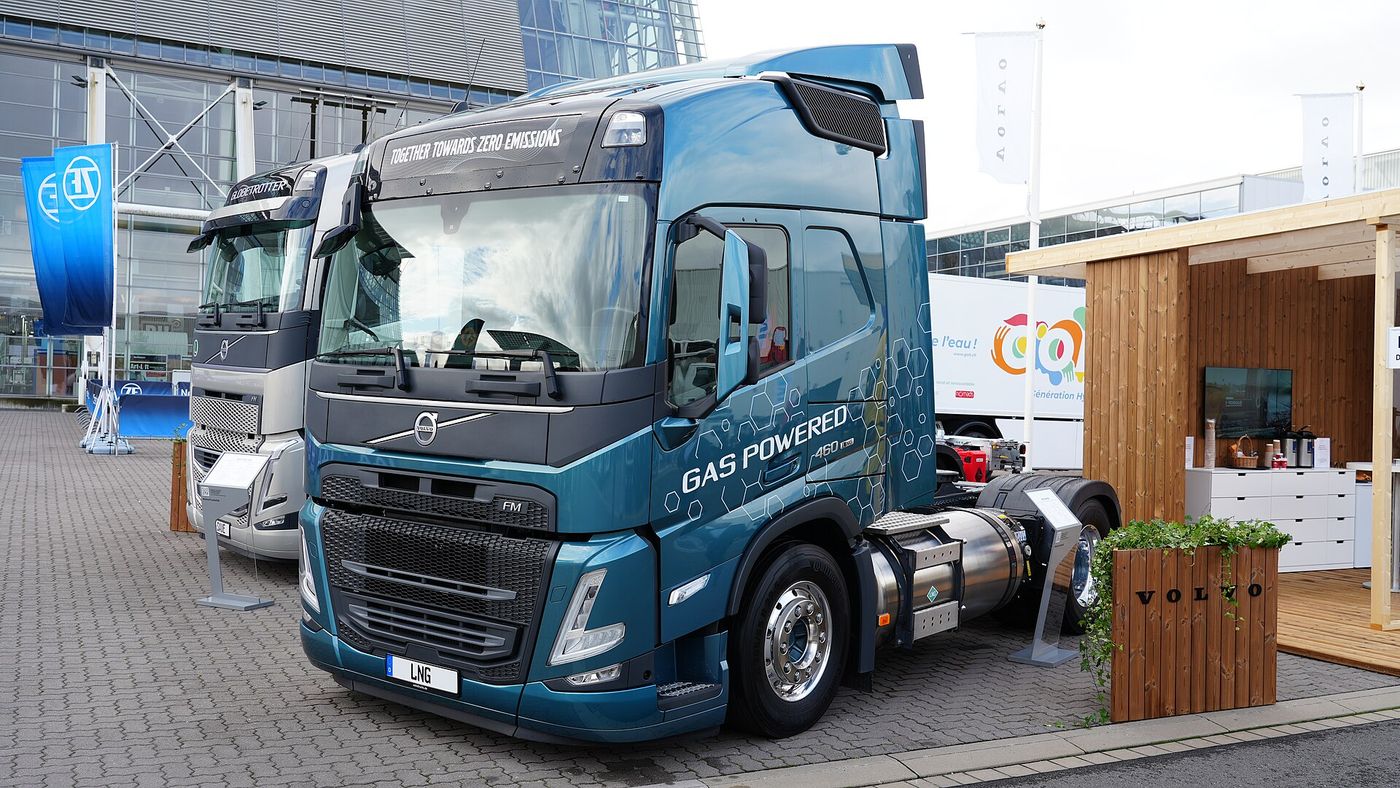
LNG stands for liquefied natural gas. The European Commission’s energy page on LNG, consulted in September 2026, describes it as “natural gas, predominantly methane, converted into liquid form for ease of storage or transport”, and says the liquefaction process “involves cooling the gas to around -162 °C and removing certain impurities, such as dust and carbon dioxide”. As a liquid, the Commission says, LNG “takes up around 600 times less volume than gas at standard atmospheric pressure”; Scania’s separate comparison, with compressed gas, is quoted below. The Commission adds that LNG is “increasingly used as an alternative fuel for ships and lorries”.
For the purposes of the EU’s Alternative Fuels Infrastructure Regulation (AFIR), Regulation (EU) 2023/1804, Article 2(4)(c) lists “natural gas in gaseous form (compressed natural gas (CNG)) and liquefied form (liquefied natural gas (LNG))” in its class of “non-renewable alternative fuels and transitional fossil fuels”, as an item separate from liquefied petroleum gas (LPG). Article 8 of the same regulation, quoted below, speaks of “liquefied methane”, which Article 2(34) defines as “LNG, liquefied biogas or synthetic liquefied methane, including blends of those fuels”. Bio-LNG, Volvo’s March 2025 article says, “is produced from feedstock, such as household waste, agricultural waste and sewage” and “is identical to regular LNG when it comes to performance, storage and refueling”.
An LNG truck burns methane whichever way the methane was made. In Scania’s words, “both gases are methane and the source can be both natural gas or renewable biomethane gas”, and Volvo says its gas trucks “can switch seamlessly between the two fuel types – or even blend them together”. The questions here are about where you can fill the truck, what the fuel does for its CO2, and who gets credit for the carbon you did not emit. What the sources say about gas and diesel engines alongside battery-electric and hydrogen powertrains is gathered in heavy-vehicle powertrains: what the sources say.
Start with why liquefied methane rather than compressed. Scania puts it plainly: “one unit of liquefied gas energy takes up three times less volume than one unit of compressed gas energy”. Simply, Scania goes on, “this means liquefied methane is denser and you can, therefore, get more energy on a vehicle than with compressed methane gas”.
Two engine architectures, and they behave differently
Volvo describes “two technology tracks for gas-powered engines”, and the choice runs all the way down to your fuel purchasing, because only one of them needs a second fuel.
Otto-cycle, spark-ignited. Scania’s gas trucks “use 9-litre or 13-litre Otto-cycle engines which burn methane as fuel”, with a power band of 280 to 460 hp across the two sizes. One fuel, ignited by a spark. Volvo, which took the other track, says that in trucks the Otto engine’s “lower compression ratio” gives it “limitations when it comes to the delivery of power and torque”; Scania says its gas engines “virtually match the performance and torque of a diesel engine”. On the 13-litre side, Scania UK’s specifications page for the Scania S-series lists one gas engine, OC13 101 at 410 hp. A Scania UK press release of 8 December 2023 announced two newer 13-litre biogas engines, OC13 103 at 420 hp and OC13 104 at 460 hp, without naming a cab series.
High-pressure direct injection. Volvo’s route uses “a common diesel engine as a base” and keeps compression ignition: “a small amount of ignition fuel is injected with high pressure to enable compression ignition before the gas is added”. Volvo says this makes it “possible to achieve a high compression ratio which results in higher energy efficiency with lower fuel consumption, and increased engine power”; Volvo UK’s FH specifications page gives the G13 gas engine a compression ratio of 17.0:1, against 18.0:1 for the D13 diesel. Volvo’s global page for the Volvo FH gas-powered, consulted in September 2026, quotes its 13-litre gas engine at up to 500 hp and 2,800 Nm. Those are the top figures Volvo gave for its all-new G13 in a press release of 12 May 2026: 420 to 500 hp and 2,400 to 2,800 Nm, with sales, the release said, to “begin during the third quarter of 2026”. Volvo UK’s FH specifications page, consulted the same month, lists the G13 at 420, 460 and 500 hp, with the 500 hp version at 2,550 Nm. Volvo says its hydrogen combustion trucks will also use HPDI technology; hydrogen trucks: fuel cell vs hydrogen combustion describes them.
The trade, as the two makers put it: Volvo says HPDI brings performance “on par with a diesel truck”, so that its gas trucks “can handle heavy loads and hilly landscapes while maintaining speed”, and the cost is a second fuel on board for ignition, which Volvo names HVO as one option for. The Otto-cycle engine needs methane only; whether it gives anything away on power and torque is where the two makers disagree.
Range, and where you can refuel
Scania’s December 2023 release says a 40-tonne tractor-and-trailer combination “can achieve ranges of up to 1,800 km when specified with the biggest Bio-LNG tank solutions that we offer”. Volvo’s March 2025 article says its gas-powered trucks “can offer ranges of up to 1000 km”. Iveco quotes up to 1,700 km for the S-Way, on what its brochure calls a best-in-class 1,080 litres of LNG tankage for a 4x2 articulated vehicle.
EU rules cap each driver’s day. Regulation (EC) No 561/2006 says daily driving time “shall not exceed nine hours” and “may be extended to at most 10 hours not more than twice during the week”, and Directive 92/6/EEC requires an N3 truck’s speed limiter to be set so that its speed “cannot exceed 90 kilometres per hour”. For a truck with one driver, ten hours at 90 km/h is 900 km (our arithmetic), below each of the three makers’ “up to” figures; for a single-driver day, on those figures, the question is the map. The same regulation also provides for multi-manning, where “there are at least two drivers in the vehicle to do the driving”; the 900 km figure does not describe that case (our reading).
What the EU’s Alternative Fuels Infrastructure Regulation (AFIR), Regulation (EU) 2023/1804, required for liquefied methane on the road is in Article 8: “Until 31 December 2024, Member States shall ensure that an appropriate number of publicly accessible refuelling points for liquefied methane are deployed, at least along the TEN-T core network, in order to allow heavy-duty motor vehicles using liquefied methane to circulate throughout the Union, where there is demand, unless the costs of doing so are disproportionate to the benefits, including environmental benefits”. The article attaches no distance to it. Recital 43 recalls that the repealed Directive 2014/94/EU “recommended that such refuelling points be deployed every 400 km along the TEN-T core network”, adds that “the existence of a limited number of gaps along the network has prevented that target from being reached”, and says Member States “should reach that target and fill the remaining gaps by 2025, after which the target should cease to apply”. Compare hydrogen, in Article 6 of the same regulation: by 31 December 2030, stations “with a maximum distance of 200 km between them along the TEN-T core network”, and “at least one” in each urban node. The Commission’s summary page describes the methane provision as covering “the TEN-T core and comprehensive network”; Article 8 itself says “at least along the TEN-T core network”.
That is the difference from hydrogen: the AFIR obligation for LNG stations set no spacing in its binding text and ran “Until 31 December 2024”, and the 400 km appears only in the recital, as a target that “should cease to apply” after 2025.
LNG and bio-LNG are two different arguments
For fossil LNG, Volvo quotes “up to 20% reduction in CO2 (tank-to-wheel)” for switching from diesel.
Bio-LNG changes the size of the number. Volvo quotes “up to 100% reduction of CO2 (well-to-wheel)” for diesel to bio-LNG, and says that when HVO is used as the ignition fuel “in combination with bio-LNG, zero CO2 emissions can be achieved”. Scania quotes a range rather than a ceiling: “With biomethane in the tanks, the CO2 reduction is 50-90%, typically 80% from a well-to-wheel perspective compared to normal diesel”.
That spread, 50 to 90%, is Scania’s own, and its page does not say what places a given supply within it.
The truck’s certified CO2 figure does not count bio-LNG
The EU’s CO2 standards for new heavy-duty vehicles, Regulation (EU) 2019/1242, work on figures that manufacturers determine under the certification regulation, (EU) 2017/2400; in the Commission’s description, CO2 emissions and fuel consumption “are simulated using the VECTO tool”. In DieselNet’s summary, the standards “follow a tank-to-wheel approach, addressing only the tailpipe CO2 emissions of the regulated vehicle groups”. Under 2017/2400 a gas engine is tested on the reference fuel “G 25 or G R”, and the fuel types the simulation accepts include “NG PI” and “NG CI”, with no separate entry for biomethane. A carbon correction factor, and “a methodology for registering heavy-duty vehicles running exclusively on CO2 neutral fuels”, are items the Commission “shall particularly assess” in a review of 2019/1242 due “By 31 December 2027” — not current law.
The consequence, in our reading of those texts: the bio-LNG you buy does nothing for the truck’s certified CO2 figure or for the manufacturer’s compliance with its specific CO2 emissions target. Annex I to 2019/1242 calculates that target from sub-group reduction targets set “pursuant to Article 3a”, and Article 3a sets the Union fleet targets, against the reporting period of 2019: 15% for nine named vehicle sub-groups for the reporting periods 2025 to 2029, then 45% for all sub-groups other than vocational vehicles for 2030 to 2034, 65% for 2035 to 2039 and 90% from 2040. Germany’s toll operator says the same of its CO2 toll, below.
The German toll exemption for gas trucks ended with 2023
From 1 January 2019 to 31 December 2023, Germany’s Federal Trunk Road Toll Act (BFStrMG, § 1(2) no. 8) exempted trucks run “überwiegend mit Erdgas” — mainly on natural gas — that left the factory for CNG, LNG or LNG/diesel dual-fuel operation and had a system approval under Regulation (EC) No 595/2009. Toll Collect’s notice of June 2023, on the government’s draft, put the end plainly: “CNG/LNG trucks will be subject to toll in the usual way from January 2024”. The same notice announced a CO2 element from 1 December 2023, after which “the toll rate per kilometre will then also depend on how much carbon dioxide (CO2) a vehicle emits”; the Act now charges a toll component for the cost of traffic-related CO2 emissions (§ 3(1) no. 4).
Bio-LNG does not lower that component. Toll Collect’s answer is that “a CO₂-neutral fuel currently has no effect on the specific CO₂ emissions or CO2 emission class”.
What the makers say it suits
Volvo calls the FH gas-powered “ideal for long and regional haul, building and construction, forest and timber, agriculture, and public services and utilities assignments”. Scania says its gas trucks “are available with L/P/G/R/S-series cabs, meaning that they can be used for urban rigid operations, all the way through to long-distance haulage”, and that “It is possible to specify our gas engines to meet strict noise regulations such as the PIEK-standard Quiet Truck in Europe”. Iveco’s brochure says the S-Way Natural Gas’s “quiet operation makes it perfect for night-time work (PIEK Quiet Truck Test Certified at less than 72 dB)”.
What to check before you sign
Confirm which architecture you are buying. Volvo’s FH gas-powered page ties its “up to 100%” CO2 reduction to bio-LNG “using HVO 100”; its March 2025 article gives “up to 100%” (well-to-wheel) for bio-LNG without naming the ignition fuel, and says zero CO2 “can be achieved” when HVO is the ignition fuel.
On a used purchase, ask which engine generation is fitted: Scania states that its updated 13-litre biomethane engines, “by coupling them with components from our Super-based powertrain”, are “5% more fuel efficient compared to our former generation”; Scania’s December 2023 release puts it as “up to 5% on fuel used on long-haul operations”.
Quick answers
- What is LNG, and what does LNG stand for?
- LNG stands for liquefied natural gas. The European Commission’s energy page on LNG, consulted in September 2026, describes it as “natural gas, predominantly methane, converted into liquid form for ease of storage or transport”. The liquefaction process, it says, “involves cooling the gas to around -162 °C and removing certain impurities, such as dust and carbon dioxide”, and as a liquid LNG “takes up around 600 times less volume than gas at standard atmospheric pressure”. For the purposes of the EU’s Alternative Fuels Infrastructure Regulation (AFIR), Regulation (EU) 2023/1804, Article 2(4)(c) lists “natural gas in gaseous form (compressed natural gas (CNG)) and liquefied form (liquefied natural gas (LNG))” in its class of “non-renewable alternative fuels and transitional fossil fuels”, as an item separate from liquefied petroleum gas (LPG).
- What does liquefying the gas change compared with CNG?
- Energy density. In Scania’s words, one unit of liquefied gas energy takes up three times less volume than one unit of compressed gas energy, so more energy fits on the vehicle. Scania says a 40-tonne combination can reach up to 1,800 km with its biggest bio-LNG tanks, and Iveco quotes up to 1,700 km for the S-Way on 1,080 litres of LNG.
- What is the difference between the two gas engine types?
- Otto-cycle spark-ignited engines, such as Scania’s 9- and 13-litre gas engines with a power band of 280 to 460 hp across the two sizes, burn methane as a single fuel. Volvo says their lower compression ratio limits power and torque in trucks; Scania says its gas engines virtually match a diesel’s performance and torque. Volvo’s high-pressure direct injection keeps compression ignition by injecting a small amount of ignition fuel, which Volvo says allows a high compression ratio, at the cost of carrying a second fuel. Volvo's global FH gas-powered page quotes up to 500 hp and 2,800 Nm, the top figures of the all-new G13 Volvo announced on 12 May 2026; the G13 on Volvo UK's FH specifications page reaches 2,550 Nm at 500 hp.
- How much CO2 does LNG or bio-LNG actually save?
- Volvo quotes up to 20% CO2 reduction (tank-to-wheel) for fossil LNG against diesel, and up to 100% well-to-wheel for bio-LNG, saying zero CO2 “can be achieved” when HVO is the ignition fuel. Scania quotes 50 to 90%, typically 80%, well-to-wheel with biomethane in the tanks.
- Does bio-LNG improve a truck’s certified CO2 figure?
- No, in our reading of the rules. The EU CO2 standards for new heavy-duty vehicles use figures simulated under Regulation (EU) 2017/2400, which tests a gas engine on reference gas and has no fuel type for biomethane; a carbon correction factor and a registration method for vehicles running exclusively on CO2-neutral fuels are items for a review due by 31 December 2027. So bio-LNG does nothing for the truck’s certified figure or the maker’s compliance with its specific CO2 emissions target, which Annex I calculates from sub-group reduction targets set “pursuant to Article 3a”; Article 3a sets the Union fleet targets against the 2019 reporting period: 15% for nine named sub-groups for 2025 to 2029, then 45% for all sub-groups other than vocational vehicles for 2030 to 2034, 65% for 2035 to 2039 and 90% from 2040. Germany’s toll exemption for gas trucks ran until 31 December 2023, and Toll Collect says a CO2-neutral fuel “currently has no effect” on a truck’s CO2 emission class.
Models in this article
Sources
- Liquefied natural gas — European Commission — Energy
- Alternative fuels infrastructure (Regulation (EU) 2023/1804) — European Commission — Mobility and Transport
- Regulation (EU) 2023/1804 on the deployment of alternative fuels infrastructure (AFIR) — Article 2 points (4) and (34), Articles 6 and 8, recital 43 (Articles 2, 6 and 8 unchanged in the consolidated text of 8 January 2026) — EUR-Lex, Publications Office of the European Union
- Lorries, buses and coaches: CO2 emission performance standards — European Commission — Climate Action
- Regulation (EU) 2019/1242 setting CO2 emission performance standards for new heavy-duty vehicles — consolidated text of 10/09/2026 (Articles 3a and 15) — EUR-Lex, Publications Office of the European Union
- Commission Regulation (EU) 2017/2400 on the determination of CO2 emissions and fuel consumption of heavy-duty vehicles — consolidated text of 1 January 2026 (reference fuels; input parameter FuelType) — EUR-Lex, Publications Office of the European Union
- Emission standards: EU: heavy-duty vehicles: GHG emissions — DieselNet
- Truck toll is to be extended (15 June 2023) — Toll Collect
- Toll for alternative drives — questions and answers — Toll Collect
- § 1 BFStrMG — Mautpflicht (Absatz 2 Nummer 8) — Bundesministerium der Justiz (gesetze-im-internet.de)
- § 3 BFStrMG — Mautsätze und Mautberechnung (Absatz 1) — Bundesministerium der Justiz (gesetze-im-internet.de)
- Regulation (EC) No 561/2006 on the harmonisation of certain social legislation relating to road transport — consolidated text of 31/12/2024 (Articles 4(o) and 6(1)) — EUR-Lex, Publications Office of the European Union
- Council Directive 92/6/EEC on speed limitation devices — consolidated text of 4 December 2002 (Article 3(1)) — EUR-Lex, Publications Office of the European Union
- How gas-powered truck technology works (21 March 2025) — Volvo Trucks
- Volvo FH gas-powered — Volvo Trucks
- Volvo Trucks' all-new combustion engine platform: Superior fuel efficiency and ready for a wide range of alternative fuels (press release, 12 May 2026) — Volvo Trucks
- Volvo FH specifications (UK) — engines, G13 power, torque and compression ratio — Volvo Trucks UK
- Gas trucks — Scania
- S-series specifications — engines by emission level, gearboxes, rear axle gears, axle configurations — Scania
- High Five: Scania's new biogas engines have just got greener (press release, 8 December 2023, with data for OC13 103 and OC13 104) — Scania
- IVECO S-Way eBrochure (publication H2331001MASTER, 02/24) — IVECO