Hydrogen refuelling for trucks in Europe: the AFIR rules and station counts
What AFIR Article 6 requires of hydrogen stations by 2030: 200 km, 1 tonne per day, 700 bar, core network only. And how the station counts in circulation are defined.
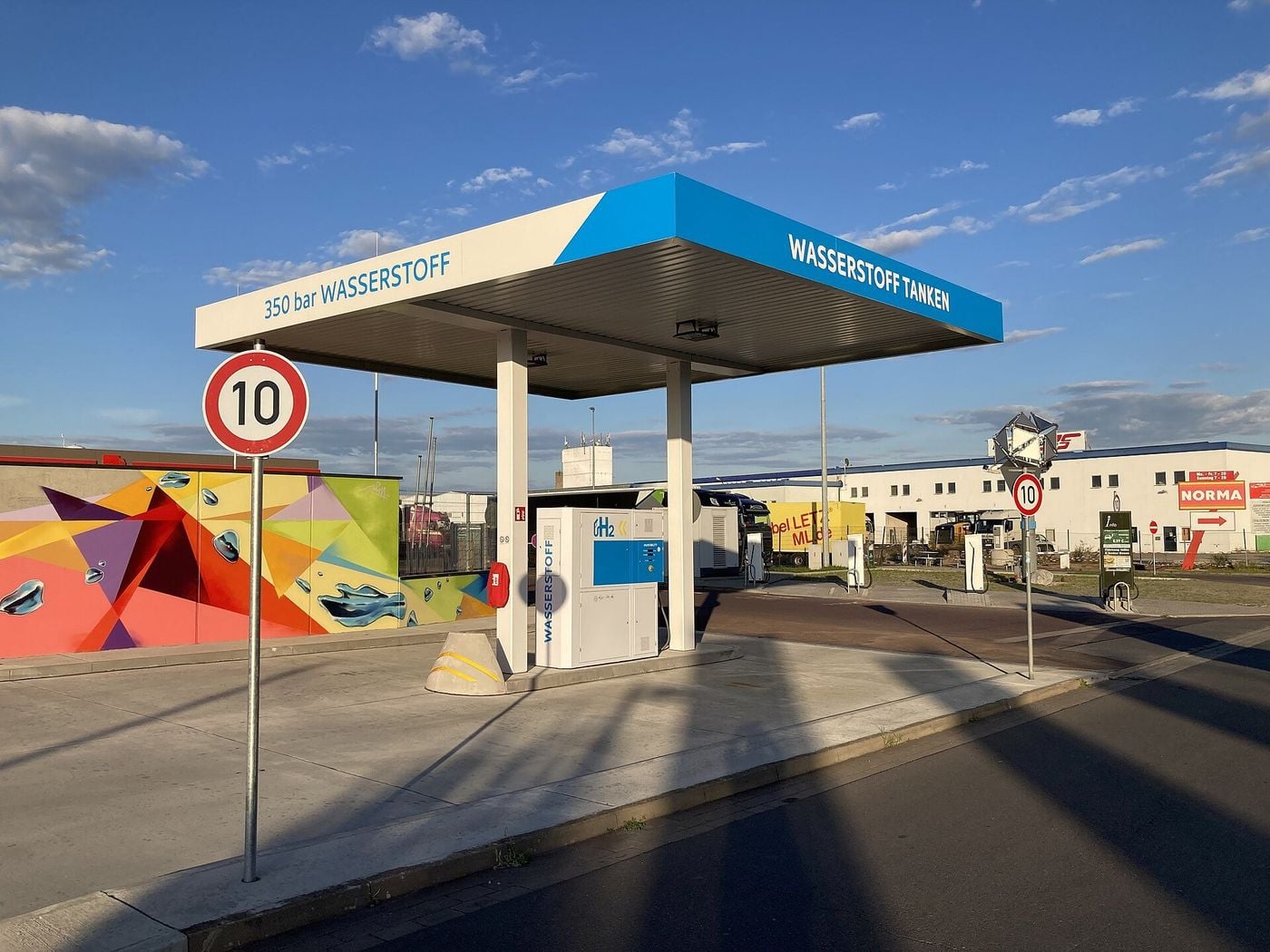
Article 6 of the EU’s Alternative Fuels Infrastructure Regulation (AFIR), Regulation (EU) 2023/1804, requires Member States to ensure that by 31 December 2030 publicly accessible hydrogen refuelling stations “designed for a minimum cumulative capacity of 1 tonne per day and equipped with at least a 700 bar dispenser” are deployed “with a maximum distance of 200 km between them along the TEN-T core network”, and that at least one publicly accessible station is deployed in each urban node. How many hydrogen stations there are in Europe depends on who counts and what is counted: the sources opened for this article give figures with different definitions and dates, and no single official count.
What AFIR requires by 31 December 2030
AFIR is Regulation (EU) 2023/1804 of the European Parliament and of the Council of 13 September 2023 “on the deployment of alternative fuels infrastructure, and repealing Directive 2014/94/EU”, published in the Official Journal on 22 September 2023 (OJ L 234). Article 26 says “It shall apply from 13 April 2024” and that the regulation is “binding in its entirety and directly applicable in all Member States”; Article 25(1) repeals Directive 2014/94/EU with effect from the same date. Article 6 is headed “Targets for hydrogen refuelling infrastructure of road vehicles”.
Article 6(1) has four subparagraphs:
- The first is a general duty: “Member States shall ensure that, in their territory, a minimum number of publicly accessible hydrogen refuelling stations are deployed by 31 December 2030.”
- The second is the core-network rule: “by 31 December 2030 publicly accessible hydrogen refuelling stations designed for a minimum cumulative capacity of 1 tonne per day and equipped with at least a 700 bar dispenser are deployed with a maximum distance of 200 km between them along the TEN-T core network.”
- The third is the urban-node rule: “by 31 December 2030, at least one publicly accessible hydrogen refuelling station is deployed in each urban node.” It adds that “an analysis is carried out to determine the best location for such refuelling stations and that the analysis examines in particular the deployment of such refuelling stations in multimodal hubs where other transport modes could also be supplied.”
- The fourth calls for “a clear linear trajectory towards meeting the 2030 targets, along with a clear indicative target for 2027 that delivers sufficient coverage of the TEN-T core network”.
The capacity and pressure conditions sit in the core-network sentence. The urban-node subparagraph says only “at least one”; it states no capacity and no pressure (our reading). Recital 40 says that “It should be possible for one publicly accessible hydrogen refuelling station located within an urban node to be taken into account to fulfil the TEN-T requirement, provided the capacity target is achieved”, and, of multimodal hubs, that “such hubs are a typical destination for heavy-duty vehicles”.
Article 6(2) covers borders: “Neighbouring Member States shall ensure that the maximum distance referred to in paragraph 1, second subparagraph, is not exceeded for cross-border sections of the TEN-T core network.”
Article 6(3) requires that the station is “designed to serve light-duty and heavy-duty vehicles”. So the regulation does not reserve stations to trucks; “for trucks” in this article’s title is a reader’s question, not a category of the law (our reading). Article 2(30) defines “heavy-duty vehicle” as “a Category M2 motor vehicle … a Category M3 motor vehicle … a Category N2 motor vehicle … or a Category N3 motor vehicle … of Regulation (EU) 2018/858”. Recital 41 gives the reason for the focus: “the heavy-duty segment was identified as the most likely segment for the early mass deployment of hydrogen-powered vehicles. Therefore, hydrogen refuelling infrastructure should focus on that segment initially”.
Definitions in Article 2 bear on these subparagraphs:
- Article 2(45) defines “publicly accessible alternative fuels infrastructure” by its site: infrastructure “located at a site or premises that are open to the general public, irrespective of whether the alternative fuels infrastructure is located on public or private property” (quotation shortened).
- Article 2(68) defines the “TEN-T core network” as “a core network within the meaning of Article 38 of Regulation (EU) No 1315/2013”; Article 2(72) defines “urban node” by reference to “Article 3, point (p), of Regulation (EU) No 1315/2013”.
- Article 2(3) defines “along the TEN-T road network” for hydrogen refuelling stations, in paragraph (b), as “that they are located on the TEN-T road network or within 10 km driving distance from the nearest exit of a TEN-T road”. The corresponding distance for electric recharging stations, in paragraph (a), is “within 3 km driving distance from the nearest exit of a TEN-T road”. Article 6 itself says “along the TEN-T core network”; the defined phrase is worded “along the TEN-T road network”.
AFIR’s targets for recharging heavy-duty electric vehicles are in its Article 4 and are covered in our megawatt charging article.
Core network only, and where the rule can bend
Article 6 names the TEN-T core network and no other. The comprehensive network appears in Article 24(1), where, regarding hydrogen refuelling stations, the Commission is to assess the requirements of Article 6 in the light of, among other things, “the need to specify a higher capacity for those stations, the need to specify targets for liquid hydrogen refuelling infrastructure, as well as the date for the extension of the requirements for the deployment of hydrogen refuelling stations to the TEN-T comprehensive network”. On our reading, Article 6 sets no hydrogen station target for the comprehensive network; the date for extending the requirements to it is a matter for the Commission to assess.
The Commission’s summary page on AFIR, consulted in September 2026, words it differently: stations “must be deployed with a maximum distance of 200 km in between them along the TEN-T core and the TEN-T comprehensive network and at least one must be available in every urban node”. Article 6(1) says “along the TEN-T core network”; this article follows the regulation’s text.
Article 6(4) allows Member States to lower the capacity requirement on low-traffic roads: “along roads of the TEN-T core network with a total annual average daily traffic of fewer than 2 000 heavy-duty vehicles and where the deployment of infrastructure cannot be justified in socio-economic cost-benefit terms, Member States may reduce by up to 50 % the capacity of a publicly accessible hydrogen refuelling station required pursuant to paragraph 1 of this Article, provided that the requirements set out in that paragraph in terms of the maximum distance between hydrogen refuelling stations and the dispenser pressure are complied with.” On that wording the distance and the dispenser pressure stay, and the capacity is what can be reduced, by up to 50 %. Member States “shall notify the Commission of any cases in which they have made use of the derogation” and “shall review those cases every two years as part of the national progress reporting referred to in Article 15.”
Article 6(5) adds a second derogation: “if the costs of the deployment of the infrastructure are disproportionate to the benefits, including the environmental benefits, Member States may decide not to apply paragraph 1 of this Article to: (a) outermost regions of the Union referred to in Article 349 TFEU; or (b) islands falling within the definition of small connected systems or small isolated systems according to Directive (EU) 2019/944.”
Article 8 of the same regulation sets the target for liquefied methane refuelling points in a different way; our LNG and bio-LNG trucks article sets it out and compares it with Article 6.
Paying at a hydrogen pump
Article 7 sets payment and price rules for hydrogen refuelling. Its payment rule, in paragraph 1, is written for refuelling points, not for stations as a whole. Article 2 defines a “refuelling point” as a “refuelling facility … which is capable of refuelling only one vehicle … at a time”, and a “refuelling station” as “a single physical installation at a specific location, consisting of one or more refuelling points”.
Article 7(1) has operators “provide end users with the possibility to refuel on an ad hoc basis”. Article 2(55) defines to “refuel on an ad hoc basis” as a refuelling service purchased “without the need for that end user to register, conclude a written agreement, or enter into a commercial relationship with the operator of that refuelling point that goes beyond the mere purchase of the refuelling service”. At publicly accessible hydrogen refuelling points, operators must accept electronic payments, “including at least one of the following: (a) payment card readers; (b) devices with a contactless functionality that is at least able to read payment cards.” The dates: “For publicly accessible hydrogen refuelling points deployed after 13 April 2024, the requirements set out in this paragraph shall apply from their deployment. For publicly accessible refuelling points deployed before 13 April 2024, the requirements set out in this paragraph shall apply from 14 October 2024.”
Article 7(2) sets the principle for prices: “reasonable, easily and clearly comparable, transparent and non-discriminatory”. Article 7(3) has operators “clearly show information on the ad hoc price per kg” so that it is known to end users “before they initiate a refuelling session”. Article 7(4) adds that operators “may provide hydrogen refuelling services to customers on a contractual basis”. This article gives no price.
Pressure, standards and liquid hydrogen in the rules
Pressure. The binding provision is the core-network sentence of Article 6(1): stations “equipped with at least a 700 bar dispenser”. Recital 41 is broader in wording: “all publicly accessible hydrogen stations should at least serve gaseous hydrogen at 700 bar”. That is a recital’s “should”, not the operative text of Article 6. In our reading the regulation names no 350 bar dispenser.
The European Hydrogen Observatory does sort stations by dispenser. Its dataset covers “publicly accessible and operational hydrogen refuelling stations (HRS) in Europe”, “presented by location and dispenser type (700 bar for cars, 350 bar for cars or/and 350 bar for heavy-duty vehicles)”, with a reference period of May 2026.
H2 MOBILITY Deutschland, an operator, said in a news item of 26 September 2024 that refuelling at 350 bar for buses and trucks was possible at 34 stations, and that by the end of December its network would offer “über 50 350-Bar-Zapfpunkte” (our translation: more than 50 dispensing points at 350 bar). That is one operator’s statement of September 2024, not a current figure. Hydrogen city buses and their tank data are covered in city bus propulsion.
Standards. Article 21(1) says “The technical specifications set out in Annex II shall apply.” Point 3 of Annex II, on hydrogen supply for road transport vehicles, exists in two versions, which this article does not mix:
- The Official Journal text of 2023 cites EN 17127:2020 in point 3.1, which concerns “Outdoor hydrogen refuelling points dispensing gaseous hydrogen”, and in point 3.3: “The fuelling algorithm shall comply with the requirements of standard EN 17127:2020.” Its point 3.5 was a heading only.
- The consolidated text of 8 January 2026 incorporates Commission Delegated Regulation (EU) 2025/656 of 2 April 2025, which amends AFIR “as regards standards for wireless recharging, electric road system, vehicle-to-grid communication and hydrogen supply for road transport vehicles”. It cites EN 17127:2024: in point 3.1 for connectors for gaseous (compressed) hydrogen refuelling points for light-duty vehicles, in point 3.3 (“The hydrogen refuelling algorithm shall comply with the requirements of standard EN 17127:2024.”), and in point 3.5, now filled in, for heavy-duty vehicles: “connectors for refuelling points dispensing gaseous (compressed) hydrogen for heavy-duty vehicles shall comply, for interoperability purposes, at least with the requirements described in standard EN 17127:2024.”
In both versions point 3.2 says hydrogen dispensed by refuelling points for motor vehicles “shall comply with the requirements described in standard EN 17124:2022”, and point 3.4 says: “Once the process of certification of standard EN ISO 17268:2020 is concluded, connectors for motor vehicles for the refuelling of gaseous hydrogen shall comply at least with that standard.” We did not read from which date Delegated Regulation 2025/656 applies to hydrogen points, so this article gives none.
Liquid hydrogen. Recital 41 refers to “new technologies, such as liquid hydrogen technology, that allow for a larger range for heavy-duty vehicles and are expected to be the preferred technology choice of some vehicle manufacturers.” Article 24(1) had the Commission, by 31 December 2024, submit “a technology and market-readiness report dedicated to heavy-duty vehicles” that also considers “the use of liquid hydrogen”, and, regarding hydrogen stations, assess “the need to specify targets for liquid hydrogen refuelling infrastructure”. Point 3.6 of Annex II, in the consolidated text of 8 January 2026, consists of the heading “Technical specifications for connectors for refuelling points dispensing liquefied hydrogen for heavy-duty vehicles.” and cites no standard (our reading). Article 6 sets no target for liquid hydrogen stations (our reading): what the text has is the Commission’s task of assessing whether to specify one. This article does not cover the Commission’s report; it was not opened.
How many stations exist, and what each count counts
The sources opened for this article give no single official count. Each figure below is given with its own definition, geography and date, and none is worked out from another. When it was adopted in 2023, the regulation noted, in recital 35, that “Currently, hydrogen refuelling points are only deployed in a few Member States and are largely unsuitable for heavy-duty vehicles.”
The VDA, citing EAFO. The VDA, the German Association of the Automotive Industry, an industry body, says in a press release of 30 August 2026: “to date, there are only about 150 hydrogen refueling stations operating at 350bar and 168 operating at 700bar across the EU.” The same paragraph says that around one-third (31%) of the hydrogen refuelling infrastructure is in Germany, and ends with “(Source: EAFO, as of July 2026)”. It does not give a total, and this article does not add the 150 and the 168. The release also says that in many EU countries, “particularly in Eastern and Southern Europe”, there are no hydrogen refuelling stations for trucks at all. The EAFO data itself was not opened for this article.
The IAA TRANSPORTATION release. A press release of 1 September 2026 on the IAA TRANSPORTATION press pages says that “only around 216 hydrogen refueling stations for road freight are currently available across Europe.” It points to figures recently published by the VDA. The VDA release above does not contain the figure 216, and the IAA release does not say how the 216 were counted.
FreightWaves, quoting Daimler Truck. FreightWaves, in a report of 17 September 2026, quotes Daimler Truck’s chief executive Karin Rådström as saying that Europe has 187 hydrogen stations. It quotes her: “Most of them are 350 bar”, adding that this “doesn’t give you the added range that you need” for it to be “really beneficial for trucking”. FreightWaves is a secondary source for this remark.
H2 MOBILITY, Germany. In a news item of 26 September 2024, H2 MOBILITY Deutschland described itself as “Deutschlands führender Betreiber von derzeit rund 70 öffentlichen Wasserstofftankstellen” (our translation: Germany’s leading operator of currently around 70 public hydrogen stations). That is one operator’s own network in Germany as of September 2024. Its 350 bar figures are given above.
The Observatory. The European Hydrogen Observatory’s page describes its dataset, with a reference period of May 2026, but its text gives no count: the numbers are in a downloadable spreadsheet that we did not download. This article therefore gives no Observatory count.
Estimates and announcements are not targets
The VDA estimates that by 2030 Europe will require around 2,000 hydrogen refuelling stations suitable for trucks, each with a capacity of approximately 2 tons of hydrogen per day, and that around 300 of them will be needed in Germany. The IAA TRANSPORTATION release of 1 September 2026 repeats the estimate in slightly different words: “around 2,000 truck-capable hydrogen refueling stations” with “a capacity of roughly 2 metric tons of hydrogen per day”. This is an industry association’s estimate of need. It is not in AFIR; the legal figures are those of Article 6, quoted in the first section.
Germany’s announcement is a ministerial statement. The show’s review of the first day of IAA TRANSPORTATION 2026, dated 15 September 2026, quotes Steffen Bilger, listed on the federal government’s website as Bundesminister für Verkehr (Federal Minister of Transport), in its section on the official opening, as saying: “Through our funding, we will deploy at least 35 hydrogen refueling stations and support the procurement of around 500 commercial vehicles.” It is not a law or a budget decision; the sources opened for this article give no name or budget for a funding programme, and this article states none.
What comes next
The dates the regulation sets, in order:
- 13 April 2024: the regulation applies (Article 26).
- 14 October 2024: the payment requirements of Article 7(1) apply to publicly accessible points deployed before 13 April 2024.
- 31 December 2024: each Member State was to “prepare and transmit to the Commission a draft national policy framework” (Article 14(1)), and the Commission was to submit its report on heavy-duty vehicles (Article 24(1)). Neither document was opened for this article.
- 31 December 2026: “By 31 December 2026 and every five years thereafter, the Commission shall review this Regulation” (Article 24(2)). Among the elements it is to assess is “whether the traffic thresholds referred to in … Article 6(4) are still relevant”.
- 2027: the “clear indicative target for 2027” of Article 6(1), fourth subparagraph.
- 31 December 2027: “By 31 December 2027 and every two years thereafter, each Member State shall submit to the Commission a standalone national progress report” (Article 15(1)). Annex I lists, among its elements, “targets for 31 December of the years 2025, 2027, 2030 and 2035” for hydrogen refuelling stations: “number of refuelling stations, capacity of the refuelling stations and connector provided”. No Member State’s targets were opened for this article.
- 31 December 2030: the targets of Article 6(1).
The Commission’s Have Your Say initiative on the review is titled “Review of EU rules on alternative fuels infrastructure”. Its page, read on 29 September 2026, shows a call for evidence published on 23 March 2026, with feedback ending on 20 April 2026, and a public consultation published on 11 May 2026, ending on 3 August 2026. It lists the proposal for a regulation as “Upcoming”, with “Q4 2026”. No proposal was listed at that reading, and Article 6 as described here is the text of the consolidated version of 8 January 2026, in which, in our comparison, it is unchanged from the Official Journal text apart from the spelling of “2 000” as “2000”.
The VDA says that the planned review of AFIR “must also include more ambitious rollout targets for hydrogen refueling stations”. That is an industry association’s demand, not a Commission position.
Quick answers
- What does AFIR require for hydrogen refuelling stations for trucks?
- By 31 December 2030, Article 6(1) of Regulation (EU) 2023/1804 requires publicly accessible hydrogen refuelling stations “designed for a minimum cumulative capacity of 1 tonne per day and equipped with at least a 700 bar dispenser”, deployed “with a maximum distance of 200 km between them along the TEN-T core network”, and at least one publicly accessible station in each urban node. The regulation does not reserve stations to trucks: Article 6(3) says the station is to be “designed to serve light-duty and heavy-duty vehicles”.
- Does AFIR require hydrogen stations on the TEN-T comprehensive network?
- No, not in Article 6, which says “along the TEN-T core network”. The comprehensive network appears in Article 24(1), which has the Commission assess “the date for the extension of the requirements for the deployment of hydrogen refuelling stations to the TEN-T comprehensive network”. The Commission’s summary page, consulted in September 2026, names both networks; this article follows the regulation’s text.
- How many hydrogen refuelling stations for trucks are there in Europe?
- The sources opened for this article give no single official count, only figures with different definitions and dates. In a release of 30 August 2026 the VDA, the German Association of the Automotive Industry, says there are about 150 hydrogen refuelling stations operating at 350bar and 168 operating at 700bar across the EU, in a paragraph that ends with “(Source: EAFO, as of July 2026)”. A release of 1 September 2026 on the IAA TRANSPORTATION press pages says around 216 stations for road freight are available across Europe, and does not say how they were counted.
- Do hydrogen trucks refuel at 350 or 700 bar under AFIR?
- AFIR requires stations along the TEN-T core network to be “equipped with at least a 700 bar dispenser”; in our reading its text names no 350 bar dispenser. The European Hydrogen Observatory’s station dataset (reference period May 2026) is presented by dispenser type, one of which it gives as “350 bar for heavy-duty vehicles”.
- Does AFIR set targets for liquid hydrogen refuelling?
- No, in our reading of the text: Article 6 sets no target for liquid hydrogen stations. Article 24(1) has the Commission assess “the need to specify targets for liquid hydrogen refuelling infrastructure”, recital 41 refers to “liquid hydrogen technology”, and point 3.6 of Annex II in the consolidated text of 8 January 2026 consists of the heading “Technical specifications for connectors for refuelling points dispensing liquefied hydrogen for heavy-duty vehicles”, with no standard cited (our reading).
- Can you pay by card at a public hydrogen station?
- Article 7(1) requires ad hoc refuelling at publicly accessible hydrogen refuelling points, with electronic payments accepted through “at least one of the following: (a) payment card readers; (b) devices with a contactless functionality that is at least able to read payment cards”. The requirement applies from deployment for points deployed after 13 April 2024, and from 14 October 2024 for publicly accessible points deployed before 13 April 2024. Article 7(3) has operators clearly show the ad hoc price per kg before a refuelling session starts.
Sources
- Regulation (EU) 2023/1804 on the deployment of alternative fuels infrastructure (AFIR) — Articles 2, 6, 7, 14, 15, 21, 24 and 26, recitals 35, 40 and 41, Annexes I and II (OJ L 234, 22.9.2023) — EUR-Lex, Publications Office of the European Union
- Regulation (EU) 2023/1804 (AFIR), consolidated text of 8 January 2026 incorporating Delegated Regulation (EU) 2025/656 — Article 6 (unchanged) and Annex II point 3 (hydrogen supply for road transport vehicles) — EUR-Lex, Publications Office of the European Union
- Alternative fuels infrastructure (Regulation (EU) 2023/1804) — European Commission — Mobility and Transport
- Review of EU rules on alternative fuels infrastructure (Have Your Say initiative 16672: call for evidence, public consultation, planned proposal) — European Commission — Have Your Say
- Inadequate charging and hydrogen refueling infrastructure severely hampers market ramp-up - rapid expansion urgently needed (press release, 30 August 2026) — VDA — German Association of the Automotive Industry
- Commercial vehicle industry to present more than 150 world premieres and new products at IAA TRANSPORTATION 2026 (press release, 1 September 2026) — IAA TRANSPORTATION (VDA)
- A Look Back at Day 1 (IAA TRANSPORTATION 2026, 15 September 2026) — IAA TRANSPORTATION (VDA)
- Steffen Bilger — Bundesminister für Verkehr — Die Bundesregierung
- Hydrogen Refuelling Stations (datastream, reference period May 2026) — European Hydrogen Observatory (Clean Hydrogen Partnership)
- Aktuelle Informationen zum Wasserstoff-Tankstellennetz von H2 MOBILITY (26 September 2024) — H2 MOBILITY Deutschland
- Daimler Truck brings NextGenH2 to IAA as hydrogen pact forms (17 September 2026) — FreightWaves