Megawatt Charging System (MCS) for electric trucks explained
MCS is CharIN's heavy-duty charging system, up to 1,250 V and 3,000 A. Volvo rates its truck at 700 kW, MAN at up to 750 kW; AFIR does not require it.
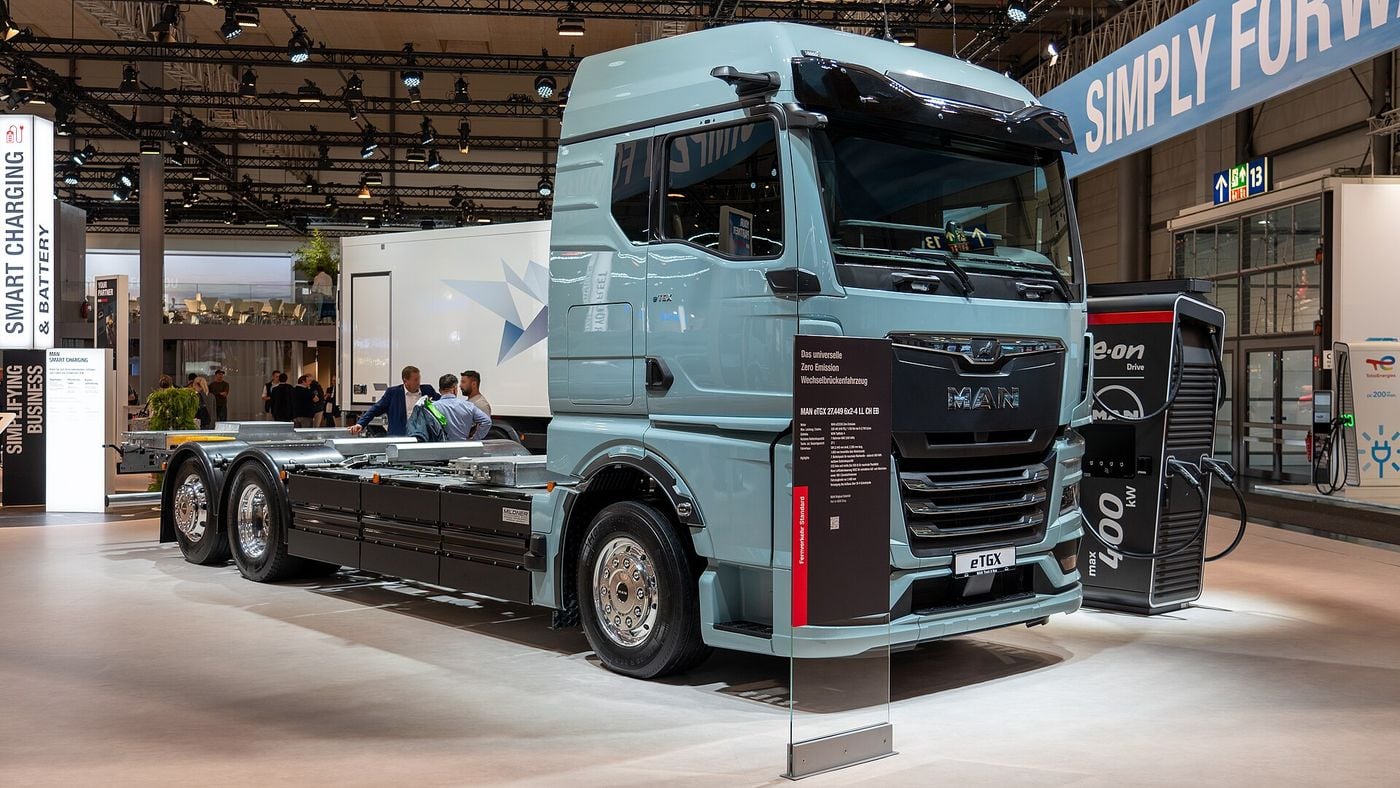
The Megawatt Charging System (MCS) is a charging system for heavy-duty electric vehicles such as long-haul trucks: it builds on the Combined Charging System (CCS), adding a liquid-cooled cable and connector and an improved communication protocol. Scania and Milence say MCS is designed for 3.75 MW, but the ratings makers quote for named trucks are far lower — 700 kW for Volvo’s FH Aero Electric with extended range and up to 750 kW for the MAN eTGX and eTGS. Makers present it as a way to recharge during the driver’s legally required break: Volvo lists 20 to 80% in approximately 50 minutes on 700 kW MCS, against approximately 85 minutes on 350 kW CCS.
MCS at a glance:
| Question | Answer |
|---|---|
| What power is it designed for? | 3.75 MW, according to Scania and Milence |
| What do makers quote for named trucks? | 700 kW for the Volvo FH Aero Electric with extended range; up to 750 kW for the MAN eTGX and eTGS; up to 1000 kW, based on internal simulations, for the Mercedes-Benz eActros 600 with ProCabin |
| How fast does it charge? | 20 to 80% in approximately 50 minutes on 700 kW MCS, against approximately 85 minutes on 350 kW CCS (Volvo); 20 to 80% in less than 30 minutes for a MAN eTGX or eTGS with six batteries (MAN states no conditions) |
| Which documents define it? | IEC TS 63379 for the connectors, vehicle inlets and cable assemblies (publication announced in February 2026); IEC 61851-23-3:2026 for the charger side (published on 21 August 2026) |
| Does EU law require it? | No. AFIR’s targets ask individual charging points for at least 350 kW, so on our reading they can be met without a megawatt charging point |
For drivers within its scope, Regulation (EC) No 561/2006 sets the break a battery-electric truck on a European long-haul run has to charge in. After a driving period of four and a half hours a driver “shall take an uninterrupted break of not less than 45 minutes, unless he takes a rest period” — a break that “may be replaced by a break of at least 15 minutes followed by a break of at least 30 minutes”. Daily driving time “shall not exceed nine hours”, and “may be extended to at most 10 hours not more than twice during the week”. Scania describes the common use case for megawatt charging in exactly those terms: the driver drives for 4.5 hours, takes the 45-minute break, and with MCS “the 45-minute break is enough to recharge the battery up to 80 percent”.
What is the Megawatt Charging System?
The Megawatt Charging System grew out of a task force that the CharIN industry association set up in 2018 “to invent a holistic system approach based on the Combined Charging System CCS”, with the aim of charging electric heavy-duty vehicles “within a reasonable time”. Among the requirements that CharIN says “are currently discussed” for MCS, it gives “Max 1.250 volt & 3.000 ampere (DC)”. Multiplied out that is 3.75 MW (our arithmetic), the figure Scania and Milence give as what MCS is “designed for”. The connectors, vehicle inlets and cable assemblies are defined in IEC TS 63379, whose official publication CharIN announced in February 2026; the charger side followed as IEC 61851-23-3:2026, which the IEC lists as published on 21 August 2026. Mercedes-Benz Trucks still footnotes its megawatt charging time “Based on internal simulations, as a binding and uniform Megawatt Charging System (MCS) standard is currently still under development.”
SAE International’s registry lists J3271_202503, “SAE Megawatt Charging System for Electric Vehicles”, as a Technical Information Report issued on 5 March 2025. SAE says the report starts from the assumption that one system-level standard covering all aspects of EV charging components and use cases “would grow to be too large for one comprehensive document”, and compiles five subtopics into one: SAE J3271/1, Electromechanical Coupler Specifications; J3271/2, Communication and Controls; J3271/3, Cables/Cable Handling, Cooling, and Automated Connection Systems; J3271/4, Use Cases Including Grid Interconnection, Black Start, and Bidirectional Power Transfer; and J3271/5, Interoperability Testing Requirements and Test Procedures. According to the registry page, the recommended practice level documents “will follow this structure, with added detail and streamlined content”, and the report itself “is intended as a guide toward standard practice and is subject to change in order to harmonize with international standards”. The page gives no voltage or current ratings.
Scania names two differences from CCS2 besides power: a “liquid-cooled cable and connector”, and “an improved communication protocol, making charging more stable and predictable compared to CCS2”. CharIN’s list of requirements under discussion gives that layer as “Ethernet + ISO/IEC 15118-20” and describes MCS as built on “a maximum utilization of existing CCS building blocks”. Milence puts it more strongly: MCS is “purpose-created for heavy-duty vehicles like planes, boats and trucks, not adapted from passenger car technology”, and its communication platform “was specifically chosen to ensure a stable operation even at megawatt levels”.
The figures for one truck
Take a Mercedes-Benz eActros 600: three LFP battery packs with a nominal 621 kWh and a stated range of up to 500 km; “Charging is via CCS2 at up to 400 kW.” The technical data on Mercedes-Benz Trucks’ eActros page gives the eActros 600 a CCS2 charging time of “approx. 70 Minutes”, “based on the framework conditions defined in ISO/SAE 12906 for heavy commercial vehicles - with 400 kW charging power at a typical DC fast-charging station with 500 A”; the table does not name the state-of-charge window. The maker’s product sheet for the truck gives 20 to 80% on CCS in “Approx. 60 min.”, from “internally determined empirical values under optimal conditions, including an ambient temperature of 20 °C at a standard DC fast charging station with 500 A charging current”. The same technical data lists MCS “up to 1000 kW” only for the eActros 600 with ProCabin, footnoted as based on internal simulations; with the proven cab the eActros 600 is listed with CCS 2 only. Mercedes-Benz Trucks presents the megawatt time as a future capability: “In future, megawatt charging will enable charging from 20 to 80% in around 30 minutes – ideal for planned long-distance routes with a legally required driving break.” Daimler Truck gives the same window with MCS as “only about 30 minutes”, also footnoted as based on internal simulations.
Volvo publishes the comparison inside a single model. For the FH Aero Electric with extended range it lists 20 to 80% “in approximately 50 minutes” on 700 kW MCS and “in approximately 85 minutes” on 350 kW CCS, and says the MCS time means “charging can be done within the legislated rest period for truck drivers in the EU”. The truck’s other specifications are on the Volvo FH Aero Electric model page.
Note the 700 kW. The MCS ratings quoted here for named trucks — Volvo’s 700 kW for the FH Aero Electric with extended range, MAN’s up to 750 kW for the eTGX and eTGS, whose MCS-equipped series production MAN announced on 30 July 2026, and Mercedes-Benz Trucks’ simulated “up to 1000 kW” for the eActros 600 with ProCabin — are far below the 3.75 MW design figure. Speaking of MCS in general rather than of a truck, Daimler Truck mentions “charging capacities of up to 1,000 kW”, and Scania’s head of solutions management said at IAA Transportation 2026: “With 1,000 amps and 750 kW as a starting point, MCS has the potential to exceed 3 MW as the technology develops.” Scania announced on 27 May 2026 that its Megawatt Charging System was “now available for order”, says its battery-electric trucks “can be fitted with both connectors”, and quotes 20 to 80% “in less than 30 minutes” with MCS, against CCS2 “typically delivering up to 350–400 kW”. “MCS-capable” is not a single number: the rating and the charging time both depend on the maker and the specific variant. What makers declare about MCS for their electric tractor units is set out row by row in a register of maker-declared values.
MAN’s series production of MCS trucks
On 30 July 2026 MAN Truck & Bus announced that the first series-production vehicle equipped with the Megawatt Charging System had rolled off the assembly line at its plant in Munich. MAN says it is the first European manufacturer to produce MCS-equipped eTrucks in series production; that claim is MAN’s own. The release says MCS enables charging capacities of up to 750 kW in the MAN eTGX and MAN eTGS, while CCS currently allows up to 375 kW for MAN eTrucks, and that MCS-equipped vehicles can achieve up to 750 kW “with up to 1,000 amps and up to 750 volts”.
For an eTGX or eTGS with six batteries and a total battery capacity of 534 kWh, MAN gives charging from 20 to 80% state of charge in “less than 30 minutes” using MCS. For the seven-battery configuration available for chassis vehicles, with a total capacity of 623 kWh, it gives charging to 80% in “less than 40 minutes”; the release does not name the starting state of charge for that time, and it states no conditions behind either time. MAN says this means eTrucks can be recharged during legally required driver break periods.
The MCS charging position is at the front left. The vehicles can optionally also be equipped with additional CCS charging points at the front right and, for chassis vehicles, at the rear on both the left and right sides. The release says the first MCS-ready MAN eTrucks “will be delivered step by step” to customers in Belgium, Denmark, Germany, Great Britain, Italy, the Netherlands, Norway, Spain and the Czech Republic — nine countries by our count. It quotes Roman Sitte, head of Sales Area Europe: “The MCS ecosystem is currently at an important stage of market introduction.” MAN’s charging times and maximum MCS power by battery-pack count are on the MAN eTGX model page.
Where the makers place it
Volvo’s next-generation FH, FM and FMX Electric — for “on-road construction, regional distribution, urban logistics, utilities, refuse and heavy special applications”, with ranges up to 470 km — are listed with 350 kW CCS charging only, 20 to 80% in approximately 65 minutes.
Scania draws the line by where the truck charges. CCS2, it says, “is sufficient for overnight depot or destination charging, as well as for en-route top-ups” and “remains highly suitable for depot and destination charging, especially where charging can happen overnight or during loading and unloading”, while MCS “is designed for en-route charging where speed is essential”. Its common use case for MCS is “heavy-duty long-haul transport on motorways, where uptime and predictable scheduling are critical”. Both standards, Scania says, “will be needed for the foreseeable future”. How battery-electric trucks are built, what their makers declare and where they charge are set out in electric trucks and tractor units explained.
What the law requires, and what it does not
AFIR, Regulation (EU) 2023/1804, sets the targets for publicly accessible recharging pools dedicated to heavy-duty electric vehicles along the TEN-T road network, deployed in each direction of travel (Article 4(1)):
| By | Where | Each pool: output | Each pool: points of at least 350 kW |
|---|---|---|---|
| 31 December 2025 | at least 15% of the length of the TEN-T road network | at least 1,400 kW | at least one |
| 31 December 2027 | at least 50% of that length — along the core network | at least 2,800 kW | at least two |
| 31 December 2027 | at least 50% of that length — along the comprehensive network | at least 1,400 kW | at least one |
| 31 December 2030 | the core network, pools at most 60 km apart | at least 3,600 kW | at least two |
| 31 December 2030 | the comprehensive network, pools at most 100 km apart | at least 1,500 kW | at least one |
For the 2025 and 2027 percentages, a stretch between two qualifying pools more than 120 km apart does not count (Article 4(2)). The Commission’s questions and answers add that the percentage is measured on the whole TEN-T road network, core and comprehensive together. The targets for safe and secure parking areas and urban nodes, and how the percentages are counted, are set out in AFIR truck-charging targets, article by article.
Article 4 also lets Member States depart from the table. Along TEN-T roads with a total annual average daily traffic of fewer than 2,000 heavy-duty vehicles, where the deployment “cannot be justified in socio-economic cost-benefit terms”, they “may” provide that one pool serves both directions of travel (Article 4(4)), or “may reduce by up to 50 %” the total power output of a pool that serves only one direction (Article 4(5)). Along TEN-T core roads with fewer than 800 heavy-duty vehicles a day, they “may allow a longer distance, of up to 100 km” between pools instead of 60 km (Article 4(6)). Cyprus may ask the Commission to authorise lower total power output or a maximum distance of up to 100 km (Article 4(8)). None of these lowers the 350 kW for individual points: paragraphs 4 and 5 keep “the power output of single recharging points” as a condition, and paragraphs 6 and 8 concern only distance and total pool output.
Read the individual figure again: at least 350 kW. No target in Article 4 asks a single point for more. The Commission’s questions and answers confirm that a megawatt charging point of 1 MW can meet a 350 kW requirement — but nothing requires one, so on our reading a Member State can meet every Article 4 target without a single megawatt charging point.
That gap was known when the regulation was adopted. Recital 22 says new recharging infrastructure standards for heavy-duty electric vehicles “are currently being developed” and that the Commission “should consider increasing the individual power output of recharging stations at recharging pools once the new common technical specifications are available”. For a planner it means, on our reading, that a pool counting towards AFIR tells you where a truck can charge at 350 kW or more, not where it can charge on MCS.
Truck charger counts and Germany’s fast-charging plan
The International Energy Agency’s Global EV Outlook 2026, published on 20 May 2026, says that after China the European Union has shown the greatest progress in deploying public chargers suitable for trucks, with more than 4,000 available “today”. The notes to the IEA’s charts of truck charging points in selected European countries in 2025 say that both public truck-dedicated chargers and public passenger-car chargers that can accommodate truck fast charging are included, and give the source as IEA analysis based on the eTrucker database, EAFO and country survey templates. About 30% of the more than 4,000 EU chargers are exclusively available to trucks; the IEA says those are nearly all faster than 150 kW, and over two-thirds of them can charge at speeds between 350 kW and 1 MW. It also says “over 40 chargers faster than 1 MW have been identified”; the passage does not say which connector they use.
For Germany, the Nationale Leitstelle Ladeinfrastruktur (NOW GmbH) describes a concept for a nationwide truck fast-charging network along the federal motorways, drawn up by the Federal Ministry for Transport (BMV) with support from Autobahn GmbH des Bundes and the Leitstelle. According to the current planning status, the network comes to 351 locations, 227 at serviced (bewirtschaftete) and 124 at unserviced (unbewirtschaftete) rest areas, and the aim is to build and operate around 1,800 MCS and around 2,400 CCS charging points across them. On 30 June 2026 Autobahn GmbH des Bundes awarded the contracts for planning, building and operating the fast-charging infrastructure at the 124 unserviced rest areas, in five lots of around 25 locations each: eliso Voltix Truck Charging GmbH (lot 1, 25 rest areas), autostrom.plus GmbH (lot 2, 24), Electric Mobility Infrastructure Deutschland GmbH (lot 3, 26), the bidding consortium STRA-loaded (lot 4, 25) and the bidding consortium E.ON Drive & mblty (lot 5, 24) — 124 rest areas in all by our arithmetic. The NOW page lists 836 charging points for road freight at these locations, 447 of them MCS and 389 CCS. For a large share of the serviced rest areas, it says, the further build-out and operation of truck charging infrastructure is to be awarded anew in competitive procedures, and further award procedures follow step by step. The page gives no opening date for the network and no power rating per charging point. Further counts of public truck charging, each with the definition and date its source gives, are set out in charging electric trucks and buses.
Where the constraint really sits
Milence, the joint venture of Daimler Truck, the TRATON GROUP and Volvo Group, describes MCS in its network as delivering up to 1.44 MW. In a pilot test it announced in July 2024, Milence and its partner Power Electronics reached a charging power of 1,100 kW with a prototype of the Mercedes-Benz eActros 600; Milence gives the power the tested charging solution can achieve as 1,440 kW. Milence argues that megawatt charging need not overwhelm the grid: it says MCS stations are planned along key freight corridors — its example is every 100 km — to spread the load on the grid rather than concentrate it, and that operators such as Milence use on-site battery storage and smart charge management to smooth out peak demand “if needed”.
Daimler Truck and Milence both point to the charging network, and Daimler Truck also to making vehicle and charger work together. When Daimler Truck sent two MCS-compatible eActros 600 test trucks on a run of about 2,400 km from Wörth am Rhein to Linköping in Sweden in January 2026, it said faster MCS charging allows more efficient and flexible long-haul logistics “provided the appropriate charging infrastructure is available”, and that only a few public MCS locations were currently available in Europe. The run was meant to ensure optimal compatibility between the vehicle and megawatt charging stations from various manufacturers and to gather real-world experience, winter conditions included. The head of e-charging components at Mercedes-Benz Trucks, Peter Ziegler, said the key challenges lie in harmonising the vehicle with various charging systems, and that the extreme charging currents of MCS also place high demands on thermal management. In September 2026 Milence’s chief executive, Anja van Niersen, said the company was demonstrating interoperable megawatt charging across trucks from different manufacturers at IAA Transportation — a chance, the release adds, to advance interoperability further — and that Europe now needs to accelerate and scale charging infrastructure along its key freight corridors.
Three figures that vary by truck and by network
MCS rating. Volvo lists 700 kW for the FH Aero Electric with extended range; MAN states up to 750 kW for the eTGX and eTGS; Mercedes-Benz Trucks lists “up to 1000 kW”, based on internal simulations, for the eActros 600 with ProCabin, and CCS 2 only for the eActros 600 with the proven cab. Mercedes-Benz Trucks footnotes its megawatt charging time as based on internal simulations; its CCS2 time carries no such footnote.
Where a truck charges. Scania’s own answer is that CCS2 “remains highly suitable for depot and destination charging, especially where charging can happen overnight”, and that MCS is for “en-route charging where speed is essential”. Charging at the depot itself, with its power classes and grid connection, is the subject of depot charging for electric trucks.
Network coverage. A pool that counts towards AFIR need not have an MCS point, and in January 2026 Daimler Truck said only a few public MCS locations were available in Europe.
Quick answers
- What is the Megawatt Charging System (MCS)?
- A charging system for heavy-duty electric vehicles that grew out of a CharIN task force set up in 2018. CharIN lists a maximum of 1,250 volts and 3,000 amps DC among the requirements it says are 'currently discussed' — 3.75 MW multiplied out (our arithmetic). The connectors, inlets and cables are defined in IEC TS 63379 and the charger side in IEC 61851-23-3:2026. The MCS ratings quoted here for named trucks are far lower: 700 kW for Volvo's FH Aero Electric with extended range, up to 750 kW for the MAN eTGX and eTGS, whose MCS-equipped series production MAN announced on 30 July 2026, and up to 1,000 kW, based on internal simulations, for the Mercedes-Benz eActros 600 with ProCabin.
- Why do long-haul electric trucks need megawatt charging?
- Regulation (EC) No 561/2006 says that after a driving period of four and a half hours a driver 'shall take an uninterrupted break of not less than 45 minutes, unless he takes a rest period'. Volvo, Mercedes-Benz Trucks and Scania all present MCS as a way to charge within the driver's legally required break. For the Volvo FH Aero Electric with extended range, Volvo lists 20 to 80% in approximately 50 minutes on 700 kW MCS against approximately 85 minutes on 350 kW CCS.
- Does the AFIR law require megawatt chargers?
- No. AFIR (Regulation (EU) 2023/1804) sets targets for heavy-duty recharging pools along the TEN-T road network whose individual points must offer 'at least 350 kW' — from pools of at least 1,400 kW with one such point along at least 15% of the network by the end of 2025, to pools of at least 3,600 kW with two such points at most 60 km apart on the core network by the end of 2030 — subject to the derogations Article 4 allows for low-traffic roads and for Cyprus. No target in Article 4 asks a single point for more than 350 kW, so on our reading a Member State can meet them all without a megawatt charging point.
- Does every electric truck need MCS?
- Not in the makers' own line-ups. Volvo lists its next-generation FH, FM and FMX Electric with 350 kW CCS charging only, 20 to 80% in approximately 65 minutes. Scania says CCS2 'remains highly suitable for depot and destination charging, especially where charging can happen overnight or during loading and unloading', and that MCS 'is designed for en-route charging where speed is essential'.
- Are trucks with MCS already in series production?
- MAN Truck & Bus announced on 30 July 2026 that the first series-production vehicle equipped with the Megawatt Charging System had rolled off the assembly line at its plant in Munich. MAN says it is the first European manufacturer to produce MCS-equipped eTrucks in series production; that claim is MAN's. MAN gives up to 750 kW with up to 1,000 amps and up to 750 volts, and 20 to 80% in less than 30 minutes for an eTGX or eTGS with six batteries and 534 kWh. The release says the first MCS-ready trucks will be delivered step by step to customers in nine countries (our count of the list it names). Scania announced on 27 May 2026 that its Megawatt Charging System was 'now available for order'.
- Is there a finished MCS standard?
- CharIN announced the official publication of IEC TS 63379, which defines the connectors, vehicle inlets and cable assemblies, in February 2026, and the IEC lists IEC 61851-23-3:2026, the charger side, as published on 21 August 2026. SAE issued J3271_202503 on 5 March 2025 as a Technical Information Report; its registry page calls it a guide toward standard practice that is subject to change in order to harmonize with international standards, and says the recommended practice level documents will follow. Mercedes-Benz Trucks still footnotes its megawatt charging time 'Based on internal simulations, as a binding and uniform Megawatt Charging System (MCS) standard is currently still under development.'
Models in this article
Sources
- Driving time and rest periods — European Commission — Mobility and Transport
- Regulation (EC) No 561/2006 on the harmonisation of certain social legislation relating to road transport — consolidated text of 31 December 2024 (Articles 6(1) and 7) — EUR-Lex, Publications Office of the European Union
- Regulation (EU) 2023/1804 on the deployment of alternative fuels infrastructure (AFIR) — Article 4 and recital 22 (Article 4 unchanged in the consolidated text of 8 January 2026) — EUR-Lex, Publications Office of the European Union
- Questions and answers on the regulation on the deployment of alternative fuels infrastructure (EU 2023/1804) — European Commission — Mobility and Transport
- Megawatt Charging System (MCS) — CharIN e.V.
- Official publication of IEC TS 63379: A game-changer for Megawatt Charging System (MCS) standardization — CharIN e.V.
- IEC 61851-23-3:2026 — Electric vehicle conductive charging system, Part 23-3: DC electric vehicle supply equipment, Megawatt charging systems — International Electrotechnical Commission (IEC Webstore)
- eActros — eActros 600 and eActros 400 model overview — Mercedes-Benz Trucks
- The new eActros 600 — product sheet — Mercedes-Benz Trucks
- Megawatt charging in long-haul endurance test: Mercedes-Benz Trucks sends eActros 600 from Germany to Sweden — Daimler Truck
- Volvo launches new electric trucks — with ranges up to 700 km — Volvo Trucks
- Megawatt charging — all you need to know about MCS — Scania Group
- Scania's new under-cab battery module and Megawatt Charging System now available for order (press release, 27 May 2026) — Scania Group
- Debunking 5 myths about Megawatt Charging System for electric long-haul transport — Milence
- Milence and Power Electronics successfully test a new Megawatt Charging System solution delivering a 1.1 MW charge — Milence
- Megawatt Charging impresses at IAA TRANSPORTATION 2026 — Milence
- MAN starts series production of MCS-ready eTrucks (press release, 30 July 2026) — MAN Truck & Bus
- SAE J3271_202503 — SAE Megawatt Charging System for Electric Vehicles (Technical Information Report, issued 5 March 2025) — SAE International (SAE Mobilus)
- Global EV Outlook 2026 — Electric vehicle charging (published 20 May 2026) — International Energy Agency (IEA)
- Lkw-Schnellladenetz — Nationale Leitstelle Ladeinfrastruktur (NOW GmbH)