Volvo
Volvo FH Aero Electric with extended range
E-axle at 420 or 460 kW, six-speed gearbox, 585 or 780 kWh installed, up to 700 km and 700 kW MCS, wheelbases and weights from Volvo's GB data sheet — plus Volvo's 80-tonne rigid variant.
- 2026—
- 6x2
- 420/460 kW

Model overview
- Segment
- Long-haul tractor
- Produced
- 2026—
- Axle configurations
- 1 (6x2…)
- Transmission
- Volvo powershift, six-speed, integrated in the e-axle
- Gross combination
- 48 t
- Battery
- 725 kWh
- Battery installed
- 585–780 kWh
- Range
- 700 km
- Charging
- 700 kW (MCS)
- Electric motor
- 420/460 kW · 2×
| Variant | Axle configurations | Wheelbase (mm) | Kerb weight (kg) | Gross vehicle (kg) | Gross combination (kg) | Sheet |
|---|---|---|---|---|---|---|
| New FH Battery Electric with Extended Range 6x2 tag tractor - E-Axle FH 62T TEE | 6x2 | 3,600 / 4,100 | 11,635 / 11,685 | 23,930 (plated) | 44,000 (plated) | FH 62T TEE 01 GBR 2026-09-30 |
The Volvo FH Aero Electric with extended range is the version of Volvo’s FH Aero Electric that Volvo describes as coming with an e-axle: an integration of two electric motors, power electronics, transmission and a 13 tonne traditional axle. Volvo’s model page presents the FH Aero Electric in two versions and gives each its own column in one specification table. This page follows the extended-range column. Volvo’s 80-tonne rigid truck, whose facts box carries the same words “with extended range”, has a section of its own near the end, and that section says how it differs from the truck described above it.
Volvo’s GB data sheet FH 62T TEE, dated 30 September 2026, is titled “New FH Battery Electric with Extended Range 6x2 tag tractor – E-Axle”; the title does not say Aero. The sheet is used on this page because it offers only two cabs, the Aero Globetrotter and the Aero Globetrotter XL, and because its battery capacities, power levels and axle layout are the ones Volvo’s FH Aero Electric page lists for the version with extended range: 585 and 780 kWh, 420 and 460 kW, and a 6x2 tag tractor with an e-axle. The variants table on this page comes from that sheet, as do the wheelbases, weights and lengths given below.
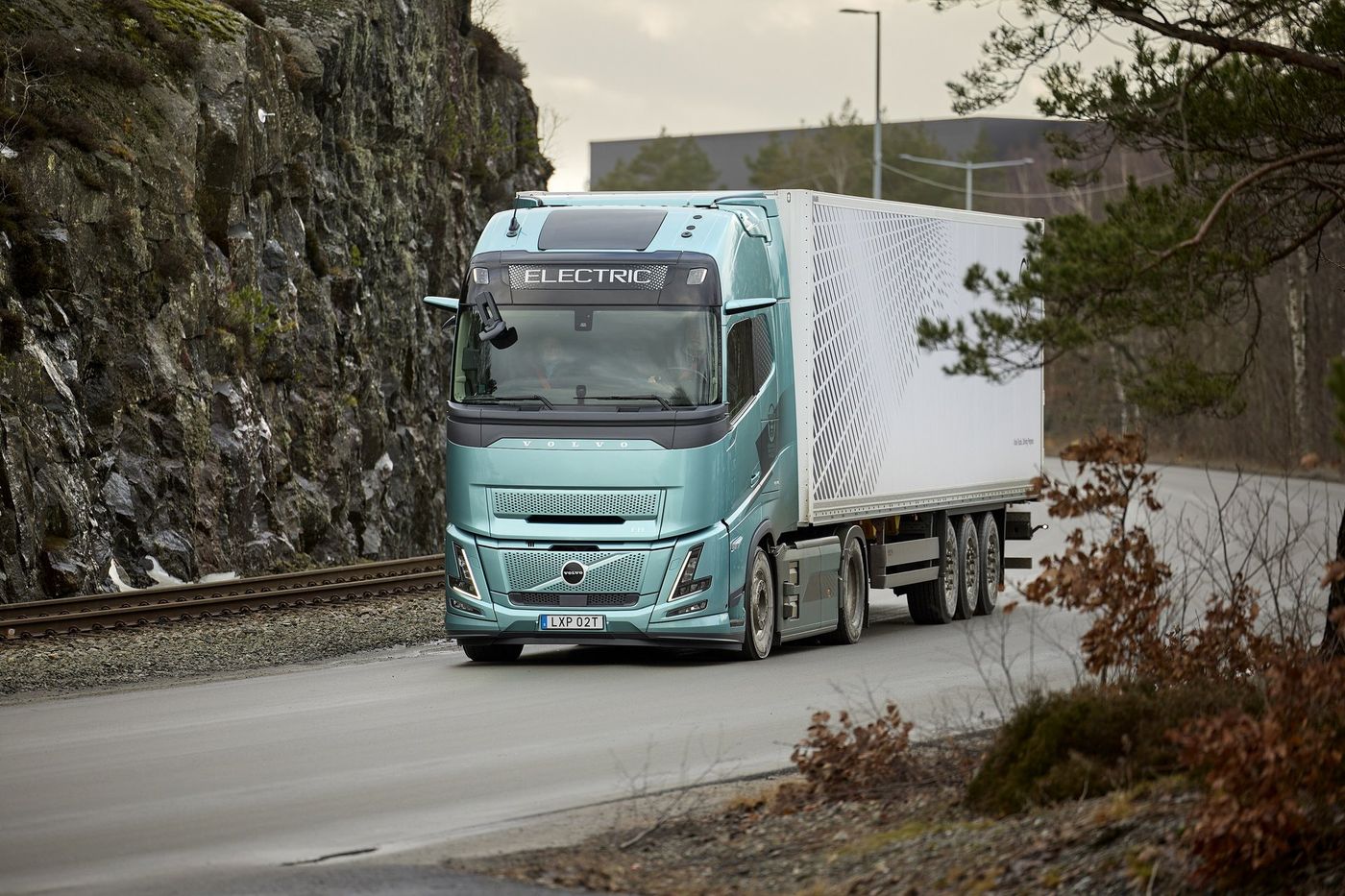
The photograph above shows a Volvo FH Aero Electric tractor unit with a box semitrailer on a road beside a rock face. Wikimedia Commons files it under Volvo FH Electric, and nothing visible in it shows which version of the truck it is, so it illustrates the model family and supports no figure on this page.
Overview and generations
Volvo says the two versions share many drivability and performance features and differ in range and in gross combination weight. The other version, which the model page calls simply the Volvo FH Aero Electric, is described there as having two electric motors and an eight-speed transmission with powershift. This page uses none of that column’s figures; the Volvo FH Electric page covers Volvo’s FH Electric on its own.
- 29 January 2024. Volvo’s release on the FH Aero says the FH Electric will also be offered in the new Aero version, and that the Aero models are to be rolled out step by step during 2024-2025 in four versions, one of them the FH Aero Electric. The release does not mention an extended-range version.
- 20 May 2025. Volvo announced the truck as the Volvo FH Aero Electric with e-axle and said it would formally launch it and start taking orders in the second quarter of 2026. Customers could already sign a letter of intent.
- 14 April 2026. Volvo launched the truck under the name FH Aero Electric with extended range, in a release that also introduced the new FH, FM and FMX Electric. It said the new trucks would be rolled out step by step to markets starting in 2026. Its facts box gives long-haul and intercity transport as the purpose.
- 14 September 2026. Volvo said it had started series production of its new generation of heavy-duty electric trucks, including this one, and that the first trucks had rolled off the assembly line in its factory in Tuve, Gothenburg. For Ghent, Belgium, the release says only that the new electric trucks will be produced there. The same day Volvo announced the rigid truck described in the last section.
Cab
Volvo’s table lists two cabs for this version: the Globetrotter cab and the Globetrotter XL cab. The GB data sheet names them Aero Globetrotter, which it lists as standard, and Aero Globetrotter XL, which it lists as an option. No page opened gives a cab dimension. Volvo’s January 2024 release says the front of the FH Aero cab has been extended by 24 centimeters versus the regular Volvo FH; that is a property of the FH Aero cab, published before Volvo announced this version. Volvo’s model page says the FH Aero Electric combines proven durability with an aerodynamically optimized cab, without naming a version, and does not restate the 24 centimeters. What an aerodynamic cab changes, and the length rules around it, are in aerodynamic cabs and length rules; the cab types are in truck cabs explained.
E-axle and power levels
The e-axle comes in two power levels, 420 kW and 460 kW. The GB data sheet lists them as “Max Power Output”, 420 kW as standard and 460 kW as an option. Volvo’s table lists the driveline as “2 EM, 2 levels” and heads the row “Performance”, and no Volvo document opened gives a continuous-and-peak pair, so the spec record carries the two levels as two figures rather than promoting one of them into a continuous or peak field. Volvo’s model page writes them as 420 kW (570 hp) and 460 kW (625 hp); the April 2026 release writes the upper level as 460 kW (623 hp). Both are Volvo’s. Which horsepower a maker means when it writes one is the subject of reading truck power figures.
Transmission
The e-axle has an integrated six-speed powershift gearbox. The April 2026 release names the two gearbox counts side by side: eight-speed on the new FH, FM and FMX Electric, six-speed on the FH Aero Electric with extended range. It says the powershift gearboxes offer seamless gear shifting and produce less noise and vibration, and gives no figure for either claim. Its facts box describes the e-axle as integrating the two electric motors and the six-speed gearbox into the rear axle.
Axles and weights
Volvo’s table gives the axle configuration of this version as a 6x2 tractor with a light-weight tag axle; it lists no rigid. The model page says that, in combination with the tag axle, the truck is designed for maximum range and payload. The May 2025 announcement gave the layout as an extra supporting tag axle, a 6x2 axle configuration, and a total weight of 48 tonnes. What a 6x2 layout and a tag axle are is covered in axle configurations explained.
Volvo’s table gives the gross combination weight as up to 48 tonnes, a ceiling. The GB data sheet of 30 September 2026 prints the same 48,000 kg as the design gross combination weight and plates the tractor at 44,000 kg; the variants table shows the plated figures. The difference between a vehicle weight and a combination weight is set out in truck weights, GVW and GCW. The April 2026 release adds payload up to 28 tonnes and names no configuration for it, so it is also a ceiling.
The data sheet gives two wheelbases, 3,600 and 4,100 mm, with a kerb weight of 11,635 and 11,685 kg and an overall chassis length of 6,925 and 7,425 mm respectively. It plates the gross vehicle weight at 23,930 kg and gives 25,000 kg as the design figure. It states that kerb weight can vary by ±3% and that legal weights can differ from country to country, and it does not say with which battery, power level or cab its kerb weights were taken.
Battery
Volvo’s model page gives the installed battery capacity of the extended-range version as 585 or 780 kWh across six to eight L-shaped packs, and its usable battery energy (UBE) as up to 725 kWh. The table row reads “585 & 780 kWh, 6-8 batteries”. Volvo’s model page says the e-axle drive unit makes space for more battery capacity, and the April 2026 release says the e-axle frees up chassis space for more batteries.
The May 2025 announcement put 780 kWh on eight batteries. The 2026 table pairs neither capacity with a pack count, and it does not say which configuration the 725 kWh belongs to. The April 2026 release calls the battery configuration flexible, to optimize the balance between range and payload.
The GB data sheet of 30 September 2026 lists 585 kWh as standard and 780 kWh as an option. It does not print 725 kWh: it lists a “Maximum Usable Battery Energy” of 556 kWh and one of 740 kWh, both as options, and does not pair either with 585 or 780 kWh.
Range
Volvo states the range of the extended-range version as up to 700 km on one charge, in its specification table and in its April and September 2026 releases. The footnote to that figure says range depends on external conditions, with weather and wind resistance as examples, and on other factors, with the total weight of the truck and the driver’s performance as examples. It is a ceiling, and no Volvo document opened ties it to a battery configuration.
The May 2025 announcement gave up to 600 km of pure electric driving range for the truck it then called the Volvo FH Aero Electric with e-axle. Volvo gives no reason for the change to 700 km.
Charging
On the extended-range version Volvo quotes approximately 50 minutes for a 20 to 80 per cent charge on 700 kW MCS (Megawatt Charging System) and approximately 85 minutes on 350 kW CCS (Combined Charging System). Volvo’s table lists the two as separate entries. The April 2026 release gives the 50 minutes for charging the eight batteries, and says this means charging can be done within the legislated rest period for truck drivers in the EU. The rules and what megawatt charging involves are in megawatt charging explained.
The May 2025 announcement gave approximately 40 minutes for 20 to 80 per cent for a truck adapted to MCS, without stating a charging power. Volvo gives no reason for the difference from the 2026 figure.
Drivability systems
Volvo’s model page describes four drivability systems for the FH Aero Electric as a whole, in a section that is not divided by version. Volvo says the two versions share many such features, but the page does not say that each of the four is fitted to the extended-range version.
- One-pedal driving. Stronger retardation power and the possibility to select a retardation level.
- Auto Go. At a standstill, when the brake pedal is released, the truck starts to move at 1.5 km/h.
- Change Direction. Direction changes possible at up to 30 km/h.
- Active Grip Control. Traction and startability on surfaces such as ice or building-site gravel.
Electric power take-off
Volvo’s table gives an AC-ePTO for this version with 43 kW of technical power and 22 kW with the tractor trailer connection (TTC), and adds that TTC is mandatory from sales start. The model page says the ePTO for both versions of the FH Aero Electric provides electric power with easy access for body builders. The April 2026 release describes an electric power take-off for refrigerated units that removes the need for a separate diesel generator.
The 80-tonne rigid variant
Volvo’s 80-tonne electric truck is a rigid truck for use with a trailer at a gross combination weight of up to 80 tonnes, with 640 kWh of usable battery energy and an eight-speed transmission developed for electric motors. Volvo announced it on 14 September 2026. Its facts box names it “Volvo FH Electric/FH Aero Electric rigid truck with extended range” and the body of the release calls it “The FH Electric rigid truck”; both names are Volvo’s. It sits here because of the words “with extended range” in the facts-box name.
It is not the truck described in the sections above. Volvo’s release describes no e-axle for the rigid: it gives the rigid the same powertrain as the new generation of electric FH, FM and FMX trucks that Volvo launched in April 2026, described on the Volvo FH Electric page. Volvo gives no installed battery capacity and no motor power for the rigid. The figures below belong to the rigid alone.
- Weight. Gross combination weight up to 80 tonnes, for a setup of a rigid truck and a trailer. Volvo’s footnote defines a rigid as a truck with a single rigid chassis and built-on applications such as box bodies, cranes, refuse compactors and concrete mixers.
- Range. Up to 450 kilometers on a single charge at a gross combination weight of 64 tonnes, and up to 420 kilometers at 74 and 76 tonnes, which Volvo says are allowed in Sweden and Finland respectively. The footnote to these figures carries the same conditions as the range footnote above.
- Battery. Updated, longer-life batteries providing 640 kWh of usable energy, an updated battery monitoring system and improved insulation that Volvo describes as suitable for colder climates.
- Charging. MCS or CCS2. Volvo gives 680 kW MCS at approximately 36 minutes for 20 to 80 per cent, and 360 kW CCS2 at approximately 70 minutes for 20 to 80 per cent.
- Axles. Volvo introduces hub-reduction axles with this combination. It says the combination can handle assignments that need better ground clearance under the axles, with improved startability at higher gross combination weights, and that the higher technical load rating allows greater payload capacity. Hub reduction itself is covered in axle ratios and final drive explained.
- Cab. All Volvo FH cabs except the XXL cab; Volvo says both standard and Aero cabs are available.
- Power take-off. Volvo lists an e-PTO that removes the need for a separate diesel generator for refrigeration units.
- Markets. Sales will begin in Sweden, Norway, Finland, Denmark, the Netherlands and Switzerland, and the rigid will be rolled out gradually across these markets starting in early 2027. Volvo says the combination is designed for markets that operate heavier transport loads than the European average.
Source notes
Volvo sells the FH Aero Electric in two versions; this record covers only the one Volvo calls “with extended range”. Its e-axle integrates two electric motors, power electronics, a six-speed transmission and a 13 tonne axle, and comes in two power levels, 420 and 460 kW, with no continuous-versus-peak split published; Volvo’s model page gives the two levels as 570 and 625 hp, while its April 2026 release gives the upper one as 623 hp. Installed energy is published as two values, 585 and 780 kWh, across six to eight L-shaped packs; the May 2025 announcement put 780 kWh on eight packs. Volvo’s model page gives usable energy as up to 725 kWh and does not say which configuration that figure belongs to; Volvo’s GB data sheet FH 62T TEE of 30 September 2026 lists a maximum usable battery energy of 556 or 740 kWh, both as options, and pairs neither with an installed capacity. Range is up to 700 km on one charge, which Volvo says depends on external conditions such as the weather and wind resistance, and on other factors such as the total weight of the truck and the driver’s performance. Charging from 20 to 80 per cent takes approximately 50 minutes on 700 kW MCS, a time the April 2026 release gives for the eight batteries, and approximately 85 minutes on 350 kW CCS. Gross combination weight is up to 48 tonnes and payload up to 28 tonnes, both ceilings; the same data sheet gives 48,000 kg as the design gross combination weight and plates the tractor at 44,000 kg. The electric power take-off is an AC-ePTO of 43 kW technical power and 22 kW with the tractor trailer connection (TTC), which Volvo says is mandatory from sales start. The 80-tonne rigid Volvo launched on 14 September 2026 is described by no figure in this record: Volvo gives it the eight-speed powertrain of the new FH, FM and FMX Electric and describes no e-axle for it.
Quick answers
- What axle configurations does the Volvo FH Aero Electric with extended range come in?
- 6x2.
- When did production of the Volvo FH Aero Electric with extended range start?
- Production of the Volvo FH Aero Electric with extended range started in 2026.
- Which transmission does the Volvo FH Aero Electric with extended range use?
- Transmission: Volvo powershift, six-speed, integrated in the e-axle.
- What is the gross combination weight of the Volvo FH Aero Electric with extended range?
- Gross combination weight: 48 t.
- What battery capacity does the Volvo FH Aero Electric with extended range have?
- Battery: 725 kWh; Battery installed: 585–780 kWh; Range: 700 km; Charging: 700 kW (MCS).
- How much does the Volvo FH Aero Electric with extended range weigh?
- Kerb weight: 11 635–11 685 kg (New FH Battery Electric with Extended Range 6x2 tag tractor - E-Axle FH 62T TEE).
Articles that mention the Volvo FH Aero Electric with extended range
More Volvo on this site
Sources
- Volvo FH Aero Electric — specifications — Volvo Trucks
- Volvo launches new electric trucks – with ranges up to 700 km — Volvo Trucks, 14 Apr 2026
- Volvo starts series production of electric trucks with up to 700 km range — Volvo Trucks, 14 Sept 2026
- Volvo Trucks launches new 80-tonne electric truck with longer range — Volvo Trucks, 14 Sept 2026
- 600 km range and superfast charging – meet Volvo's new electric truck — Volvo Trucks, 20 May 2025
- The Volvo FH Aero is here – a new benchmark for energy efficient heavy-duty trucks — Volvo Trucks, 29 Jan 2024
- New FH Battery Electric with Extended Range 6x2 tag tractor – E-Axle (data sheet FH 62T TEE, 30 September 2026) — Volvo Trucks, 30 Sept 2026