kW, hp and Nm: how to read a truck's power figures
Kilowatts and horsepower measure the same thing, power is torque times engine speed, and EU law sets a minimum of 5 kW per tonne for trucks.
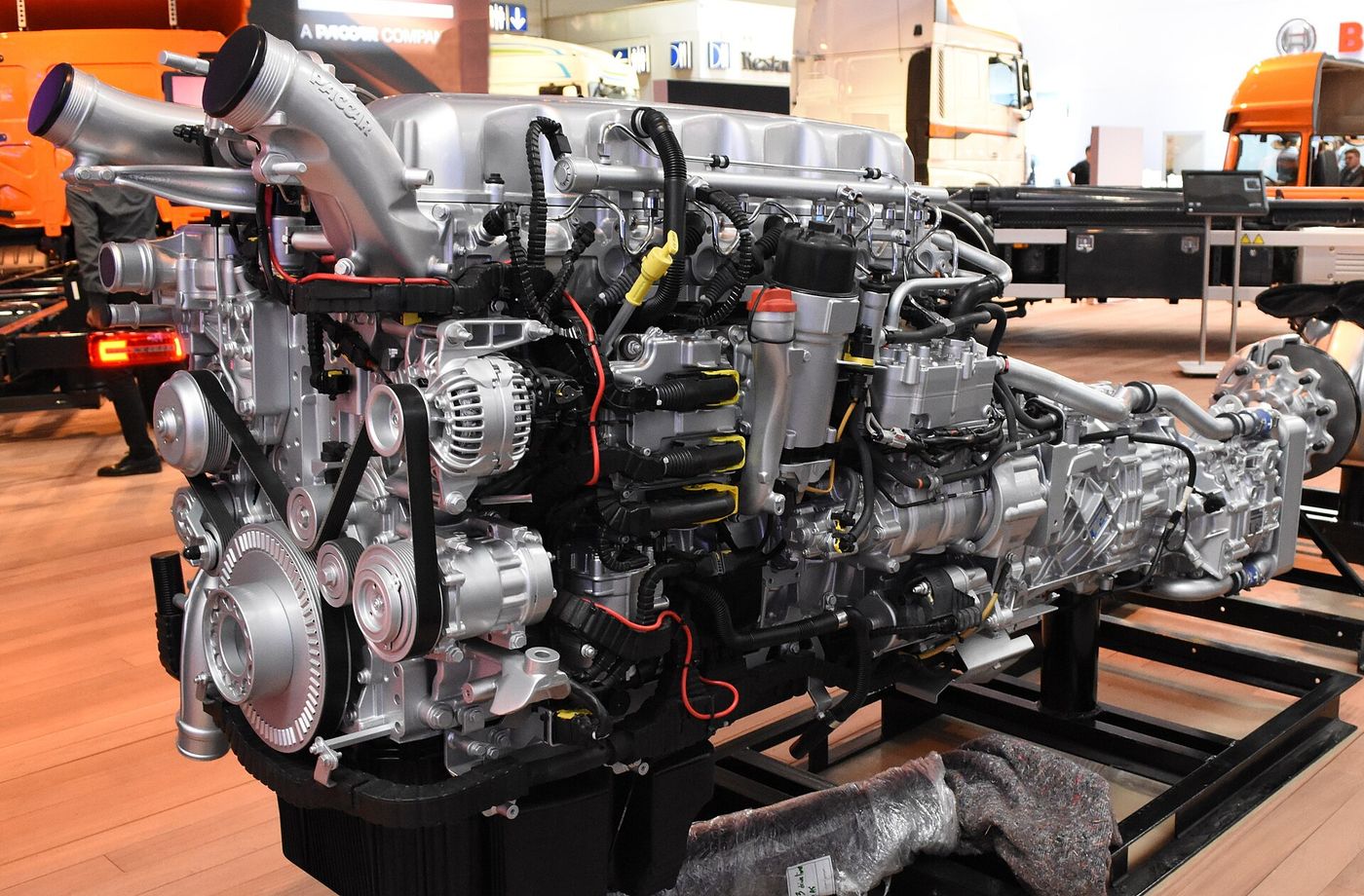
A tractor unit’s specification line reads something like “390 kW / 530 hp, 2,600 Nm”. Three numbers, two of which are the same number, and none of which tells you directly how the truck will climb a long motorway gradient at 40 tonnes. They are all useful, but only once you know what each one is measuring and where it was measured.
Two of the three numbers are the same number
Kilowatts and horsepower are the same quantity in different units. In the EU the kilowatt is the legal one: Council Directive 80/181/EEC lists the watt as the unit of power among the legal units, and a figure in any other unit printed beside it is a “supplementary indication”. The legal unit “shall predominate”, and the other figure “shall be expressed in characters no larger than” it. The forms in UN Regulation No 85, the approval standard for engine power, record “Maximum net power: … kW”.
There are also two horsepowers. NIST gives metric horsepower — the PS in MAN’s tables — as 735.4988 W, and the imperial horsepower of 550 ft·lbf/s as 745.6999 W. So 390 kW is 530 metric hp but only 523 imperial hp, a gap of seven that comes from the unit alone (our arithmetic). The makers cited here use the metric one, whatever they call it. Scania prints “560 hp (412 kW)”, Volvo “540 hp (397 kW)”, MAN “471 (640)” under “kW (PS)”, and the 2024 data sheet for a Mercedes Actros L 1845 LS “330kW (449hp)”. Each pair divides out at the metric horsepower, not the imperial one (our arithmetic). MAN UK’s May 2022 sheet calls its 26,000 kg GVW, 640 PS D38 tractor “TGX 26.640”; the 2024 Actros L 1845 LS sheet gives 18,000 kg technically permissible weight and 330 kW (449 hp) (our comparison of name and sheet).
Because “horsepower” names more than one unit, convert everything to kilowatts first when comparing trucks.
Where the figure comes from, and what “net” excludes
Engine power for type approval is net power, and the definition is precise. UN Regulation No 85 defines it as the power obtained on a test bench “at the end of the crankshaft or its equivalent”, with the auxiliaries listed in the regulation’s annexes fitted, “determined under reference atmospheric conditions”. For heavy-duty engines in the EU the measurement runs under Annex XIV of Regulation (EU) No 582/2011, which applies Section 5 of UN Regulation No 85 “with the exceptions specified in this Annex”. Volvo’s UK specification page labels its engine figures “Net output according to: EC 582/2011”.
Two consequences follow. First, the figure is a measured one. The power a manufacturer declares for approval “shall be accepted if it does not differ by more than ± 2 per cent for maximum power” from what the technical service measures. On the bench, the auxiliaries the engine needs to run are fitted, while accessories “necessary only for operation of the vehicle and which may be mounted on the engine” — the regulation’s examples include the brake air compressor and the air-conditioning system — “shall be removed”. Where such accessories cannot be removed, the power they absorb in the unloaded condition “may be determined and added to the measured engine power”. Second, it is measured at the crankshaft, so the driveline has not taken its cut yet.
Torque is the number; power is arithmetic done to it
Power is not an independent property. Regulation (EU) 2017/2400, Annex VI, point 3.1.1.11, gives power as rotational speed times torque, P = N · T, with N in rad/s, T in Nm and P in W:
P (kW) = T (Nm) × n (rpm) / 9549Converting rpm to rad/s (× 2π/60) and W to kW (/ 1000) gives the 9549 (our arithmetic). The watt is a joule per second (Directive 80/181/EEC).
Which means the two headline numbers are a single curve sampled at two different points. Scania’s 2021 brochure gives its Super 13-litre 560 a maximum torque of 2,800 Nm at 900–1,400 rpm and 412 kW at 1,800 rpm. Run the arithmetic (ours): at 900 rpm those 2,800 Nm are 264 kW. At 1,800 rpm, 412 kW corresponds to 2,186 Nm. Torque is more than a fifth lower there and power more than half as high again, because the revs have doubled.
Makers print where maximum torque is reached, not only how much. Scania gives the Super 13-litre a band. Mercedes gives a single speed, 1,100 rpm, for every one of the ten engine ratings on its Actros L page. Daimler Truck’s April 2022 release on the third-generation OM 471 describes an extended Top Torque range: for the 330 kW and 350 kW ratings with the G281 transmission, “200 Nm torque is available to the crankshaft in gears 7 to 12 in the ‘A Standard’ program”. The release’s examples of when it helps are highway on-ramps and overtaking.
Rated speed
Rated speed is the engine speed printed beside maximum power — the UN Regulation No 85 form asks for “Maximum net power: … kW at … min⁻¹” — and it differs between makers. DAF’s MY2025 infosheet for the PACCAR MX-13, one of the engines in the DAF XG+, gives 1,600 rpm for its 315 and 355 kW ratings and 1,675 rpm for 390 kW. Scania’s brochure gives 1,800 rpm for all four Super 13-litre ratings. MAN UK’s May 2022 sheet for the TGX D38 6×4 tractor gives 1,800 rpm for its 540, 580 and 640 PS versions. Volvo’s UK specification page gives a band instead: maximum power at 1,458–1,700 r/min for the 540 hp D13. By the formula above, the same power at a lower speed means more torque (our arithmetic).
The lighter trucks cited here sit higher. MAN UK’s May 2022 sheet for the 12-tonne MAN TGL rates its D0834 engines at 2,300 rpm; MAN’s TGM and TGL data sheet lists the D0834 as a four-cylinder in-line. Mercedes’ distribution page quotes all seven Atego ratings at 2,200 rpm, four-cylinder and six alike, with maximum torque at 1,200–1,600 rpm.
Scania presents torque at low engine speed as a fuel strategy. Its Super brochure calls the engine “the latest step in our low-rev philosophy”. It says the engine delivers maximum torque at a lower engine rpm, “resulting in optimal fuel efficiency”. That is the maker’s claim.
The legal floor: 5 kW per tonne
There is a statutory minimum. Commission Implementing Regulation (EU) 2021/535, Annex XIII, Part 2, Section D, covers vehicles of categories N2 and N3. It requires them to “provide an engine power output of at least 5 kW per tonne of the technically permissible maximum laden mass of the combination”. At a 40-tonne combination mass that is 200 kW; at 44 tonnes, 220 kW (our arithmetic). “A road tractor, or a tractor unit for semi-trailer intended for the transport of indivisible loads” needs “at least 2 kW per tonne”. Neither figure applies to the electric-only driving mode of hybrid electric vehicles. The same section requires vehicles designed to tow a trailer, laden to that combination mass, to be “capable of starting five times within five minutes at an up-hill gradient of at least 12 %”.
Regulation (EU) No 1230/2012 set the same 5 and 2 kW per tonne until Regulation (EU) 2019/2144 repealed it with effect from 6 July 2022. From that date, the requirement has been in the 2021/535 annex.
The lowest rating on MAN’s TGX specifications page, the 9.0-litre D15 at 243 kW, is above the 200 kW floor for 40 tonnes. At the top of the ranges cited here, the 16-litre V8 in the Scania S-series runs to 566 kW. MAN’s D38 runs to 471 kW, and Mercedes’ OM 473 in the Actros L to 460 kW with 3,000 Nm.
What the power figure cannot tell you
It cannot tell you fuel consumption. Regulation (EU) 2017/2400 applies to medium lorries, heavy lorries and heavy buses, and not to off-road or special-purpose vehicles. Under it the manufacturer “shall determine the CO2 emissions and fuel consumption of each new vehicle”, to be “sold, registered or put into service in the Union”, with exceptions for certain vehicle technologies. It does so with the Commission’s VECTO simulation tool. The tool’s input data cover the engines, transmissions, axles, air drag and tyres, among other components. The obligation first applied from 1 January 2019, to vehicles in groups 4, 5, 9 and 10 produced from that date: 4×2 lorries and tractors over 16 tonnes, and 6×2 lorries and tractors. The result belongs to the vehicle as specified, not to the engine.
Nor does the engine rating tell you the gradient a truck can start on at your gross weight. MAN UK prints that per driveline: its May 2022 D38 6×4 tractor sheet gives, “at 44000 kg”, a “Starting Grade” of “33%+” for each engine with its gearbox and 3.08:1 axle. If a hill is the reason you are specifying the truck, that driveline starting-grade figure is the one to ask for.
The kW to hp converter and the Nm to lb-ft converter convert between the units in which makers print power and torque.
Quick answers
- What is the difference between kW, PS and bhp on a truck?
- Kilowatts and horsepower measure the same quantity. In the EU the watt is the legal unit of power under Directive 80/181/EEC, and a horsepower figure beside it is a supplementary indication. NIST gives the metric horsepower (the PS) as 735.4988 W and the imperial horsepower of 550 ft·lbf/s as 745.6999 W, so 390 kW is 530 metric hp but 523 imperial hp (our arithmetic). Because "horsepower" names more than one unit, the kilowatt figure is the one to compare.
- What is the difference between torque and power?
- Regulation (EU) 2017/2400, Annex VI, gives power as rotational speed times torque, P = N · T, with N in rad/s, T in Nm and P in W. Converting rpm to rad/s and W to kW gives P (kW) = T (Nm) × n (rpm) / 9549, where 9549 is 60,000 divided by 2π (our arithmetic). Power is the rate at which work is done; Directive 80/181/EEC defines the watt as a joule per second. Scania's 2021 brochure gives its Super 13-litre 560 as 2,800 Nm at 900–1,400 rpm and 412 kW at 1,800 rpm. By our arithmetic that is 264 kW at 900 rpm, and 2,186 Nm at 1,800 rpm.
- What minimum engine power does EU type-approval law require of a truck?
- Under Commission Implementing Regulation (EU) 2021/535, Annex XIII, N2 and N3 vehicles 'shall provide an engine power output of at least 5 kW per tonne' of the technically permissible maximum laden mass of the combination. That is 200 kW at 40 tonnes and 220 kW at 44 tonnes (our arithmetic). A road tractor, or a tractor unit for semi-trailer intended for the transport of indivisible loads, needs 'at least 2 kW per tonne'. Neither figure applies to the electric-only driving mode of hybrid electric vehicles. The rule was carried over from Regulation (EU) No 1230/2012, Annex I Part C points 5.1–5.1.1, repealed from 6 July 2022.
- Does the power figure tell you fuel consumption?
- No. Regulation (EU) 2017/2400 applies to medium lorries, heavy lorries and heavy buses, and not to off-road or special-purpose vehicles. Under it the manufacturer determines the CO2 emissions and fuel consumption of each new vehicle, with some exceptions, using the Commission's VECTO simulation tool. Its input data cover the engine, transmission, axles, air drag and tyres among other components. The obligation first applied from 1 January 2019, to 4×2 and 6×2 lorries and tractors in vehicle groups 4, 5, 9 and 10 produced from that date. The result belongs to the vehicle as specified, not to the engine.
Models in this article
Sources
- UN Regulation No 85 — approval of internal combustion engines or electric drive trains with regard to the measurement of net power (text incorporating Supplement 6 to the original version, OJ L 323, 7.11.2014) — EUR-Lex, Publications Office of the European Union
- Commission Implementing Regulation (EU) 2021/535 — Annex XIII, masses and dimensions (consolidated text, 1 January 2025) — EUR-Lex, Publications Office of the European Union
- Regulation (EU) 2019/2144 — Article 18 (repeal of Regulation (EU) No 1230/2012) and Article 19 (date of application) — EUR-Lex, Publications Office of the European Union
- Commission Regulation (EU) No 1230/2012 — Annex I, Part C, points 5.1–5.1.1 (as adopted; repealed with effect from 6 July 2022) — EUR-Lex, Publications Office of the European Union
- Council Directive 80/181/EEC on units of measurement (consolidated text, 13 June 2020) — EUR-Lex, Publications Office of the European Union
- NIST Guide to the SI, Appendix B.8 — factors for units listed alphabetically (horsepower) — National Institute of Standards and Technology
- Commission Regulation (EU) No 582/2011 — Annex XIV, measurement of net engine power (consolidated text, 12 March 2026) — EUR-Lex, Publications Office of the European Union
- Commission Regulation (EU) 2017/2400 on the determination of the CO2 emissions and fuel consumption of heavy-duty vehicles — Articles 2, 9 and 12, and Annex VI, point 3.1.1.11 (consolidated text, 1 January 2026) — EUR-Lex, Publications Office of the European Union
- Commission Regulation (EU) 2017/2400 as adopted — Article 24 (first dates of application) and Annex I, Table 1 (vehicle groups) — EUR-Lex, Publications Office of the European Union
- Lorries, buses and coaches — VECTO and CO2 certification of heavy-duty vehicles — European Commission — Climate Action
- Super powertrain — 13-litre engine range — Scania
- Scania Super 13-litre engine (brochure, Edition 2021.10) — Scania
- The Scania V8 Range (brochure, Edition 2025.02) — Scania
- Actros L — technical data and model overview — Mercedes-Benz Trucks
- Technical data — Actros L 1845 LS 4x2 (BM 96340312) — Mercedes-Benz
- Full power – even more efficiency: third generation of the OM 471 (press release, 7 April 2022) — Daimler Truck
- The Atego for distribution — model overview and engine performance data — Mercedes-Benz Trucks
- MAN TGX — specifications — MAN Truck & Bus
- TGX D38 6x4 tractor — chassis specification (MAN TGX D38 6x4TRAC / 09, May 2022) — MAN Truck & Bus UK
- TGL 12 tonne 4x2 rigid — chassis specification (MAN TGL 12T4X2RIG / 11, May 2022) — MAN Truck & Bus UK
- MAN TGM & MAN TGL — specifications data sheet — MAN Truck & Bus
- PACCAR MX-13 engines (infosheet, MY2025) — DAF Components
- Volvo FH specifications — engines — Volvo Trucks UK