Mercedes-Benz
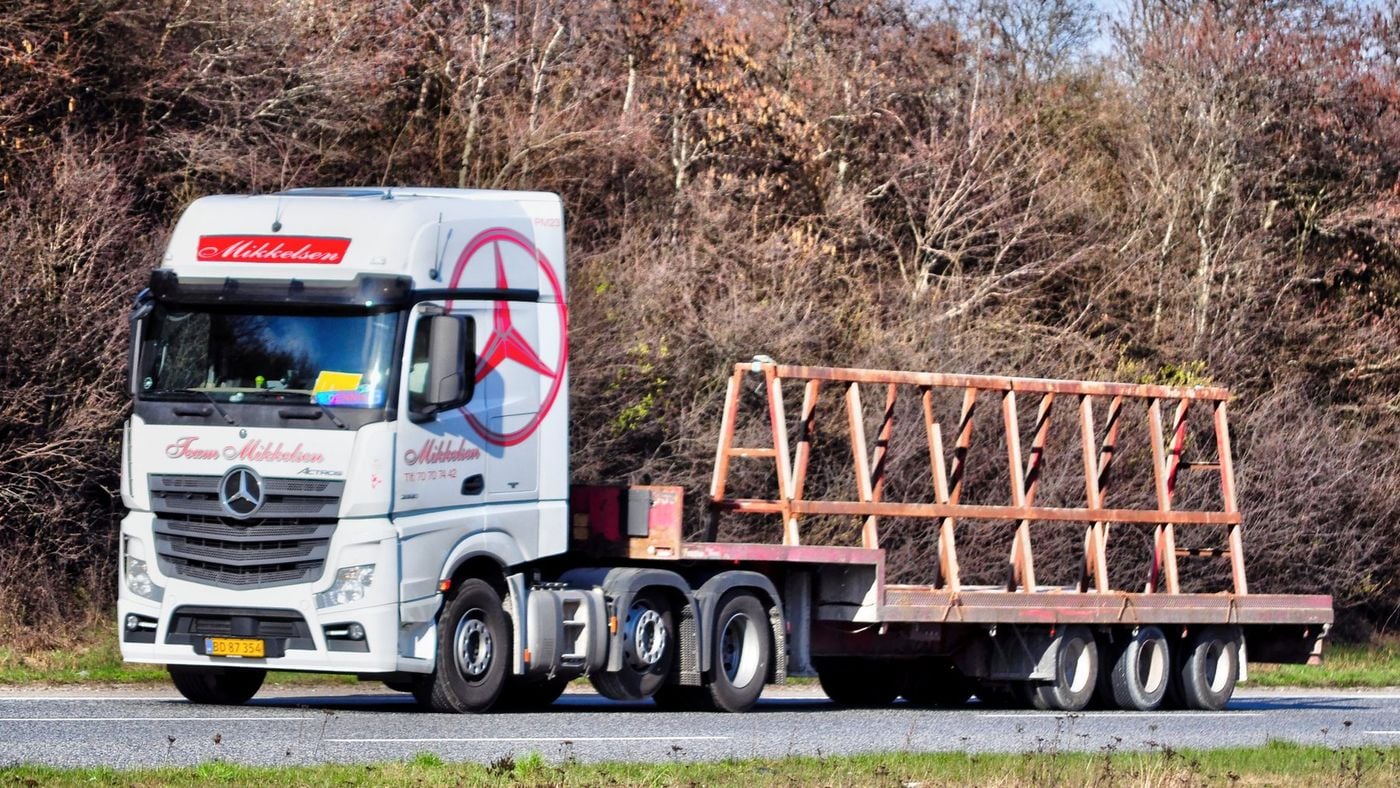
Mercedes-Benz Actros L
The Actros L is the Mercedes-Benz long-haul flagship, with OM 470, OM 471 and OM 473 engines from 265 to 460 kW and the ProCabin since December 2024.
- 2021—
- 7 configurations
- 265–460 kW
- Euro 6e
DSC_4000_Balancer_(23544658978).jpg)
Model overview
- Segment
- Long-haul tractor
- Produced
- 2021—
- Axle configurations
- 7 (4×2…)
- Emission
- Euro 6e (Euro VI-E)
- Transmission
- Mercedes-Benz Powerliner generation, non-synchronised automated manual: 12-speed G 211-12/G 230-12 (OM 470, moderate applications) or G 291-12/G 340-12 (moderate and heavy applications), and 16-speed G 280-16, with a turbo retarder clutch as G 280-16 TRC (heaviest applications).
- Gross combination
- 44 t (Actros L 1845 LS 4x2 tractor)
Axle configurations: 4×2 · 6×2/2 VLA · 6×2/4 NLA · 6×2/4 VLA · 6×2 ENA · 6×2 DNA · 6×4
Engine families
- Power
- 265–335 kW
- Torque
- 1800–2200 Nm
- Rated speed
- 1500 rpm
- Power
- 310–400 kW
- Torque
- 2200–2800 Nm
- Rated speed
- 1500 rpm
- Power
- 380–460 kW
- Torque
- 2600–3000 Nm
- Rated speed
- 1600 rpm
| Cab | Engine tunnel (mm) | Width (mm) | Length (mm) | Standing height (mm) | In front of the seats (mm) |
|---|---|---|---|---|---|
| ProCabin Stream | flat floor | 2,500 | 2,395 | 1,970 | 1,830 |
| ProCabin Big | flat floor | 2,500 | 2,395 | 1,990 | 1,910 |
| ProCabin Giga | flat floor | 2,500 | 2,395 | 2,130 | 2,050 |
| StreamSpace L-Cab | 2,500 | 2,300 | 1,970 | 1,830 | |
| BigSpace L-Cab | 2,500 | 2,300 | 1,990 | 1,910 | |
| GigaSpace L-Cab | 2,500 | 2,300 | 2,130 | 2,050 |
The Actros L is the top of the Mercedes-Benz heavy truck range: the long-haul flagship, sold with a conventional diesel powertrain since Mercedes-Benz Trucks opened Europe-wide ordering on 1 July 2021, with production starting in November 2021. Mercedes-Benz Trucks describes it as the largest and most-equipped model of the series at that launch. It is the premium specification of the Actros rather than a separate model, distinguished mainly by its cab and its aerodynamics.
Overview and generations
Mercedes-Benz Trucks opened orders for a reworked Actros L on the same underpinnings in April 2024. Its new cab, ProCabin, had first been shown on the battery-electric eActros 600 at that truck’s world premiere in October 2023. Series production of the ProCabin Actros L began in December 2024, and the first customer vehicle — an Actros L 1848 LS 4×2 in crystal green metallic — left the Mercedes-Benz plant in Wörth am Rhein shortly afterwards.
ProCabin extends the front of the cab by 80 millimetres; Mercedes-Benz Trucks attributes up to 3% of the fuel saving on the ProCabin Actros L to the aerodynamic changes this and other measures bring. The generational step also carries a newer set of assistance systems: comparing Mercedes-Benz Trucks’ 2021 launch materials with its current ProCabin materials shows the 2021 truck’s standard-fit Active Brake Assist 5 and optional Active Drive Assist 2 and Sideguard Assist (S1X) against Active Brake Assist 6, Active Sideguard Assist 2 and Active Drive Assist 3 on the ProCabin truck — described section by section below.
Mercedes-Benz Trucks’ Powerliner materials, current at the time of writing, compare a Powerliner-generation Actros L 4×2 LS (type 1850) against “a similarly equipped predecessor vehicle as type 1851 with a 3rd generation OM 471 engine”, which places the Powerliner drivetrain as the Actros L’s current engine, transmission and axle generation, succeeding the third-generation OM 471 introduced in 2022. Mercedes-Benz Trucks also lists the Actros L among the vehicles offered as a special edition marking Daimler Truck’s 130th anniversary in 2026.
The cab
The Actros L’s L-Cab is offered in three sizes — StreamSpace, BigSpace and GigaSpace — all 2,500 mm wide with a flat floor (Mercedes-Benz Trucks attributes this to the cab’s lack of an engine tunnel). Mercedes-Benz Trucks’ technical data gives each an exterior length of 2,300 mm and a different standing height:
| L-Cab | Headroom between the seats | Headroom in front of the seats |
|---|---|---|
| GigaSpace | 2,130 mm | 2,050 mm |
| BigSpace | 1,990 mm | 1,910 mm |
| StreamSpace | 1,970 mm | 1,830 mm |
ProCabin, available in these same three sizes, extends the front of the cab by 80 mm over the pre-ProCabin cab and adds a pre-spoiler ahead of the roof spoiler, A-pillar deflector panels, a flatter front-end flap, a revised bumper with smaller cooling air inlets, new underbody paneling, a more streamlined entrance, improved wheel-arch and side trim, and side deflectors shaped to bridge the gap to the semitrailer; the cab’s exterior is fully painted, including the star and lettering finished in dark chrome, with aluminium step plates. All exterior lights — main headlamps, turn signals, and side and rear lights — use LED technology as standard, with matrix LED headlamps optional. Mercedes-Benz Trucks attributes up to 3% fuel saving to the ProCabin’s aerodynamic package as a whole.
Engines
“Actros L” does not describe one powertrain: Mercedes-Benz Trucks sells it with three engine families, each offered at several power ratings. Across all three, peak torque arrives at 1,100 rpm, and every rating meets the Euro 6e emissions standard.
| Family | Displacement | Rated speed | Power | Torque |
|---|---|---|---|---|
| OM 470 | 10.7 l | 1,500 rpm | 265 / 300 / 335 kW | 1,800 / 2,000 / 2,200 Nm |
| OM 471 | 12.8 l | 1,500 rpm | 310 / 330 / 365 / 400 kW | 2,200 / 2,500 / 2,650 / 2,800 Nm |
| OM 473 | 15.6 l | 1,600 rpm | 380 / 425 / 460 kW | 2,600 / 2,800 / 3,000 Nm |
Mercedes-Benz Trucks’ data sheet for one specific configuration, the Actros L 1845 LS 4×2 (BM 96340312), records an OM 471 rated at 330 kW (449 hp) with 2,200 Nm, meeting Euro VI, E.
Mercedes-Benz Trucks introduced a third generation of the OM 471 in April 2022, available to order from then and available from October 2022, crediting it with a further reduction in fuel consumption of up to 4 percent at the lower and medium performance levels and up to 3.5 percent at the upper ones, a newly developed exhaust-gas aftertreatment system, and turbochargers built to order in a fuel-consumption- or performance-optimised variant. The current Powerliner engine generation, which Mercedes-Benz Trucks ties directly to the Actros L, is credited with a further reduction of up to 4% against that third-generation OM 471, through a new injection system, in-house-developed turbochargers and an optimised oil circuit; Mercedes-Benz Trucks states this drivetrain is designed to meet Euro 6e over its service life and is certified for CO₂-neutral EN 15940 XtL fuel. The 2022 OM 471 introduction describes an extended Top Torque range, available for the 330 kW (450 hp) and 350 kW (476 hp) output levels paired with the G281 transmission — a pre-ProCabin gearbox, per the current Actros L page’s own footnotes — delivering a further 200 Nm in gears 7 to 12, described as “power at the press of a button” for extra performance when needed, for example on highway on-ramps or when overtaking.
Transmission
Mercedes-Benz Trucks’ Powerliner materials describe a portfolio of non-synchronised automated manual transmissions built around the Actros L’s engine range, giving for each its ratio spread and an “R1” ratio — R1 being the first reverse gear in Daimler Truck’s operator’s manual for the Actros and Arocs:
- G 211-12 / G 230-12 — 12-speed, wide ratio spread, “best fit for OM 470 and moderate applications”; direct-drive G 211-12 runs 14.93–1.0 (R1 14.93), overdrive G 230-12 runs 11.67–0.78 (R1 11.67).
- G 291-12 / G 340-12 — 12-speed, extra-wide ratio spread, for “moderate and heavy applications”; direct-drive G 291-12 runs 16.46–1.0 (R1 18.25), overdrive G 340-12 runs 12.79–0.78 (R1 14.18).
- G 280-16 / G 280-16 TRC — 16-speed, extra-wide ratio spread, for particularly heavy applications and engine-driven power take-offs; the TRC variant adds a turbo retarder clutch. Overdrive G 280-16 runs 11.72–0.69 (R1 10.66).
For typical long-haul use, Mercedes-Benz Trucks recommends the long rear-axle ratio i = 2.278 paired with the OM 471 and G 291 transmission, citing lower engine speed at cruising speed for reduced fuel consumption and noise. The ProCabin press materials separately describe an “optimized powertrain” option combining the G 291-12 transmission with a “RAR 2.278d” rear axle, which Mercedes-Benz Trucks says improves acceleration on inclines and at low manoeuvring speeds and gives a quieter ride at 80 km/h through reduced engine speed. Mercedes-Benz Trucks’ data sheet for the Actros L 1845 LS 4×2 records that specific vehicle’s clutch as a single-disc unit, its transmission as G 211-12/14.93-1.0, and its final drive (axle) ratio as i = 2.412.
Heavy-haulage Actros L variants add a turbo retarder clutch that Mercedes-Benz Trucks describes as operating “permanently, temperature-stable and almost completely wear-free” for manoeuvring, moving the truck hydraulically forwards and backwards or holding it stationary under heavy load without engaging the service brake, and offer three switchable driving programmes — ECO, HEAVY and MANUAL.
Axles, suspension and brakes
The standard Actros L range is offered in seven axle configurations, each with Mercedes-Benz Trucks’ own technical description:
- 4×2 — two-axle vehicle with a driven rear axle and differential lock.
- 6×2/2 VLA — three-axle vehicle with a rigid leading axle (17.5” or 22.5” tyres) and a driven rear axle with differential lock.
- 6×2/4 NLA — three-axle vehicle with a driven rear axle with differential lock and a second rear axle as a steered trailing axle.
- 6×2/4 VLA — three-axle vehicle with a steered leading axle, driven rear axle and differential lock.
- 6×2 ENA — three-axle vehicle with a driven rear axle with differential lock and a single-tyred, rigid trailing axle.
- 6×2 DNA — three-axle vehicle with a rigid leading axle (17.5” or 22.5” tyres) and a driven rear axle with differential lock.
- 6×4 — three-axle vehicle with two driven rear axles, a longitudinal lock and two transverse locks.
The heavy-haulage range above this adds two further configurations: a 6×4 with two driven rear axles (longitudinal lock and two transverse locks), and an 8×4/4 VLA four-axle vehicle that adds a steered leading axle — Mercedes-Benz Trucks notes the latter is fitted by installing an axle from Custom Tailored Trucks (CTT). These variants are rated to a gross combination weight of up to 180, 250 or 500 tonnes depending on coupling. A reinforced front trailer bracket carries a register coupling as standard, with an optional Rockinger heavy-duty coupling approved to a gross train weight of 500 t at low speed; a separate heavy-duty coupling at the rear is rated to a gross vehicle weight of up to 500 t, and a heavy-duty sliding device lets the fifth-wheel coupling position be adjusted to different axle-load distributions.
Mercedes-Benz Trucks’ data sheet for the Actros L 1845 LS 4×2 (BM 96340312) gives, for that configuration: a front axle rated at 8.0 t on a two-leaf front spring, a rear axle rated at 13.0 t with a hypoid crown wheel (440) on air suspension, disc brakes on both axles, an electronic braking system with ABS and ASR, a “High Performance Engine Brake” as the retarding system, and single-circuit steering. Its tyres are 315/70 R 22.5 on 15-degree tapered 9.00 x 22.5 rims, both axles. Its frame is described as high-strength with continuous U-section side members of constant web height on a 50 x 50 mm hole pattern, with a frame track at the rear of 834 mm.
Dimensions and weights
Mercedes-Benz Trucks’ data sheet for the Actros L 1845 LS 4×2 (BM 96340312), fitted with the BigSpace L-Cab, gives a wheelbase of 3,850 mm and a frame (rear) overhang of 1,050 mm. It records a total height including air intake of 3,990 mm, a turning circle of 15.30 m, front and rear ground clearance of 227 mm and 215 mm, frame height at the front of 904 mm laden / 983 mm unladen, and frame height at the rear of 922 mm laden / 957 mm unladen; the rear axle’s extent of lift/sinking is given as 180 mm up and 60 mm down, the same in the sheet’s laden and unladen columns.
For the same configuration, Mercedes-Benz Trucks’ data sheet gives technically permissible axle weights of 8,000 kg (front) and 11,500 kg (rear), for a technically permissible gross vehicle weight of 18,000 kg; a kerb weight (ready-to-drive condition per European Directive 97/27/EC) of 5,639 kg front / 2,723 kg rear, totalling 8,362 kg; and a payload/fifth-wheel load that the sheet totals at 9,638 kg — the technically permissible weight less the kerb weight. Its gross combination weight is 44,000 kg. Body-and-payload centre of gravity is given as a range of 344–943 mm ahead of the rearmost axle.
Tanks
Mercedes-Benz Trucks’ data sheet for the Actros L 1845 LS 4×2 (BM 96340312) gives a main fuel tank of 850 l plus a 120 l AdBlue tank, mounted on the left side, measuring 735 x 700 x 2,305 mm, in aluminium, with a step integrated into the tank.
Safety and driver-assistance systems
At the 2021 launch, Mercedes-Benz Trucks fitted the Actros L as standard with Active Brake Assist 5, an emergency braking system using combined radar and camera detection that issues a visual and audible warning, then partial braking, and — for moving persons — can perform automated full-stop braking at speeds up to 50 km/h. MirrorCam, replacing the main and wide-angle mirrors, and Lane Keeping Assist and Proximity Control Assist were part of the same launch. Optional systems included the Active Sideguard Assist S1X, which warns of pedestrians or cyclists on the co-driver’s side and, if the driver does not react, can brake the truck to a standstill at turning speeds of up to 20 km/h, and the second-generation Active Drive Assist (ADA 2), which assists longitudinal and lateral guidance under set conditions and includes an Emergency Stop Assist sub-function that can bring the truck to a stop — engaging the electronic parking brake and unlocking the doors — if the driver stops steering despite warnings.
With the ProCabin generation from December 2024, Mercedes-Benz Trucks describes a sixth generation of Active Brake Assist (ABA 6) using 270-degree sensor-fusion technology, able to perform automated full-stop braking up to 60 km/h ahead of crossing or oncoming traffic or other road users in the same lane, and up to 80 km/h ahead of a stationary vehicle, with multi-lane monitoring to 250 m. The current ProCabin materials describe a further-enhanced Active Brake Assist 6 Plus, built on the same 270-degree fusion technology, with improved pedestrian and cyclist detection and curve response, performing automated full-stop braking at speeds up to 90 km/h; on the heavy-haulage range, special equipment S2J can disable the system’s deactivation option. The second-generation Active Sideguard Assist (ASGA 2), introduced with the ProCabin in December 2024, uses six sensors to monitor both sides of the vehicle, with a two-stage warning covering up to 30 m behind and 7 m ahead of the truck at speeds up to 30 km/h, and can brake the vehicle to a stop within its own turning speed of 20 km/h if the driver does not respond; it also carries a lane-change warning based on the vehicle’s position in its lane. At IAA Transportation 2026, Mercedes-Benz Trucks announced a third generation, Active Sideguard Assist 3, described as completing the turning-assistance support on both sides of the vehicle and, for the first time, adding a function for turns across the driver’s side with automated braking support. Active Drive Assist 3 (ADA 3), a further generation of semi-automated driving (SAE Level 2) available in production Mercedes-Benz trucks since 2018, further improves longitudinal and lateral guidance; at IAA Transportation 2026, Mercedes-Benz Trucks announced an enhanced ADA 3 across all Mercedes-Benz Actros with a rapid steering-assistance deactivation button on the steering wheel, storage of individual driver settings, and an enhanced active lane-centering function. Predictive Powertrain Control (PPC), the cruise-control and transmission-control system, automatically accounts for topography, road layout and traffic signs; from April 2025, Mercedes-Benz Trucks added route information from the navigation system to it. Front Guard Assist and Attention Assist are also named among the Actros L’s current assistance systems.
From February 2026, Mercedes-Benz Trucks says its lineup is being extended with systems meeting the EU General Safety Regulation requirements that take effect in July 2026 and September 2028: a next-generation Attention Assist 2 uses an integrated infrared camera from 20 km/h to track the driver’s pupil position and calculate their line of sight, warning if attention strays from the road, while retaining fatigue monitoring based on lane-keeping, driver activity and steering behaviour.
On the heavy-haulage range, Mercedes-Benz Trucks also lists Active Cross Traffic Assist, using the same 270-degree camera-and-radar sensor fusion at the front, corners and sides to detect crossing vehicles at speeds up to 120 km/h, issuing a visual and audible warning with partial braking and, if the driver does not react, automated full braking.
The Multimedia Cockpit forms the centrepiece of the driver interface; the current Multimedia Cockpit Interactive 2, in the ProCabin, has a 12-inch instrument display and an enlarged touchscreen. Mercedes-Benz Trucks says that from April 2025 it gained a revised menu, voice control, further connectivity and new applications such as Connected Traffic Warnings; per the current Actros L ProCabin materials, it also has a favourites menu with direct access to functions such as installed power take-offs. In the 2021 Actros L, the Multimedia Cockpit could optionally display the combined weight of the towing vehicle and trailer, and the front-axle load, including on semitrailer tractors with only partial air suspension.
Equipment and options
The ProCabin interior — available in Stream, Big or Giga size, as above — adds improved seat heating, premium flat-woven seat covers, beds with full slatted frames and a new, thicker premium mattress (the pre-ProCabin cab’s mattress topper was 45 mm thick), expanded functions on the bedside control panels, ambient lighting, gooseneck LED reading lamps, additional USB-C sockets in the side panels, a two-tone curtain, a second refrigerator, a 230-volt socket, and the SoloStar Concept, offered in two additional seat-cover options. Mercedes-Benz Trucks also offers the Actros L as a limited-edition model marking Daimler Truck’s 130th anniversary in 2026.
Mercedes-Benz Trucks’ digital services for the Actros L include TruckLive (connectivity services reachable through My TruckPoint, including Maintenance Management and Live Traffic real-time route planning, free for the first 36 months of registration), Fleetboard’s telematics services, Mercedes-Benz Trucks Uptime (continuous vehicle-status diagnosis with maintenance and repair instructions), over-the-air updates, Service24h Connected, and Connected Traffic Warnings, which detect and share hazard warnings with nearby vehicles. Mercedes-Benz Trucks Complete, an all-inclusive service contract covering workshop work including wear parts, is offered alongside individually bookable service contracts.
On the heavy-haulage range, Mercedes-Benz Trucks offers a choice of long-lasting LED or halogen headlights, with an option of work lights illuminating to the rear, front and sides for loading; two coolers to keep the cooling system thermally stable under sustained heavy load, plus an additional fuel cooler; and inlets in the side panelling for cooling-air supply.
What the operator’s manuals say
Daimler’s 2014 operating instructions for the Actros, Antos and Arocs say that the scope and frequency of maintenance work mainly depends on the operating conditions, which can differ widely.
Daimler Truck’s 2025 operator’s manual for the Actros and Arocs, whose illustrations include the Actros L with and without ProCabin, tells an owner who sells the vehicle to pass on to the new owner the documents it names as integral parts of the vehicle, which include the operator’s manual and, on a truck without digital maintenance documentation, the maintenance booklet. The manual says that with digital maintenance documentation, service and maintenance work that has been performed is confirmed in Daimler Truck’s central database and the owner can obtain a printout, and that without it, the maintenance booklet confirms that all service and maintenance work has been carried out at a qualified specialist workshop. The same manual says that where emission control systems are required by law, the engine must be serviced according to particular specifications using appropriate measuring equipment, and that modifying or tampering with exhaust system components is prohibited.
The manual says that if the vehicle is sold, the buyer must be informed of a changed engine power, and that failing to do so may be a punishable offence under national law. After an output increase, the requirements it lists include having the vehicle recertified and reporting the change to the insurer, and it says that otherwise the vehicle’s general operating permit and its insurance cover are invalidated.
Source notes
ProCabin extends the front of the cab by 80 mm. Maximum torque is reached at 1,100 rpm across the range. Top Torque adds a further 200 Nm in gears 7 to 12, for the 330 kW and 350 kW OM 471 output levels paired with the G281 transmission. Heavy-haulage variants are rated to 180 t, 250 t or 500 t with the optional heavy-duty coupling.
Quick answers
- Which engines are available in the Mercedes-Benz Actros L?
- The record for the Mercedes-Benz Actros L covers these engine families: OM 470 (10.7 l), OM 471 (12.8 l), OM 473 (15.6 l). Output spans 265–460 kW and 1800–3000 Nm.
- What axle configurations does the Mercedes-Benz Actros L come in?
- 4×2, 6×2/2 VLA, 6×2/4 NLA, 6×2/4 VLA, 6×2 ENA, 6×2 DNA, 6×4.
- What emission standard does the Mercedes-Benz Actros L meet?
- Euro 6e (Euro VI-E).
- When did production of the Mercedes-Benz Actros L start?
- Production of the Mercedes-Benz Actros L started in 2021.
- Which transmission does the Mercedes-Benz Actros L use?
- Transmission: Mercedes-Benz Powerliner generation, non-synchronised automated manual: 12-speed G 211-12/G 230-12 (OM 470, moderate applications) or G 291-12/G 340-12 (moderate and heavy applications), and 16-speed G 280-16, with a turbo retarder clutch as G 280-16 TRC (heaviest applications)..
- What is the gross combination weight of the Mercedes-Benz Actros L?
- Gross combination weight: 44 t (Actros L 1845 LS 4x2 tractor).
Mercedes-Benz models on this site, side by side
| Segment | Produced | Axle configurations | Power | Torque | Gross combination | |
|---|---|---|---|---|---|---|
| Mercedes-Benz Actros | Distribution | 1996— | 7 configurations | 175–460 kW | 1000–3000 Nm | |
| Mercedes-Benz Actros L | Long-haul tractor | 2021— | 7 configurations | 265–460 kW | 1800–3000 Nm | 44 t |
| Mercedes-Benz Arocs | Construction | 2013— | 12 configurations | 175–460 kW | 1000–3000 Nm | |
| Mercedes-Benz Atego | Distribution | 2013— | 2 configurations | 115–220 kW | 650–1200 Nm |
Articles that mention the Mercedes-Benz Actros L
More Mercedes-Benz on this site
Sources
- Actros L — technical data and model overview — Mercedes-Benz Trucks
- Mercedes-Benz Actros L ProCabin: focus on aerodynamics, efficiency and driver comfort — Daimler Truck Newsroom
- Technical data — Actros L 1845 LS 4x2 (BM 96340312) — Mercedes-Benz
- Actros L up to 500 t — heavy haulage variants — Mercedes-Benz Trucks
- Actros, Antos, Arocs 963, 964 — Operating Instructions (edition 04-14) — Daimler AG
- Actros/Arocs 963 — Operator's Manual, Multimedia Cockpit (edition 10.2025) — Daimler Truck AG
- Full power – even more efficiency: In 2022, Mercedes-Benz Trucks will be launching the third generation of its OM 471 heavy-duty commercial vehicle engine on the market — Daimler Truck Newsroom
- The Actros L: Mercedes-Benz Trucks sets new standards in the premium segment for long-distance haulage trucks — Daimler Truck Newsroom
- Even more efficiency on the road: the new Actros L from Mercedes-Benz Trucks with its futuristic ProCabin, even better aerodynamics and further optimized assistance systems — Daimler Truck Newsroom
- The new Actros L: first vehicle rolls off the production line at the Mercedes-Benz plant in Wörth — Daimler Truck Newsroom
- Mercedes-Benz Powerliner — engine, transmission and axle generation — Mercedes-Benz Trucks
- IAA Transportation 2026: Daimler Truck celebrates 130 years of trucks and drives transportation forward — Daimler Truck Newsroom
- Actros L with ProCabin - model overview, technical data and cab variants (Mercedes-Benz Trucks International) — Mercedes-Benz Trucks
- The new Actros L ProCabin - product sheet (Daimler Truck AG; PDF title MBT-099-24_ProCabin_Product_Sheet_2024, no printed date) — Mercedes-Benz Trucks