Mercedes-Benz
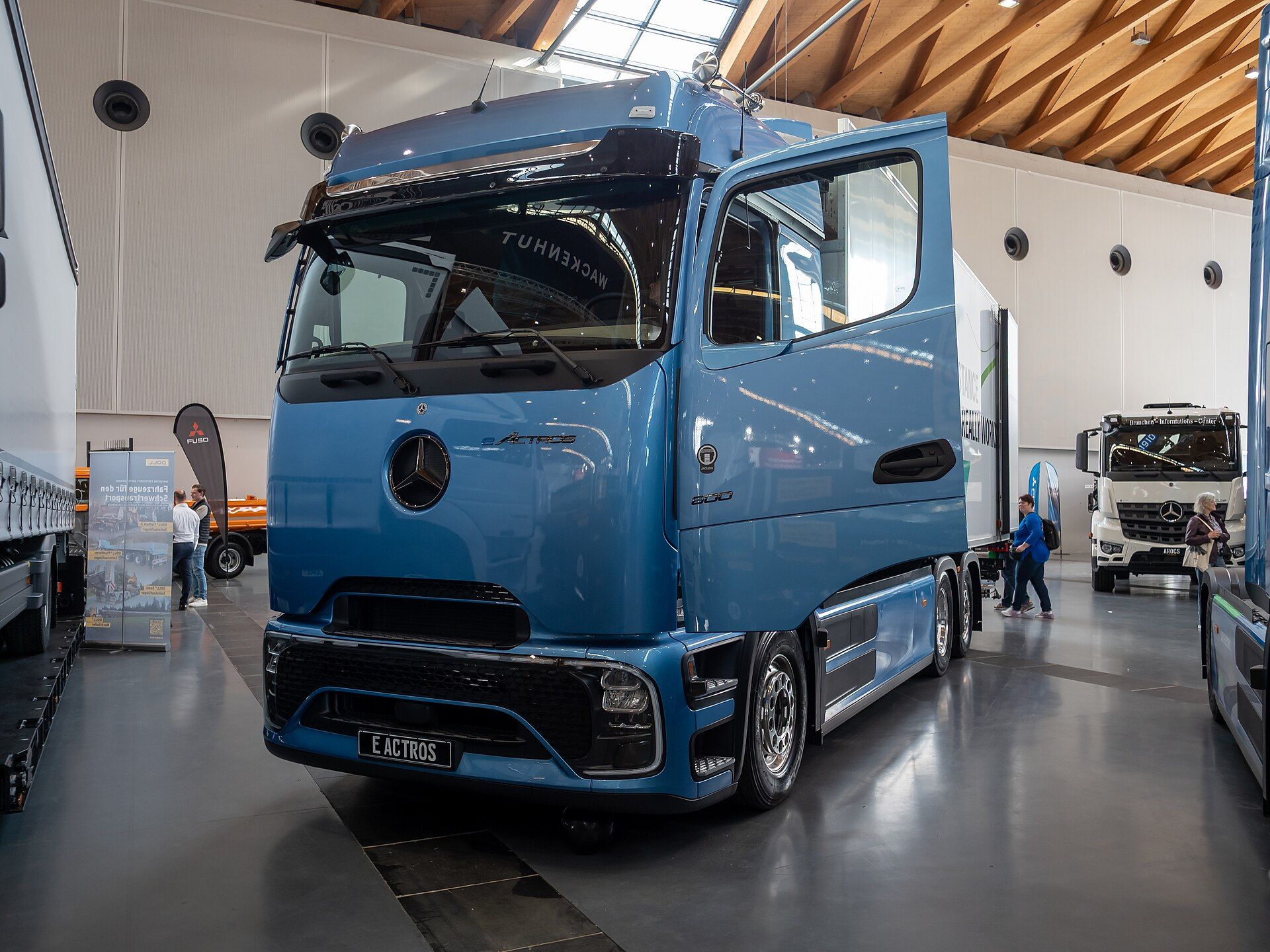
Mercedes-Benz eActros 600
621 kWh installed against 600 kWh usable, a 500 km range figure with its test conditions attached, and what a battery-electric long-haul tractor is really plated for.
.jpg)
Model overview
Axle configurations: 4x2 · 6x2
Installed and usable capacity are published as two separate figures: 621 kWh in three packs of 207 kWh, of which 600 kWh — 200 kWh per pack — is released for normal operation. At the world premiere Daimler Truck put the share as approximately 95 percent of installed capacity usable with LFP technology; 600 of 621 kWh divides to 96.6 percent, which is our arithmetic and appears in neither document. The 500 km range was determined internally under specific test conditions, after preconditioning, with a 4x2 tractor unit at 40 t total towing weight — the sheet's own wording — and 20 °C outside temperature in long-haul operation, and the maker states it may deviate from values determined in accordance with Regulation (EU) 2017/2400. Up to 560 km is quoted separately for the most economical combination with three battery packs in classic long-haul at a gross train weight of 40 t, and that figure carries a weaker footnote: an estimated range derived from internal simulations as well as real driving tests. CCS2 charging takes approximately 60 minutes from 20 to 80 percent with three packs, footnoted as internally determined empirical values under optimal conditions, including 20 °C ambient at a standard DC fast charging station with 500 A charging current; around 70 minutes is quoted over the wider 10 to 80 percent window under the heavy-duty conditions defined in ISO/SAE 12906, with 400 kW charging power and 500 A. Different windows and different bases. The 1000 kW megawatt figure and its 30 minutes rest on internal simulation, on the ground that a binding and uniform MCS standard was under development when the sheet was written. The 4x2 tractor sits on a 4000 mm wheelbase, is plated at 22 t technical gross vehicle weight (9 t front, 13 t rear) and weighs approximately 11.7 t unladen; Mercedes-Benz quotes a payload of around 22 t with a standard semitrailer in the EU. The flatbed chassis is listed at 4600 and 4900 mm, plated at 28 t (9 t front, 13 t rear, 7.5 t third axle), and weighs approximately 13.2 t and 13.4 t unladen respectively. Labelling discrepancy, recorded and not settled: the product sheet heads the 44 t row "technically permissible gross trailer weight" in all three columns, while Daimler Truck's releases call 44 t a gross combination weight the vehicle is technically designed for and say it of the tractor; this record follows the press release and applies it to the 4x2 tractor unit only. Electric and electro-mechanical power take-offs cover 22 to 90 kW. Mercedes-Benz designs the vehicle for up to 1.2 million km in ten years of operation and warrants the high-voltage batteries for a maximum of 72 months, 720,000 km or 1,800 charging cycles, whichever is reached first.
The eActros 600 is the battery-electric long-haul tractor at the top of the Mercedes-Benz range, and the model designation is the specification: the number refers to the battery, not to a power output or a tonnage. Series production started at the Wörth plant at the end of 2024, deliveries to customers began in December 2024, and the truck was voted International Truck of the Year 2025.
This page is the record: the published figures with the conditions they were measured under, the variants and what each one is plated for, and what to ask about on a used one. What those figures mean once the truck is working — the shift, the payload trade, the charging arithmetic against a driver’s break — is argued in the eActros 600 explained, and this page does not argue it a second time.
Two things distinguish the vehicle from the first generation of electric trucks that came before it. It was designed from the start as a long-distance vehicle rather than a distribution truck with extra packs, and its maker publishes a full specification table rather than a marketing summary. That table is the reason this record has as few blanks as it does.
The two battery figures, and why both are printed here
The most useful number on this page is not one number but two. The eActros 600 carries three lithium iron phosphate packs of 207 kWh each, giving 621 kWh installed. What the truck releases for normal operation is 600 kWh, or 200 kWh per pack. Mercedes-Benz publishes both in the product sheet under two separate headings with two separate footnotes: the installed figure is the nominal capacity of a new battery, the usable figure is the capacity available for regular truck operation with new batteries, and both footnotes add that the values rest on internally defined boundary conditions and may vary with use case and ambient conditions.
Almost every secondary source collapses the pair into one. The maker publishes a third thing again — a share rather than a pair. At the world premiere Daimler Truck stated that, in contrast to other battery cell technologies, approximately 95 percent of the installed capacity can be used with LFP technology. That is an approximation, and it is the maker’s. Dividing the two published capacities gives 96.6 percent, which is our arithmetic and appears in neither the product sheet nor the press release: a sharper figure than the one Mercedes-Benz offers, reached by a division the maker never performs. Both belong on the page, and they are not the same kind of statement.
The chemistry choice is also why the packs contain no nickel and no cobalt, and why the durability claim runs as long as it does. Mercedes-Benz designs the vehicle for up to 1.2 million kilometres in ten years of operation and says battery state of health should still be over 80 percent after that; the product sheet puts the same ceiling on the batteries themselves. “Up to” is the maker’s own word and it carries weight — it is the top of a range that includes a great deal less, not a distance the vehicle is engineered to reach. The factory warranty stops well short of that ceiling anyway, at a maximum of 72 months, 720,000 kilometres or 1,800 charging cycles, whichever is reached first, with a warranty case arising if state of health falls below 80 percent under the specified conditions. Those three ceilings are what the used-vehicle section at the foot of this page turns on.
What the 500-kilometre range figure is measuring
The published range is 500 kilometres without intermediate charging, and the footnote attached to it is not decoration. Mercedes-Benz states the figure was determined internally under specific test conditions, after preconditioning, with a 4x2 tractor unit at 40 t total towing weight and an outside temperature of 20 °C in long-haul operation, and that it may deviate from the values determined in accordance with Regulation (EU) 2017/2400. Total towing weight is the sheet’s own phrase, reproduced rather than quietly re-labelled as gross combination weight, for the reason set out under labelling below.
A second range figure sits beside it and is the one most often misread. Up to 560 kilometres is quoted for the most economical combination with three battery packs in classic long-haul at a gross train weight of 40 tonnes. It is not the 500 measured further out. Daimler Truck footnotes the 560 as an estimated range derived from the results of internal simulations as well as real driving tests, where the 500 is an internal determination under stated test conditions — two figures resting on two different kinds of exercise, and not two points on one scale. The maker’s separate claim of significantly more than 1,000 kilometres in a day depends on intermediate charging during the legally prescribed driver breaks; that is a statement about the working day rather than about the battery, and the companion article sets it against the break the law actually gives.
Charging: about an hour today, half an hour on paper
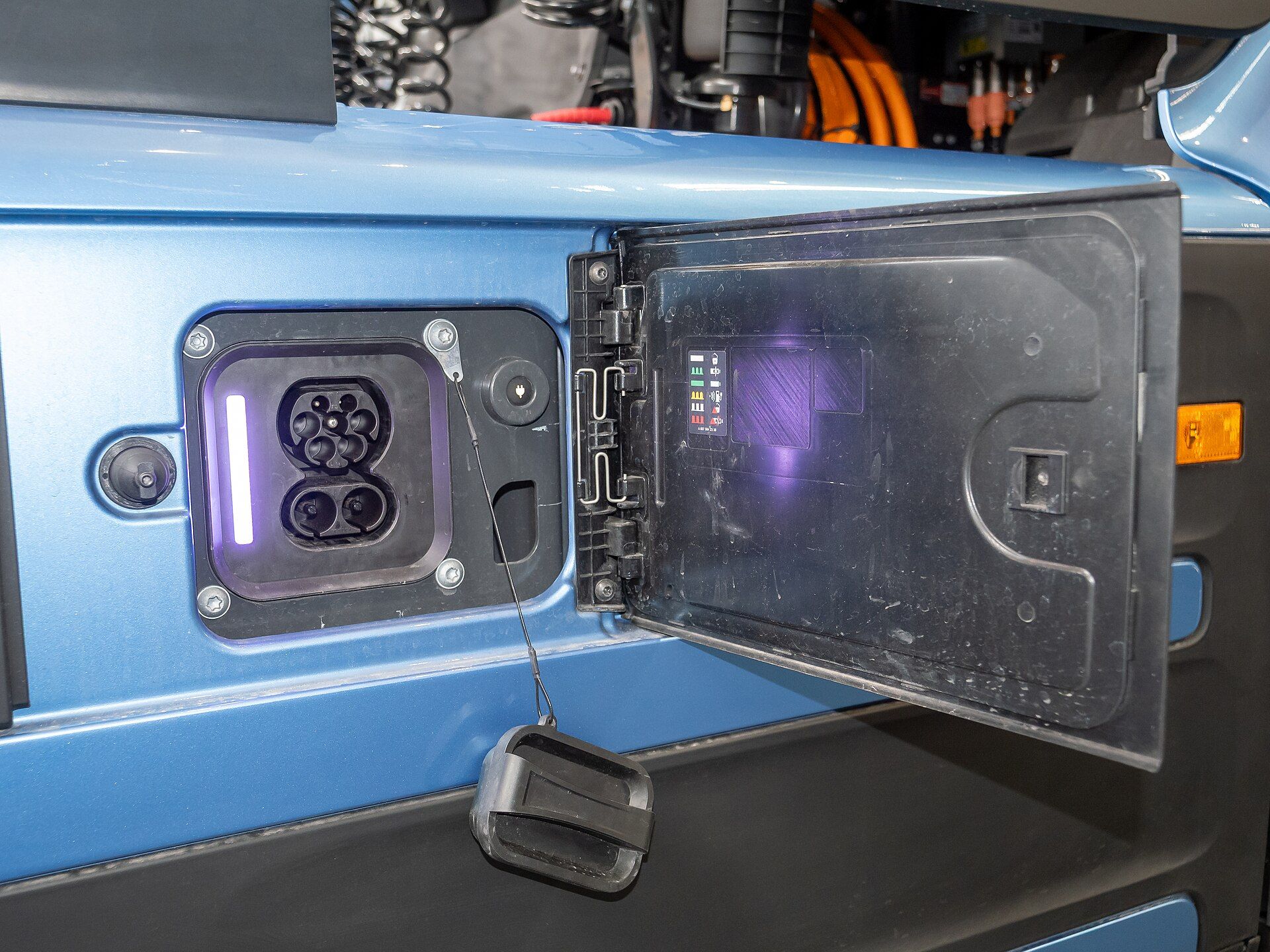
The truck charges over a CCS2 socket on the left side of the vehicle behind the cab at up to 400 kW, and a second socket on the right-hand side can be ordered. Both published CCS2 times come with conditions attached, and they are not the same conditions.
The product sheet gives approximately 60 minutes from 20 to 80 percent with the three packs, and footnotes it as internally determined empirical values under optimal conditions, including an ambient temperature of 20 °C at a standard DC fast charging station with 500 A charging current. “Under optimal conditions” is the maker’s own warning and it is part of the figure, not a gloss on it. The wider 10 to 80 percent window is quoted at around 70 minutes, and that one is footnoted differently again: to the conditions defined for heavy-duty trucks in ISO/SAE 12906, with 400 kW charging power at a standard DC fast-charging station with 500 A. So the two differ in more than the window they cover. One is the maker’s own best case, the other is measured to a published standard, and neither describes what a driver meets at an arbitrary charger on a cold morning.
Megawatt charging is the other half of the story and is not the same kind of fact at all. Mercedes-Benz quotes approximately 30 minutes from 20 to 80 percent at an output of around one megawatt — the product sheet’s charging-power row reads 400 kW for CCS and 1000 kW for MCS — but footnotes it as based on internal simulations, on the ground that a binding and uniform Megawatt Charging System standard was, when the sheet was written, still under development. Where that standard has got to since is set out in megawatt charging explained. This record therefore carries 400 kW over CCS2 as the charging figure and treats the megawatt number as a design target rather than a rating. From the start of sales customers could order a pre-installation, with retrofit planned once the technology is available and standardised across manufacturers.
One axle, two motors, four gears
There is no engine block on this page because there is no engine. Drive comes from an 800-volt electric axle developed in-house, carrying two electric motors and a four-speed transmission. Continuous output is 400 kW and peak output is 600 kW, and the world-premiere release states that the full motor output is available most of the time with almost no interruption in torque — which is the practical difference between four gears behind an e-machine and twelve behind a diesel.
Recuperation is driver-selectable across five levels, one-pedal driving can be enabled from the touchscreen, and Predictive Powertrain Control is tuned for the electric driveline so that topography manages battery energy rather than fuel. Electric and electro-mechanical power take-offs cover 22 to 90 kW, which is what lets a tipping, sliding-floor or silo semi-trailer work without a diesel auxiliary.
Variants, wheelbases and plated weights
The product sheet prints three columns, and they are the record of what the truck is actually sold as. The 4x2 semitrailer tractor is the long-haul vehicle and sits on a 4000 mm wheelbase. The flatbed chassis appears twice, at 4600 and 4900 mm. All three carry three battery packs.
Mercedes-Benz has since said there will be more, and the announcement is narrower than it is usually reported. For the eActros 600 the release names four further wheelbases for the 6x2 platform truck, alongside the 4600 and 4900 mm already available, and a 4x2 platform chassis in future. It does not list the four, so neither does this page, and it says nothing at all about added wheelbases for the tractor. Two axle configurations are therefore in play, 4x2 and 6x2, and the second of them is a rigid rather than a tractor.
On weights, the tractor is technically designed for a gross combination weight of up to 44 tonnes. Its own technical gross vehicle weight is 22 tonnes, split 9 tonnes on the front axle and 13 tonnes on the rear, on full air suspension; unladen it weighs approximately 11.7 tonnes depending on the features. With a standard semitrailer in the EU, Mercedes-Benz quotes a payload of around 22 tonnes and notes that national law may in some cases permit a higher one — a published figure rather than a subtraction from the two before it. The flatbed chassis is plated at 28 tonnes, on the same 9 and 13 tonne axles with 7.5 tonnes on the third, and weighs approximately 13.2 tonnes at 4600 mm and 13.4 tonnes at 4900 mm. The pattern to take from the block is the one that governs every electric tractor: the battery mass lands on the vehicle rather than on the trailer, so the payload question is decided before the load is anywhere near it.
What we could not confirm
Mercedes-Benz publishes no turning circle, no axle ratio, no fifth-wheel height and no tyre specification on any page or document that opened for this record. Those rows are blank here rather than filled from a dealer listing.
One labelling point belongs in the record rather than in an argument. The GB product sheet heads the 44 tonne row “technically permissible gross trailer weight” and prints the same 44 tonnes in all three columns, tractor and chassis alike. Daimler Truck’s releases call 44 tonnes a gross combination weight the vehicle is technically designed for, and say it of the tractor. Same figure, two labels, and nothing published reconciles them. The spec record above follows the press release and applies the gross combination label to the 4x2 tractor unit only; the chassis columns keep the product sheet’s own heading. That records the discrepancy without resolving it, and why the distinction matters as soon as a load is weighed is in truck weights, gross vehicle and gross combination.
Who this truck is right for
The eActros 600 suits a fleet running fixed, repeating long-haul routes with depot charging at one or both ends, because that is the case where the 500 kilometre figure and the driver-break charging pattern line up with something real. It suits operators in countries where zero-emission trucks are given favourable toll treatment, which can be a large enough line to move the whole calculation on its own.
It suits fleets less well where the work is unpredictable, where the truck is away from its own infrastructure for days, or where every kilogram of payload is billable — a three-pack electric tractor gives away payload against a diesel, and Mercedes-Benz answers that specific objection with a two-pack model rather than by arguing the point.
On cost, the maker’s claim is bounded and the bounds are most of what it says. Daimler Truck states that the time to cost parity with a comparable diesel differs from country to country, depending in particular on electricity and diesel prices and on the toll system, and it names France and Germany with a different mechanism in each: a low electricity price and the then-planned CO2-based truck toll respectively. On that basis the release says the eActros 600 can be more profitable than a diesel long-haul truck within an average holding period of around five years or after around 600,000 kilometres, despite a purchase price around two to two and a half times higher than the diesel equivalent. Two named countries, two different mechanisms and two alternative break-even points — and for a long-haul operator the distance one can arrive a good deal earlier than the time one. The German toll was a planned measure when the claim was made; where it has since landed is in EU road tolls and CO2 classes, and the framework for testing the whole claim against your own numbers is in tractor unit running costs.
Where it sits against its rivals
Against the Volvo FH Electric the comparison is the closest one available: both are premium European long-haul tractors from makers that publish real specification blocks, and the decision usually turns on charging strategy and dealer coverage rather than on the vehicles. The MAN eTGX and the DAF XF Electric put the same argument from within the Traton and Paccar groups. Daimler Truck, the TRATON GROUP and the Volvo Group jointly founded Milence to build public charging points, so three of these rivals are partners in the infrastructure all of them need. Against its own diesel sibling, the Actros L, the eActros 600 is a different purchase rather than a better one: the cab and the aerodynamics carry over, the ownership model does not. Who builds what, and under which group, is mapped in who builds trucks in Europe.
What to check on a used one
The battery is the asset, so the questions are about the battery. Ask for the state of health reading and the charging history, and establish where the vehicle sits against the three warranty ceilings — months, kilometres and charging cycles — because whichever is nearest is the one that will expire first. A tractor that has lived on high-power public charging has had a different life from one that charged slowly at a depot overnight, and the record will show it.
Then check the specification against the work. Ask how many packs are fitted: this model is the three-pack vehicle in every product-sheet column, and a two-pack truck wearing similar bodywork is a different proposition on both range and payload. Ask which cab, which wheelbase, and whether the megawatt pre-installation was ordered, since retrofit depends on it. The same general used-truck checks apply as to any tractor of this age — service record, tyres, coupling wear, damage history — with the difference that here the most expensive component has a condition you can read off a screen.
Quick answers
- What axle configurations does the Mercedes-Benz eActros 600 come in?
- 4x2, 6x2.
Compared with
- Volvo FH Electric
- MAN eTGX
- DAF XF Electric
Sources
- The new eActros 600 — product sheet — Mercedes-Benz Trucks
- Mercedes-Benz Trucks celebrates world premiere of the battery electric long-haul truck eActros 600 — Daimler Truck
- Mercedes-Benz Trucks presents the new eActros 400 based on the eActros 600 — numerous new variants available — Daimler Truck
- Mercedes-Benz Trucks expands portfolio of battery-electric trucks based on the eActros 600 — Daimler Truck
- eActros — model overview — Mercedes-Benz Trucks