Electric trucks and tractor units explained: how they work, what makers declare, where they charge
How battery-electric trucks are built, what installed and usable kWh and range footnotes mean, where they charge, and the EU market figures and rules behind them.
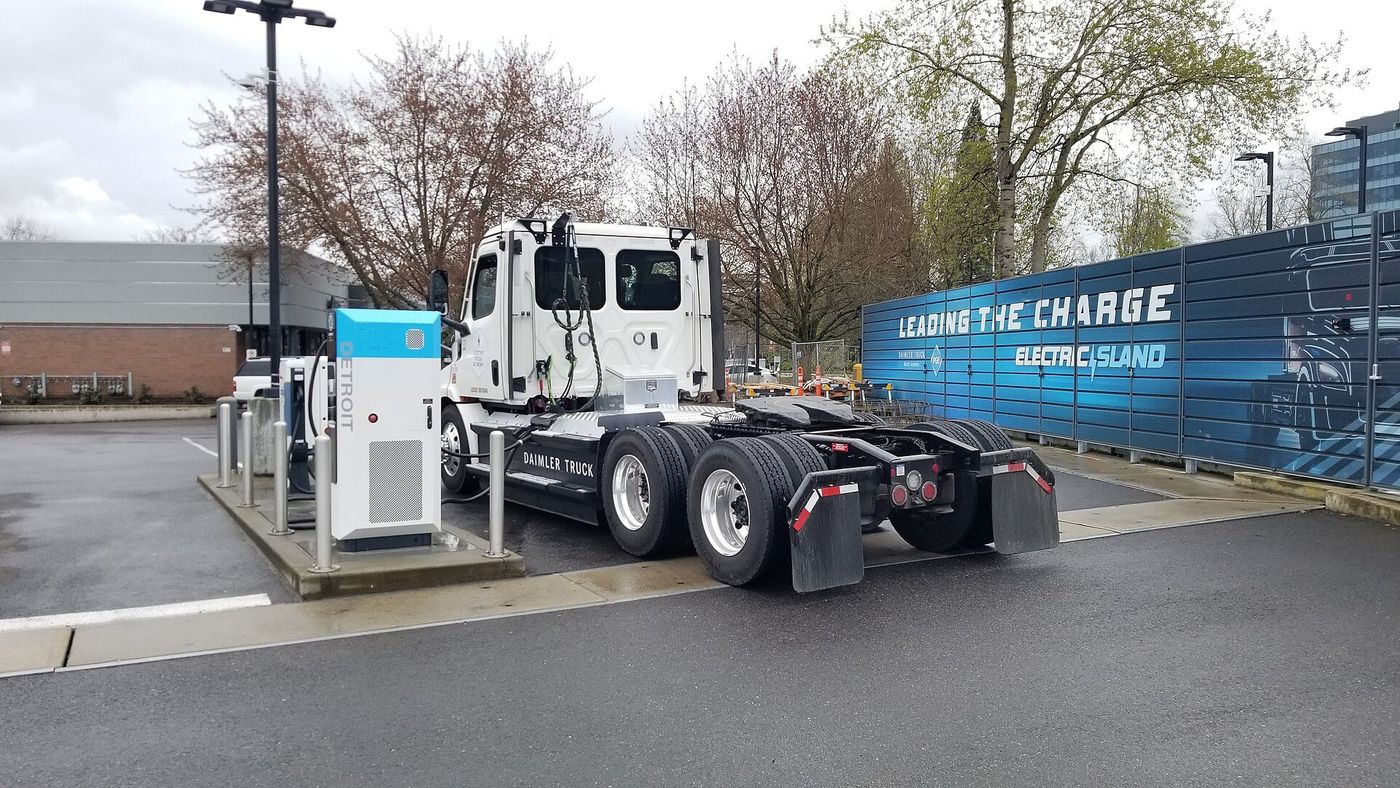
A battery-electric truck or tractor unit carries battery packs and electric motors, which the makers’ documents describe either as a powertrain unit with a gearbox or as an electric axle; where a document states a gear count, the gearboxes run from three to eight speeds (by our count). It charges at a depot or at public chargers over CCS or, on some models, the Megawatt Charging System (MCS), and the capacity, range and charging-time figures its maker publishes each carry conditions that this page sets out, beside the EU and worldwide sales figures and the EU rules behind them.
In EU law this is one kind of zero-emission heavy-duty vehicle. Recital 9 of Regulation (EU) 2024/1610 says zero-emission heavy-duty vehicles currently include battery electric vehicles, fuel-cell and other hydrogen-powered vehicles. Point (a) of the definition of “zero-emission heavy-duty vehicle” in Article 3(11) of Regulation (EU) 2019/1242, as amended by Regulation (EU) 2024/1610, covers a heavy-duty motor vehicle without an internal combustion engine, or with one that emits not more than 3 g CO2/(tkm) or 1 g CO2/(pkm) as determined in accordance with Article 9 of Regulation (EU) 2017/2400; the definition has further points that are not covered here. This page covers the battery-electric kind; fuel-cell and hydrogen vehicles are a separate subject. Hyundai’s hydrogen fuel-cell heavy-duty truck is described on the Hyundai XCIENT Fuel Cell page. The sister subject for buses is Electric buses explained. Hydrogen trucks, with a fuel cell or with a hydrogen combustion engine, are described in hydrogen trucks: fuel cell vs hydrogen combustion.
How a battery-electric truck is put together
Makers state the battery as a number of packs. The Mercedes-Benz eActros 600 has three packs of 207 kWh each, for an installed total of 621 kWh (Daimler Truck, 10 October 2023). DAF says the XG and XG+ Electric can be fitted with three to five packs, positioned modularly on the chassis (13 January 2026).
The makers name the cell chemistry themselves. DAF and Mercedes-Benz name lithium iron phosphate (LFP), MAN names NMC, and Renault Trucks names NCA (nickel, cobalt, aluminium) lithium-ion batteries for the E-Tech T 780 and T 585. DAF adds that its LFP batteries are cobalt- and nickel-free and can be charged daily up to 100 per cent without compromising their durability. How makers state battery cover is set out in electric truck and bus battery warranties.
The documents describe the drive in two ways.
A powertrain unit with a gearbox. DAF says the unit in the XG and XG+ Electric consists of two separate electric engines combined with an integrated transmission with three gears. Volvo’s release of 14 April 2026 describes the FH, FM and FMX Electric as having a dual-motor drivetrain with a purpose-built gearbox with eight gears.
An electric axle. Mercedes-Benz says it developed a new 800-volt electric axle with two electric motors and a four-speed transmission for the eActros 600, specifically for heavy-duty long-haul transport. Volvo describes the FH Aero Electric with extended range as having a compact e-axle that integrates two electric motors and a six-speed gearbox into the rear axle, freeing up chassis space for more batteries. Renault Trucks says the electric axle on the E-Tech T 780 and T 585 lets all parts of the powertrain, the electric motors and the transmission, be grouped together at the rear of the vehicle, and that this architecture frees up space between the side members for additional battery packs (18 November 2025).
Three makers state a gear count: three (DAF), four (Mercedes-Benz), and six or eight (Volvo, by model). By our count that is three to eight speeds in the documents that give one; Renault Trucks’ release names a transmission without a count.
Recuperation and the brake resistor
Mercedes-Benz says the driver of the eActros 600 can choose between five different recuperation levels. DAF’s XG Electric infosheet says that in endurance braking, for example when going downhill, most of the energy is recuperated, and that in some cases the required energy capacity is not fully available and its brake resistor takes over. MAN’s release of 14 September 2026 gives the new 598 hp (440 kW) engine of the eTGX a maximum recuperation power of 480 kW. The levels as makers describe them, type approval and the annual test in Great Britain are covered in regenerative braking in trucks and buses.
Two capacity figures: installed and usable
Makers publish more than one battery capacity, and the words differ: Mercedes-Benz writes installed and usable, DAF installed and available, MAN gross and available.
The Mercedes-Benz eActros 600 product sheet lists 621 kWh installed in total (207 kWh per pack) and 600 kWh usable in total (200 kWh per pack). Its footnotes define the first as the nominal capacity of a new battery and the second as the capacity available for regular truck operation with new batteries; both are based on internally defined boundary conditions and may vary with use case and ambient conditions.
DAF’s XG Electric infosheet lists installed capacities of 315, 420 and 525 kWh, says its LFP batteries offer 88 per cent depth of discharge, and gives the available energy as 277, 370 and 462 kWh respectively.
MAN’s release of 14 September 2026, presenting the new eTGX at the IAA in Hanover, gives a gross capacity of 92 kWh per battery pack with 88 kWh available for vehicle operation, and states a usable capacity of 95 per cent. The release gives no order or production date for this battery generation. MAN’s earlier release of 30 July 2026, quoted under charging below, gives a total of 534 kWh for six batteries; on our reading, the two releases describe different battery generations.
Range is a declaration, with conditions attached
IEA’s Global EV Outlook 2026 says there is currently no harmonised regulatory regime for measuring the actual range of electric heavy-duty vehicles across different countries and regions. It puts the average self-declared range of available battery-electric medium freight truck models at 270 km in 2025, and that of heavy freight truck models at nearly 310 km. In IEA’s definitions, medium freight trucks (MFTs) have a gross weight of 3.5 to 15 tonnes and heavy freight trucks (HFTs) a gross weight of more than 15 tonnes. On our reading, “self-declared” means the makers’ own declaration rather than the result of a harmonised test.
Makers attach their own conditions to the figures they publish. Four examples, in alphabetical order of maker:
- MAN (14 September 2026): with six battery packs, the new-generation eTGX has a maximum possible range of 660 km, or well over 500 km under real conditions in typical long-haul transport.
- Mercedes-Benz (eActros 600 product sheet): a range of 500 km, which the footnote says was determined internally under specific test conditions, after preconditioning, with a 4x2 tractor unit at 40 t total towing weight and 20 °C outside temperature in long-haul operation, and may deviate from the values determined in accordance with Regulation (EU) 2017/2400.
- Renault Trucks (18 November 2025): its range and consumption figures are footnoted as depending on usage and operating condition, and as based on 32T GCW.
- Volvo (14 April 2026): up to 700 km on one charge for the FH Aero Electric with extended range, with a footnote that range depends on external conditions such as the weather and wind resistance, and on other factors such as the total weight of the truck and the driver’s performance.
The figures are listed, not ranked: each rests on its own conditions.
Where they charge: depot, CCS and MCS
IEA’s Global EV Outlook 2026 says the growth in electric truck uptake is focused on applications in which distances are shorter and trucks can rely on depot charging. It says electric trucks can use chargers dedicated to heavy-duty vehicles, with an HDV-specific connector such as MCS (which IEA writes as Megawatt Charging Standard) or ChaoJi, or chargers that mainly serve light-duty vehicles but that trucks can access, where the site layout allows adequate manoeuvring and parking. Charging power, grid connection and lead times at a truck depot are set out in depot charging for electric trucks.
The same IEA report, of May 2026, says that after China the European Union has shown the greatest progress in deploying public chargers suitable for trucks, with more than 4,000 available; the same passage says over 40 chargers faster than 1 MW have been identified. Public networks and maps, depot charging and charging in the driver’s break are covered in charging electric trucks and buses.
Each maker states its own charging figures, again in alphabetical order:
- DAF (XG Electric infosheet): AC charging up to 22 kW, and DC fast charging at 150 or 325 kW.
- MAN (30 July 2026): CCS charging up to 375 kW for MAN eTrucks, and up to 750 kW for MCS-equipped vehicles, with up to 1,000 amps and up to 750 volts. MAN says the first series-produced eTruck equipped with MCS has rolled off its assembly line. Charging from 20 to 80 per cent state of charge takes less than 30 minutes over MCS in an eTGX or eTGS with six batteries and a total battery capacity of 534 kWh.
- Mercedes-Benz (eActros 600 product sheet): CCS charging power of 400 kW.
- Renault Trucks (18 November 2025): the E-Tech T 780 and T 585 are compatible with MCS stations up to 720 kW, and can be charged at a depot with standard CCS up to 350 kW.
- Volvo (14 April 2026): for the FH Aero Electric with extended range, 700 kW MCS with 20 to 80 per cent in approximately 50 minutes, and 350 kW CCS with 20 to 80 per cent in approximately 85 minutes; the FH, FM and FMX Electric are listed with 350 kW CCS.
Each time above is one maker’s statement for its own battery and charger, so the times are not set against one another. The EU’s alternative-fuels infrastructure rules and the driving-time and rest rules that bear on charging stops are covered in Megawatt Charging System: how electric truck charging scales.
How many are sold
Two organisations publish figures on different definitions, and this page keeps them apart.
In the EU (ACEA)
ACEA, the European Automobile Manufacturers’ Association, reports new EU truck registrations in its category of medium and heavy commercial vehicles over 3.5 tonnes. Its “electrically chargeable” power-source line includes battery electric and plug-in hybrids, so it is not a share of battery-electric trucks alone; fuel cell electric vehicles are counted in ACEA’s “others” line, together with vehicles powered by natural gas, LPG, E85/ethanol and other fuels.
| Period and release | Electrically chargeable | Diesel |
|---|---|---|
| Full year 2025 (release of 29 January 2026) | 4.2% (2.3% in 2024) | 93.2% |
| First half of 2026 (release of 29 July 2026) | 4.8% (3.6% in H1 2025) | 92.1% |
The definitions come from the footnotes to ACEA’s 2025 tables; the H1 2026 web release does not repeat them. The two rows cover different periods, a full year and a half-year. The categories, their definitions and the year’s totals are explained in What a European truck registration figure counts.
Worldwide (IEA)
IEA’s Global EV Outlook 2026, published on 20 May 2026 under a CC BY 4.0 licence, says sales of electric trucks grew for the fifth consecutive year in 2025, exceeding 400,000 for the first time and doubling on the previous year. Globally, electric trucks reached 9 per cent of all truck sales; battery electric trucks were 97 per cent of electric truck sales; China accounted for over 90 per cent of global sales, and one in four trucks sold in China in 2025 was electric.
IEA counts medium freight trucks (3.5 to 15 tonnes gross weight) and heavy freight trucks (more than 15 tonnes gross weight). Its 2026 outlook reclassified delivery vans and other vehicles with a gross vehicle weight of 3.5 tonnes and above from light commercial vehicles to medium freight trucks, so historical values may differ from those reported in the 2025 outlook.
For Europe, IEA reports that electric truck (MFT and HFT) sales in 2025 increased by 40 per cent year on year, reaching nearly 17,000 and accounting for 3 per cent of all truck sales in the region. The page does not say which countries it counts as Europe. IEA’s classes and regions are its own, so on our reading its figures do not line up with ACEA’s EU category, and this page draws no comparison between them. What ACEA, the IEA, EU law and the makers say about battery-electric, hydrogen and combustion powertrains is set side by side in heavy-vehicle powertrains: what the sources say.
The EU rules behind the shift
Regulation (EU) 2024/1610 of 14 May 2024 amends Regulation (EU) 2019/1242 to strengthen the CO2 emission performance standards for new heavy-duty vehicles. It was published in the Official Journal on 6 June 2024 and applies from 1 July 2024. The European Commission’s climate directorate says the targets apply to new heavy-duty vehicles registered in a reporting period, which runs from 1 July of a year to 30 June of the following year. Two sets of numbers sit in the Regulation, and they measure different things.
Union fleet average. Article 3a(1), inserted into Regulation (EU) 2019/1242, sets reductions of the average CO2 emissions of the Union fleet of new heavy-duty motor vehicles (other than special purpose vehicles, off-road vehicles and off-road special purpose vehicles) compared with the average of the 2019 reporting period: 15 per cent for the sub-groups 4-UD, 4-RD, 4-LH, 5-RD, 5-LH, 9-RD, 9-LH, 10-RD and 10-LH for the reporting periods 2025 to 2029; 45 per cent for all sub-groups other than vocational vehicles for 2030 to 2034; 65 per cent for all sub-groups for 2035 to 2039; and 90 per cent for all sub-groups from 2040.
Targets per sub-group. Annex I, point 4.3.1 sets CO2 emissions reduction targets that apply to the heavy-duty vehicles of each vehicle sub-group, by reporting period.
| Vehicle sub-groups | 2025–2029 | 2030–2034 | 2035–2039 | From 2040 |
|---|---|---|---|---|
| Medium lorries | 0 | 43% | 64% | 90% |
| Heavy lorries above 7.4 t | 0 | 43% | 64% | 90% |
| Heavy lorries above 16 t with 4x2 and 6x4 axle configurations | 15% | 43% | 64% | 90% |
| Heavy lorries above 16 t with special axle configurations | 0 | 43% | 64% | 90% |
| Vocational vehicles | 0 | 0 | 64% | 90% |
| Coaches and interurban buses | 0 | 43% | 64% | 90% |
| Trailers | 0 | 7.5% | 7.5% | 7.5% |
| Semi-trailers | 0 | 10% | 10% | 10% |
So 45 per cent for 2030 to 2034 is the reduction of the Union fleet average against the 2019 reporting period, while 43 per cent is the 2030 to 2034 target that Annex I attaches to the lorry, coach and interurban bus sub-groups in the table above; both figures are in the Regulation.
Regulation (EU) 2026/1046 of 29 April 2026 (Official Journal, 7 May 2026) amends Regulation (EU) 2019/1242 as regards the calculation of emission credits for the reporting periods 2025 to 2029. Recital 4 says that in those periods manufacturers should collect emission credits if their specific CO2 emissions are below the specific CO2 emissions target, rather than below the CO2 emissions reduction trajectory. Recital 3 gives as reasons facilitating compliance with the targets applicable as of 2030 and the delay in the deployment of the public charging infrastructure along motorways for heavy-duty vehicles; recital 2 says it is essential that the level of the CO2 emissions reduction targets remain unchanged.
Directive (EU) 2025/2459 of 26 November 2025 (Official Journal, 4 December 2025) amends Directive 1999/62/EC as regards the extension of the period in which zero-emission heavy-duty vehicles can benefit from significantly reduced rates of infrastructure or user charges or from exemptions to pay them. Its Article 1 replaces two dates in Article 7ga(1), fifth subparagraph, of Directive 1999/62/EC: 31 December 2025 becomes 30 June 2031, and 1 January 2026 becomes 1 July 2031. Recital 6 says the optional nature of the amended provision means Member States are not obliged to transpose the Directive. Article 7ga and Germany’s application of it are covered in EU road tolls and CO2 emission classes: what the class changes.
The electric models on this site
Model pages for the battery-electric trucks described above, in alphabetical order:
- DAF XG and XG+ Electric
- MAN eTGX
- Mercedes-Benz eActros 600, which also has its own article, Mercedes-Benz eActros 600: what 600 kWh means in service
- Renault Trucks E-Tech T
- Volvo FH Electric
Quick answers
- How does an electric truck work?
- The makers' documents describe two electric motors and a gearbox, either as a powertrain unit (DAF XG Electric: two motors and three gears; Volvo FH, FM and FMX Electric: dual motors and eight gears) or as an electric axle (Mercedes-Benz eActros 600: an 800-volt axle with two motors and four gears). The eActros 600 carries three battery packs of 207 kWh each, and its driver can choose between five recuperation levels.
- How far can an electric truck go on one charge?
- IEA puts the 2025 average self-declared range of available battery-electric heavy freight truck models at nearly 310 km, and that of medium freight truck models at 270 km. Individual makers publish higher figures, such as Volvo's up to 700 km for the FH Aero Electric with extended range, each with its own footnoted conditions, and IEA says there is currently no harmonised regulatory regime for measuring the actual range of electric heavy-duty vehicles.
- How long does it take to charge an electric truck?
- For the FH Aero Electric with extended range, Volvo lists 20 to 80 per cent in approximately 50 minutes on 700 kW MCS and approximately 85 minutes on 350 kW CCS. MAN says charging from 20 to 80 per cent state of charge takes less than 30 minutes over MCS in an eTGX or eTGS with six batteries and a total capacity of 534 kWh; each time is one maker's statement for its own battery and charger, so the two are not set against each other.
- What share of new trucks in the EU are electric?
- ACEA reports that electrically-chargeable trucks above 3.5 tonnes took 4.2 per cent of the EU market in 2025, up from 2.3 per cent in 2024, and 4.8 per cent in the first half of 2026, against 3.6 per cent in the first half of 2025. ACEA's electrically-chargeable category includes battery electric and plug-in hybrids, so it is not a battery-electric share; diesel took 93.2 per cent in 2025 and 92.1 per cent in the first half of 2026.
- How many electric trucks are sold worldwide?
- IEA reports sales of more than 400,000 electric trucks in 2025, double the previous year and 9 per cent of all truck sales, with battery electric trucks 97 per cent of them and China over 90 per cent of global sales. IEA's classes are medium freight trucks of 3.5 to 15 tonnes gross weight and heavy freight trucks of more than 15 tonnes, so on our reading its figures are not ACEA's EU truck category.
- What EU rules apply to electric trucks?
- Regulation (EU) 2024/1610 sets a Union fleet-average reduction of 45 per cent for the reporting periods 2030 to 2034 against the 2019 reporting period, for all sub-groups other than vocational vehicles, and separate per-sub-group targets in Annex I, point 4.3.1, such as 43 per cent for medium lorries in the same periods. Directive (EU) 2025/2459 replaces the date 31 December 2025 with 30 June 2031 in Article 7ga(1) of Directive 1999/62/EC, extending the period in which zero-emission heavy-duty vehicles can benefit from reduced charges or exemptions from them; the amended provision is optional for Member States.
Models in this article
Sources
- Global EV Outlook 2026 — Trends in other EV modes — International Energy Agency (IEA), 20 May 2026
- Global EV Outlook 2026 — Electric vehicle charging — International Energy Agency (IEA), 20 May 2026
- New commercial vehicle registrations: vans -8.8%, trucks -6.2%, buses +7.5% in 2025 (press release with tables) — ACEA — European Automobile Manufacturers' Association, 29 Jan 2026
- New commercial vehicle registrations: vans +1.9%, trucks +9.8%, buses +22.7% in H1 2026 — ACEA — European Automobile Manufacturers' Association, 29 Jul 2026
- Regulation (EU) 2024/1610 amending Regulation (EU) 2019/1242 as regards strengthening the CO2 emission performance standards for new heavy-duty vehicles — Article 3a and Annex I, point 4.3 (OJ L, 6.6.2024) — Publications Office of the European Union, 14 May 2024
- Regulation (EU) 2026/1046 amending Regulation (EU) 2019/1242 as regards the calculation of emission credits for heavy-duty vehicles for the reporting periods of the years 2025 to 2029 (OJ L, 7.5.2026) — Publications Office of the European Union, 29 Apr 2026
- Directive (EU) 2025/2459 amending Directive 1999/62/EC as regards the extension of the period in which zero-emission heavy-duty vehicles can benefit from significantly reduced rates of infrastructure or user charges or from exemptions to pay them (OJ L, 4.12.2025) — Publications Office of the European Union, 26 Nov 2025
- Reducing CO2 emissions from heavy-duty vehicles — European Commission — Directorate-General for Climate Action
- DAF introduces XG and XG⁺ Electric — DAF Trucks N.V., 13 Jan 2026
- DAF XG Electric — infosheet — DAF Trucks
- MAN starts series production of MCS-ready eTrucks (press release, 30 July 2026) — MAN Truck & Bus, 30 Jul 2026
- World premiere at the IAA: MAN eTGX with greater range, efficiency and safety (press release, 14 September 2026) — MAN Truck & Bus, 14 Sept 2026
- Mercedes-Benz Trucks celebrates world premiere of the battery electric long-haul truck eActros 600 — Daimler Truck, 10 Oct 2023
- The new eActros 600 — product sheet — Mercedes-Benz Trucks
- A range of 600 km: Renault Trucks unveils its long-distance electric trucks — Renault Trucks, 18 Nov 2025
- Volvo launches new electric trucks – with ranges up to 700 km — Volvo Trucks, 14 Apr 2026