Regenerative braking in trucks and buses: levels, type approval and the annual test in Great Britain
How UN R13 defines regenerative braking, how DAF, Mercedes-Benz, Volvo, MAN and Ford describe its levels, and how DVSA's manuals treat it at the annual test in Great Britain.
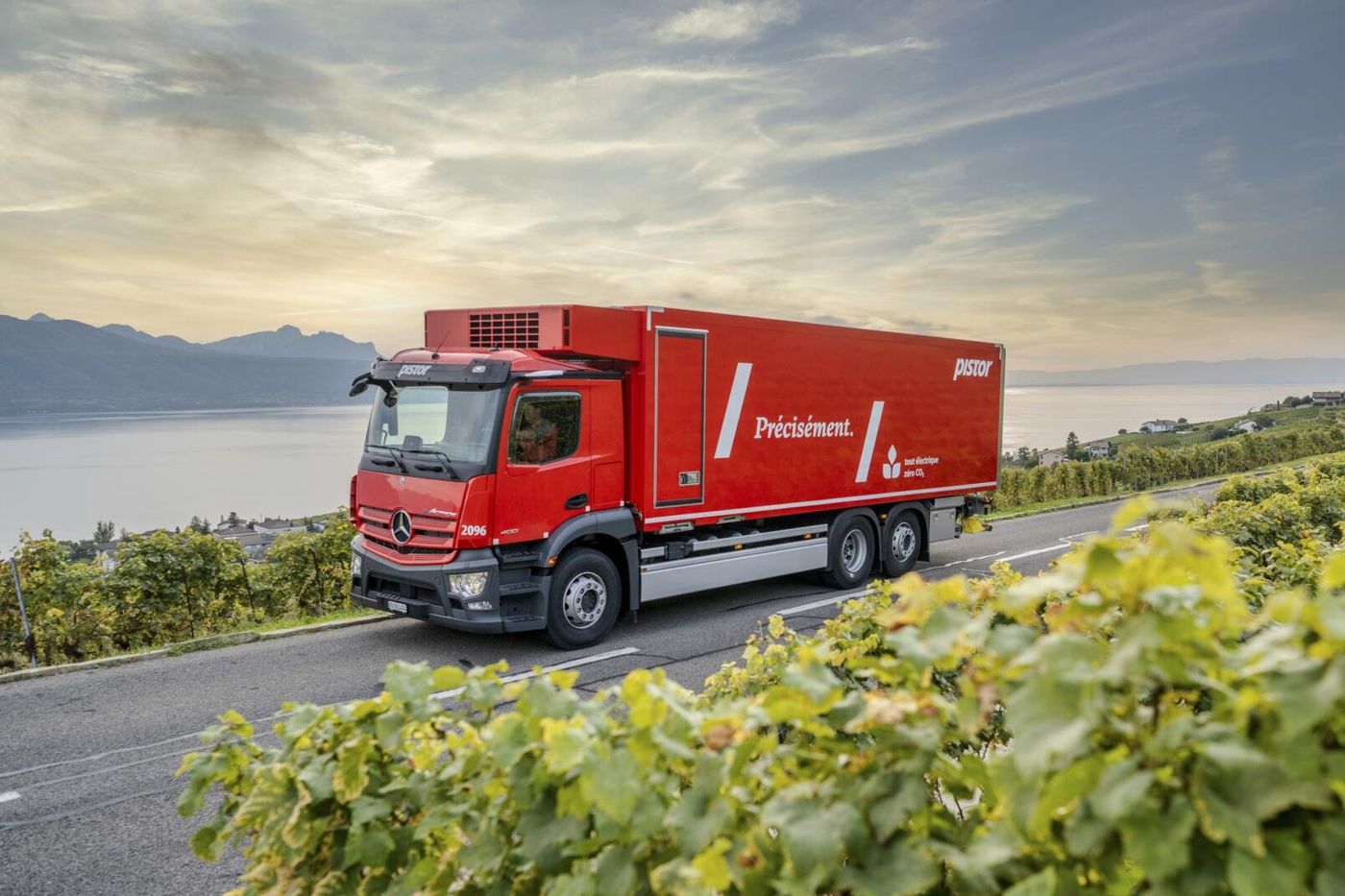
Regenerative braking is a braking system that converts vehicle kinetic energy into electrical energy during deceleration, which is how UN Regulation No. 13 defines it before dividing it into category A, not part of the service braking system, and category B, part of it. Makers describe how much of it a driver can call on as levels or as kilowatts, and in Great Britain the inspection manuals of the Driver and Vehicle Standards Agency (DVSA) say that where a hybrid or electric vehicle’s power train equipment acts as a regenerative brake (in the bus manual, to comply with the additional braking requirements), the unit should be inspected as if it is an additional braking device.
What the braking regulation calls it
UN Regulation No. 13 applies, at paragraph 1.1, to vehicles of categories M2, M3, N and O with regard to braking, so it reaches both trucks and buses. The text cited here is the one published in the Official Journal of the European Union on 13 April 2026 (L series 2026/746), which incorporates all valid text up to Supplement 1 to the 15 series of amendments and describes itself as “meant purely as documentation tool”.
| Paragraph | Term | Definition |
|---|---|---|
| 2.21 | Electric regenerative braking | A braking system which, during deceleration, provides for the conversion of vehicle kinetic energy into electrical energy. |
| 2.21.1 | Electric regenerative braking control | A device which modulates the action of the electric regenerative braking system. |
| 2.21.2 | Category A | An electric regenerative braking system which is not part of the service braking system. |
| 2.21.3 | Category B | An electric regenerative braking system which is part of the service braking system. |
| 2.21.4 | Electric state of charge (SOC) | The instantaneous ratio of electric quantity of energy stored in an electrical storage device (e.g., battery, capacitor, etc.) relative to the maximum quantity of electric energy which could be stored in this device. |
Type approval treats the presence of a regenerative system as one of the things that separate vehicle types. Paragraph 2.2 defines a vehicle type as vehicles that do not differ in such essential respects as those it lists, and paragraph 2.2.1.5 lists a different type of braking equipment, with more particular reference to trailer-braking equipment or to “any presence of an electric regenerative braking system”.
Two paragraphs add requirements for regenerative systems, 5.2.1.24 for category A and 5.2.1.25 for category B. Both are headed as applying to vehicles of categories M2, N1 and N2 below 5 tonnes, and neither is summarised here. The stop-lamp rule for category A systems and the electric branch of the endurance braking requirement, paragraph 5.1.2.4.3, are set out in retarders and engine braking; of 5.1.2.4.3, only the driver-warning requirements of 5.1.2.4.3.2 and 5.1.2.4.3.3 are given below.
Levels, pedals and stalks: how truck makers describe it
The makers below each state the driver’s access to regenerative braking in a different unit: a share of power, a number of levels, or kilowatts. Each is given as its maker wrote it. The units are not converted into one another and the makers are not ranked.
DAF. DAF words it in percentages of power. Its XG Electric infosheet and its product page for the XF, XG and XG+ Electric say that the maximum amount of available braking power “has three levels: 33%, 67%, or 100% of the maximum motor power” and can be adjusted manually with the right-hand stalk. DAF’s news release of 28 January 2026, which names the XD, XF, XG and XG+ Electric, states the levels differently: the driver can choose “various levels of braking power (33%, 66% or 100% of the total braking power)”, and One Pedal Drive can be activated using the engine brake switch on the steering column. The two wordings are given side by side; the 67% of one and the 66% of the other are not reconciled here.
DAF’s One Pedal Drive infosheet describes the accelerator pedal, when the function is active, as “a control mechanism for both accelerating and (regenerative) braking”, with the effect of the pedal stroke position varying with driving conditions. Regenerative braking is activated by pulling the right-hand steering-column stalk. The spring-return stalk raises the level of braking when pulled down, switches to the maximum level instantly if held down longer, and deactivates the function directly if held up longer. The news release adds that the lower part of the pedal travel is for acceleration, while the upper part can be used for regenerative braking. The infosheet also says regenerative braking on DAF electric vehicles is available through One Pedal Drive and by applying the brake pedal, and that it is “only activated by the brake pedal when requesting heavy braking force”.
The same infosheet says the maximum power available to One Pedal Drive is determined by the motor power and the battery capacity, and gives a table of the “maximum regenerative brake power” of the various motors. Its header shows three settings, 33%, 67% and 100%, and gives no kilowatt figure for each setting; the figures are the maximum by motor and number of battery packs. The infosheet does not say which vehicles are offered with which motor; the DAF XG and XG+ Electric model page lists the EX-D2 outputs.
| Motor | 2 packs, 210 kWh | 3 packs, 315 kWh | 4 packs, 420 kWh | 5 packs, 525 kWh |
|---|---|---|---|---|
| PACCAR EX-D1 170 kW | 210 | 270 | 270 | 270 |
| PACCAR EX-D1 220 kW | 270 | 270 | 270 | |
| PACCAR EX-D1 270 kW | 270 | 270 | 270 | |
| PACCAR EX-D2 270 kW | 315 | 350 | 350 | |
| PACCAR EX-D2 310 kW | 350 | 350 | ||
| PACCAR EX-D2 350 kW | 350 | 350 |
Mercedes-Benz. In its world-premiere release of 10 October 2023, Mercedes-Benz Trucks says the driver of the eActros 600 can, depending on the situation, choose between “five different recuperation levels”. It adds that one-pedal driving can optionally be enabled on the touchscreen in the digital cockpit, which it explains as deceleration by means of recuperation with reduced actuation of the mechanical brake. The passage does not say what each of the five levels does. The maker’s full specification is on the Mercedes-Benz eActros 600 model page.
Volvo. Volvo’s FH Electric product page, which carries no date, lists one-pedal driving under the heading “Smooth, safe, and intuitive” and says it “offers stronger retardation power and the possibility to select a suitable retardation level”. The passage does not give a number of levels. See the Volvo FH Electric model page.
MAN. MAN’s press release of 14 September 2026, issued for the world premiere of the new eTGX at the IAA in Hanover, states a maximum recuperation power for each of three power levels of the new eTGX.
| Power level | Recuperation power |
|---|---|
| 440 kW | 480 kW maximum recuperation power |
| 360 kW | up to 420 kW recuperation power |
| 290 kW | up to 320 kW recuperation power |
MAN says that “a high recuperation performance also means a high continuous braking performance”, which it says also contributes to driving safety, and that the new eTGX has up to 20 per cent more powerful recuperation, a comparison the release makes with the previous generation. The release calls the 440 kW engine the “new top-of-the-range engine” and says the increase in drive power will be reached “in the future”; it is a premiere announcement and gives no order or delivery date. See the MAN eTGX model page.
Ford Trucks. Ford Trucks’ technical features sheet for the F-LINE E Road Series (July 2026) has a “Regenerative Braking Power” row: 290 kW for the 4x2 and 390 kW for the 6x2. Its “Vehicle Peak Power” row carries the same two kilowatt figures. In the equipment list the “Retarder” row shows a dash for both versions; the sheet’s key defines only “Standard” and “Optional”. See the Ford Trucks F-LINE E model page.
On a city bus
Otokar’s e-Kent data sheet, document code KS98TA-26 and written in Turkish, lists disc brakes at front and rear and, under auxiliary brakes (“Yardımcı Frenler”), “Rejenerasyon”, regeneration. Its standard-equipment list gives “Rejenerasyon (Ayaktan ve koldan kontrollü)”, which is Turkish for regeneration controlled by foot and by lever. The sheet gives no number of levels and no regenerative power figure. The maker’s specification is on the Otokar Kent model page, and the drive types used in city buses are set out in city bus propulsion.
What the makers say it returns
Mercedes-Benz says that with an anticipatory driving style electrical energy can be recovered through recuperation, fed back into the batteries of the eActros 600 and then available again for the drive system, and that recuperation puts less strain on the truck’s brakes, “a positive side effect”. The passage gives no figure for either.
DAF’s One Pedal Drive infosheet says that, using only the accelerator pedal for both accelerating and braking, “10-30% of battery energy can be recuperated, depending on route and driving conditions”.
Both statements are the makers’ own; this article cites no independent measurement. How one maker’s service contracts for electric trucks list brake discs and pads is described in electric-truck maintenance compared with diesel.
When the battery cannot take the energy
DAF’s XG Electric infosheet says that in endurance braking, that is, braking for a longer period of time, for example when going downhill, most of the energy is recuperated, and that in some cases the required energy capacity is not fully available and its brake resistor takes over. DAF states the result as endurance braking being ensured, extra energy reservation not being required, and more usable energy capacity. The same infosheet’s feature list carries the line “Brake resistor for endurance braking and extra range (combination only)”; the infosheet does not say what “combination only” means.
The One Pedal Drive infosheet says the available power can be limited by certain conditions: battery state of charge, temperature and motor temperature “may trigger the limitation”. When they do, yellow blocks appear in the digital instrument panel, and the yellow overlay represents the amount of power not available. A green bar shows the energy currently being recuperated, and a green telltale shows the activation and, if applicable, the regenerative braking power level.
UN Regulation No. 13 addresses a case of this kind for the service brakes. Paragraph 5.2.1.29.7 covers vehicles with a category A or B system that use the service braking system in addition to the endurance braking system only when the state of charge of the traction battery does not allow the energy to be stored because it is high. Such vehicles shall warn the driver at the latest when the service braking performance falls below the minimum value in Annex 4, paragraph 1.6.3, by the yellow warning signal of paragraph 5.2.1.29.1.2, and below the minimum value in Annex 4, paragraph 2.2.1, by the red warning signal of paragraph 5.2.1.29.1.1. The vehicle manufacturer shall describe the method used to assess the service braking performance, with temperature or energy calculation and/or deceleration control as the text’s examples, and include it in the documentation package required by Annex 18.
Paragraph 5.1.2.4.3.2 ties the same warning to the endurance braking requirement: as an alternative to paragraph 5.1.2.4.3.1, the service braking system shall fulfil the requirements of Annex 4, paragraph 1.8.2.5, and “a brake performance estimator shall warn the driver” according to paragraph 5.2.1.29.7. Paragraph 5.1.2.4.3.3 adds a requirement for an endurance braking system “solely based on” an electric regenerative braking system: before the time when the braking force of the regenerative braking can no longer be provided, with a fully loaded battery as the text’s example, the driver shall be informed, for example by information on the remaining retardation capacity or by a reduction of the provided retardation force. The rest of the endurance branch is in retarders and engine braking.
Each of these sources states its own condition, and none is read here as a general rule about what regenerative braking does when a battery is full.
How type approval tests it
Annex 4 of UN Regulation No. 13 sets the braking tests. For vehicles powered completely or partially by an electric motor or motors permanently connected to the wheels, paragraph 1.2.8 says all tests shall be carried out with the motor or motors connected. For those vehicles, when fitted with a category A system, paragraph 1.2.9 has the behaviour tests of paragraph 1.4.3.1 carried out on a track with a low adhesion coefficient, paragraph 1.2.9.1 adds that transient conditions such as gear changes or accelerator control release shall not affect the behaviour of the vehicle under test, and paragraph 1.2.10 says wheel locking is not allowed during those tests, though it permits steering correction within limits it states.
In the Type-0 test (the ordinary performance test with brakes cold), paragraph 1.4.1.2.2 sets a rule by category. For category A, any separate regenerative braking control that is provided shall not be used. For category B, the contribution of the regenerative system to the braking force generated “shall not exceed that minimum level guaranteed by the system design”. The paragraph deems that requirement satisfied if the batteries are at one of the following state of charge conditions, the state of charge being determined by the method in the appendix to Annex 4:
- (a) at the maximum charge level recommended by the manufacturer in the vehicle specification; or
- (b) at a level not less than 95 per cent of the full charge level, where the manufacturer has made no specific recommendation; or
- (c) at the maximum level which results from automatic charge control on the vehicle; or
- (d) when the tests are conducted without a regenerative braking component, regardless of the state of charge of the batteries.
Any one of the four is enough; the 95 per cent applies only to option (b). In the Type-I test (the fade test), paragraph 1.5.1.8 asks, for category B, that the condition of the batteries at the start of the test be such that the regenerative contribution does not exceed the minimum guaranteed by the system design, and deems this satisfied under the same four conditions. For category A, paragraph 1.5.3.1.2 says that during brake applications the highest gear shall be continuously engaged and the separate regenerative braking control, if any, shall not be used.
The annual test in Great Britain
The two DVSA manuals cited here, the heavy goods vehicle (HGV) inspection manual and the public service vehicle (PSV) inspection manual, are the editions in force from 1 April 2026. GOV.UK marks both as applying to England, Scotland and Wales, and both publication pages were last updated on 19 February 2026. This section reports what the manuals say. Each describes itself as not “a legal interpretation of Regulations”, assumes that only parts of a vehicle which can readily be seen without dismantling are to be examined, and points to the regulations that hold the requirements: Schedule 3 of the Goods Vehicle (Plating and Testing) Regulations for the HGV manual, and Schedule 2 of The Motor Vehicle (Test) Regulations 1981 as amended for the PSV manual. Those regulations were not opened for this article.
Both manuals define an electric vehicle (EV) as one powered by an electric power train only, and say a vehicle with a hydrogen fuel cell should be considered an electric vehicle. They define a hybrid electric vehicle (HEV) as one powered by a power train that consists of both an internal combustion engine and an electrical energy or power storage device.
Additional braking devices (IM58). In the HGV manual, item 58 applies to all vehicles and trailers where a device is fitted or required. For hybrid and electric vehicles “where the power train equipment acts as a regenerative brake”, it says the unit or units should be inspected as if an additional braking device, and that this should be marked on the technical record. The check of operation is a visual assessment to establish the likelihood of correct fitment and function, rather than to see actual operation, and any inoperative device will be a deficiency whether or not it is mandatory. In the deficiency list of both manuals, an additional braking device missing when known to be a mandatory item is Major; components missing, insecure or damaged are Minor, or Major where they are so to an extent that the device is inoperative; and wiring insecure or damaged to that extent is Major. The HGV manual grades deficiencies as Minor, Major or Dangerous and says that if only defects of a minor nature are present, a pass must be recorded.
The PSV manual words the same rule more narrowly: the power train equipment acts as a regenerative brake “to comply with the additional braking requirements”. It says item 58 applies to “most buses (not local service buses) with a maximum gross weight greater than 10000kg first used from 1 April 1983 or 5000kg first registered 1 May 2002”. Whether a bus requires an additional braking device, it adds, “will have been determined at certification” and will be recorded on the technical record for the vehicle.
Service brake performance (IM71). Both manuals contain the same passage on hybrid and electric vehicles: attention must be paid to them, because “due to the nature of the control systems” some vehicles cannot be tested on the roller brake tester and “must receive a decelerometer brake test”. For a regenerative braking system connected to the service brake system, they give two cases.
| Condition | Test |
|---|---|
| The regenerative system cannot be disconnected from the service brake | A decelerometer brake test is required. |
| The regenerative system can be disconnected and the vehicle control system allows a roller brake test | The roller brake test must be carried out. |
The manuals’ list of vehicles that require decelerometer testing reads “Any vehicle where regenerative braking cannot be disconnected”. They also say that brake testing hybrid and electric vehicles with a regenerative brake system must be appropriately charged, and define appropriately in this context as “the warning light is not illuminated”; they do not say which warning light. This is the condition the manuals set for brake testing. It is separate from the state of charge conditions of the type-approval tests above.
The manuals also list vehicles that can be tested on the brake rollers, each with a condition. The HGV manual names the Mitsubishi Canter (transmission in neutral) and Smiths Electrical: for its light vehicles the ignition turned on and neutral selected, and for its heavy vehicles the high voltage system on and neutral selected. The PSV manual names Alexander Dennis (a switch that needs to be turned off), the Optare Solo EV, HEV, Versa EV and Versa HEV (transmission in neutral with ignition off) and Wrights (vehicle in neutral).
As the manuals describe the decelerometer test, the decelerometer is set up in accordance with the instrument manufacturer’s instructions; at a speed of approximately 20 mph the service brake is applied, and the reading is noted together with whether the vehicle deviates from a straight line. In both manuals a braking efficiency recorded by the decelerometer below the specified efficiency is Major. The HGV manual has a second entry, that the vehicle deviates appreciably from a straight line, also Major; the PSV manual’s list for this test has no such entry.
A separate article covers roadworthiness tests and roadside checks.
Quick answers
- What is regenerative braking on a truck or bus?
- UN Regulation No. 13, paragraph 2.21, defines electric regenerative braking as a braking system which, during deceleration, provides for the conversion of vehicle kinetic energy into electrical energy. Paragraphs 2.21.2 and 2.21.3 divide such systems into category A, which is not part of the service braking system, and category B, which is.
- How many regenerative braking levels does an electric truck have?
- It depends on the maker, and the makers do not describe it on one scale. DAF's XG Electric infosheet gives three levels, 33%, 67% or 100% of the maximum motor power, while DAF's release of 28 January 2026 gives 33%, 66% or 100% of the total braking power. Mercedes-Benz said on 10 October 2023 that the eActros 600 driver can choose between five different recuperation levels, and Volvo's FH Electric page says a suitable retardation level can be selected without giving a number.
- What happens to regenerative braking when the battery is full?
- UN Regulation No. 13, paragraph 5.1.2.4.3.3, requires the driver to be informed before the braking force can no longer be provided, for an endurance braking system solely based on electric regenerative braking, with a fully loaded battery as its example; the sources opened for this article state no single rule for every vehicle. DAF says its available power can be limited by battery state of charge, temperature and motor temperature, and that in some cases its brake resistor takes over in endurance braking.
- How is an electric HGV brake-tested at the annual test in Great Britain?
- DVSA's HGV inspection manual, item IM71, calls, for a vehicle with a regenerative braking system connected to the service brake system, for a decelerometer brake test where the regenerative system cannot be disconnected from the service brake, and for a roller brake test where it can be disconnected and the vehicle control system allows one. The decelerometer test is run at a speed of approximately 20 mph, and the manual says a hybrid or electric vehicle with a regenerative brake system must be appropriately charged, which it defines as the warning light not being illuminated. The manual applies in England, Scotland and Wales.
- Is regenerative braking treated like a retarder at the annual test in Great Britain?
- DVSA's HGV inspection manual, item IM58, says that where the power train equipment of a hybrid or electric vehicle acts as a regenerative brake, the unit should be inspected as if it is an additional braking device, and that this should be marked on the technical record. The PSV manual words the same rule as applying where the equipment acts as a regenerative brake to comply with the additional braking requirements.
Models in this article
Sources
- Heavy goods vehicle (HGV) inspection manual (from 1 April 2026) — sections 58 Additional Braking Devices and 71 Service Brake Performance — Driver and Vehicle Standards Agency (GOV.UK)
- MOT inspection manual: HGVs — publication page (applies to England, Scotland and Wales; last updated 19 February 2026) — Driver and Vehicle Standards Agency (GOV.UK)
- Public service vehicle (PSV) inspection manual (from 1 April 2026) — sections 58 Additional Braking Devices and 71 Service Brake Performance — Driver and Vehicle Standards Agency (GOV.UK)
- MOT inspection manual: public service vehicles (PSVs) — publication page (applies to England, Scotland and Wales; last updated 19 February 2026) — Driver and Vehicle Standards Agency (GOV.UK)
- UN Regulation No. 13 — Uniform provisions concerning the approval of vehicles of categories M, N and O with regard to braking [2026/746], incorporating all valid text up to Supplement 1 to the 15 series of amendments (paragraphs 2.21 to 2.21.4, 5.2.1.29.7 and Annex 4) — Official Journal of the European Union, L series 2026/746 of 13 April 2026
- DAF XF, XG, XG⁺ Electric — product page (DAF One Pedal Drive) — DAF Trucks N.V.
- DAF XG Electric — infosheet — DAF Trucks
- DAF One Pedal Drive — infosheet — DAF Trucks
- DAF expands range of electric trucks (28 January 2026) — DAF Trucks N.V.
- Mercedes-Benz Trucks celebrates world premiere of the battery electric long-haul truck eActros 600 (10 October 2023) — Daimler Truck
- Volvo FH Electric — product page — Volvo Trucks
- World premiere at the IAA: MAN eTGX with greater range, efficiency and safety (Hanover, 14 September 2026) — MAN Truck & Bus
- F-LINE E Road Series — Technical Features - GSR-C, July 2026 — Ford Trucks
- e-Kent — teknik özellikler (technical data sheet, document code KS98TA-26) — Otokar