Ford Trucks
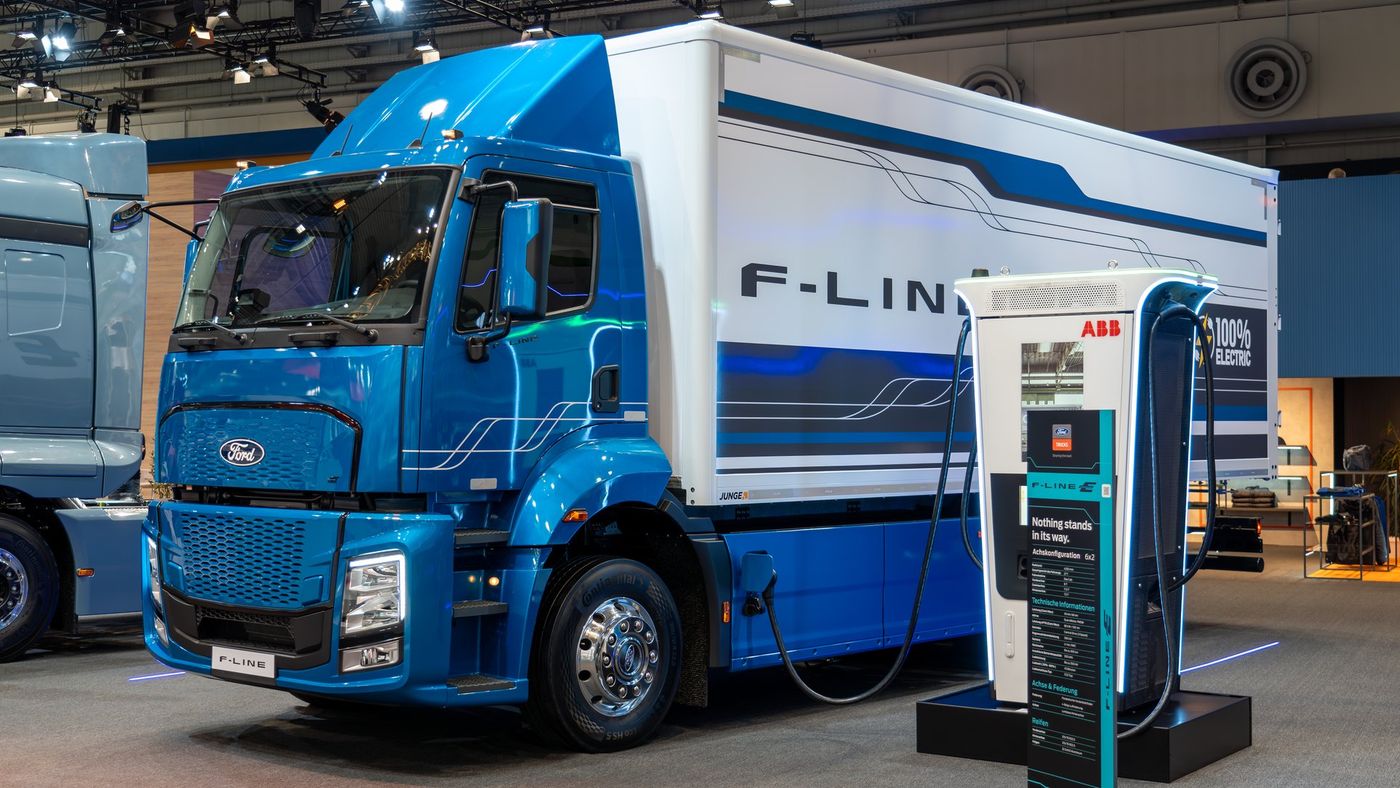
Ford Trucks F-LINE E
Ford Trucks F-LINE E, 4x2 / 6x2: 294 / 392 kWh installed, 235 / 314 kWh usable, NMC, 235 / 310 kW continuous, CCS2 up to 213 / 285 kW, 19,000 / 27,000 kg technically permissible.
- 2 configurations
- 235/310 kW

Model overview
- Segment
- Distribution
- Axle configurations
- 2 (4x2…)
- Transmission
- Automated 3-speed, 3 forward + 1 reverse (10 - 7.9 - 3.2)
- Battery capacity
- 294–392 kWh
- Electric motor
- 235/310 kW
- Wheelbase
- 4 250 mm
Axle configurations: 4x2 · 6x2
The F-LINE E is Ford Trucks’ all-electric truck, as Ford Otosan’s press kits for Solutrans and for IAA Transportation 2026 both call it. Ford publishes its English-language technical data as one sheet, “Technical Features - GSR-C”, dated July 2026. The sheet’s cover reads “F-LINE E Road Series”, and its tables have two columns, a “4x2 Day Cab” and a “6x2 Day Cab”. Every figure below is the sheet’s own unless another Ford document is named, and each is given for its variant, because the two columns differ on power, range, battery, charging, dimensions and weights, so no figure on those rows belongs to “the F-LINE E” as a whole.
Ford Trucks presented the F-LINE E to Europe at Solutrans in Lyon, France, held 18–22 November 2025, according to the title of Ford Otosan’s press kit for the show, which names the F-MAX alongside it. The kit for IAA Transportation 2026 places Ford Trucks at Hall 21, Stand C02, with the F-LINE E in its line-up.
Variants: 4x2 and 6x2
The sheet lists two versions, both with a day cab: a 4x2 with three battery packs and a 6x2 with four. Both take an 8 T front axle and an XSS-470 rear axle rated 11.5 T. The 6x2 adds a trailing axle with a capacity of 7.5 T, a row the 4x2 shows as not offered. Where “not offered” appears, the sheet shows a dash; its legend defines only “Standard” and “Optional”. What the layouts mean is covered in axle configurations explained.
| 4x2 | 6x2 | |
|---|---|---|
| Cab | Day Cab | Day Cab |
| Battery packs | 3 | 4 |
| Front axle | 8 T | 8 T |
| Rear axle | XSS-470, 11.5 T | XSS-470, 11.5 T |
| Trailing axle capacity | not offered | 7.5 T |
| Rear air suspension, standard | C4AS | C6AS |
| Rear steerable axle (C6AS) | not offered | optional |
| Wheelbase, standard | 4,250 mm | 4,250 mm |
| Wheelbase, optional | 4,750, 5,500 and 6,550 mm | 4,750 and 5,500 mm |
The 6,550 mm wheelbase is marked optional on the 4x2 only and is not offered on the 6x2. Ford’s highlights sheet gives the span of wheelbase options as 4,250 mm to 6,550 mm.
Electric motor and power
Ford’s sheet gives the 4x2 a vehicle continuous power of 235 kW (319 PS) and a vehicle peak power of 290 kW (394 PS), and the 6x2 310 kW (421 PS) continuous and 390 kW (530 PS) peak. The PS figures are Ford’s own, printed beside the kilowatts. What a quoted power figure covers is explained in reading truck power figures.
The sheet also prints two motor-level power rows, the same in both columns, and they are separate rows from the vehicle figures above. The 4x2’s vehicle peak power is 290 kW, and 390 kW appears in its column only as the motor’s maximum net power. The sheet does not say why the vehicle and motor rows differ.
| Row on the sheet | 4x2 | 6x2 |
|---|---|---|
| Vehicle Continuous Power | 235 kW (319 PS) | 310 kW (421 PS) |
| Vehicle Peak Power | 290 kW (394 PS) | 390 kW (530 PS) |
| Electric Motor Maximum 30 Min Power | 380 kW | 380 kW |
| Electric Motor Maximum Net Power | 390 kW | 390 kW |
| Electric Motor Continuous Torque | 1,370 Nm | 1,370 Nm |
| Electric Motor Peak Torque | 2,470 Nm | 2,470 Nm |
| Electric Motor Max. RPM | 8,000 rpm | 8,000 rpm |
| Vehicle Max. Speed | 90 km/h | 90 km/h |
Ford’s product page and highlights sheet summarise the two variants together as 235–310 kW continuous power, with peak power up to 390 kW. The highlights sheet also lists “Multi-Mode Driving (Eco / Power)”, which it describes as letting the driver switch between energy-saving and high-performance modes.
Transmission
The sheet lists an automated transmission with three speeds, three forward and one reverse, in both variants. Its ratio row reads “10 - 7,9 - 3,2”, in Ford’s own notation with decimal commas.
Battery: installed and usable capacity
Ford’s sheet gives the 4x2 three battery packs with 294 kWh installed and 235 kWh usable, and the 6x2 four packs with 392 kWh installed and 314 kWh usable. The chemistry is NMC (Nickel Manganese Cobalt) in both. The equipment list marks three packs standard on the 4x2 and four packs standard on the 6x2, each with the other pack count not offered, and shows no pack option within either variant.
| 4x2 | 6x2 | |
|---|---|---|
| Battery packs | 3 | 4 |
| Installed battery capacity | 294 kWh | 392 kWh |
| Usable battery capacity | 235 kWh | 314 kWh |
| Battery chemistry | NMC | NMC |
The usable figure is 79.9 per cent of the installed one on the 4x2 (235 of 294 kWh, a difference of 59 kWh) and 80.1 per cent on the 6x2 (314 of 392 kWh, a difference of 78 kWh). Ford publishes the two capacities, not the ratio. Averaged over the packs, 294 kWh over three and 392 kWh over four both come to 98 kWh; the sheet gives no capacity per pack.
Ford’s highlights sheet describes the battery’s management functions without figures: integrated cooling of the battery and the power electronics; “Smart Battery Hostelling”, which it says prevents overcooling at low temperatures; battery health monitoring; a choice between long-life and fast-charging modes; customisable state-of-charge limits, set through the multimedia interface; and programmable pre-conditioning, with which the battery temperature can be pre-adjusted before use.
Range as Ford states it
Ford’s sheet gives a range of up to 250 km for the 4x2 and up to 300 km for the 6x2. Its footnote reads: “Range depends on factors such as driving style, payload, type of road and ambient temperature.” Ford’s Turkish product page gives the same two figures. Ford’s documents name no test cycle and attach no load, speed or temperature value to the figure.
Ford’s highlights sheet says that regenerative braking recovers kinetic energy during deceleration, “improving range by 10–20% depending on usage”. The technical sheet carries no such percentage.
Charging
Ford’s sheet gives CCS2 DC charging at up to 213 kW and 265 A for the 4x2 and up to 285 kW and 350 A for the 6x2, and a charge from 20 to 80 per cent in under 50 minutes for both variants.
| 4x2 | 6x2 | |
|---|---|---|
| Charging type | CCS2, DC, up to 213 kW, 265 A | CCS2, DC, up to 285 kW, 350 A |
| Charging time | 20% – 80%, <50 min. |
20% – 80%, <50 min. |
Two footnotes qualify these rows. The charging-type row carries the assumption “that no component in the vehicle consumes energy during charging”. The charging-time row reads: “Based on 0.6C rate, 30°C battery temperature, 25°C ambient temperature by max. DC charging power.”
Ford’s highlights sheet, which prints no date, repeats the 213 kW and 285 kW figures for the 4x2 and 6x2 and words the time differently: “Charging from 20% to 80% under optimal conditions takes around 50 minutes”. None of the Ford documents opened mentions AC charging or megawatt charging for the F-LINE E; how CCS relates to the megawatt standard is covered in megawatt charging explained.
Axles, suspension, brakes and tyres
The front suspension is a parabolic leaf spring and the rear is air suspension, in both variants. The 4x2 has rear air suspension C4AS as standard and the 6x2 has C6AS; a rear steerable axle (C6AS) is optional on the 6x2 and not offered on the 4x2. The chassis is a high-strength U profile, 7 mm thick, in both.
The sheet lists a dual brake circuit with an air processing unit that has an integrated oil separator and heater, and disc brakes at the front and rear as the service brake. The disc size is printed as 430 x 45 under the row label “Ø.mm x mm. Length”. An electrical air brake compressor and a differential lock are standard on both. Regenerative braking power is 290 kW on the 4x2 and 390 kW on the 6x2. The retarder is shown with a dash on both, so it is not offered.
The tyres are 315/70 R 22,5 at the front and rear on steel rims of 22.5X9.0, in both variants. Optional on both: 315/80 R 22,5 tyres and aluminium wheel rims.
Dimensions and weights
The dimension table gives one wheelbase, 4,250 mm, the standard one; the sheet gives no length, overhang or height for the longer wheelbases. Ford prints the turning figure as a turning radius, without saying how it is measured.
| Dimension (mm) | 4x2 | 6x2 |
|---|---|---|
| Wheelbase | 4,250 | 4,250 |
| Overall length | 7,980 | 9,380 |
| Front overhang | 1,450 | 1,450 |
| Rear overhang | 2,280 | 2,344 |
| Overall vehicle width, excluding mirrors | 2,540 | 2,540 |
| Overall cab length | 1,777 | 1,777 |
| Total vehicle height | 2,970 | 3,048 |
| Turning radius | 8,580 | 10,130 |
For weights the sheet gives the 4x2 a technically permissible weight of 19,000 kg, a kerb weight of 7,971 kg and a payload of 11,029 kg, and the 6x2 27,000 kg, 9,335 kg and 17,665 kg. Ford’s highlights sheet gives the same two totals as technical capacity of up to 19 tons for the 4x2 and 27 tons for the 6x2. The kerb weight footnote reads: “The kerb weight data includes all fluids, tools, a spare tire, and a driver weighing 75 kg. Weight values may vary depending on the vehicle configuration.”
| Weight (kg) | 1st axle | 2nd axle | 3rd axle | Total |
|---|---|---|---|---|
| 4x2 technically permissible | 8,000 | 12,600 | not listed | 19,000 |
| 4x2 kerb weight | 4,790 | 3,181 | not listed | 7,971 |
| 4x2 payload | 3,210 | 7,819 | not listed | 11,029 |
| 6x2 technically permissible | 8,000 | 11,500 | 7,500 | 27,000 |
| 6x2 kerb weight | 5,092 | 3,057 | 1,186 | 9,335 |
| 6x2 payload | 2,908 | 8,443 | 6,314 | 17,665 |
The 4x2’s second axle appears twice on the sheet, as “XSS - 470, 11.5 T” in the axle row and as 12,600 kg technically permissible in the weights table. The sheet does not explain the difference.
Ford’s Turkish-language sheet (June 2026) adds a row headed “İzin Verilen Toplam Ağırlık (Yasal)”, permissible total weight (legal). It gives the 4x2 8,000, 11,000 and 18,000 kg (first axle, second axle, total) and the 6x2 8,000, 11,500, 7,500 and 26,000 kg (first, second and third axle, total). The English sheet has no such row, and the Turkish sheet does not say which country’s regulation it refers to. How a technical and a legal weight differ is set out in truck weights, GVW and GCW.
Ford publishes no gross combination weight for either variant in the documents opened. The sheet lists “Full Trailer - O3 (up to 10T towing capability)” as an option on both variants. The O3 trailer category is covered in trailer braking systems.
Cab
The sheet lists one cab, the Day Cab, for both variants, with an overall cab length of 1,777 mm. Ford’s Turkish product page gives the cab type of both variants as “2.2mYataksız Kabin”, where “Yataksız Kabin” is the Turkish sheet’s term for the day cab. Cab types in general are covered in truck cabs explained.
Standard on both variants: four-point independent cab suspension and electrically operated cab tilting. Air cab suspension is not offered on either.
The interior equipment marked standard on both variants is a multimedia system with a 9-inch touch screen (DAB radio, Bluetooth, USB in A and C types, Apple CarPlay, Android Auto and a remote control), navigation, a 12-inch “Ghost Cluster”, a driver-facing camera, improved sound and heat insulation, air conditioning, a high-voltage wet-type heater, an adjustable steering wheel, a driver seatbelt warning system, power windows and remote height adjustment (as the English sheet words the row), premium seat fabric and two multi-function remote control keys. A dual passenger seat and a driver seat armrest are optional on both.
Safety and driver-assistance systems
The sheet marks these standard on both variants: Pre-Collision Assist; Lane Keeping Alert (LDWS); Electronic Stability Program (ESP); Driver Alert System; Moving-off Information System (MOIS); Rear View Camera; Blind Spot Information System (BLIS); Alcohol Interlock Facilitation; Traffic Sign Recognition; Emergency Stop Signal; Tire Pressure Monitoring System (TPMS); Auto High Beam Headlamps; Pre-Collision Assist with Pedestrian Detection; Intelligent Adaptive Cruise Control with Stop & Go (iACC); Electronic Brake System with ABS & ATC (EBS); and an Emergency HV Off Switch. Which such systems EU rules require on new trucks, and from which dates, is covered in mandatory driver assistance systems.
Equipment and options
Standard on both variants, beyond the items above: heated and electrically controlled side mirrors, side skirts, a power distribution unit, a front spare tyre and rim, halogen headlamps, a rain sensor with automatic lamps, a 95 aH AGM battery, a smart tachograph (see smart tachograph explained) and a medium bumper.
Optional on both variants: e-PTO, deletion of the front spare tyre, LED headlamps, a roof spoiler, the Cold Pack, the Residual Collection Pack, the Frigo Pack, the Special Residual Collection Pack, rear towing hooks, front towing hooks, double front towing hooks, a double roof beacon lamp (passenger-side lamp and driver-side infrastructure), a manual slide sunroof and side underrun rails. Ford prints three restrictions: the roof spoiler is not available with the Frigo Pack, the manual slide sunroof is not available with the roof spoiler, and side underrun rails are not available with the 4,250 mm wheelbase. A beacon lamp is optional on the 4x2 only. The sheet lists an ADR package for “FL, EX/II, OX & AT” classifications, and it is not offered on either variant.
The sheet lists a power distribution unit as standard and an e-PTO as optional. Under separate headings, Ford’s highlights sheet describes an electromechanical power take-off that supports auxiliary systems such as garbage compactors or water tanks, and a high-voltage power distribution system that supplies units such as fridges or coolers. It also lists a “Towing Mode”, which it describes as allowing the truck to be towed without disconnecting the driveshaft or lifting the front axle.
The Turkish sheet words some equipment rows differently from the English one. It has “Halojen Sis Farı” where the English sheet has “Halogen Headlamps”, “Dijital Takograf” where the English sheet has “Smart Tachograph”, and “Elektrikli Camlar & Far Yükseklik Ayarı” (power windows and headlamp height adjustment) where the English sheet has “Power Windows & Remote Height Adjustment”. It has no “Ghost Cluster” row, and it shows its “Özel Çöp Paketi” with a dash where the English sheet lists the Special Residual Collection Pack as optional. The technical, dimension and weight figures are the same in both sheets.
The Ford and Ford Otosan documents cited here give no start of production or of sales, place of manufacture, number of electric motors, supplier of the motor, inverter, battery or cells, cell format, system voltage, or battery warranty or service life, and do not say what “GSR-C” in the sheet’s title stands for.
The sheet’s back cover says the specifications are “for standard vehicles” and that “Selection of any optional accessories might cause differences from these specifications.”
Quick answers
- What axle configurations does the Ford Trucks F-LINE E come in?
- 4x2, 6x2.
- Which transmission does the Ford Trucks F-LINE E use?
- Transmission: Automated 3-speed, 3 forward + 1 reverse (10 - 7.9 - 3.2).
- What battery capacity does the Ford Trucks F-LINE E have?
- Battery capacity: 294–392 kWh.
Articles that mention the Ford Trucks F-LINE E
More Ford Trucks on this site
Sources
- F-LINE E Road Series — Technical Features - GSR-C, July 2026 — Ford Trucks
- F-LINE E — Teknik Özellikler, Haziran 2026 — Ford Trucks
- F-LINE E — Highlights — Ford Trucks
- F-LINE E — product page — Ford Trucks
- e-Mobilite — F-LINE E — Ford Trucks
- Ford Trucks presents its new F-MAX and F-LINE E models to Europe at Solutrans — Ford Otosan
- Ford Trucks showcases its latest transport solutions at IAA Transportation 2026 — Ford Otosan