Ford Trucks
Ford Trucks F-MAX
One 12.7-litre Ecotorq at a single rating, sixteen forward speeds and three variants of one 4x2 tractor — what Ford publishes about the F-MAX, and what it does not.
.jpg)
Model overview
Engine families
- Power
- 375 kW
- Torque
- 2600 Nm
- Rated speed
- 1800 rpm
Ford publishes the single rating as 510 PS and 375 kW together at 1,800 rpm, with 2,600 Nm from 1,000 to 1,300 rpm; bore and stroke are 130 mm x 160 mm. The user manual adds six cylinders, a compression ratio of 21 ± 0.5:1, an engine brake of 30 kW per litre at 2,400 rpm and 205 Nm per litre. The March 2024 pre-GEN2 sheet gives 17 ± 0.5:1 for the same 12.7 litres at 500 PS and 2,500 Nm. Three gearboxes appear across Ford's own documents and only the last is current: a ZF 12 TX 2620 running 16.688 to 1.000, an Ecotorq 16S 2600 DD running 17.03 to 1.00, and the Ecotorq 16S 2600 OD in the row above. Final drive is 2.31 on the F-MAX and the F-MAX L and 2.17 on the LL, with 2.47 offered against most fifth-wheel heights. The dimensions above are the base F-MAX; the L runs a 3,750 mm wheelbase and is 6,162 mm long and 3,919 mm tall, and the LL is 5,907 mm long and 3,950 mm tall. Turning radius 7,590 mm, or 7,810 mm on the L. Cab: extra-high-roof sleeper, 2.5 m wide and 2,350 mm long, air suspended, leaving 3,150 mm of useful chassis. Coupling: SAF Holland SK-S 36.20, at 150 mm on a 1,100 mm fifth wheel, at 128 mm on 980 mm for the LL, and at 185 mm on 1,200 mm on the Turkish home-market sheet. Clutch 430 mm single disc; brakes 430 x 45 discs front and rear; engine brake max. 320 kW at engine level and a hydraulic retarder, optional, at max. 450 kW with 160 kW continuous. Weights: 18,000 kg gross vehicle with 19,000 kg optional; 8,000 kg technically permissible on the front axle and 12,000 kg on the drive axle against 8,000 and 11,500 kg legally permissible; front axle 8 t, or 7.5 t optional and standard on the LL; rear axle XSS-470 rated 11.5 t with an XSS-510 at 13.5 t optional. Kerb weight is footnoted as including a 90% full fuel tank, other fluids, tools, a spare wheel and a 75 kg driver: 8,413 kg on the July 2026 English sheet, 8,122 kg for the differently specified home-market F-MAX on the Turkish sheet of the same month, and 8,412 kg on the October 2025 Spanish sheet. Tanks: 600 L of diesel on the right with a 450 L tank on the left and 78 L of AdBlue on the F-MAX, 510 plus 410 L and 55 L on the LL. Chassis U-profile in S500 MC, 8 mm thick and 10 mm on the LL. HVO compatibility is standard on all three.
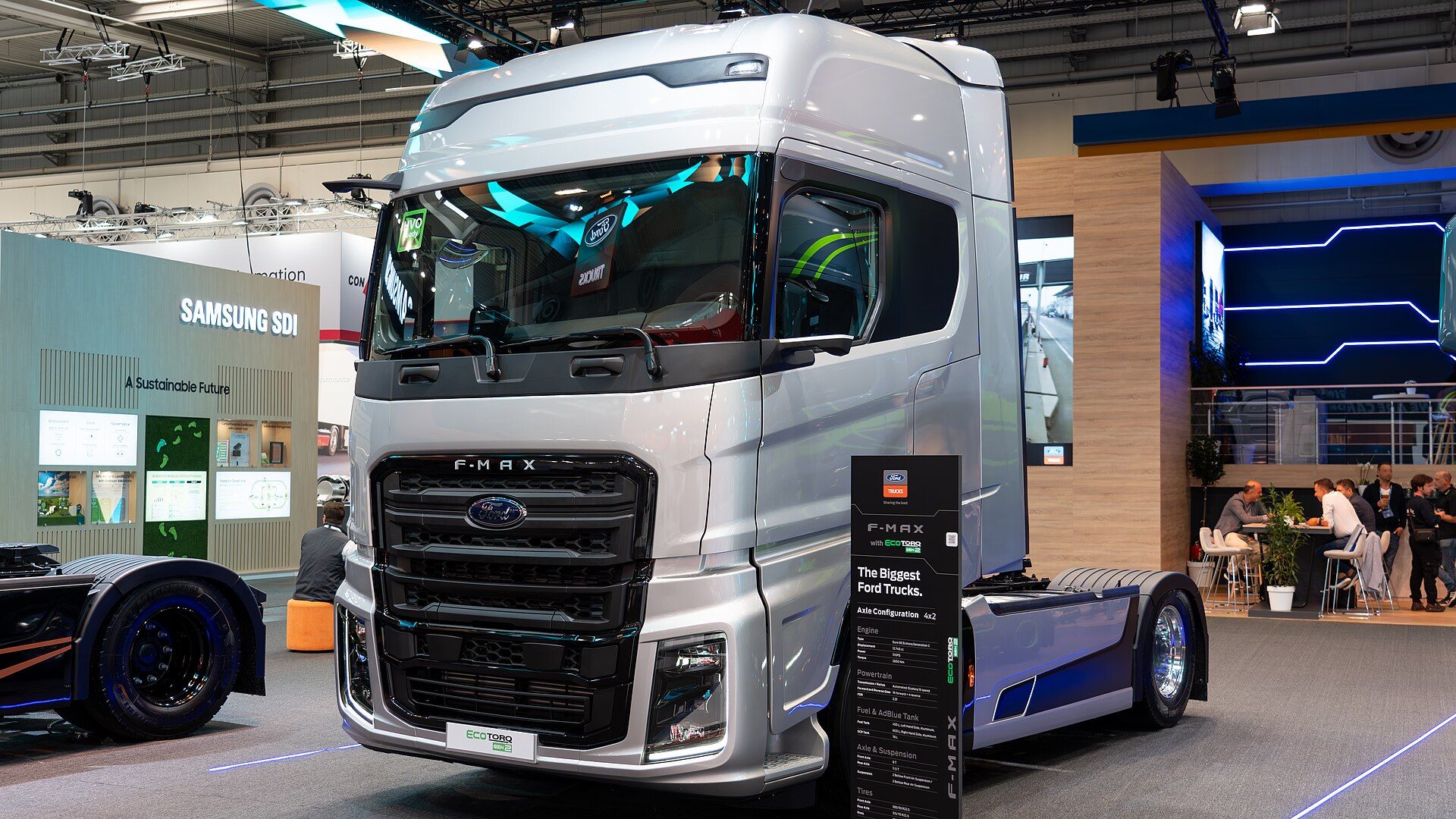
The F-MAX is Ford Trucks’ long-haul tractor, and inside it there is nothing to choose. Where a European incumbent spreads three or four engine families across five wheel formulas, the F-MAX is one engine at one power step in one wheel formula, in three variants that differ mostly in where the trailer sits and how much fuel the truck carries. It was launched at the IAA Commercial Vehicles show in Hanover in 2018, took the 2019 International Truck of the Year award there, and is built in Turkey and sold across European markets.
One engine, one rating, and two traps around it
Ford’s data sheet puts on a single line what most makers spread over a table: GEN2 Ecotorq Euro 6, 12.7 litres, 510 PS — 375 kW — at 1,800 rpm, and 2,600 Nm from 1,000 to 1,300 rpm. The English, Turkish and Spanish sheets carry them identically. Ford publishes the kilowatt number itself, so nothing here has been converted, and the 130 mm x 160 mm bore and stroke is part of the engine’s name on the sheet rather than a footnote. The user manual adds six cylinders, a compression ratio of 21 ± 0.5:1 and 205 Nm of torque per litre.
Two figures circulate that are not a second rating. Ford’s own GEN2 engine page mentions 450 PS, but attaches it to the road, construction and 4x2 tractor ranges rather than to the F-MAX. Ford’s own catalogue advertises 510 PS and 450 PS from one engine, which is the Eco+ Mode driver setting and not an ordering option. Reading a published power figure starts with asking which vehicle and which document it belongs to. Every F-MAX data sheet answers the same way: one rating.
The emission line is where two current Ford documents disagree. All three data sheets say Euro 6 and stop; the English F-MAX catalogue states full compliance with Euro 6E standards, and Euro 6E is also printed on Ford’s September 2021 English export sheet for the 500 PS truck that came before this one, which is in the source list below. A sub-step that appears in a catalogue and on no current specification sheet is not one this page records, so the field above reads Euro 6. Compatibility with HVO is standard on all three variants.
Sixteen forward speeds, and what the top one is for
The gearbox is Ford’s own: an automated Ecotorq 16S 2600 OD with 16 forward and 4 reverse ratios, spanning 14.107 to 0.823. Sixteen speeds against the twelve that are the European default is the first thing an operator used to a TraXon or a TipMatic notices; the more consequential detail is the suffix. OD is overdrive: the highest ratio is 0.823 rather than the 1.00 of a direct-drive box.
Ford’s own documents make the comparison unusually easy, because the current user manual still prints full ratio tables for the two gearboxes this one replaced — a ZF 12 TX 2620 running 16.688 down to 1.000, and an Ecotorq 16S 2600 DD running 17.03 down to 1.00. Both of those top out in direct drive. Only the OD is on the current truck, and a used F-MAX may carry any of the three.
The final drive follows from the same choice: 2.31 on the F-MAX and the F-MAX L, 2.17 on the LL, with 2.47 offered against most fifth-wheel heights. Ford then publishes something few makers do: a table tying each ratio to a rear tyre size and to a laden and an unladen coupling height, so driveline and trailer geometry can be read against each other on one page.
Three variants, and a coupling height that explains them
The F-MAX, the F-MAX L and the F-MAX LL share a cab, an engine and a gearbox. The L is the long-range version: a 3,750 mm wheelbase against 3,600, 6,162 mm overall length against 5,877, and the big tank pairing. The LL is the low one, and it exists for a single measurement. Its fifth wheel sits at 980 mm where the other two sit at 1,100 mm, achieved with a 128 mm coupling in place of the 150 mm unit — the same SAF Holland SK-S 36.20 in all three cases. Dropping the coupling height from 1,100 mm to 980 mm is what lets a taller volume trailer stay under the same overall limit, which is the clearest example this site has of why trailer height is a tractor problem as much as a trailer one. Ford pays for it in chassis steel — 10 mm rails on the LL against 8 mm — and in front air suspension in place of parabolic leaf springs.
On the Turkish home market the same three vehicles are sold as F-MAX, F-MAX Max Range and F-MAX Midilli, and the specification behind the names moves with them: the Turkish base truck carries a 7.5 t front axle, a 2.47 final drive and a 185 mm coupling on a 1,200 mm fifth wheel, where the export sheet’s base F-MAX has an 8 t axle, a 2.31 drive and a 150 mm coupling on a 1,100 mm fifth wheel. Two of the three Turkish items are on the export sheet as well, just not as the standard fit: the 7.5 t axle is listed among the options and the 2.47 drive is offered against several fifth-wheel heights, 1,200 mm among them. Only the 185 mm coupling is absent from the export sheet altogether. The names are not all that changes at the border.
Tanks follow the same split. The F-MAX takes 600 L on the right with a 450 L tank on the left and 78 L of AdBlue; the LL takes 510 and 410 L of diesel against 55 L. The AdBlue-to-diesel ratio those pairings imply is not the same on the two trucks. The cab above them is one specification only: an extra-high-roof sleeper 2.5 m wide and 2,350 mm long, air suspended, leaving 3,150 mm of useful chassis behind it.
What we could not confirm
Ford publishes a turning radius — 7,590 mm, or 7,810 mm on the L — and never says whether it is measured kerb-to-kerb or wall-to-wall. Doubling it would produce a turning circle Ford has not published, so that row is blank and the figure stands above as a radius.
Gross combination weight is the harder one. The three current sheets publish gross vehicle and per-axle weights and no combination figure at all. The 44 tonnes shown here comes from the March 2024 Turkish sheet, which describes the pre-GEN2 500 PS truck, and the variant line above says so. Ford has stopped printing the number, and this page does not carry it forward silently.
Kerb weight moves between documents. The July 2026 English sheet gives the F-MAX 8,413 kg with all the usual footnoted conditions — a 90% full tank, other fluids, tools, a spare wheel and a 75 kg driver. The Turkish sheet of the same month gives 8,122 kg, for the differently specified home-market truck described above. The October 2025 Spanish sheet prints 8,412 kg over axle figures of 5,892 and 2,420 kg, and those two add to 8,312 kg — that addition is ours, not Ford’s, and the July 2026 revision’s axle figures do add up.
Two smaller gaps. Ford states no kilowatt figure anywhere for the pre-GEN2 500 PS engine, so it is quoted in PS here and given no row of its own. And the engine has no code: no F-MAX equivalent of a D2676 or an MX-13 appears in any document that opens, only GEN2 Ecotorq Euro 6 130 mm x 160 mm.
Axles and weights
There is one wheel formula, 4x2, on every sheet and every variant. Ford’s tractor range lists other models beside the F-MAX, and the GEN2 engine page mentions a 6x4 tractor series; those are different vehicles sharing an engine, not F-MAX options.
Gross vehicle weight is 18,000 kg with 19,000 kg optional. The front axle is rated at 8 t, or 7.5 t as an option and as standard on the LL; the rear axle is an XSS-470 at 11.5 t, with an XSS-510 at 13.5 t optional. The interesting row is the pair Ford prints together: 12,000 kg technically permissible on the drive axle against 11,500 kg legally permissible. That gap is the whole argument of what a weight figure on a plate means, set out by the manufacturer in two adjacent columns.
Braking is published with its measurement point attached. The engine brake is quoted at max. 320 kW at engine level; the hydraulic retarder, an option rather than standard equipment, at max. 450 kW with 160 kW continuous. Comparing those two numbers with a rival’s means checking first where each was measured.
Who this truck is right for
The F-MAX suits an operator who wants one specification decided for them. There is no engine, gearbox or wheel formula to choose; what is left is the variant, the tank pairing and the coupling height, and those follow from the work rather than from taste. For a fleet running 4x2 artics on trunk routes, that is a short order form and a short parts list.
It is the wrong truck for anything needing a driven tandem, a heavy-haulage rating or a light regional chassis, and for an operator who wants a 9-litre on payload grounds: Ford does not offer one here.
Where it sits against its rivals
Against a TGX, an S-Way or a Renault T, the F-MAX competes on a narrower front. Its driver assistance list is long: the July 2026 sheet marks moving-off information, blind spot information, lane departure warning, tyre pressure monitoring, driver attention monitoring, traffic sign recognition and alcohol interlock facilitation as standard, and what European law now requires a new truck to carry is the list to read those against. The cab is the other place it does not concede anything — Ford calls it a 2.5 m full-width cab and offers no narrower one. What it does not offer is choice, and it is not trying to.
Buying used
Establish which gearbox is fitted before anything else. The ratio tables in Ford’s own manual show why: a 16-speed with a 0.823 overdrive top, a 16-speed direct-drive box and a 12-speed ZF are three different trucks to drive and to gear for, and only the first is current. Read the final drive off the paperwork in the same breath, because 2.17 and 2.47 are bought for opposite reasons.
Then check which sheet the vehicle was built to. A pre-GEN2 F-MAX is a 500 PS truck with a different compression ratio and a different gearbox; a Turkish home-market truck and an export truck of the same age differ in front axle rating, coupling height and tank layout. None of that is visible from the outside, and all of it is on the registration documents, which is the first of the standard checks on a used tractor unit.
Quick answers
- Which engines are available in the Ford Trucks F-MAX?
- The record for the Ford Trucks F-MAX covers these engine families: Ecotorq GEN2 12.7 (12.7 l). Output spans 375 kW and 2600 Nm.
- What axle configurations does the Ford Trucks F-MAX come in?
- 4x2.
- What emission standard does the Ford Trucks F-MAX meet?
- Euro 6.
Compared with
- Iveco S-Way
- Renault Trucks T
- MAN TGX
Sources
- F-MAX series — Technical Features, July 2026 — Ford Trucks
- F-MAX serisi — Teknik Özellikler, Temmuz 2026 — Ford Trucks
- F-MAX — fichas técnicas, octubre 2025 — Ford Trucks España
- Ford Trucks F-MAX Euro 6 — föy, Mart 2024 — Ford Trucks
- Ford Trucks F-MAX Euro 6E — English export data sheet, September 2021 — Ford Trucks
- Ford Trucks F-MAX — user manual — Ford Otosan
- 2019 International Truck of the Year Award goes to the new Ford Trucks tractor F-MAX — Ford Otosan
- Ford Trucks F-MAX — tractor series — Ford Trucks
- Ecotorq GEN2 engine — Ford Trucks
- New F-MAX — catalogue — Ford Trucks