operating
SCR and AdBlue: what the law makes the system detect
Euro VI never tells a truck how much AdBlue to use. It tells the reagent system what to detect, and what to do to the vehicle once it has — ending at 20 km/h.
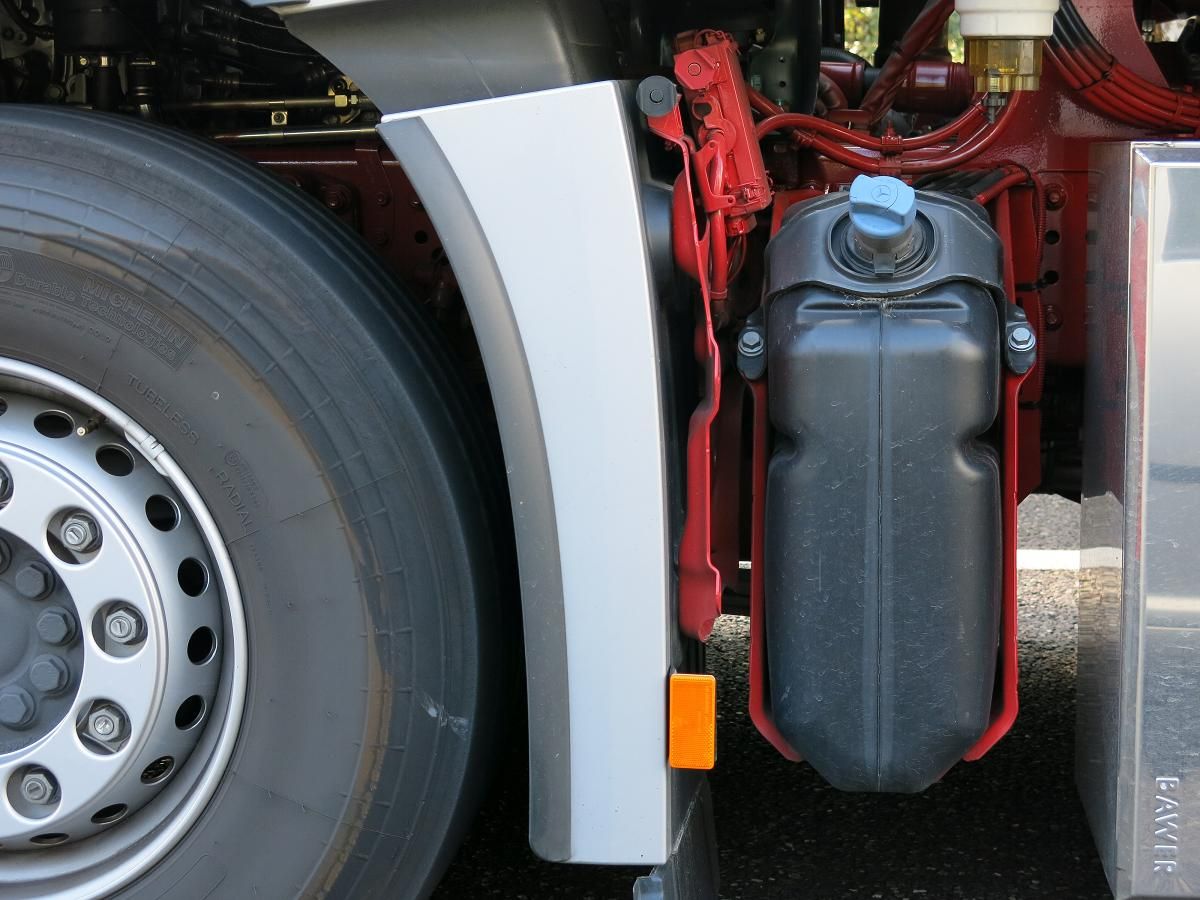
Every Euro VI diesel truck carries a second tank, a blue filler cap and a dashboard indicator most operators think about only when it starts counting down. What that countdown measures, and what happens at the end of it, is not a manufacturer’s design decision. It is written down in detail, with numbers — just not in the document an operator would open first.
The rule is three documents away from where you would look
Regulation (EC) No 595/2009 is the Euro VI regulation, and it does not contain the rule. Article 5(4)(k) instructs the Commission to adopt specific provisions ensuring the correct operation of NOx control measures, and says what they have to achieve: that vehicles cannot be operated if the NOx control measures are inoperative due, for example, to lack of any required reagent, incorrect exhaust gas recirculation flow or deactivation of EGR. That is the legislature’s whole instruction — a purpose, not a threshold.
The implementing measure is Commission Regulation (EU) No 582/2011; the consolidated version on EUR-Lex carries the date 12 March 2026. Article 3(1) makes type-approval conditional on compliance with a list of annexes that includes Annex XIII, headed “Requirements to ensure the correct operation of NOx control measures”. Open it and most of it points somewhere else. Point 3.1 says the maintenance requirements “shall be those set out in paragraph 3 of Annex 11 to UNECE Regulation No 49”, and points 4.1 to 9.1 do the same for the warning system, the inducement system, reagent availability, reagent quality, consumption and dosing, and tampering. What is left is a list of substitutions — which sentence to read in place of a named UN paragraph. Most fit the UN text to the EU framework: the information document, the documentation package, “the territory of the Union” for “the relevant region”, the definition of CDmin and its demonstration, dual-fuel. Only points 4.1.1 and 5.1.1 concern the rescue services, and two carry EU figures the UN annex does not: point 7.1.2 substitutes “the value of 900 mg/kWh” for the NOx emission limit during a phase-in, and point 8.1.1 a 50 per cent deviation threshold.
Which published version of that annex does the pointing reach? Regulation (EU) No 582/2011 answers once, in the footnote on its reference to the UN regulation: “Regulation No 49 of the Economic Commission for Europe of the United Nations (UN/ECE) … (OJ L 171, 24.6.2013, p. 1).” That is the 06 series of amendments. The reference is fixed, not rolling, and only an amending act moves it: Commission Regulation (EU) No 133/2014 was adopted to put it there, its recital 6 reasoning that “[s]ince a 06 series of amendments of UNECE Regulation No 49 has been adopted … it is necessary to update the references of Euro VI to UNECE Regulation No 49”. Nothing since has moved it again, and the phrase “07 series” appears nowhere in the consolidated text. The UN text itself has moved on — the EU published it again as UN Regulation No 49 [2023/64] at OJ L 14 of 16 January 2023, carrying the 07 series in force since 7 January 2022 — but the EU measure has not been amended to follow. So every figure below is read off the 2013 publication, and where the 2023 one differs this page gives both. Paragraph 1.1, identical in both, covers M1, M2, N1 and N2 vehicles with a reference mass over 2,610 kg and all M3 and N3 — the Euro VI scope Article 2 of Regulation (EC) No 595/2009 also sets.
Four things the system has to notice
Annex 11 does not describe an AdBlue gauge. It sets four monitoring duties, three of which run counters of engine operating hours. Paragraph 6 covers availability and requires a dashboard level indicator close to the fuel gauge; it has no counter, because under point A.2.3.3 of Appendix 2 warning and inducement there follow from an assessment of the quantity in the tank and do not depend on any diagnostic trouble code. Paragraph 7 covers quality, against a minimum concentration CDmin the manufacturer declares and proves at type-approval, counted under 7.1.3. Paragraph 8 covers consumption and dosing, comparing what was used against what the engine demanded, with a counter for each under 8.2.1. Paragraph 9 covers tampering, and names two failures — impeding of the EGR valve, and failure of the anti-tampering monitoring itself, including removal or deactivation of any sensor it needs — counted under 9.2.2.1 and 9.2.3.1. Five counters in all: the minimum set listed at point A.2.4.1.1 of Appendix 2, and the same five Appendix 5 makes readable off-board.
| Detected condition | Paragraph | What follows |
|---|---|---|
| Reagent level below 10 per cent of tank capacity, or a higher percentage at the manufacturer’s choice | 6.2.1 | Driver warning system activates |
| Reagent level below 2.5 per cent of nominally full capacity, or a higher percentage at the manufacturer’s choice | 6.3.1 | Low-level inducement enabled |
| Reagent tank empty, or any level below 2.5 per cent of nominally full capacity at the manufacturer’s discretion | 6.3.2 | Severe inducement enabled |
| Reagent concentration below CDmin | 7.1.2, 7.2 | Treated as incorrect reagent; warning |
| Incorrect reagent not rectified within 10 / 20 engine operating hours | 7.3.1, 7.3.2 | Low-level / severe inducement |
| Consumption deviating more than 20 per cent from demanded consumption | 8.4.1 | Driver warning system activates |
| Interruption in reagent dosing, unless the engine ECU demanded it | 8.4.2 | Driver warning system activates |
| Consumption or dosing fault not rectified within 10 / 20 engine operating hours | 8.5.1, 8.5.2 | Low-level / severe inducement |
| EGR valve impeded, or the anti-tampering monitoring failing | 9.1, 9.3 | Driver warning system activates |
| Tampering failure not rectified within 36 / 100 engine operating hours | 9.4.1, 9.4.2 | Low-level / severe inducement |
Two things in that table read as more fixed than they are. None of the three tank-level triggers is a setting: 6.2.1 and 6.3.1 each end “or a higher percentage at the choice of the manufacturer”, and 6.3.2 fires either on an empty tank — the dosing system can no longer draw from it — or at any level below 2.5 per cent the manufacturer chooses. And the dosing row carries its own exception: 8.4.2 requires no warning where the interruption is demanded by the engine ECU because operating conditions are such that the vehicle’s emission performance does not require dosing. That is the pause an operator is likeliest to meet and likeliest to misread as a fault.
The hours are engine operating hours, not calendar time, so a vehicle standing still does not run its clock down. And paragraphs 7.3.3, 8.5.3 and 9.4.3 all say the same thing: the hours before inducement are reduced where the malfunction recurs. A fault that keeps coming back gets less rope each time.
Two stages, and the second one is 20 km/h
Paragraph 5.1 gives the shape of the whole thing in one sentence: a two-stage driver inducement system, starting with a low-level inducement — a performance restriction — followed by a severe inducement, effective disablement of vehicle operation. Paragraph 5.2 then lifts a whole class back out. The requirement does not apply to engines or vehicles for use by the rescue services, or to those designed and constructed for use by the armed services, civil defence, fire services and forces responsible for maintaining public order; permanent deactivation may be done only by the engine or vehicle manufacturer. Point 5.1.1 of Annex XIII restates that for EU purposes, replacing the second limb with the vehicles named in point (b) of Article 2(3) of Directive 2007/46/EC. Nothing in the rest of this section reaches them.
The low-level stage is paragraph 5.3. It cuts the maximum available engine torque by 25 per cent between the peak torque speed and the governor breakpoint, and the maximum available torque below the peak torque speed may not exceed the reduced torque at that speed, so the cut cannot be dodged lower down the range. It takes effect when the vehicle becomes stationary for the first time after the triggering condition — a moment the 2013 text leaves undefined and the 2023 one pins down in a footnote, at the latest one minute after road speed has fallen to zero, with no need to engage a park, trailer or hand brake. The truck is not slowed on the move; it is reduced at the next stop, a different reading of a torque curve from the one on a brochure.
The severe stage, paragraph 5.4, is not one system but a choice plus a backstop: the manufacturer fits at least one of three, and fits the fourth regardless. A “disable after restart” system limits the vehicle to 20 km/h after the engine has been shut down at the driver’s request. A “disable after fuelling” system does so once the fuel tank level has risen by a measurable amount — not more than 10 per cent of fuel tank capacity, approved against the capability of the fuel level meter. A “disable after parking” system does so after the vehicle has stood for more than an hour. The backstop, paragraph 5.4.4, limits it to 20 km/h at the first stop after eight hours of engine operation if none of the other three has fired. There is no waiting it out.
Cold weather is written into the rule
Paragraph 2.4 lets the manufacturer choose a heated or a non-heated reagent tank and dosing system, then imposes different duties on each. A heated system must, under paragraph 2.4.2.1, make reagent available for use within a maximum of 70 minutes after the vehicle is started at an ambient temperature of 266 K (−7 °C) with the reagent frozen — proved by soaking tank and dosing system at 255 K (−18 °C) for 72 hours, then running the engine at 266 K.
A non-heated system gets no such grace. Under paragraph 2.4.3.1 the warning system must activate if no dosing occurs at an ambient temperature at or below 266 K, and under 2.4.3.2 the severe inducement system must activate if no dosing occurs at or below that temperature within a maximum of 70 minutes after vehicle start. Paragraph 2.4.1.1 requires the choice of a non-heated tank to be stated in the written instructions to the owner — a question worth asking of any used vehicle, alongside the other paperwork checks in buying a used truck.
Paragraph 2.3.2 sets the envelope the emission control monitoring system generally works in: ambient temperatures between 266 K and 308 K (−7 °C and 35 °C), all altitudes below 1,600 m, engine coolant temperatures above 343 K (70 °C). Its closing sentence then lifts that envelope off the monitor an operator cares about most: it does not apply to monitoring the reagent level in the storage tank, which “shall be conducted under all conditions where measurement is technically feasible including all conditions when a liquid reagent is not frozen”. The two tank-level rows at the top of the table are bounded by technical feasibility, not by that envelope.
Consumption is a manufacturer’s claim, and the law says so
There is no litres-per-100-km figure anywhere in this chain, and the absence is deliberate. Paragraph 3.4 of Annex 11 requires the manufacturer’s written instructions to specify the required reagent quality, explain how to refill the tank, and indicate a likely rate of reagent consumption for the type of vehicle and how often it will need replenishing. The duty is to publish a rate; the regulation sets none. A consumption figure is therefore a manufacturer’s statement about its own product, carrying no regulatory standing, and this page prints none.
What the regulation does put numbers on is the gap between actual and demanded dosing. In the 2013 text, paragraph 8.4.1 activates the warning when a deviation of more than 20 per cent is detected between average reagent consumption and average demanded consumption over a period the manufacturer defines. Paragraph 8.3.1 caps that period at 48 hours or the equivalent of at least 15 litres of demanded consumption, whichever is longer, and 8.3.2 requires at least one of two parameters to be watched to get there: the level of reagent in the on-vehicle tank, or the flow or quantity injected as close as technically possible to the point of injection. Those are limits on how long a fault may hide, not statements about how much a truck uses.
They are also where the choice of published text bites hardest, which is why it was worth settling first. The 2013 text carries a paragraph 8.4.1.1 relaxing the 20 per cent to 50 until the end of a phase-in, and point 8.1.1 of Annex XIII is the EU substitution for it, tying that relaxation to Article 4(7) of Regulation (EU) No 582/2011: three years after the dates in Article 8(1) and (2) of Regulation (EC) No 595/2009, which are 31 December 2012 and 31 December 2013. Adding the three years is our arithmetic, not the Regulation’s — the later window closed at the end of 2016, so the relaxation has lapsed and the 20 per cent is what is left. The 2023 publication resolves it the other way: fifty per cent written into 8.4.1 itself, 8.4.1.1 dropped, the base period in 8.3.1 cut to five hours or at least 2 litres, and a new 8.3.1.1 extending it back to 48 hours or 15 litres where consumption is monitored by tank level or injected quantity. Quote either pair without naming the publication and you are quoting a number, not a rule.
What the operator carries
Two duties in Regulation (EC) No 595/2009 sit on the operator rather than the manufacturer. Article 7(1) says manufacturers, repairers and operators of the vehicles shall not tamper with systems which use a consumable reagent; Article 7(2) says operators shall ensure that vehicles are not driven without a consumable reagent. Article 11(2) requires member states to make both punishable, listing tampering with systems which control NOx emissions and, for operators specifically, driving a vehicle without a consumable reagent. Annex 11 paragraph 3.6 requires the owner’s instructions to say as much: that it may be a criminal offence to use a vehicle that does not consume reagent where reagent is needed to reduce emissions.
Two provisions make that enforceable. Paragraph 2.5 requires every separate reagent tank to include a means of taking a sample of the fluid inside it, accessible without a specialised tool. And point 3.4 of Annex II to Regulation (EU) No 582/2011 provides that engines with any Annex XIII counter not at zero may not be used for in-service conformity testing, and that this be reported to the approval authority. The counters outlast the driver who ignored the light, which is why the reagent system belongs in the running-cost conversation rather than the workshop one.
What Euro 7 does with all this
Regulation (EU) 2024/1257 replaces the framework on dates that are now close. Article 10(6) stops approval authorities granting emission type-approval to non-compliant new types of M2, M3, N2 and N3 vehicles and O3 and O4 trailers from 29 May 2028. From 29 May 2029, Article 10(7) has national authorities consider the certificates of conformity of non-compliant new vehicles and trailers in those categories to be no longer valid for the purposes of registration, and prohibit the registration, sale or entry into service. Two carve-outs sit against that date. Article 10(8) derogates from it until 31 December 2029 for M2 and M3 vehicles carrying a 100 per cent zero-emission target from the 2030 reporting period under Regulation (EU) 2019/1242, which may still be registered, sold or put into service on a valid Regulation (EC) No 595/2009 approval — a bus derogation. Article 10(10) sets 1 July 2031 instead for vehicles in those four categories from small-volume manufacturers. Article 20 repeals both Regulation (EU) No 582/2011 and Regulation (EC) No 595/2009 with effect from 1 July 2031. Until then both remain in force.
Euro 7 keeps the concept and moves the detail. Article 3(70) defines a low-reagent driver warning system, and Article 12 has national authorities verify during in-service conformity or market surveillance checks that manufacturers have installed it correctly. The characteristics and performance of driver warning systems and inducement methods sit in Article 14(4)(k), among the things the Commission is to lay down in implementing acts, and one such act exists: Commission Implementing Regulation (EU) 2025/1707 of 25 July 2025, made on Article 14(3)(a) and Article 14(4), points (j), (k), (o), (s), (t), (u) and (v). Its Article 1(2) confines it to M1 and N1 and to N2 vehicles designated “Euro 7ext” and “Euro 7Gext” under Article 5, so it does not reach the categories this page is about; for M2, M3, N2 and N3 the corresponding acts fall under Article 14(9), which gives the Commission until 29 November 2026. The wider step from Euro VI to Euro 7 is set out in Euro VI and Euro 7 explained. Until a heavy-duty act arrives, the operative text is the one described here: a UN annex, published in the Official Journal in 2013, that the EU regulation points at rather than repeats.
Quick answers
- What happens if a truck runs out of AdBlue?
- The vehicle is limited to 20 km/h. Annex 11 to UN Regulation No 49 enables the severe inducement system at paragraph 6.3.2 when the reagent tank is empty, or at any level below 2.5 per cent of nominally full capacity at the manufacturer's discretion, and paragraphs 5.4.1 to 5.4.4 define that system as a creep mode capped at 20 km/h. Paragraph 5.2 exempts rescue-service, armed-services, civil-defence, fire-service and public-order vehicles from inducement altogether.
- Why does a truck lose power when AdBlue runs low?
- It loses 25 per cent of its maximum available engine torque. Annex 11 paragraph 5.3 requires the low-level inducement system to make that reduction between the peak torque speed and the governor breakpoint, taking effect the first time the vehicle becomes stationary; paragraph 5.2 exempts rescue-service vehicles and the other categories named in it from inducement entirely.
- At what AdBlue level does the warning come on?
- Below 10 per cent of reagent tank capacity, under Annex 11 paragraph 6.2.1, or a higher percentage if the manufacturer chooses. The low-level inducement follows below 2.5 per cent of nominally full capacity under paragraph 6.3.1, again or a higher percentage at the manufacturer's choice.
- How much AdBlue does a truck use per 100 km?
- No figure in the type-approval rules answers that. Annex 11 paragraph 3.4 only requires the manufacturer's written instructions to indicate a likely rate of consumption for the type of vehicle; the regulation itself sets no rate, so any number you are quoted is a manufacturer's claim with no regulatory standing.
- How long can frozen AdBlue take to thaw?
- 70 minutes at most. Annex 11 paragraph 2.4.2.1 requires a heated reagent tank and dosing system to make reagent available for use within a maximum of 70 minutes after the vehicle is started at 266 K (−7 °C).
Sources
- Regulation No 49 of the UN Economic Commission for Europe, 06 series of amendments, Annex 11 — the text Regulation (EU) No 582/2011 cites — EUR-Lex, Official Journal of the European Union, L 171, 24.6.2013
- Commission Regulation (EU) No 582/2011 (Euro VI implementing measures), consolidated text — Annex XIII — EUR-Lex, European Union
- Commission Regulation (EU) No 133/2014 — the act that set the Euro VI references to that publication of UN Regulation No 49 — EUR-Lex, Official Journal of the European Union, L 47, 18.2.2014
- Regulation (EC) No 595/2009 on type-approval with respect to emissions from heavy duty vehicles (Euro VI) — EUR-Lex, Official Journal of the European Union
- UN Regulation No 49 [2023/64], 07 series of amendments — the current UN text, cited for comparison — EUR-Lex, Official Journal of the European Union, L 14, 16.1.2023
- Regulation (EU) 2024/1257 on type-approval of motor vehicles and engines with respect to their emissions and battery durability (Euro 7) — EUR-Lex, Official Journal of the European Union
- Commission Implementing Regulation (EU) 2025/1707 — driver warning systems and inducement methods for M1, N1 and certain N2 vehicles — EUR-Lex, Official Journal of the European Union, 5.9.2025