What it costs to run a tractor unit
Fuel, driver, tolls, tyres and residual value: where the money actually goes on a European long-haul tractor, and which lines the specification sheet controls.
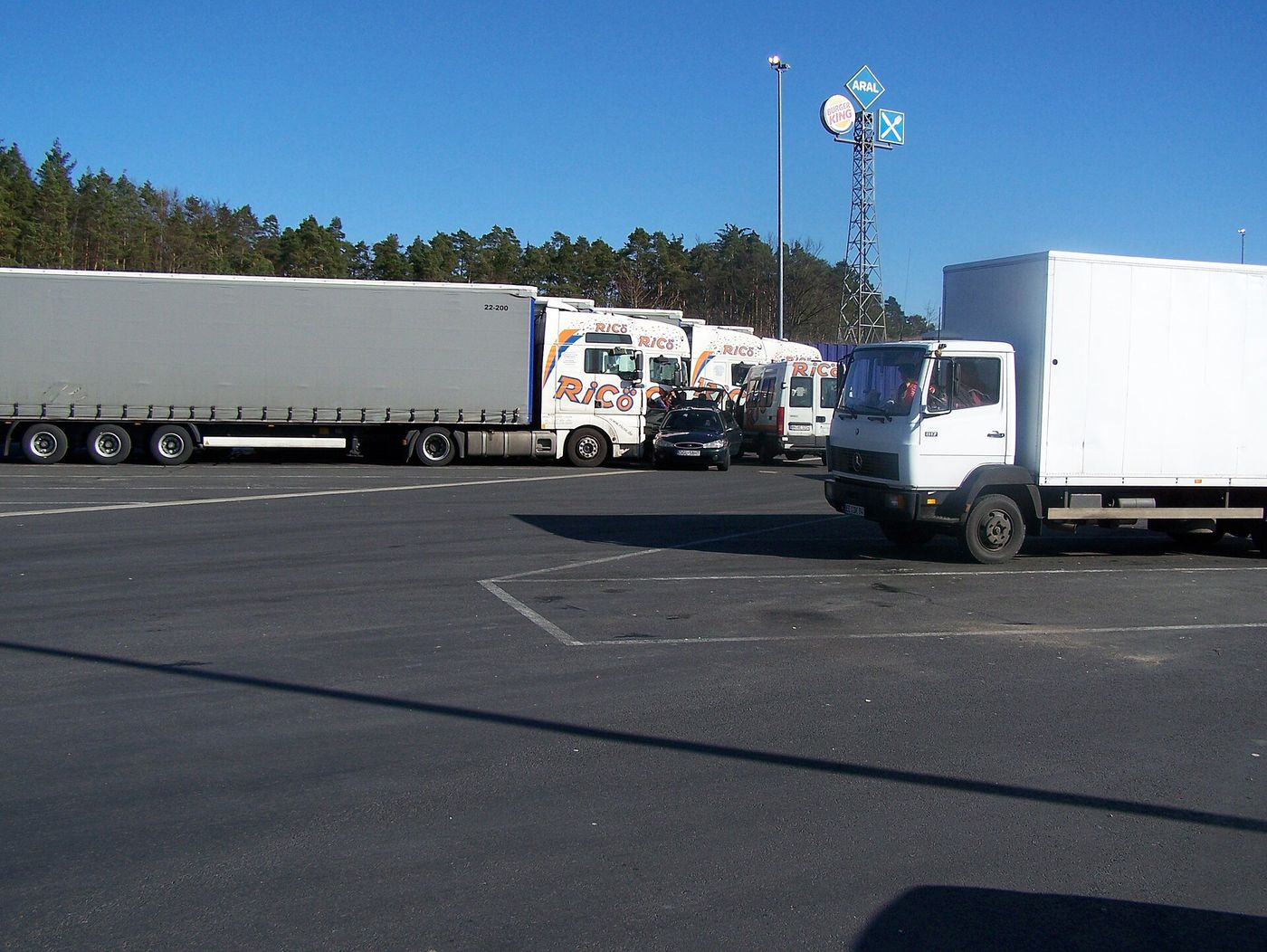
Ask what a tractor unit costs and someone quotes the list price. Over a first life of four or five years a European long-haul tractor also has to be fuelled, driven and tolled, and those lines recur for as long as it runs. The purchase decision is worth making carefully, but what you are really buying is a position on the other cost lines.
The working unit is cost per kilometre, and the first job is to split it in two: costs that accrue per kilometre (fuel, AdBlue, tyres, tolls, wear-driven maintenance) and costs that accrue per day the vehicle exists (finance, depreciation, insurance, road tax, operator licence, workshop and office overhead, and most of the driver’s pay). The two piles respond to entirely different levers, and mixing them is how fleets end up chasing the wrong saving. AdBlue is the one variable line with no regulated consumption rate behind it: the type-approval rules govern only what the reagent system must detect and what it does to the vehicle when it does, so every litres-per-100-km figure you are quoted comes from the manufacturer.
The denominator is capped by law
Every fixed cost is divided by annual kilometres, and annual kilometres are limited by driving-time law before they are limited by anything else. Regulation (EC) No 561/2006 allows nine hours of driving a day, extendable to ten twice a week, with a ceiling of 56 hours in a week and 90 hours in any two consecutive weeks, and a 45-minute break after four and a half hours at the latest.
Ninety hours a fortnight is 45 driving hours a week. At a door-to-door average of 70 km/h — generous once loading bays, urban approaches and traffic are counted — that is around 3,150 km a week, so a single-manned tractor working 46 weeks tops out, by our arithmetic, near 145,000 km a year. Almost no fleet achieves it. The point is that the ceiling is legal, not mechanical: the truck could do far more.
This is why utilisation dominates the model. The same tractor carries the same finance and depreciation whether it runs 90,000 km or 140,000 km a year, so the fixed component of cost per kilometre falls, by our arithmetic, by more than a third between those two figures. Double-manning, back-loading and trailer-swap operations exist to attack that denominator, and none of them is a specification choice.
Fuel, and the fact that it is now a certified number
Since 2019 every new 4x2 or 6x2 long-haul tractor sold in the EU — 6x4 long-haul tractors followed a year later, from 2020 — has carried a declared CO2 and fuel-consumption figure produced by VECTO under Regulation (EU) 2017/2400, a simulation over defined mission profiles and payloads, fed with measured data for the engine, gearbox, axle, tyres and air drag. For the first time, two tractors from different manufacturers can be compared on the same basis.
Use it with two cautions. VECTO’s mission profiles are not your route, so the declared figure is for ranking vehicles, not for budgeting. And it is a whole-vehicle result: aerodynamics, axle ratio, tyre choice and gearbox software move it as much as the engine does. Mercedes credits the aerodynamically optimised ProCabin of the Actros L with up to 3%; Scania claims up to 8% for the Super powertrain against its own previous 13-litre. Treat both as best cases, then note that one cent per kilometre over 600,000 km is, by our arithmetic, €6,000 — which is why a percentage point is worth arguing about.
The price side is not in your control but the exposure is. The IRU’s 2025 cost work, reported by trans.info, put the weighted EU average diesel price at €1.54 a litre in August 2025 — with taxes making up around half of the pump price, and excise duty averaging €0.45 and ranging from €0.33 to €0.63 a litre across member states. The same truck on the same job has a materially different fuel bill depending on where it fills, which is why routing and fuel-card strategy sit alongside vehicle choice rather than below it.
Setting a charging tariff beside a diesel price
A charging tariff is quoted per kilowatt-hour and a diesel price per litre, so the two cannot be ranked as they stand. The two meet only when each is multiplied by what the vehicle itself uses over the same distance, which gives a cost per kilometre. This page does not compute that result. It sets out what the two published prices are and on what basis each is stated, because two prices are compared only on the same tax basis.
As listed on 29 September 2026, Milence (which also appears in megawatt charging explained) gives its charging tariffs by country and marks them “Prices do not include VAT.” The European Commission’s Weekly Oil Bulletin, which “presents weekly consumer prices for petroleum products in EU countries”, publishes its prices as two separate files, “Prices with taxes” and “Prices without taxes”. The Bulletin’s price-history file heads its with-taxes sheet “Consumer prices of petroleum products inclusive of duties and taxes” and its without-taxes sheet “Consumer prices of petroleum products net of duties and taxes”. Neither file is on the tariff’s stated basis: the first includes VAT, and the second is net of duties as well as taxes, a wider set than VAT alone, since the Bulletin’s tax section covers “value added taxes (VAT), excise duties, and other indirect taxes”.
Bringing a diesel price from the with-taxes file to the tariff’s stated basis means taking VAT out, and that needs the country’s VAT rate, which the Bulletin publishes in a separate duties-and-taxes file. It is a division, not the subtraction of a fixed amount: in Council Directive 2006/112/EC VAT is a tax “exactly proportional to the price of the goods and services” (Article 1(2)) and the taxable amount “shall include” “taxes, duties, levies and charges, excluding the VAT itself” (Article 78(a)), so a price with VAT is the price before VAT multiplied by one plus the rate. That step is our arithmetic, not the Directive’s wording.
What each published number stands for also differs. Milence describes its list as “the ad-hoc charging tariff that applies to customers who pay Milence directly through their bank or credit card”; prices for customers using an eMSP charge card or app “may differ”, depending on the contract with the eMSP, and Milence also offers volume-based discounts and flexible agreements for high-demand fleets. A listed price per kWh is therefore one tariff, not the price every customer pays. Where a Milence hub is in an existing safe and secure truck parking, parking fees “might still apply and are not part of the charging tariff”. The Bulletin’s diesel prices are weekly consumer prices, in EUR per 1,000 litres, so a price per litre is the Bulletin figure divided by 1,000, by our arithmetic; Milence gives its United Kingdom, Denmark and Sweden tariffs in £, DKK and SEK.
Both sources change, and each price here is written with its date. Milence’s tariff page shows no publication or effective date and says that tariffs “may be updated as conditions change”. The Bulletin’s national data and prices are submitted to the Commission on Wednesdays and subscribers receive the bulletin every Thursday, and the date of a bulletin is not the date of its prices: the bulletin of 24 September 2026 carries prices dated 21 September 2026. As an illustration of two published figures, not of a comparison: on 29 September 2026 Milence listed Germany at “€ 0.399 / kWh”, VAT excluded, and the Bulletin of 24 September 2026 gives German diesel with taxes at 2,457.00 EUR per 1,000 litres for 21 September 2026 — €2.457 a litre by our arithmetic. The unit, the tax basis and the date all differ, so this page draws no ratio or difference between the two.
Tolls have become a specification decision
Germany is the clearest case because the rates are written into statute. Annex 1 to the Bundesfernstraßenmautgesetz sets four partial rates for vehicles over 18 t. Infrastructure, noise and air pollution each use a single four-axles-or-more bracket; the CO2 rate alone splits four axles from five or more. An ordinary 40-tonne artic carries five axles, so for a Euro VI engine in CO2 emission class 1: infrastructure costs €0.155 per kilometre, noise €0.012, air pollution €0.023, and CO2 €0.158. Add the four and the total, by our arithmetic, is 34.8 cents a kilometre. For a class 5 vehicle the CO2 partial rate is zero.
Read that again: at €0.158 the CO2 component is the largest of the four — ahead even of the infrastructure charge — and it is the only one you can change by buying a different truck. On 120,000 German motorway kilometres, the CO2 component alone is, by our arithmetic, €18,960 a year.
This is not a German peculiarity. Under the Eurovignette directive as amended in 2022, tolls and vignettes for heavy vehicles have had to vary by CO2 emissions since 2024, and from 2026 the external cost of air pollution must be built in as well. The IRU’s 2025 cost work, reported by trans.info, found that in Austria the toll for a Euro VI artic can reach €0.62 per kilometre against fuel intensity of around €0.46 — in that work, the toll could cost more than the diesel.
The CO2 emission class is derived from the vehicle’s certified VECTO result. A number that began as an environmental label is now a line in the profit and loss account, and it belongs on the specification sheet next to the engine rating. How the five classes are defined, and which part of the bill each one actually moves, is set out in EU road tolls and CO2 classes.
The driver, and why the cab is a cost line
In Western Europe the driver is one of the largest cost lines, and unlike fuel it does not stop when the truck does. Waiting at a loading bay, running empty to reposition and sitting out a mandatory rest are all paid time producing no revenue. Anything that raises the loaded proportion of the working day beats almost anything you can do to the vehicle. On cross-border work the rate itself moves: a driver performing cabotage is posted to the host state and has to be paid on its terms.
That is also the honest argument for cab specification. A flat-floor, full-height cab of the sort fitted to the DAF XG+ or the Volvo FH in its taller variants costs money and a little fuel, and it is defended on retention rather than on efficiency. If a driver vacancy costs you weeks of a tractor standing still, the cab is competing against the fixed-cost-per-kilometre line, and it usually wins that argument — and how long such a vacancy stays open is set by European truck driver supply. Keeping an existing driver legal is its own fixed cost: the 35 hours of periodic training every five years described in Driver CPC explained fall due whether the tractor is earning or not.
Tyres, maintenance and the number nobody budgets
Tyres are two costs at once: rolling resistance shows up in fuel, casing wear shows up in replacement. Only the first of those is on the EU tyre label, whose C3 rolling resistance classes are set out in truck tyre labelling. Axle configuration decides how much rubber you buy — a 6x2 carries more than a 4x2, which is part of why the third axle is liftable.
Maintenance is best handled as a policy question rather than a forecast. A repair-and-maintenance contract converts an unpredictable variable cost into a fixed monthly one; that is a risk and cash-flow decision, not a saving, and it should be priced as such. The alternative, sourcing parts and labour outside the dealer network, is governed by the rules set out in genuine, OE and aftermarket parts. What some makers’ service contracts for electric trucks list and exclude is described in electric-truck maintenance compared with diesel.
Residual value is one of the largest lines in a three-to-five-year model, and the one operators guess at. It is set by the used market, not by you, and it responds to emission class, completeness of service history and how ordinary the specification is. An unusual axle configuration or a rare engine step is cheap to buy and slow to sell. The book value the figure is measured against is a different thing again, set by a published table rather than by the market: see truck depreciation and book value.
Putting it together
Build the model in cost per kilometre with fixed and variable separated, put your own utilisation into the denominator rather than a brochure figure, and price tolls corridor by corridor rather than as a national average. Then sanity-check it against a route you already run. If the model cannot reproduce a cost you already know, it will not predict one you do not.
The trip cost calculator adds up fuel, AdBlue, tolls and driver time for one trip from the prices entered.
Quick answers
- What are the main cost lines on a long-haul tractor?
- Beyond the purchase price, the lines are diesel, the driver and tolls, alongside AdBlue, tyres, finance, depreciation and insurance. The useful unit is cost per kilometre, split into per-kilometre costs (fuel, AdBlue, tyres, tolls) and per-day costs (finance, depreciation, insurance, most of the driver’s pay).
- How many kilometres can a single-manned tractor legally cover in a year?
- Regulation (EC) No 561/2006 allows nine hours of driving a day (ten twice a week), 56 hours in a week and 90 hours in any two weeks. At a door-to-door average of 70 km/h that is roughly 3,150 km a week, so a single-manned tractor working 46 weeks tops out, by our arithmetic, near 145,000 km a year — a legal ceiling, not a mechanical one.
- Why has the toll become a specification decision?
- Germany’s toll charges a CO2 component derived from the vehicle’s certified VECTO result. For an ordinary 40-tonne artic, which carries five axles, in CO2 class 1 the partial rates total, by our arithmetic, 34.8 cents per kilometre, of which the CO2 part — the largest of the four — is 15.8 cents; for a class 5 vehicle that part is zero. On 120,000 German motorway kilometres the CO2 component alone is, by our arithmetic, €18,960 a year.
- Why is the cab counted as a cost line?
- In Western Europe the driver is one of the largest cost lines, and a truck a driver will not live in is a truck that stands. A flat-floor, full-height cab costs money and a little fuel but is defended on retention: if a driver vacancy costs weeks of a tractor standing still, the cab competes against the fixed-cost-per-kilometre line and usually wins.
- How do you compare an electricity price per kWh with a diesel price per litre?
- A price per kWh and a price per litre meet only when each is multiplied by what the vehicle itself uses over the same distance, which gives a cost per kilometre; this page does not compute that result. Two prices are compared only on the same tax basis: Milence’s tariffs, as listed on 29 September 2026, carry the note 'Prices do not include VAT.', while the EU Weekly Oil Bulletin publishes diesel prices in two separate files, 'Prices with taxes' and 'Prices without taxes'.
- Do truck charging tariffs include VAT?
- Milence’s country tariffs, as listed on 29 September 2026, do not: they carry the note 'Prices do not include VAT.' That is one operator’s list, and Milence says tariffs 'may be updated as conditions change'. The EU Weekly Oil Bulletin publishes diesel prices in two separate files, 'Prices with taxes' and 'Prices without taxes', and its price-history file heads the two as consumer prices 'inclusive of duties and taxes' and 'net of duties and taxes', so neither is on the basis of a tariff whose stated exclusion is VAT alone.
Models in this article
Sources
- Driving time and rest periods (Regulation (EC) No 561/2006) — European Commission — Mobility and Transport
- Bundesfernstraßenmautgesetz (BFStrMG), Anlage 1 — Mautteilsätze — Bundesministerium der Justiz (gesetze-im-internet.de)
- Road charging — tolls and vignettes for heavy-duty vehicles — European Commission — Mobility and Transport
- Lorries, buses and coaches — VECTO and CO2 standards for heavy-duty vehicles — European Commission — Climate Action
- Driving profitability: fuel, tolling and cost trends in the EU — IRU — World Road Transport Organisation
- Tolls overtake fuel in Europe's truck costs — trans.info
- Super powertrain — 13-litre engine range — Scania
- Milence charging tariffs — Milence
- General FAQ — Milence
- Weekly Oil Bulletin — European Commission — Energy, 24 Sept 2026
- Council Directive 2006/112/EC on the common system of value added tax (consolidated text, 14.04.2025) — Publications Office of the European Union
- Commission Regulation (EU) 2017/2400 on the determination of the CO2 emissions and fuel consumption of heavy-duty vehicles (OJ L 349, 29.12.2017) — Publications Office of the European Union
- Mercedes-Benz Actros L ProCabin: focus on aerodynamics, efficiency and driver comfort — Daimler Truck Newsroom