Volvo
Volvo FH
Volvo's 2020-generation FH runs three 13-litre engine families: the D13 at 420 to 540 hp, the turbocompound D13 I-Save and the gas G13, with five cabs.
- 2021—
- 6 configurations
- 309–397 kW
- Euro VI
.jpg)
Model overview
- Segment
- Long-haul tractor
- Produced
- 2021—
- Axle configurations
- 6 (4x2…)
- Emission
- Euro VI
- Transmission
- Volvo I-Shift automated, 12-speed; I-Shift Dual Clutch with diesel engines of 460 hp and above, not with the G13
- Gross combination
- 44 t (FH 13 6x4 tractor, GB data sheet FH 64T 3A)
Axle configurations: 4x2 · 6x2 · 6x4 · 8x2 · 8x4 · 10x4
Engine families
- Power
- 309–397 kW
- Torque
- 2100–2600 Nm
- Power
- 309–368 kW
- Torque
- 2400–2800 Nm
- Power
- 309–368 kW
- Torque
- 2100–2550 Nm
| Variant | Axle configurations | Wheelbase (mm) | Kerb weight (kg) | Gross vehicle (kg) | Gross combination (kg) | Sheet |
|---|---|---|---|---|---|---|
| FH 42T 3A | 4x2 | 3,500 / 3,600 / 3,700 / 3,800 | 6,845 / 6,855 / 6,865 / 6,870 | 18,000 (plated) | 40,000 (plated) | FH 42T 3A 01 GBR 2026-09-25 |
| FH 62T P3A | 6x2 | 3,800 / 3,900 / 4,000 / 4,100 | 7,755 / 7,770 / 7,775 / 7,780 | 22,800 (plated) | 44,000 (plated) | FH 62T P3A 01 GBR 2026-09-25 |
| FH 62T T3A | 6x2 | 3,000 / 3,200 / 3,400 / 3,700 / 3,900 | 8,045 / 8,070 / 8,105 / 8,140 / 8,145 | 26,000 (plated) | 44,000 (plated) | FH 62T T3A 01 GBR 2026-09-25 |
| FH 64T 3A | 6x4 | 3,000 / 3,200 / 3,400 / 3,600 / 3,900 | 8,875 / 8,900 / 8,940 / 8,960 / 8,995 | 26,000 (plated) | 44,000 (plated) | FH 64T 3A 01 GBR 2026-09-25 |
| FH 64T 3L | 6x4 | 3,000 / 3,200 / 3,400 / 3,600 / 3,900 | 8,875 / 8,890 / 8,920 / 8,940 / 8,960 | 26,000 (plated) | 44,000 (plated) | FH 64T 3L 01 GBR 2026-09-25 |
| FH 84T P3A | 8x4 | 3,600 / 3,900 | 9,870 / 9,900 | 24,850 (plated) | 44,000 (plated) | FH 84T P3A 01 GBR 2026-09-25 |
| FH 104RFT3A | 10x4 | 4,300 / 4,350 / 4,600 / 4,900 / 5,100 / 5,600 / 6,000 | 11,230 / 11,260 / 11,275 / 11,335 / 11,375 / 11,380 / 11,420 | 32,000 (plated) | 38,770 (plated) | FH 104RFT3A 01 GBR 2026-09-25 |
| FH 42R 3A | 4x2 | 3,400 / 3,700 / 4,000 / 4,300 / 4,600 / 4,900 / 5,200 / 5,600 / 6,000 / 6,300 / 6,500 / 6,700 | 6,830 / 6,855 / 6,905 / 6,945 / 6,995 / 7,025 / 7,050 / 7,050 / 7,165 / 7,225 / 7,245 / 7,285 | 18,000 (plated) | FH 42R 3A 01 GBR 2026-09-25 | |
| FH 42R 3L | 4x2 | 3,400 / 3,700 / 4,000 / 4,300 / 4,600 / 4,900 / 5,200 / 5,600 | 6,820 / 6,850 / 6,895 / 6,945 / 6,990 / 7,020 / 7,050 / 7,055 | 18,000 (plated) | FH 42R 3L 01 GBR 2026-09-25 | |
| FH 62R T3A | 6x2 | 3,500 / 3,700 / 3,900 / 4,300 / 4,600 / 4,800 / 4,900 / 5,200 / 5,600 / 6,000 | 7,765 / 7,785 / 7,820 / 7,875 / 7,935 / 7,945 / 7,960 / 7,995 / 8,065 / 8,125 | 26,000 (plated) | 26,780 (plated) | FH 62R T3A 01 GBR 2026-09-25 |
| FH 64R 3A | 6x4 | 3,700 / 3,900 / 4,300 / 4,600 / 4,900 / 5,200 / 5,600 | 8,530 / 8,545 / 8,610 / 8,705 / 8,720 / 8,735 / 8,800 | 26,000 (plated) | 27,880 (plated) | FH 64R 3A 01 GBR 2026-09-25 |
| FH 64R 3L | 6x4 | 3,700 / 3,900 / 4,300 / 4,600 / 4,900 / 5,200 / 5,600 | 8,905 / 8,925 / 9,005 / 9,110 / 9,135 / 9,170 / 9,245 | 26,000 (plated) | 27,880 (plated) | FH 64R 3L 01 GBR 2026-09-25 |
| FH 82RF 3A | 8x2 | 5,100 / 5,600 / 6,000 | 9,355 / 9,405 / 9,470 | 32,000 (plated) | 35,580 (plated) | FH 82RF 3A 01 GBR 2026-09-25 |
| FH 82RPT3A | 8x2 | 5,100 / 5,600 | 9,225 / 9,255 | 32,000 (plated) | 35,580 (plated) | FH 82RPT3A 01 GBR 2026-09-25 |
| FH 84RF 3A | 8x4 | 5,100 / 5,600 / 6,000 / 6,400 | 9,930 / 9,975 / 10,010 / 10,040 | 32,000 (plated) | 35,580 (plated) | FH 84RF 3A 01 GBR 2026-09-25 |
| FH 84RF 3L | 8x4 | 5,100 / 5,600 / 6,000 / 6,200 | 9,950 / 9,990 / 10,025 / 10,030 | 32,000 (plated) | 35,580 (plated) | FH 84RF 3L 01 GBR 2026-09-25 |
| FH 84R P3A | 8x4 | 4,600 / 4,900 / 5,100 / 5,300 / 5,600 | 9,710 / 9,750 / 9,765 / 9,790 / 9,835 | 29,850 (plated) | 32,830 (plated) | FH 84R P3A 01 GBR 2026-09-25 |
| FH 84R T3A | 8x4 | 3,700 / 3,900 / 4,100 / 4,300 / 4,600 / 4,900 / 5,200 | 9,875 / 9,900 / 9,940 / 9,955 / 10,005 / 10,030 / 10,040 | 32,000 (plated) | 35,470 (plated) | FH 84R T3A 01 GBR 2026-09-25 |
| FH 42T LA2 (G13 gas) | 4x2 | 3,700 / 3,800 | 7,460 / 7,465 | 18,000 (plated) | 40,000 (plated) | FH 42T LA201 GBR 2026-09-25 |
| FH 62T PLA2 (G13 gas) | 6x2 | 4,100 | 8,285 | 23,430 (plated) | 44,000 (plated) | FH 62T PLA201 GBR 2026-10-05 |
| FH 62T TLA2 (G13 gas) | 6x2 | 3,900 | 8,895 | 26,000 (plated) | 44,000 (plated) | FH 62T TLA201 GBR 2026-09-25 |
| FH 64T LA2 (G13 gas) | 6x4 | 3,900 | 9,755 | 26,000 (plated) | 44,000 (plated) | FH 64T LA201 GBR 2026-09-25 |
| FH 42R LA2 (G13 gas) | 4x2 | 5,200 | 7,580 | 18,000 (plated) | FH 42R LA201 GBR 2026-09-25 | |
| FH 62R TLA2 (G13 gas) | 6x2 | 4,300 / 4,600 / 4,800 / 4,900 / 5,200 | 8,520 / 8,570 / 8,590 / 8,600 / 8,630 | 26,000 (plated) | 31,180 (plated) | FH 62R TLA201 GBR 2026-09-25 |
| FH 64R LA2 (G13 gas) | 6x4 | 4,300 / 4,600 / 4,900 / 5,200 | 9,135 / 9,235 / 9,245 / 9,260 | 26,000 (plated) | 31,180 (plated) | FH 64R LA201 GBR 2026-09-25 |
Overview and generations
Volvo launched the current generation of the FH on 27 February 2020, together with new versions of the FH16, FM and FMX. Its release of 4 March 2021 says the four models were then entering serial production, with the Tuve plant in Gothenburg first, in March 2021, and that more than 12,000 trucks of the new range had already been ordered in 2020. This record covers that FH with the three 13-litre engine families that Volvo Trucks UK still lists on its FH specifications page in September 2026: the D13, the D13 I-Save and the gas-powered G13. In May 2026 Volvo announced an all-new 13-litre diesel and gas platform; the section on the new engines below sets out what that announcement says and does not say about these engines, and why its figures are not in the tables. Volvo’s documents opened for this record describe only the current, 2020-launched generation.
Cab
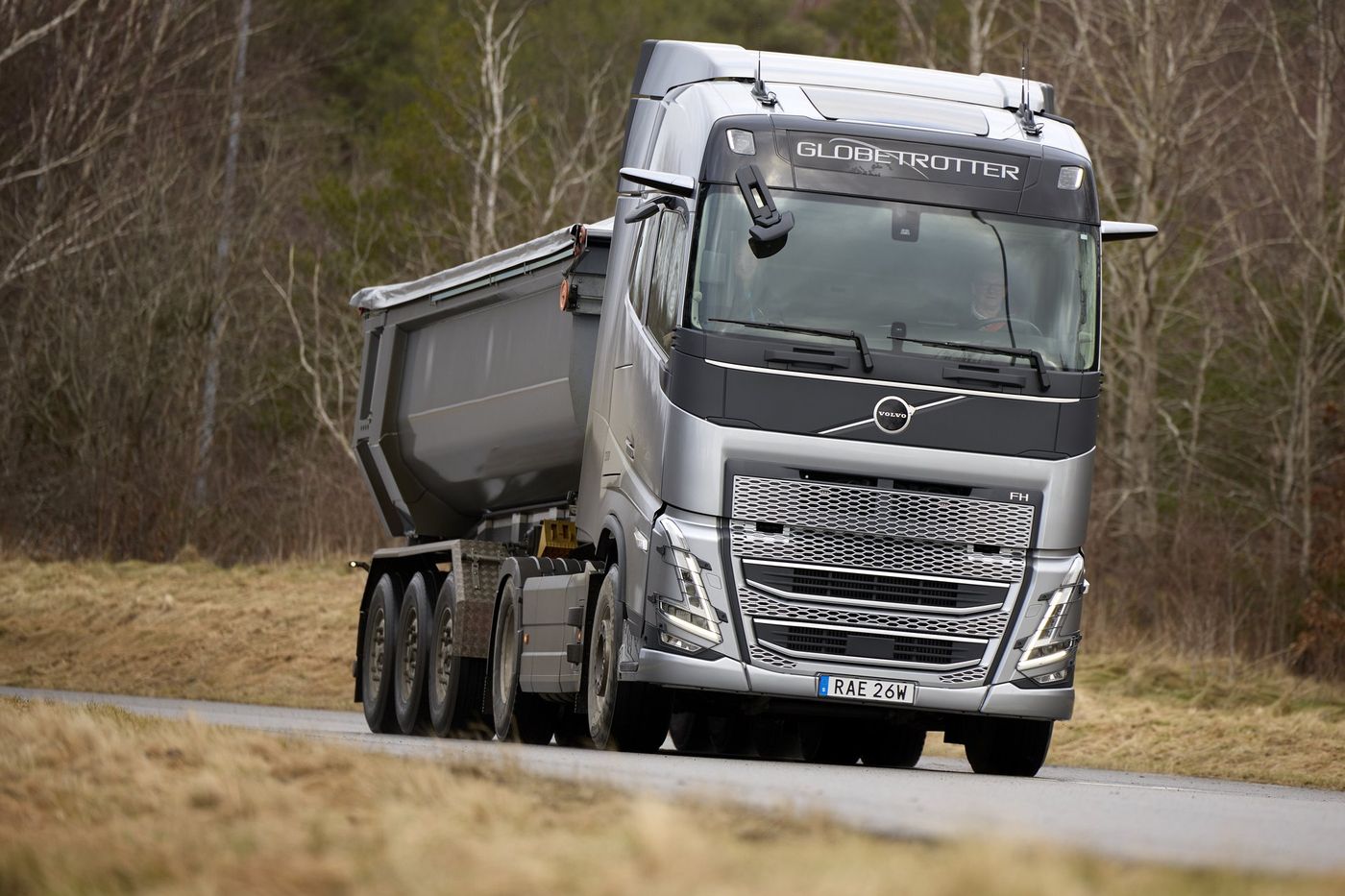
Volvo’s UK specifications page lists five cab variants for the FH, distinguished by interior height. The Low Sleeper Cab (CAB-LSLP) has a lowered roof and cab suspension that adds load space above the cab, and an interior height of 147 centimetres (138 centimetres over the engine compartment cover). The Sleeper cab (CAB-SLP) is 171 centimetres (162 over the engine cover). The Globetrotter cab (CAB-HSLP) is 205 centimetres (196 over the engine cover). The Globetrotter XL (CAB-XHSL) is 220 centimetres (211 over the engine cover) and Volvo describes it as built for extra storage space through its added height. The Globetrotter XXL is a longer cab: its bed is 213 centimetres long, with widths of 99, 106.5 and 91 centimetres at the head, middle section and feet.
Measured to the top of the cab, the FH’s height above the ground depends on chassis height, suspension and drive configuration: Volvo’s tables run from about 3,025 mm, on a 4x2 tractor with a Low chassis, air suspension and the Low Sleeper Cab, up to about 4,000 mm, on an 8x4 or 10x4 rigid with a High chassis, leaf suspension and the Globetrotter XL cab. The cab has four-point suspension, with a choice of coil springs and dampers, front coil springs with rear air suspension, or air suspension all round.
The standard bed measures 74×200 centimetres, with an 81.5-centimetre-wide middle section; an extendable version pulls out from 74×200 to 88×200 centimetres, widening its middle section to 95.5 centimetres. An Upper Comfort bed is also available, at 60×190 or 70×190 centimetres. Volvo offers a foam mattress or a 16-centimetre pocket-spring mattress, each in soft, semi-firm or firm variants, plus an overlay protector. Interior storage includes a front shelf with four DIN-standard recesses, storage compartments on both sides with roller-blind doors, an illuminated upper rear shelf, two pull-out drawers under the bed totalling 130 litres, and smaller compartments under the mattress at the foot (10 litres) and head (15 litres) of the bed. Volvo lists around 650 exterior colour variants and separate exterior and interior trim levels, from a Basic exterior trim with a Thunder Grey grille to a highest level with a cab-coloured grille, mirrors, visor, door handles, bumper and spoiler; interior trim runs from vinyl-and-textile Robust through textile Dynamic to two-tone leather Progressive.
Three engine families
The standard D13 is a 12.8-litre, six-cylinder engine with a 131 mm bore and 158 mm stroke and an 18.0:1 compression ratio, at 309–397 kW and 2,100–2,600 Nm, in four steps from 420 to 540 hp. Volvo’s Great Britain data sheet for the FH 13 6x4 tractor, dated 25 September 2026, lists these four steps only as options, as it does the I-Save engines described below. Its standard-fit engine is a D13 marked VGT, at 420 hp and 2,400 Nm, from a series the sheet also offers at 460 hp and 2,600 Nm, 500 hp and 2,800 Nm, and 560 hp and 2,900 Nm; the sheet gives that series no kilowatt figures, so it is not in the table. The sheet notes that the specification can vary from country to country. Volvo UK gives the D13 an economy-rev band of 900–1,400 r/min, an oil change volume of 35 litres including the filter, and a cooling-system volume of 24 litres.
The D13 I-Save shares that displacement, bore and stroke and the same 18.0:1 compression ratio, and adds a turbocompound unit, which Volvo describes as an additional turbine in the exhaust flow that uses excess exhaust energy to power the engine. Volvo introduced the FH with I-Save in March 2019, a year before this generation, and the 2020 launch release carries it into the new FH. Volvo UK lists the engine at 309–368 kW and 2,400–2,800 Nm, and at each of its three power steps it has 300 Nm more than the standard D13 of the same horsepower; its economy revs run 900–1,300 r/min, its oil change volume is also 35 litres, and its cooling-system volume is 26 litres. The 6x4 data sheet also lists a 480 hp I-Save at 2,700 Nm; it gives no kilowatt figure, so that step is not in the table.
Volvo UK’s page gives the two diesel engines’ peaks at different engine speeds: the I-Save’s maximum power from 1,230, 1,240 and 1,250 r/min at 420, 460 and 500 hp, against 1,404 r/min for the standard D13 at the same steps, and its maximum torque from 900 r/min against 905, 945 and 980 r/min. The GB 6x4 data sheet of 25 September 2026 gives no engine speeds.
Volvo aimed I-Save at long haul, and its fuel claim is for a package rather than the engine alone. The 2019 release describes the FH with I-Save as the D13TC engine together with new rear axles, an updated I-See, I-Shift with long-haul software, I-Cruise with I-Roll, engine idle shutdown and a variable-displacement power steering pump. It credits the combined gains with fuel-cost savings of up to 7% against a Euro 6 step D standard D13 without that Long Haul Fuel Package. That is Volvo’s own comparison, and the release says actual fuel economy will vary with factors that include vehicle specification, vehicle load and vehicle maintenance. The two versions of the release disagree on who it was for: Volvo’s global release says I-Save was tailored especially to operators driving more than 120,000 km a year, Volvo UK’s version says more than 160,000 km.
The G13 runs on LNG or bio-LNG, at the same 12.8-litre displacement, 131 mm bore, 158 mm stroke and 900–1,400 r/min economy-rev band as the D13, but a lower, 17.0:1 compression ratio. Volvo UK’s page rates it at 309–368 kW and 2,100–2,550 Nm, in three steps from 420 to 500 hp, and gives it a 35-litre oil change volume and a 38-litre cooling-system volume. Volvo’s seven GB data sheets for the gas-powered FH, dated 25 September 2026 and, for one of them, 5 October 2026, give the same 420 hp at 2,100 Nm and 460 hp at 2,300 Nm, but 2,500 Nm at 500 hp, where the UK page gives 2,550 Nm. The variants table marks the rows taken from those sheets “G13 gas”. The battery-electric FH is a separate model with its own record, the Volvo FH Electric.
Volvo UK’s page gives all three engine families as Euro 6 and names no step, so this record stops at Euro VI. The 2020 launch release called the gas engine of that time Euro 6 step D and based its I-Save fuel claim on step D engines; the GB 6x4 data sheet of 25 September 2026 gives Euro VI, with SCR, EGR and a particulate filter, and names no step either. The launch release also refers to Euro 3 and Euro 5 versions of the FH; this record covers only the Euro 6 engines Volvo UK lists. Volvo UK also publishes engine-braking figures for each family: an optional engine brake of 340 kW at 2,300 r/min for the D13 and 435 kW at 2,300 r/min for the D13 I-Save, against exhaust-brake effects of 175 kW and 150 kW; the G13 has a 200 kW exhaust brake and an optional 380 kW engine brake at 2,300 r/min.
The new 13-litre engines
Volvo announced its all-new 13-litre diesel and gas platform on 12 May 2026. The release gives the new D13 at 380–560 hp and 1,800–2,900 Nm and the new G13 at 420–500 hp and 2,400–2,800 Nm, for the FM, FMX, FH and FH Aero, with sales to begin during the third quarter of 2026 and Europe among the first markets. Its fuel comparison is against “the engine it is replacing”, which a footnote identifies as the previous standard D13 eSCR engine. The release does not mention the I-Save or turbocompound, and Volvo’s global FH page, which now quotes up to 560 hp and 2,900 Nm for diesel and up to 500 hp and 2,800 Nm for gas, still lists I-Save among its options. Neither gives kilowatt figures, so the new engines are absent from the table.
Transmission
Volvo UK’s powertrain tables pair every engine with I-Shift, which the page describes as a 12-speed splitter and range gearbox with automated gear changing, available with a compact retarder, a power take-off, an emergency power steering pump and an oil cooler, and orderable with crawler gears, ultra-low crawler gears or a reverse multispeed. The I-Shift Dual Clutch appears in those tables only against the diesel engines of 460 hp and above, standard and I-Save, and not against the G13; the 6x4 data sheet lists it as optional equipment. The same page gives each gearbox a GCW approval: the direct-drive AT2412 (2,400 Nm) is approved to 44 tonnes, the direct-drive AT2612 (2,600 Nm) and overdrive ATO2612 (2,600 Nm) to 100 tonnes, the direct-drive AT2812 (2,800 Nm) to 70 tonnes, the overdrive ATO3112 (3,150 Nm) to 100 tonnes, and the overdrive I-Shift Dual Clutch SPO2812 (2,800 Nm) to 80 tonnes. The rear axles listed there carry their own approvals, from 44 to 100 tonnes.
Volvo’s documents do not agree on the gearboxes. The GB 6x4 tractor data sheet of 25 September 2026 gives a GCW of 60 tonnes for the AT2612 and the AT2812, which the UK page approves to 100 and 70 tonnes, and of 100 tonnes for the ATO2612. It gives no GCW for the ATO3112, which it labels “FH16 600”, for the I-Shift Dual Clutch SPO2812, which it labels not for heavy haulage, or for an AT3012 that the UK page does not list. It rates its standard drive axle for a GCW of 70 tonnes and its optional drive axles for 100 tonnes, plates that tractor at 44 tonnes GCW, plated and design, and notes that legal weights can differ from country to country.
Crawler gears are a further option. Volvo UK says I-Shift can be ordered with crawler gears and ultra-low crawler gears, and the data sheet gives their ratios: 19:1 on a direct-top gearbox or 17:1 on an overdrive gearbox, and 32:1 for the ultra-low crawler. The 325-tonne figure attached to them comes from Volvo’s crawler-gear release of March 2016, four years before this generation: it says a truck with crawler gears can move off from standstill and transport a gross combination weight of up to 325 tonnes. That describes start-off ability, not a weight approval, and none of the current Volvo documents opened for this record repeats it.
Volvo UK also lists engine-mounted, clutch-independent power take-offs for the FH: the EPTT350, EPTT650 and EPTT1000, each geared at 1.26:1 and delivering 350, 650 and 1,000 Nm respectively, both while driving and standing still. Separate clutch-independent, rear-mounted power take-offs (PTER-DIN, PTER1400, PTER-100) and a range of clutch-dependent power take-offs with flange or DIN attachment (PTR-F, PTR-FL/FH, PTR-D/DM/DH, PTRD-F, PTRD-D, PTRD-D1, PTRD-D2) are offered to drive body equipment.
Axles, suspension and brakes
The FH 13 data sheets on Volvo UK’s FH page cover 4x2, 6x2 pusher, 6x2 tag, 6x4 and 8x4 pusher-tridem tractors, and 4x2, 6x2 tag, 6x4, 8x2, 8x4 and 10x4 rigids, so the 8x2 and 10x4 layouts are rigid only. Every tridem sheet among them, the 8x4 tractor’s included, carries a note in its title to contact Volvo sales engineering. Volvo UK’s front-axle load table breaks the rating out by chassis height: on a single front axle, air suspension is rated at 8 tonnes on the X-Low and Low chassis and 10 tonnes on the Med and High chassis, while leaf suspension is rated at 9 tonnes on the Med chassis and 10 tonnes on the High and X-High chassis (air suspension is not offered on the X-High chassis, nor leaf suspension on X-Low or Low). With dual front axles, Volvo UK rates the axle at up to 20 tonnes, on the Med and High chassis with air suspension or the High and X-High chassis with leaf suspension. Pusher axles are available fixed or actively steered, at loads of 4.5, 7.5 or 9 tonnes; tag axles come fixed with single or dual wheels, self-steered or actively steered, at loads of 7.5, 9.5 or 10 tonnes. A Tandem Axle Lift, which raises the rearmost drive axle on the tandem bogie when the truck is unloaded and lowers it automatically when loaded, is available for 6x4 and 8x4 configurations with a tandem bogie and disc brakes.
Volvo UK lists single-reduction, hypoid-gear rear axles rated up to 13 tonnes solo or up to 23 tonnes on a tandem bogie, and hub-reduction, spiral-cut rear axles rated up to 13 tonnes solo or up to 38 tonnes on a tandem bogie, with a maximum axle torque of 3,800 Nm on the highest-rated types. Across the rear axle types it lists for the FH, the published ratios run from 2.06:1 up to 7.22:1. Volvo’s page pairs rear suspension types with these axles, from parabolic and multi-leaf springs to air suspension, at bogie loads it states individually for each type.
Volvo UK describes EBS (Electronically-controlled Brake System) as standard on all specifications, available for disc brakes and for Z-cam drum brakes on a selected range of axle configurations and chassis heights, with EBS status monitoring through the TEA2+ vehicle electronic system and Volvo Tech Tool. It lists an Auto Hold function that keeps the last applied braking pressure until the driver presses the accelerator, a lining-wear analysis that calculates remaining mileage on disc brakes, and an automatic parking-brake release, tied to I-Shift, that releases when the driver presses the accelerator with a gear selected. Centrally mounted, semi-undermounted and undermounted towbars for centre-axle trailers can be fitted at intervals of 25 millimetres.
Dimensions and weights
Volvo UK gives four nominal chassis heights for the FH — X-Low at approximately 810 mm, Low at approximately 850 mm, Med at approximately 900 mm and High at approximately 1,000 mm — plus an X-High chassis at approximately 1,200 mm. Combined with the cab and suspension choices above, these set the cab-height figures given in the Cab section. The GCW approvals recorded under Transmission above, from 44 to 100 tonnes depending on gearbox and rear axle, are the combination-weight figures Volvo UK publishes for the FH; the FH 13 6x4 tractor data sheet instead plates its one configuration at 44 tonnes GCW, plated and design. Neither document gives a single wheelbase table for the FH; the wheelbases and kerb weights in the variants table each come from the GB data sheet named in that row.
Fuel and AdBlue tanks
Volvo UK lists aluminium or steel fuel tanks in volumes from 150 to 900 litres, with a maximum fuel volume of 1,510 litres on a 4x2 tractor. Gas tanks for the G13 come in three sizes: 155 kg (375 litres), 205 kg (495 litres) and 225 kg (545 litres). AdBlue tanks, plastic with an integrated pump module, are listed in volumes from 32 to 112 litres.
Safety and driver-assistance systems
The FH specifications page itself describes Volvo Dynamic Steering, under its own “Driver support systems” heading, as an active steering system with torque overlay that delivers more steering force at low speeds, reduces steering kicks, keeps the steering wheel straight during braking on a split-friction surface, and returns the wheel automatically to its neutral position when driving forward or in reverse; Volvo UK says it is available for all axle configurations, including dual front axles, and in combination with individual front suspension.
Volvo Trucks UK’s separate driver-support-systems page, reached from the FH’s own features menu, describes further systems for its truck range without stating which are standard or optional on the FH specifically: Pilot Assist, built on Volvo Dynamic Steering, which reads lane markings by camera and gives continuous active steering support while requiring the driver’s hands on the wheel; Lane Keeping Assist, which alerts the driver and steers toward the centre of the lane if the truck drifts from it; Stability Assist, which counter- steers if the system detects the truck starting to skid; adaptive cruise control, which keeps a set distance from the vehicle ahead down to a full stop and pulls away again; road sign recognition with Intelligent Speed Assist, which reads recently passed signs together with map and GPS data and alerts the driver if the speed limit is exceeded; Driver Alert Support, which detects signs of drowsy or inattentive driving; Collision Warning with Emergency Brake, which detects vehicles, cyclists and pedestrians ahead and brakes automatically if the driver does not react to a collision risk; downhill cruise control, which limits speed on a descent using the auxiliary brake before the wheel brakes; Stretch Brake, which applies braking pulses to the trailer to reduce jackknife risk on a slippery downhill surface; adaptive high beam, which reshapes the light beam around other vehicles it detects; Electronic Stability Control, which reduces engine power and brakes individual wheels if it detects a critical skid or roll risk; a Tyre Pressure Monitoring System; Front Short Range Assist, which uses radar and camera at standstill and up to 10 km/h to warn of road users ahead of the truck; Side Collision Avoidance Support, which uses radar to warn of pedestrians, cyclists and vehicles beside the truck and adds steering guidance if the turn indicator is used toward a detected road user; Door Opening Warning, which uses radar to warn of road users close to the cab doors; and Active Grip Control, which controls wheel spin to improve stability, acceleration and braking in slippery conditions, activating instantly when it detects signs of skidding.
Volvo Trucks UK’s Camera Monitoring System page describes a system of up to three cameras — one on each side and an optional front passenger corner camera — replacing the door mirrors, with automatically heated lenses, a zoomable, switchable wide or narrow view, infra-red-assisted night vision, a front close-up mirror view and a parked-vehicle surveillance mode; that page states that the features it depicts “may not be standard or available for all equipment levels and powertrain options.”
Equipment and options
Volvo UK’s seat listing gives three comfort levels for the driver’s seat — Progressive (plush or leather), Dynamic (textile) and Robust (vinyl) — with an adjustable head restraint, backrest and lumbar support and an angle-adjustable seat base; the passenger seat offers the same three levels with a standard head restraint and an optional moving passenger seat. Upholstery is available in vinyl, textile or plush, and some non-vinyl, non-textile trims can be ordered with a ventilating function. Climate options listed include a manual air-conditioning system (MCC), an automatic system (ECC/ECC2) with optional sun, fog and air-quality sensors, a cab and engine parking heater, and I-ParkCool, a battery-powered system for cooling or heating the cab while the truck is parked that Volvo describes as roughly 20 dB quieter than earlier comparable systems and that does not affect cab aerodynamics or standing height, other than with the optional cab heater (PH-CAB). Exterior storage comprises large compartments on both sides of the cab, openable from outside or within, plus an additional unheated compartment under the cab on each side. Air intakes are positioned on the left side, in a high or low position depending on the application, with a front air intake also available.
Source notes
Engines as Volvo UK still listed them in September 2026; Volvo announced new 13-litre D13 and G13 engines in May 2026. Combination weight depends on components as well as the model: Volvo UK’s specifications page gives I-Shift gearboxes GCW approvals from 44 t to 100 t, while Volvo’s GB data sheet for the FH 13 6x4 tractor rates two of them, the AT2612 and AT2812, to 60 t and plates that tractor at 44 t. Volvo’s 2016 crawler-gear release, which predates this generation, says a truck with crawler gears can move off from standstill and transport a GCW of up to 325 t; that is not a weight approval.
Quick answers
- Which engines are available in the Volvo FH?
- The record for the Volvo FH covers these engine families: Volvo D13 (12.8 l), Volvo D13 I-Save (turbocompound) (12.8 l), Volvo G13 (LNG / bio-LNG) (12.8 l). Output spans 309–397 kW and 2100–2800 Nm.
- What axle configurations does the Volvo FH come in?
- 4x2, 6x2, 6x4, 8x2, 8x4, 10x4.
- What emission standard does the Volvo FH meet?
- Euro VI.
- When did production of the Volvo FH start?
- Production of the Volvo FH started in 2021.
- Which transmission does the Volvo FH use?
- Transmission: Volvo I-Shift automated, 12-speed; I-Shift Dual Clutch with diesel engines of 460 hp and above, not with the G13.
- What is the gross combination weight of the Volvo FH?
- Gross combination weight: 44 t (FH 13 6x4 tractor, GB data sheet FH 64T 3A).
- How much does the Volvo FH weigh?
- Kerb weight: 6 845–6 870 kg (FH 42T 3A); 7 755–7 780 kg (FH 62T P3A); 8 045–8 145 kg (FH 62T T3A); 8 875–8 995 kg (FH 64T 3A).
Volvo models on this site, side by side
| Segment | Produced | Axle configurations | Power | Torque | Gross combination | |
|---|---|---|---|---|---|---|
| Volvo FE | Distribution | 3 configurations | 184–258 kW | 950–1400 Nm | 32 t | |
| Volvo FH | Long-haul tractor | 2021— | 6 configurations | 309–397 kW | 2100–2800 Nm | 44 t |
| Volvo FH16 | Long-haul tractor | 2021— | 6 configurations | 441–574 kW | 3000–3800 Nm | 44 t |
| Volvo FL | Distribution | 2 configurations | 154–235 kW | 800–1200 Nm | 24 t | |
| Volvo FM | Long-haul tractor | 2021— | 6 configurations | 246–368 kW | 1600–2550 Nm | 44 t |
| Volvo FMX | Construction | 2021— | 10 configurations | 246–397 kW | 1600–2600 Nm | 44 t |
Articles that mention the Volvo FH
- Electric tractor units: register of maker-declared values
- Battery-electric, hydrogen or combustion: heavy-vehicle powertrains and what the sources say
- Turbocompound engines: how they work and what makers claim
- Electric-truck maintenance compared with diesel: what goes, what stays
- How electric-truck range is declared (and why the figures cannot be compared)
- Megawatt Charging System (MCS) for electric trucks explained
- Aerodynamic cabs and the EU length rules
- Automated manual transmissions in heavy trucks
More Volvo on this site
Sources
- Volvo FH specifications — engines, I-Shift GCW approvals, rear axles, data sheets — Volvo Trucks UK
- FH 13 6x4 Tractor – Rear Air Suspension – N3 or N3G (data sheet, 25 September 2026) — Volvo Trucks
- Volvo Trucks launches the new Volvo FH (press release, 27 February 2020) — Volvo Trucks
- Serial production starts for Volvo Trucks' new generation of heavy-duty trucks (press release, 4 March 2021) — Volvo Trucks
- New Volvo FH with I-Save cuts fuel costs by up to 7% (press release, 7 March 2019) — Volvo Trucks
- Cut Fuel Costs by up to 7% Using the New Volvo FH With I-Save (press release, 7 March 2019) — Volvo Trucks UK
- New I-Shift with crawler gears can start off from standstill with 325 tonnes (15 March 2016) — Volvo Group
- Volvo Trucks' all-new combustion engine platform (press release, 12 May 2026) — Volvo Trucks
- Volvo FH — Volvo Trucks
- Driver support systems — Volvo Trucks UK
- Camera Monitoring System — Volvo Trucks UK
- FH 13 4x2 Tractor – Rear Air Suspension (data sheet FH 42T 3A, 25 September 2026) — Volvo Trucks, 25 Sept 2026
- FH 13 6x2 Pusher Tractor – Standard or Lite – Rear Air Suspension (data sheet FH 62T P3A, 25 September 2026) — Volvo Trucks, 25 Sept 2026
- FH 13 6x2 Tag Tractor – Rear Air Suspension (data sheet FH 62T T3A, 25 September 2026) — Volvo Trucks, 25 Sept 2026
- FH 13 6x4 Tractor – B/T Ride – N3 (data sheet FH 64T 3L, 25 September 2026) — Volvo Trucks, 25 Sept 2026
- FH 13 8x4 Tractor – Pusher Axle Tridem – contact sales engineering reference application (data sheet FH 84T P3A, 25 September 2026) — Volvo Trucks, 25 Sept 2026
- FH 13 10x4 Rigid – Tag Tridem – N3 – contact sales engineering reference application (data sheet FH 104RFT3A, 25 September 2026) — Volvo Trucks, 25 Sept 2026
- FH 13 4x2 Rigid – Rear Air Suspension (data sheet FH 42R 3A, 25 September 2026) — Volvo Trucks, 25 Sept 2026
- FH 13 4x2 Rigid – Steel Suspension (data sheet FH 42R 3L, 25 September 2026) — Volvo Trucks, 25 Sept 2026
- FH 13 6x2 Tag Rigid – Rear Air Suspension (data sheet FH 62R T3A, 25 September 2026) — Volvo Trucks, 25 Sept 2026
- FH 13 6x4 Rigid – Rear Air Suspension – N3 or N3G (data sheet FH 64R 3A, 25 September 2026) — Volvo Trucks, 25 Sept 2026
- FH 13 6x4 Rigid – B/T Ride – N3 (data sheet FH 64R 3L, 25 September 2026) — Volvo Trucks, 25 Sept 2026
- FH 13 8x2 Tag Rigid – Rear Air Suspension (data sheet FH 82RF 3A, 25 September 2026) — Volvo Trucks, 25 Sept 2026
- FH 13 8x2 Rigid – Pusher & Tag Axle Tridem – contact sales engineering reference application (data sheet FH 82RPT3A, 25 September 2026) — Volvo Trucks, 25 Sept 2026
- FH 13 8x4 Rigid – Rear Air Suspension – N3 or N3G (data sheet FH 84RF 3A, 25 September 2026) — Volvo Trucks, 25 Sept 2026
- FH 13 8x4 Rigid – B/T ride – N3 (data sheet FH 84RF 3L, 25 September 2026) — Volvo Trucks, 25 Sept 2026
- FH 13 8x4 Rigid – Pusher Axle Tridem – contact sales engineering reference application (data sheet FH 84R P3A, 25 September 2026) — Volvo Trucks, 25 Sept 2026
- FH 13 8x4 Rigid – Tag Tridem – N3 or N3G – contact sales engineering reference application (data sheet FH 84R T3A, 25 September 2026) — Volvo Trucks, 25 Sept 2026
- FH Gas powered 4x2 Tractor – Rear Air Suspension – Contact Regional Business Manager before quoting (data sheet FH 42T LA2, 25 September 2026) — Volvo Trucks, 25 Sept 2026
- FH Gas powered 6x2 Lite Pusher Tractor – Contact Regional Business Manager before quote (data sheet FH 62T PLA2, 5 October 2026) — Volvo Trucks, 5 Oct 2026
- FH Gas powered 6x2 Tag Tractor – Rear Air Suspension – Contact Regional Business Manager before quote (data sheet FH 62T TLA2, 25 September 2026) — Volvo Trucks, 25 Sept 2026
- FH Gas powered 6x4 Tractor – Rear Air Suspension – Contact Regional Business Manager before quote (data sheet FH 64T LA2, 25 September 2026) — Volvo Trucks, 25 Sept 2026
- FH Gas powered 4x2 Rigid – Rear Air Suspension – Contact Regional Business Manager before quoting (data sheet FH 42R LA2, 25 September 2026) — Volvo Trucks, 25 Sept 2026
- FH Gas powered 6x2 Tag Rigid – Rear Air Suspension – Contact Regional Business Manager before quote (data sheet FH 62R TLA2, 25 September 2026) — Volvo Trucks, 25 Sept 2026
- FH Gas powered 6x4 Platform – Rear Air Suspension – Contact Regional Business Manager before quote (data sheet FH 64R LA2, 25 September 2026) — Volvo Trucks, 25 Sept 2026