How electric-truck range is declared (and why the figures cannot be compared)
Internal tests, the EU's VECTO output file, WLTP, 'up to', 'typical' and ranges by weight: the bases on which makers state electric-truck range, each with its stated conditions.
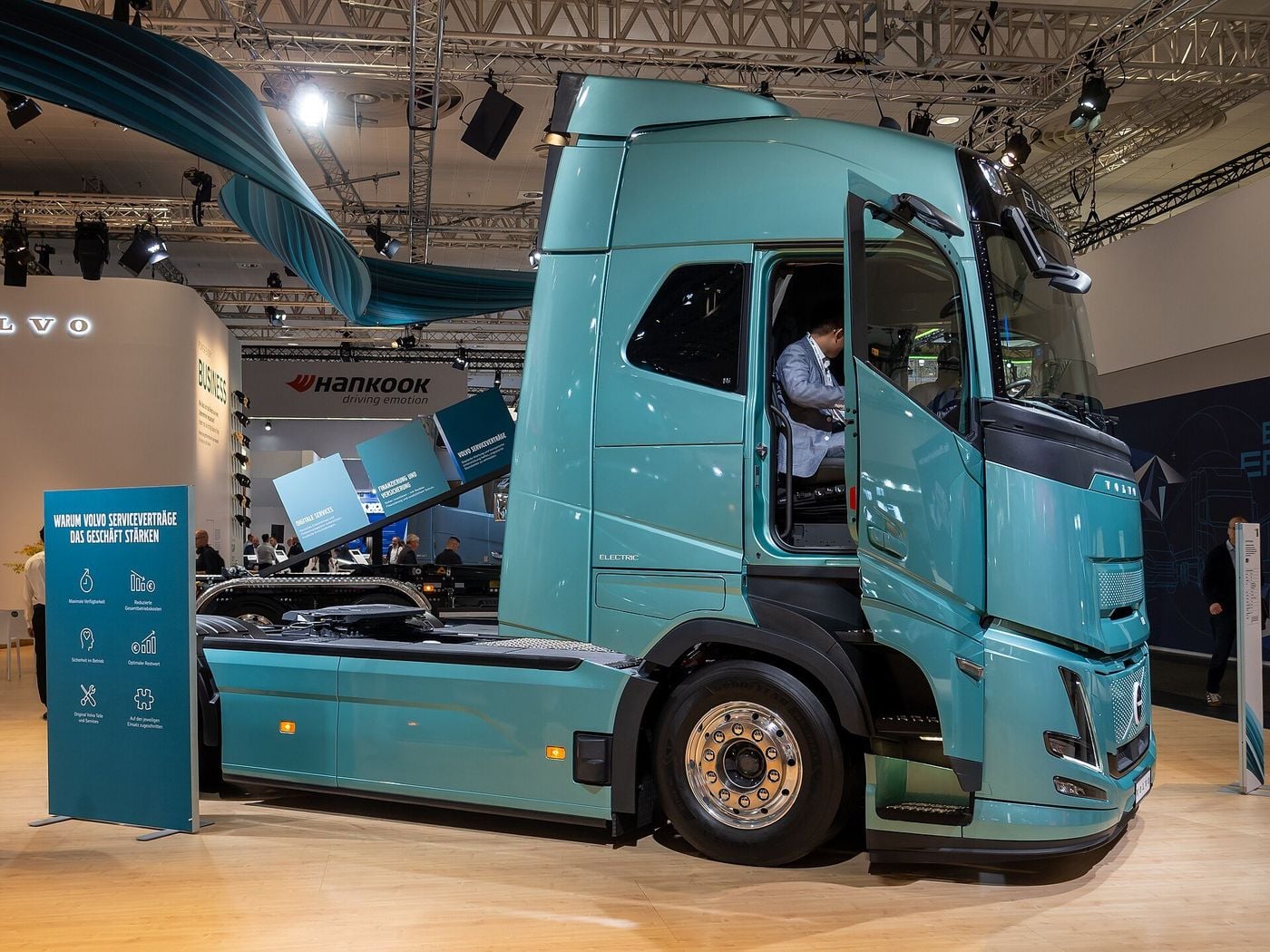
The makers cited on this page state electric-truck range on different bases: an internal test, an internal simulation, a WLTP figure, a “typical” load profile, or an “up to” ceiling at a named weight. In several of the documents the basis sits in a footnote rather than beside the figure, and on our reading figures declared on such different bases cannot be set side by side line by line.
The IEA’s Global EV Outlook 2026 (20 May 2026) says that there is at present no harmonised regulatory regime for measuring the actual range of electric heavy-duty vehicles (HDVs) across different countries and regions. This page takes the makers’ published range figures, and the EU regulation’s definitions, one basis at a time. It ranks nothing and gives no verdict: each figure appears with the conditions its own document states, and miles and pounds stay in the makers’ units.
Internal tests and internal estimates: Daimler Truck
One Daimler Truck press release, dated 13 September 2026 for IAA Transportation 2026, carries two range figures that rest on two different bases.
The first is for the eActros 600: up to 560 km in what Daimler describes as its most energy-efficient configuration at a gross combination weight of 40 t. Footnote 1 says this is an estimated range derived from internal simulations together with real driving tests, and that the actual range may deviate through factors it names: topography, weather conditions, speed, preconditioning, auxiliary consumers, individual vehicle configuration and driving style.
The second is for the eActros 600 Lowliner: around 500 km at full load. Footnote 4 says Daimler determined that range internally under specific test conditions: after preconditioning, with a 4x2 tractor unit at a total towing weight of 40 t and an outside temperature of 20 °C, in long-haul operation. The same footnote adds that the figure may deviate from the values determined in accordance with Regulation (EU) 2017/2400; it does not say whether higher or lower, or by how much.
The two figures are not interchangeable. The 4x2 tractor unit and the 20 °C belong to the Lowliner’s 500 km; the footnote to the 560 km names a simulation-plus-driving-test estimate instead.
The same release also bases a charging time (footnote 5) on the conditions defined for heavy-duty trucks in ISO/SAE 12906, at 400 kW charging power and 500 A: a named standard, where the range figures rest on internal determination. What ISO/SAE 12906 contains was not opened for this page. Charging itself is covered in megawatt charging explained.
The vehicle’s specification is on the eActros 600 model page, and the eActros 600 figures in the maker’s separate product sheet are discussed in Mercedes-Benz eActros 600: what 600 kWh means in service. This page uses only the 13 September 2026 release.
The EU’s own figure: VECTO and Regulation (EU) 2017/2400
Daimler’s footnote 4 does not mention VECTO; it refers to values determined in accordance with Regulation (EU) 2017/2400. That regulation, of 12 December 2017, concerns the determination of CO2 emissions and fuel consumption of heavy-duty vehicles. VECTO is the simulation tool the European Commission developed to determine those CO2 emissions and fuel consumption.
The Commission’s VECTO page (last updated 18 July 2024) describes it as working from characteristic parameters for each relevant vehicle component, among them rolling resistance, air drag, masses and inertias, gearbox friction, auxiliary power and engine performance, and simulating CO2 emissions and fuel consumption on standardised driving cycles. A variety of mission profiles for lorries, buses and coaches is built into the tool. The page speaks of CO2 emissions and fuel consumption; it does not mention electric vehicles or range. On our reading, a VECTO result is a simulation on standardised cycles and profiles rather than a test drive.
Electric vehicles entered that framework with Commission Regulation (EU) 2022/1379 of 5 July 2022 (OJ L 212, 12.8.2022), whose title says it amends Regulation (EU) 2017/2400 to introduce electric vehicles and other new technologies. Its first recital describes the 2017 regulation as introducing a common method for objectively comparing the performance of heavy-duty vehicles placed on the Union market as regards CO2 emissions and fuel consumption. That statement is about CO2 and fuel consumption, and this page does not extend it to range.
Annex IV of the 2022 regulation, the model of the output files of the simulation tool, defines three ranges:
- actual charge depleting range: the distance that can be driven in charge depleting mode on the usable amount of energy in the REESS, with no interim charging;
- equivalent all electric range: the part of the actual charge depleting range attributable to electric energy from the REESS, that is, without energy from a non-electric propulsion energy storage system;
- zero CO2 emissions range: the range attributable to energy from propulsion energy storage systems counted as having zero CO2 impact.
REESS is the regulation’s abbreviation for a rechargeable electric energy storage system.
The results go into the customer information file (CIF), which the regulation defines as a file produced by the simulation tool holding a defined set of vehicle information and the CO2 and fuel consumption results. Part II of Annex IV sets it out for each mission profile and loading combination. It includes an Electric Ranges block with the three ranges in km, and, among the fuel and energy results, an energy consumption line in MJ/km and kWh/km; its weighted results include a specific electric energy consumption line in kWh/t-km. Annex I names mission profiles for heavy lorries such as long haul, regional delivery, urban delivery, municipal utility and construction. On our reading, one vehicle therefore carries several results, one per mission profile and loading combination, rather than a single range figure.
As amended, the regulation provides that lorries and heavy buses to be registered, sold or put into service are to be accompanied by the CIF that the manufacturer draws up to the Part II model (Article 9(4)). Which vehicles are in scope, and from which date, is set in Articles 2, 4 and 24 of the regulation; this page does not summarise them. How the CIF’s CO2 line is used for toll classes is covered in EU road tolls and CO2 emission classes.
By our reading of the documents opened, none of the maker documents cited here quotes its own value on this basis; the only reference is Daimler’s footnote 4, above. The definitions were read from the 2022 text as published in the Official Journal; later amendments of the annex were not opened.
WLTP: the light-vehicle procedure behind van figures
Renault Trucks’ release of 15 September 2026 presents the E-Tech Trafic, which it calls a light commercial vehicle developed on a 100% electric platform, with up to 470 km of combined WLTP range, marked with an asterisk. The asterisk leads to a line reading “Data pending homologation”, so the figure is not an approved value. Under the same asterisk the release gives up to 280 km recovered by charging from 15% to 80% in approximately 20 minutes at a DC fast-charging station. The vehicle goes on sale in Europe in the first half of 2027.
WLTP stands for Worldwide Harmonized Light Vehicles Test Procedure. Annex III of Regulation (EU) 2024/1257 (Euro 7) applies UN Regulation No 154 to exhaust emission tests run on the WLTP chassis dynamometer test cycle; under its Article 21, Euro 7 applies to new types of vehicles of categories M1 and N1 from 29 November 2026. The title of UN Regulation No 154 covers light-duty passenger and commercial vehicles and, among other things, the measurement of electric energy consumption and electric range. That is Table 1 of the annex, whose heading concerns vehicles of categories M1 and N1. Table 2, for categories M2, M3, N2 and N3, names the WHTC/WHSC engine bench test cycles instead. Both tables concern exhaust emission tests; in these two tables the only link to range is the title of UN Regulation No 154. The content of that regulation and the WLTP cycle itself were not opened.
On our reading, a WLTP figure for a light commercial vehicle is not on the same basis as the figures of the heavy tractors on this page, whose documents name other bases.
Maximum possible, real conditions and typical
MAN’s release of 14 September 2026 from Hanover, on the new eTGX, describes a 4x2 ultra semitrailer tractor with six packages of the new battery generation and a total capacity of 552 kWh. For it the release gives a maximum possible range of 660 km, or well over 500 km under real conditions in typical long-haul transport. Its opening section states the same 660 km as “up to” for a typical 4x2 semitrailer tractor with six batteries and 552 kWh, so one figure appears under two wordings.
For the 6x2 semitrailer tractor, which the release says will also be available in the future, it gives up to 720 km with seven batteries and a total capacity of 644 kWh without intermediate charging, and describes a typical range of over 600 km as realistically achievable under everyday long-haul transport conditions. MAN says it demonstrates the seven-battery concept at IAA Transportation 2026 on a current 6x2 semitrailer tractor.
By our reading of the release, no weight, temperature or test method is tied to any of these range figures; where the word “conditions” stands beside a range figure, it is only in the phrases about real conditions and everyday long-haul transport conditions. The eTGX’s specification is on the MAN eTGX model page.
Freightliner’s eCascadia is a North American product, and its pages, which carry no date, give range in miles. They state a typical driving range of 230 miles for the 4x2 and 220 miles for the 6x4 with the 438 kWh battery, and a typical range of 155 miles for the 4x2 with the 291 kWh battery. The stated assumptions are a gradually diminishing load, consistent use of regenerative braking and routes that start on a full charge. The specifications page footnotes the figure: it derives from 1,000,000+ miles of real operation on Freightliner’s Innovation and Customer Experience (CX) fleets and is calculated for typical load profiles in the target applications, with regenerative braking. The same footnote lists drive axle and battery configuration, load, driver behavior, environmental conditions and other factors as things range varies with. The maximum gross combined weight for the eCascadia and trailer is given as 82,000 lbs.
One battery, several ranges: figures by weight
Scania’s UK battery-electric truck page, which carries no date of its own, lists usable battery capacities of 240, 320, 400, 480 or 560 kWh. For the 560 kWh option it presents a maximum possible range, “up to”: 560 km at 29 t GTW, 515 km at 42 t GTW and 360 km at 64 t GTW. It gives a technical GTW maximum of 74 t. One usable capacity therefore carries three figures, distinguished only by weight. GTW is Scania’s term; this page otherwise says gross combination weight, which is explained in truck weights: gross vehicle, gross combination and axle loads. The page also offers a Scania BEV calculator, described as designed to predict the driving range of electric trucks; it was not used.
Volvo’s release of 14 September 2026 introduces the FH Electric/FH Aero Electric rigid truck with extended range, for a gross combination weight of up to 80 t. It gives up to 450 km on a single charge at a gross combination weight of 64 t, and up to 420 km at 74 t and 76 t, weights Volvo says are allowed in Sweden and Finland respectively. In its facts box Volvo labels the 420 km at 76 t a “Range example”. Volvo’s footnote to these figures says range depends on external conditions such as weather and wind resistance, and on other factors such as the total weight of the truck and the driver’s performance.
“Up to” with a list of factors, and a headline without a basis
Volvo’s release of 14 April 2026 is headed with ranges up to 700 km. The 700 km belongs to one vehicle, the FH Aero Electric with extended range: up to 700 km on one charge. For the next-generation FH, FM and FMX Electric trucks the same release gives up to 470 km, described on the Volvo FH Electric model page. Both carry the footnote described above: weather, wind resistance, total weight and driver’s performance. The facts box for the FH Aero Electric with extended range lists a gross combination weight of up to 48 t and a flexible battery configuration; by our reading, the release does not say at which weight or battery configuration the 700 km applies.
BYD’s release from IAA Transportation 2026 (Hannover, 14 September 2026) puts 372 miles of range from a 651 kWh Blade Battery on the ETT 44 4x2 in its sub-headline, alongside charging from 20% to 80% in 20 minutes, adding 248 miles of range. In the release’s specification table, driving range (under Performance) reads “TBC” and gross combination weight (under Dimensions & Weights) 44,000 kg. By our reading, the release gives no test method, temperature or load condition for the range. The page records both statements as they stand in the one document.
Three makers list factors that range varies with: Daimler names seven (footnote 1), Volvo names weather, wind resistance, total weight and driver performance, and Freightliner names drive axle and battery configuration, load, driver behavior and environmental conditions. The factor lists are the makers’ own, and this page attaches no size to them.
Why the figures cannot be set side by side
The table lists the bases that appear in the documents above. It has no kilometre column: such a column would put figures side by side that the documents do not put on one footing. Each figure is in the section above, with its conditions.
| Basis | Maker and vehicle | Conditions the document states | Document |
|---|---|---|---|
| Internal test | Daimler Truck, eActros 600 Lowliner | After preconditioning; 4x2 tractor unit; total towing weight 40 t; outside temperature 20 °C; long-haul operation; may deviate from Regulation (EU) 2017/2400 values (footnote 4) | Daimler Truck release, 13 September 2026 |
| Internal simulation plus real driving tests (an estimate) | Daimler Truck, eActros 600 | Most energy-efficient configuration at a gross combination weight of 40 t; seven factors listed (footnote 1) | Daimler Truck release, 13 September 2026 |
| Simulation output file of the EU tool | Regulation (EU) 2017/2400 as amended by Regulation (EU) 2022/1379 | Standardised driving cycles; results per mission profile and loading combination; three range definitions | OJ L 212, 12.8.2022; European Commission VECTO page |
| WLTP, pending homologation | Renault Trucks, E-Tech Trafic (light commercial vehicle) | Combined WLTP range; data pending homologation | Renault Trucks release, 15 September 2026 |
| Maximum possible, and under real conditions | MAN, eTGX 4x2 ultra semitrailer tractor | Six packages, 552 kWh; by our reading no weight, temperature or test method stated | MAN release, 14 September 2026 |
| Typical, from fleet operation | Freightliner, eCascadia (North America) | Typical load profiles; gradually diminishing load; regenerative braking; routes starting on a full charge; 1,000,000+ miles of fleet operation | Freightliner eCascadia pages (undated) |
| Up to, by weight | Scania (560 kWh usable); Volvo FH Electric/FH Aero Electric rigid truck with extended range | Scania: 29, 42 and 64 t GTW. Volvo: 64 t gross combination weight; 74 t and 76 t total weight | Scania UK page (undated); Volvo release, 14 September 2026 |
| Up to, with a list of factors | Volvo, FH Aero Electric with extended range; FH, FM and FMX Electric | Weather, wind resistance, total weight, driver’s performance; by our reading no weight or battery configuration tied to the headline figure | Volvo release, 14 April 2026 |
| Basis not stated in the release (by our reading) | BYD, ETT 44 4x2 | No test method, temperature or load condition stated; the specification table entry for driving range reads TBC | BYD release, 14 September 2026 |
On our reading, the figures on this page cannot be compared line by line, and the reasons are the ones set out above rather than any judgement of the makers. The stated conditions differ in kind: weight (Daimler’s 40 t, Volvo’s 64 t, 74 t and 76 t, Scania’s 29 t, 42 t and 64 t GTW), temperature and preconditioning (Daimler’s footnote 4), method (internal test, internal simulation, WLTP, fleet operation), battery configuration (MAN’s six and seven packages, Freightliner’s 438 kWh and 291 kWh) and approval status (Renault’s data pending homologation).
The IEA sentence cited at the top speaks of countries and regions. The EU regulation defines three ranges for the customer information file. By our reading, the maker documents opened for this page do not refer to that regulation, apart from Daimler’s footnote 4.
The same kind of question, what basis a figure rests on, is asked of power figures in kW, hp and Nm: how to read a truck’s power figures.
Quick answers
- How is the range of an electric truck declared?
- The makers cited here state it on different bases, and where a basis is given at all it is often in a footnote. Daimler's around 500 km for the eActros 600 Lowliner is an internal test with a 4x2 tractor unit at a total towing weight of 40 t and an outside temperature of 20 °C. Renault Trucks' up to 470 km for the E-Tech Trafic light commercial vehicle is a combined WLTP figure pending homologation. Scania gives up to 560 km, 515 km and 360 km for the same 560 kWh of usable capacity at 29 t, 42 t and 64 t GTW.
- Why can't electric-truck range figures be compared?
- On our reading, because the conditions the documents state differ. Volvo gives up to 450 km at a gross combination weight of 64 t and up to 420 km at 74 t and 76 t for one rigid truck. MAN gives 660 km as a maximum possible range and well over 500 km under real conditions in one release. The IEA says that at present there is no harmonised regulatory regime for measuring the actual range of electric heavy-duty vehicles across different countries and regions.
- Is there an official EU range for electric trucks?
- Regulation (EU) 2022/1379 of 5 July 2022 defines three ranges: actual charge depleting range, equivalent all electric range and zero CO2 emissions range. It introduced electric vehicles into Regulation (EU) 2017/2400, and the customer information file carries a line in km for each of the three, set out for each mission profile and loading combination. By our reading of the documents opened for this page, no maker quotes its own value on that basis, and Daimler says its Lowliner figure of around 500 km may deviate from the values determined in accordance with Regulation (EU) 2017/2400.
- How much electricity does an electric truck use?
- The EU customer information file carries an energy consumption line in MJ/km and kWh/km, set out for each mission profile and loading combination, and its weighted results include a specific electric energy consumption line in kWh/t-km. By our reading, the maker documents opened for this page state range and battery capacity rather than consumption, and this page does not divide one figure by the other.
- What do 'up to' and 'typical' mean in an electric-truck range claim?
- In two of the documents cited they are tied to different things. Volvo's up to 700 km for the FH Aero Electric with extended range carries a footnote saying range depends on external conditions such as weather and wind resistance and on factors such as the truck's total weight and the driver's performance. Freightliner's typical 230 miles for the eCascadia 4x2 with the 438 kWh battery is derived from 1,000,000+ miles of real operation on its own fleets, with a gradually diminishing load and regenerative braking assumed.
Models in this article
Sources
- IAA Transportation 2026: Daimler Truck Celebrates 130 Years of Trucks and Drives Transportation Forward — Daimler Truck, 13 Sept 2026
- Vehicle Energy Consumption calculation TOol - VECTO — European Commission — Climate Action, 18 Jul 2024
- Commission Regulation (EU) 2022/1379 of 5 July 2022 amending Regulation (EU) 2017/2400 as regards the determination of the CO2 emissions and fuel consumption of medium and heavy lorries and heavy buses and to introduce electric vehicles and other new technologies (OJ L 212, 12.8.2022; Annex IV) — Publications Office of the European Union, 12 Aug 2022
- Regulation (EU) 2024/1257 on type-approval of motor vehicles and engines with respect to their emissions and battery durability (Euro 7) — Annex III, Tables 1 and 2 — Publications Office of the European Union, 8 May 2024
- Renault Trucks steps up its ambitions in the LCV market and presents the new Renault Trucks E-Tech Trafic — Renault Trucks, 15 Sept 2026
- World premiere at the IAA: MAN eTGX with greater range, efficiency and safety (press release, 14 September 2026) — MAN Truck & Bus, 14 Sept 2026
- eCascadia — Freightliner Trucks
- eCascadia Specs — Freightliner Trucks
- Battery electric trucks — Scania (Great Britain)
- Volvo Trucks launches new 80-tonne electric truck with longer range — Volvo Trucks, 14 Sept 2026
- Volvo launches new electric trucks – with ranges up to 700 km — Volvo Trucks, 14 Apr 2026
- BYD Commercial Vehicles unveils its most comprehensive zero-emission transport portfolio at IAA Transportation 2026 — BYD UK Media, 14 Sept 2026
- Global EV Outlook 2026 — Trends in other EV modes — International Energy Agency (IEA), 20 May 2026