Mercedes-Benz eActros 600: what 600 kWh means in service
What separates 621 kWh installed from 600 kWh usable, how the 500 km range figure is footnoted, what an hour on a CCS2 charger does to a shift, and how payload compares with the eActros 400.
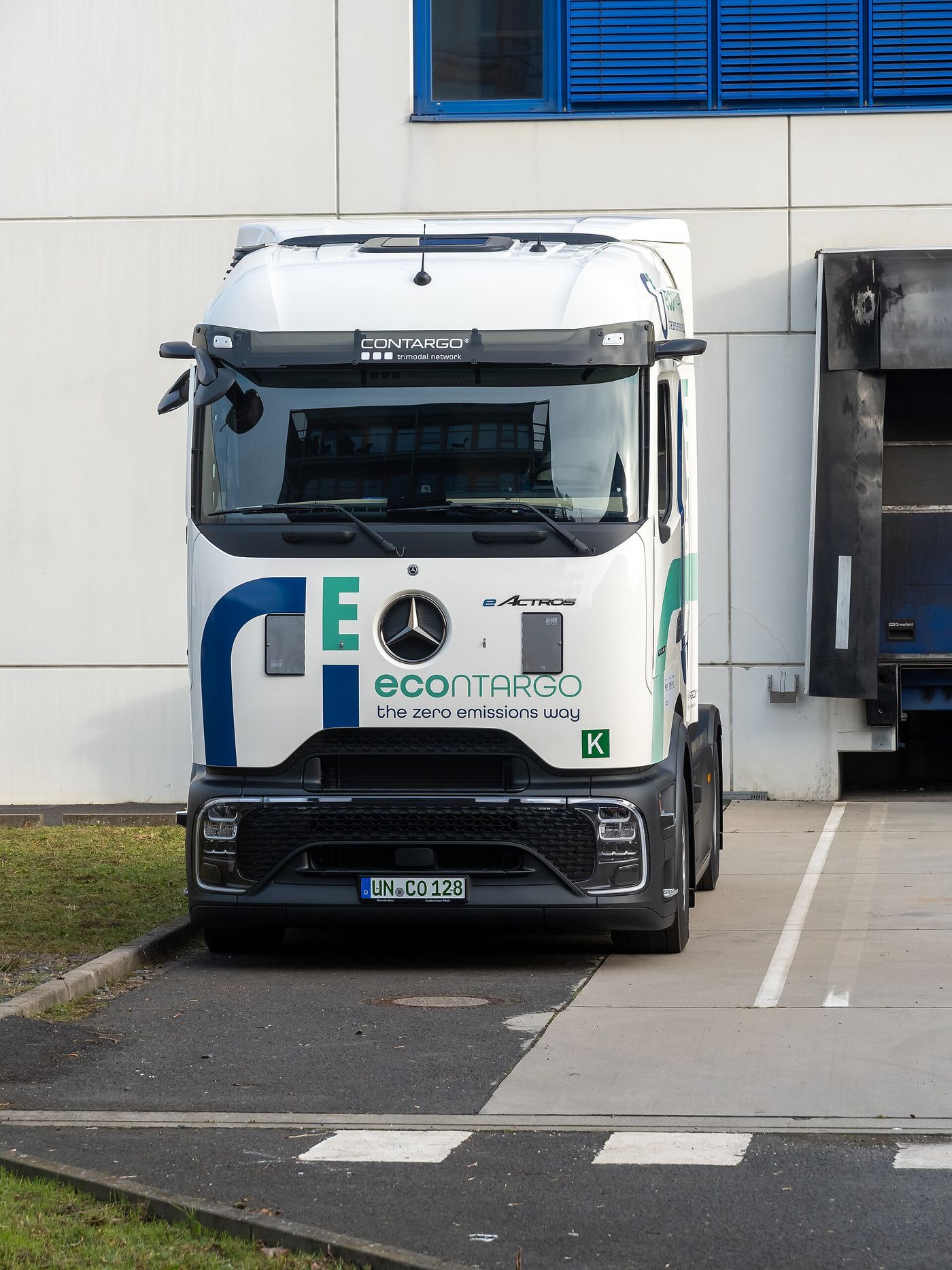
The number in the name is the battery. Not a power output, not a tonnage: Daimler Truck ties the designation to a battery capacity of “more than 600 kilowatt hours” — 621 kWh installed, of which the product sheet gives 600 kWh as usable — and what that quantity buys in long-haul work is the subject of this page. The specification itself — variants, weights, axle configurations, what to ask about on a used one — sits on the eActros 600 model page. What follows is what those figures mean once the truck is working. The wider subject, how battery-electric trucks and tractor units from several makers are built and charged, is set out in electric trucks and tractor units explained.
Two capacity figures, and the gap between them
Mercedes-Benz publishes two battery numbers for this truck, under two separate headings with two separate footnotes, and the gap between them is the first thing to understand. The product sheet lists 621 kWh installed — three lithium iron phosphate packs of 207 kWh each — and 600 kWh usable, at 200 kWh per pack. The installed figure is defined in its footnote as the nominal capacity of a new battery, the usable figure as the capacity available for regular truck operation with new batteries, and both footnotes close the same way: “based on internally defined boundary conditions, may vary depending on use case and ambient conditions”.
Subtracting one from the other leaves 21 kWh held back across the vehicle, or 7 kWh per pack; that subtraction is ours and appears in neither document. It is also the difference between two numbers the maker has just qualified, so it is a gap rather than a constant. Neither footnote explains why the gap exists, and this page does not invent a reason. What the maker does claim is the commercial consequence: at the world premiere Daimler Truck stated that, in contrast to other battery cell technologies, approximately 95 percent of the installed capacity can be used with LFP technology, which “makes a higher range with the same installed battery capacity possible”.
Read as a buyer, that makes the usable figure a specification line in its own right: of the two, it is the only one the product sheet defines as capacity available for regular truck operation. How other makers name and publish the two figures is set out in installed vs usable battery capacity.
What the 500 kilometres was measured against
The published range is 500 kilometres without intermediate charging, and the footnote attached to it does more work than the headline. Mercedes-Benz states the figure was determined internally under specific test conditions, after preconditioning, with a 4x2 tractor unit at 40 t total towing weight and an outside temperature of 20 °C in long-haul operation, and that it may deviate from values determined in accordance with Regulation (EU) 2017/2400. That is the maker measuring its own vehicle under conditions it set, and saying so; a May 2025 release describes them as “very realistic and practical conditions with a gross combination mass of 40 tons”. The EU regulation’s own range definitions, and the other bases on which makers state electric-truck range, are set out in how electric-truck range is declared.
Two more numbers sit beside it. The first: the maker quotes up to 560 kilometres separately, for the most economical combination with three packs in classic long-haul at a gross train weight of 40 tonnes — and footnotes it as an estimated range derived from the results of internal simulations as well as real driving tests. The maker does not footnote the 500 kilometres one way either. The product sheet and the releases give it the internal test determination above, but the ProCabin section of Mercedes-Benz Trucks’ international model overview says the eActros 600 “achieves a range of 500 km without recharging” and attaches the estimated-range footnote: “The estimated range is derived from results of internal simulations as well as real driving tests.” With the 500 footnoted two ways, the 60 kilometres between the two figures cannot be read as either a measured or a like-for-like difference. The range conditions other makers state for their electric tractor units are quoted in a register of maker-declared values.
The second number is ours. Dividing the 600 kWh usable by the 500 kilometres gives 1.2 kWh per kilometre, but that is a division, not a consumption figure the maker publishes: neither footnote says the range test drew down the full usable capacity. Notice also which side of the socket it sits on: 600 kWh is capacity available in the battery, while an electricity tariff meters at the plug. The charging and conditioning losses in between are not in any of these documents, so this figure is energy out of the pack and cannot be multiplied by a tariff to reach a cost per kilometre without them.
The maker’s other framing is about the working day. At the 2023 world premiere Daimler Truck said the eActros 600 would be able to travel significantly more than 1,000 kilometres a day, made possible by intermediate charging during the legally prescribed driver breaks — and the release finishes that thought with the clause that matters most to what follows: even without megawatt-charging. The May 2025 release repeats the claim with a condition attached: “provided that charging options are available”. The 2023 release also stated that around 60 percent of the long-distance journeys made by Mercedes-Benz Trucks customers in Europe are shorter than 500 kilometres anyway, and that for those cases charging infrastructure at the depot and at the loading and unloading points is sufficient. That is a claim about one manufacturer’s own customer base, not a measurement of European long-haul, and it should not be repeated as one.
An hour on the charger, and what that does to a shift
The truck charges over CCS2 at up to 400 kW. What that yields is published as several windows measured under different sets of conditions, and they are not interchangeable.
| Window | Vehicle and packs | Time | Stated conditions |
|---|---|---|---|
| 20 to 80 percent, CCS2 | eActros 600, 3 | Approx. 60 min | Internally determined empirical values under optimal conditions, including 20 °C ambient and 500 A |
| 10 to 80 percent, CCS2 | eActros 600, 3 | Around 70 min | ISO/SAE 12906, 400 kW, 500 A |
| 10 to 80 percent, CCS2 | eActros 400, 2 | Around 46 min | ISO/SAE 12906, 400 kW, 500 A |
| 20 to 80 percent, MCS | eActros 600, 3 | Approx. 30 min | Quoted future capability, not a charging window in service: internal simulation, on the ground that a binding, uniform MCS standard was under development when the sheet was written |
Set those against the clock the driver runs on. The European Commission summarises the requirement under Regulation (EC) No 561/2006 as “breaks of at least 45 minutes (separable into 15 minutes followed by 30 minutes)” that “should be taken after 4 ½ hours at the latest”; the rest of that framework is in driving time and rest rules. None of the published CCS2 windows is as short as that 45-minute minimum — not the hour, not the 70 minutes, and not even the two-pack eActros 400’s 46. A longer break is lawful, and none of the documents cited here says how much a 45-minute CCS2 stop adds. The 30-minute megawatt figure is shorter than the minimum, and Mercedes-Benz Trucks’ model overview pitches it with the break in mind: “ideal for planned long-distance routes with a legally required driving break”.
But that window is a quoted capability, not a socket the truck charges through today; the same overview still calls it “future megawatt charging”. The world premiere release says megawatt charging comes later, that customers can order a pre-installation for it from the start of sales, and that, for trucks ordered with that pre-installation (“these models of the eActros 600”), a retrofit is planned once MCS technology becomes available and is standardised across manufacturers; the September 2025 release narrows it to “the eActros 600 with ProCabin”. And the world premiere release says the more-than-1,000-kilometres-a-day claim holds even without megawatt charging. The release does not say how long the breaks it has in mind are or how much charge each one adds, while every published CCS2 window is longer than the 45-minute minimum; the release does not reconcile the two, and this page will not do it on the maker’s behalf. What “MCS-capable” does and does not commit a maker to, and where the standard work has since got to, is set out in megawatt charging explained.
One sum makes the gap concrete, and it is ours: sixty percent of the 500-kilometre rating is 300 kilometres. Reading that as 300 kilometres bought back in an hour on CCS2 takes two steps the maker never takes. None of the maker’s documents cited here maps a state-of-charge window onto the range figure, and the hour rests on empirical values under optimal conditions while the 500 kilometres was determined after preconditioning at 40 t and 20 °C — a different test. So the 300 kilometres is a sum, not a rating. The third pack cuts both ways here: the maker credits the 500 kilometres to the battery capacity together with its new electric axle, and its 2025 release times three packs at around 70 minutes over the 10-to-80 window where two take around 46.
What the packs cost in payload
This is where the specification stops being interesting and starts being billable. Start with two published figures: the product sheet gives the tractor unit an unladen weight of approximately 11.7 t, and with a standard semitrailer in the EU Mercedes-Benz quotes a payload of around 22 tonnes, noting that “in some cases, national law may permit a higher payload”.
Against a diesel the order of magnitude is easy to see. A Mercedes-Benz data sheet for an Actros 1845 LS 4x2 semitrailer tractor with the 2.50 m L-cab BigSpace on a 3850 mm wheelbase gives kerb weight 8,362 kg, technically permissible weight 18,000 kg, 9,638 kg of payload and fifth-wheel load, and a gross combination weight of 44,000 kg. Set the electric tractor’s approximately 11.7 t against that 8,362 kg and the difference is about 3.3 tonnes — our subtraction, of two figures the maker publishes for two different vehicles.
Treat that as an indication rather than a weighing, and not only because the cabs differ and the wheelbases are 150 mm apart. The two masses are not defined the same way. The data sheet marks 8,362 kg as a ready-to-drive condition as specified by European Directive 97/27/EC — a directive repealed with effect from 1 November 2014 by Regulation (EC) No 661/2009, which was itself repealed from 6 July 2022 by Regulation (EU) 2019/2144; the product sheet gives the eActros figure as an unladen weight with no definition attached at all, footnoted only as depending on the features. Subtracting an undefined mass from a defined one and reporting the answer to 100 kg is not like-for-like, and owning the arithmetic does not make it so.
What the pair does settle is where the difference lands against the technical ceiling. Both vehicles carry the same 44 tonnes of combination weight — the eActros 600’s technical figure and the Actros sheet’s line are identical — so against that technical figure the electric tractor’s extra tare comes out of payload; that reading is ours. The legal ceiling in international traffic is a different number, and there the law does make an allowance for the technology’s weight. Annex I to Council Directive 96/53/EC sets 40 tonnes for a two-axle motor vehicle with a three-axle semi-trailer, and for “vehicle combinations including alternatively fuelled or zero-emission vehicles” says the maximum authorised weights “shall be increased by the additional weight of the alternative fuel or zero-emission technology with a maximum of 1 tonne and 2 tonnes respectively”. The tractor’s own technical rating is 4 tonnes higher than the diesel’s, 22 t of technical gross vehicle weight against 18,000 kg technically permissible, which is again our subtraction; and that gap is not the European allowance either. For a two-axle motor vehicle Annex I sets 18 tonnes and, for a zero-emission vehicle, increases it “by the additional weight of the zero-emission technology with a maximum of 2 tonnes” (one tonne for an alternatively fuelled vehicle). Article 10b of the directive attaches the conditions: the additional weight “shall be defined on the basis of the documentation provided by the manufacturer when the vehicle in question is approved” and “shall be indicated in the official proof required in accordance with Article 6”, and such vehicles “shall also comply with the maximum authorised axle weight limits set out in point 3 of Annex I”. So the driving axle stays at 11.5 tonnes, while the eActros product sheet rates its rear axle at 13 t. A manufacturer’s technical rating and an authorised weight are two different kinds of number, and the difference between them is set out in truck weights, gross vehicle and gross combination.
Mercedes-Benz answers the payload objection with a vehicle rather than an argument. The eActros 400 carries two of the same 207 kWh packs for 414 kWh installed, and the maker states it has an additional payload of more than 3 tonnes compared with the eActros 600, bringing it to over 25 tonnes with a standard semitrailer and, in its words, to the payload level of diesel trucks; the weight reduction also raises the maximum fifth-wheel load to 9.5 tonnes. The release puts the gain down to the lower vehicle weight of the two-pack truck and publishes no weight for a pack, so the 3 tonnes is a payload difference rather than a weighed battery pack. The release does not say which cab or configuration either figure refers to, and it credits the lighter L-cab with “a slight payload advantage due to the lower weight” of its own. The same release puts the trade plainly: battery packs determine range, payload and purchase price.
One labelling point belongs here. The GB product sheet heads the 44 t row “technically permissible gross trailer weight”; Daimler Truck’s own release says the vehicle is technically designed for a gross combination weight of up to 44 tons. Same figure, different label, and the model page records the discrepancy rather than resolving it.
The battery’s published ceilings
Mercedes-Benz publishes two sets of ceilings for the battery, one for design life and one for warranty. At the 2023 world premiere it said the vehicle was designed for up to 1.2 million kilometres in ten years of operation and that battery state of health should still be over 80 percent after that. The warranty on the high-voltage batteries stops a long way short of that design life, at a maximum of 72 months, 720,000 kilometres or 1,800 charging cycles, whichever is reached first, counted in the model overview from the date the truck leaves the plant. How other makers state battery cover is set out in electric truck and bus battery warranties.
Which of the three ceilings arrives first depends on the duty cycle. At the published 500 kilometres per charge, 1,800 cycles would be 900,000 kilometres — our multiplication — beyond the 720,000 kilometre ceiling, so on a truck that covered the full 500 kilometres between every charge, distance or time would expire before cycles did. That holds only if a cycle means a full charge, and neither the product sheet nor the model overview defines the term, though both print the 1,800 cycles, so a fleet charging in 20-to-80 percent bites cannot assume the same answer. Ask how cycles are counted.
The number that decides it is not on the vehicle
Daimler Truck’s profitability claim is carefully bounded, and the bounds are the point. Time to cost parity with a comparable diesel differs from country to country, depending in particular on electricity and diesel prices and on the toll system. In the large transit countries of France and Germany the release named a low electricity price and the then-planned CO2-based truck toll respectively — the cheap electricity in France, the toll in Germany — as positive effects on the operational costs of battery-electric trucks, and on that basis said the eActros 600 can be more profitable than a diesel long-haul truck within an average holding period of around five years or after around 600,000 kilometres, despite a purchase price around two to two and a half times higher than the diesel equivalent. Where the toll side has since landed is in EU road tolls and CO2 classes; the rest of the cost stack belongs with tractor unit running costs.
The maker’s own conditions sit outside the vehicle. In September 2025 Achim Puchert, CEO of Mercedes-Benz Trucks, said the eActros 600 was already operating in over 15 European countries, and stated the condition plainly: for the transformation to succeed, the expansion of the charging infrastructure must keep pace with the vehicles and the operation must be profitable for customers. Neither half of that is a vehicle specification. Another battery-electric tractor recorded on this site is the Volvo FH Electric; a diesel Mercedes-Benz also offers with the ProCabin is the Actros L.
Quick answers
- How far can a Mercedes-Benz eActros 600 go on one charge?
- 500 kilometres without intermediate charging. Mercedes-Benz determined that figure internally, after preconditioning, with a 4x2 tractor unit at 40 t total towing weight and 20 °C outside temperature in long-haul operation, and states it may deviate from values determined in accordance with Regulation (EU) 2017/2400. Up to 560 kilometres is quoted separately for the most economical combination with three battery packs in classic long-haul at a 40-tonne gross train weight, with the footnote that it is an estimated range derived from the results of internal simulations as well as real driving tests. The maker's documents do not footnote the 500 kilometres consistently either: the ProCabin section of Mercedes-Benz Trucks' international model overview attaches that same estimated-range footnote to it, so the 60 kilometres between the two figures cannot be read as a measured or like-for-like difference.
- What is the difference between the eActros 600's 621 kWh and 600 kWh?
- 21 kilowatt hours, which is our subtraction of the maker's two published figures. 621 kWh is the installed nominal capacity of three new 207 kWh packs; 600 kWh, or 200 kWh per pack, is what the truck releases for regular operation with new batteries. Both footnotes add that the figures rest on internally defined boundary conditions and may vary with use case and ambient conditions, so the 21 kWh is the gap between two conditional numbers rather than a fixed reserve. Only the second is defined as capacity available for regular truck operation.
- How long does an eActros 600 take to charge?
- About 60 minutes from 20 to 80 percent on a CCS2 charger at up to 400 kW, which the product sheet footnotes as internally determined empirical values under optimal conditions, and about 70 minutes over the wider 10 to 80 percent window with three packs. Mercedes-Benz quotes about 30 minutes from 20 to 80 percent at an output of around one megawatt, but footnotes that as internal simulation on the ground that a binding, uniform megawatt charging standard was under development when the sheet was written. The 2023 launch release says customers can order a pre-installation from the start of sales and that, for trucks ordered with it ("these models of the eActros 600"), a retrofit is planned once MCS technology becomes available and is standardised across manufacturers; a September 2025 release says it is the eActros 600 with ProCabin that will later also enable megawatt charging.
- How does the eActros 600's payload compare with the two-pack eActros 400?
- Mercedes-Benz quotes a payload of around 22 tonnes with a standard semitrailer in the EU, adding that in some cases national law may permit a higher payload. Its own two-pack eActros 400 is stated to carry more than 3 tonnes more than the eActros 600, reaching over 25 tonnes and what the maker calls the payload level of diesel trucks. The release does not say which cab or configuration either figure refers to, and it credits the lighter L-cab with a slight payload advantage of its own.
- How long is the eActros 600 battery warranty?
- Up to 72 months, 720,000 kilometres or 1,800 charging cycles, whichever is reached first. A warranty case arises if battery state of health falls below 80 percent under the stated conditions. The vehicle as a whole is designed for up to 1.2 million kilometres in ten years of operation.
Models in this article
Sources
- The new eActros 600 — product sheet — Mercedes-Benz Trucks
- Mercedes-Benz Trucks celebrates world premiere of the battery electric long-haul truck eActros 600 — Daimler Truck
- Mercedes-Benz Trucks presents the new eActros 400 based on the eActros 600 — numerous new variants available — Daimler Truck
- Mercedes-Benz Trucks expands portfolio of battery-electric trucks based on the eActros 600 — Daimler Truck
- eActros — model overview and technical data — Mercedes-Benz Trucks
- Technical data — Actros 1845 LS 4x2 semitrailer tractor (BM 96340312) — Mercedes-Benz
- Driving time and rest periods — European Commission, DG Mobility and Transport
- Council Directive 96/53/EC — Annex I: maximum weights and dimensions — legislation.gov.uk (The National Archives)
- Council Directive 96/53/EC — consolidated text (Article 10b) — EUR-Lex, Official Journal of the European Union
- Regulation (EC) No 661/2009 — type-approval requirements for the general safety of motor vehicles (Article 19: repeal of Directive 97/27/EC) — EUR-Lex, Official Journal of the European Union
- Regulation (EU) 2019/2144 — type-approval requirements for motor vehicles as regards their general safety (Article 18: repeal of Regulation (EC) No 661/2009) — EUR-Lex, Official Journal of the European Union