Installed vs usable battery capacity in electric trucks
Why electric-truck data sheets print two kWh figures, what each maker calls them, which makers publish one, the other or both, and how depth of discharge links them.
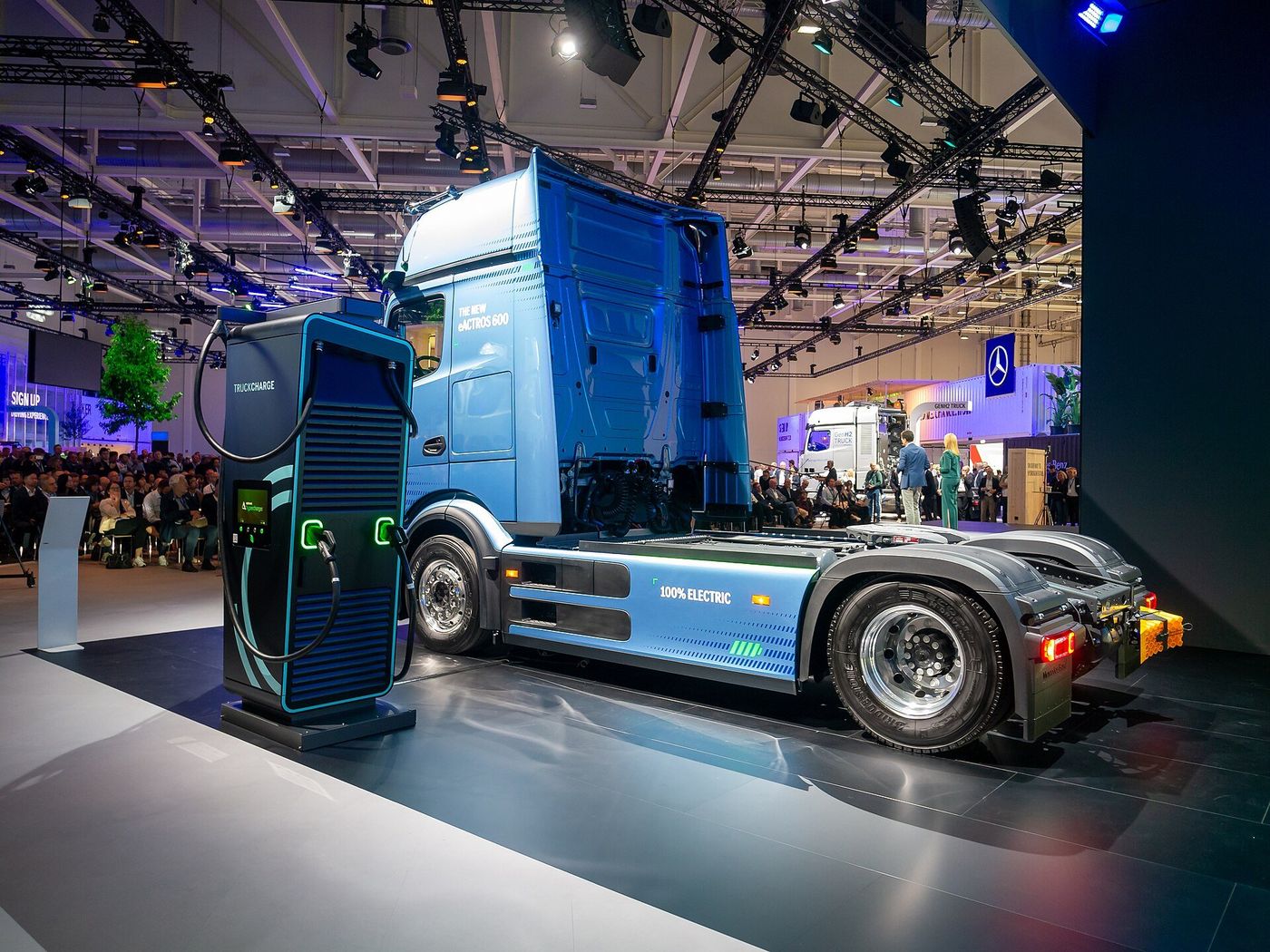
On the Mercedes-Benz eActros 600 product sheet, installed capacity is the nominal capacity of a new battery (621 kWh) and usable capacity is the capacity available for regular truck operation with new batteries (600 kWh). Other makers use other words and other splits, and a data sheet may print one of the two figures, the other or both.
Two figures, two footnotes
The eActros 600 product sheet lists both figures in one table: “Installed battery capacity” of 621 kWh in total, 207 kWh per pack, and “Usable battery capacity” of 600 kWh in total, 200 kWh per pack. Footnote 5 defines the first as the nominal capacity of a new battery. Footnote 6 defines the second as capacity available for regular truck operation with new batteries. Both footnotes add that the figures rest on internally defined boundary conditions and may vary with use case and ambient conditions.
Daimler Truck’s world-premiere release of 10 October 2023 says the truck has three battery packs of 207 kWh each, an installed total capacity of 621 kWh, and cells based on lithium iron phosphate (LFP). It adds a statement of its own: in contrast to other battery cell technologies, approximately 95 percent of the installed capacity can be used with LFP technology. By our arithmetic, the product sheet’s two totals give 96.6% (600 divided by 621). The two percentages differ, and each is given here with its source. The eActros 600 model page records the specification, and the eActros 600 article works through that truck’s range and charging figures.
What each maker calls them
The documents do not share a vocabulary. For the installed side they say “installed” (Mercedes-Benz, DAF, Ford Trucks, Scania), “gross capacity” (MAN, 2026), “onboard energy” (Volvo) or “total energy capacity” (IVECO). For the usable side they say “usable” (Mercedes-Benz, Ford Trucks, IVECO, Volvo USA), “available” (DAF, MAN 2026, Volvo), “net” or “can be used” (MAN) or “Usable Battery Energy (UBE)” (Volvo). Figures are as each document prints them, and the rows are not a ranking.
| Maker | Document | Installed side | Usable side |
|---|---|---|---|
| DAF | XG Electric infosheet (undated) | “installed”: 315, 420 and 525 kWh | “available”: 277, 370 and 462 kWh, paired in that order |
| Ford Trucks | F-LINE E, Technical Features GSR-C (July 2026) | “Installed Battery Capacity”: 294 kWh (4x2, 3 packs) and 392 kWh (6x2, 4 packs) | “Usable Battery Capacity”: 235 kWh and 314 kWh |
| IVECO | S-eWay Artic press release (12 June 2025) | “total energy capacity”: 603 kWh, three LFP packs | “usable energy”: 97%; no kWh figure given |
| MAN, generation with 89 kWh packs | Press releases of 9 November 2023 and 15 October 2024; eTruck brochure (09/2026) | Pack “contains 89 kWh of energy”; “battery capacity of 534 kWh” with six packs | “can be used”: 80 kWh per pack, 480 kWh with six; “net”: up to 480 kWh; brochure “Max. usable battery capacity”: 320 kWh with four packs, 480 kWh with six |
| MAN, new generation shown at IAA 2026 | eTGX world-premiere press release (14 September 2026) | “gross capacity”: 92 kWh per pack; “total capacity”: 552 kWh (six batteries), 644 kWh (seven batteries) | “available for vehicle operation”: 88 kWh per pack; “usable capacity”: 95 percent; no vehicle total given |
| Mercedes-Benz Trucks | eActros 600 product sheet (undated); Daimler Truck release (10 October 2023) | “Installed battery capacity”: 621 kWh total, 207 kWh per pack | “Usable battery capacity”: 600 kWh total, 200 kWh per pack |
| Scania | MP20 press release (14 September 2026) | “installed capacity”: approximately 356 kWh from two MP20 packs mounted behind the cab in a typical configuration, in addition to the batteries on the chassis and under the cab | None published in the release |
| Volvo Trucks | FH Electric and FH Aero Electric product pages (undated) | “Battery capacity”: 360–540 kWh, 4-6 batteries; “onboard energy”: up to 540 kWh | “Usable battery energy”: up to 460 kWh; “available for use” |
| Volvo Trucks | FH Aero Electric with extended range, product page (undated) | “Battery capacity”: 585 and 780 kWh, 6-8 batteries | “Usable Battery Energy”: up to 725 kWh |
| Volvo Trucks USA | VNR Electric product page (undated) | “Battery capacity”: 565 kWh and 375 kWh | “usable energy”: 452 kWh and 300 kWh respectively |
Depth of discharge: the link between the two
Two makers state the link outright. DAF’s infosheet gives installed energy capacity of 315 to 525 kWh and says its LFP batteries offer 88% depth of discharge, so the available energy is 277, 370 and 462 kWh; the table pairs 315 with 277, 420 with 370 and 525 with 462. The DAF XG Electric model page carries the three pairs.
MAN does it in a footnote. Its November 2023 release says each MAN BatteryPack contains 89 kWh of energy, of which 80 kWh can be used, and that up to six packs can be combined for system capacities of up to 480 kWh net. Its October 2024 release describes a truck with a battery capacity of 534 kWh, of which 480 kWh can be used, with six packs. Footnote 3 to the charging table in the eTruck brochure reads: “Total usable capacity of the modular battery system with BoL and range-optimised design, i.e. DoD (Depth of Discharge) 90%”. The brochure does not spell out “BoL”. By our arithmetic, 80 of 89 kWh and 480 of 534 kWh are both 89.9%, which agrees with the 90% in the footnote; that agreement is ours, not MAN’s. The MAN eTGX model page covers the truck itself.
When a document gives only one figure, or an ambiguous label
IVECO’s release of 12 June 2025 for the S-eWay Artic gives three transversal LFP battery packs with a total energy capacity of 603 kWh and 97% usable energy: a percentage and no usable kWh figure. This page does not turn the percentage into kilowatt hours.
Scania’s release of 14 September 2026 gives only the installed side. In a typical configuration, two MP20 battery packs can be mounted behind the cab, adding approximately 356 kWh of installed capacity in addition to the batteries on the chassis and under the cab. The release gives no usable figure and no vehicle total. It also quotes an electric range of up to 720 kilometres, depending on configuration and operating conditions, without a total capacity beside it.
The same words can point either way. In MAN’s eTruck brochure, the technical table for the 4x2 semi-trailer tractor prints “Battery capacity 320 – 480 kWh” with four to six battery packs, and those are the values the charging table gives as “Max. usable battery capacity”: 320 kWh (four packs of 80 kWh) and 480 kWh (six packs of 80 kWh). In MAN’s October 2024 release, “a battery capacity of 534 kWh (of which 480 kWh can be used)” is the larger figure, with the usable one in brackets. In Volvo’s FH Electric table, the “Battery capacity” row (360–540 kWh, 4-6 batteries) is a separate row from “Usable battery energy” (up to 460 kWh), and the page text calls the 540 kWh “onboard energy”. A label on its own does not say which figure it is; a data sheet may print one, the other or both. BMC’s technical page for the BMC Procity+ Electric labels its battery figure “Capacity” and does not say whether it is installed or usable capacity.
The same applies to totals. MAN’s IAA 2026 release prints a “total capacity” of 552 kWh for six batteries and 644 kWh for seven. By our arithmetic these are six and seven times the 92 kWh gross pack, so they are gross totals. The release gives 88 kWh available per pack but no usable total for a vehicle, and this page does not multiply one.
Volvo prints its usable figures as “up to” values. The pages publish no usable figure for the four- and five-battery FH Electric versions, or for the 585 kWh version of the FH Aero Electric with extended range, so none is given here.
The share is the maker’s, not the chemistry’s
Set side by side, each share below is either a maker’s own statement or our division of two figures a maker prints. The list is alphabetical.
- DAF: LFP batteries, 88% depth of discharge.
- Ford Trucks: NMC (Nickel Manganese Cobalt) chemistry. By our arithmetic, 235 of 294 kWh is 79.9% and 314 of 392 kWh is 80.1%. The Ford Trucks F-LINE E model page covers the truck itself.
- IVECO: LFP packs, 97% usable energy.
- MAN: NMC battery technology. The new generation shown at IAA 2026 is stated at 95 percent usable capacity, with 88 kWh available from a gross 92 kWh pack; the brochure footnote for its modular battery system gives DoD 90%.
- Mercedes-Benz: LFP cells, approximately 95 percent of the installed capacity in the maker’s statement; 96.6% by our arithmetic from the product sheet’s totals.
- Volvo VNR Electric: by our arithmetic, 452 of 565 kWh and 300 of 375 kWh are both 80.0%, pairs Volvo’s footnote joins with “represents”.
These documents do not bear out a fixed share by chemistry. That is our reading of them side by side; no maker claims it. The statement about LFP is Mercedes-Benz’s alone.
MAN says the new generation has ten per cent more usable energy than the previous generation and that it achieves the increase through improvements in cell chemistry. The release does not say which earlier pack the comparison is made against, so this page does not test it against the 80 kWh figure. The release presents the new eTGX at IAA 2026 and gives no order or production date.
How this site records both figures
A model page’s spec record keeps the two numbers in separate fields, installedKwh and usableKwh. On the page, the usable figure sits on the row labelled “Battery” and the installed figure on the row labelled “Battery installed”. installedKwh takes a single number or a two-number range; usableKwh takes a single number.
The records show how that plays out. The Mercedes-Benz eActros 600 holds 621 installed and 600 usable. The Volvo FH Electric holds an installed range of 360 to 540 and a usable 460. It is kept as a range because, as the schema comment records, the top end typed alone rendered “Battery installed 540 kWh” beside “Battery 460 kWh”, a single installed and usable pair in place of the range Volvo prints. The MAN eTGX holds 534 installed and 480 usable. The DAF XG Electric holds an installed range of 315 to 525 and leaves usable empty, because the field holds one number and DAF publishes three; the three pairs are in the page text.
Quick answers
- What is the difference between installed and usable battery capacity?
- For the Mercedes-Benz eActros 600 it is 621 kWh against 600 kWh. The product sheet defines installed capacity as the nominal capacity of a new battery and usable capacity as the capacity available for regular truck operation with new batteries, and adds that both rest on internally defined boundary conditions and may vary with use case and ambient conditions. Other makers use their own words and their own splits, listed in the table above.
- Why is only part of the battery usable?
- DAF gives 88% depth of discharge for its LFP batteries, so 277 kWh is available from 315 kWh installed. MAN's brochure footnote gives the total usable capacity of its modular battery system for a range-optimised design at a depth of discharge of 90%, and MAN attributes the ten percent increase in usable energy of its new battery generation to improvements in cell chemistry.
- Does battery capacity on a data sheet mean installed or usable?
- It depends on the document. MAN's brochure prints Battery capacity 320 – 480 kWh for a 4x2 semi-trailer tractor, the same values it gives elsewhere as maximum usable battery capacity, while MAN's October 2024 release uses a battery capacity of 534 kWh, of which 480 kWh can be used, for the larger figure. Volvo's FH Electric table prints Battery capacity 360–540 kWh on one row and Usable battery energy of up to 460 kWh on another.
- What share of an electric truck's battery can be used?
- The documents give no single share; each maker states its own or leaves it to be worked out. Stated by the makers, alphabetically: DAF 88% depth of discharge for its LFP batteries, IVECO 97% usable energy on a total energy capacity of 603 kWh, MAN a depth of discharge of 90% in its brochure footnote and 95 percent for the new generation shown at IAA 2026, and Mercedes-Benz approximately 95 percent of the installed capacity with LFP technology. By our arithmetic, Ford Trucks' F-LINE E figures give 79.9% and 80.1%, the Mercedes-Benz eActros 600 totals give 96.6% and Volvo's VNR Electric pairs give 80.0%. The order is alphabetical, not a ranking.
- What is depth of discharge?
- In DAF's infosheet it is the step from installed to available energy: at 88% depth of discharge, 315 kWh installed gives 277 kWh available, 420 kWh gives 370 kWh and 525 kWh gives 462 kWh. MAN's brochure footnote gives DoD (Depth of Discharge) 90% for the total usable capacity of its modular battery system.
Models in this article
Sources
- The new eActros 600 — product sheet — Mercedes-Benz Trucks
- Mercedes-Benz Trucks celebrates world premiere of the battery electric long-haul truck eActros 600 (press release, 10 October 2023) — Daimler Truck
- DAF XG Electric — infosheet — DAF Trucks
- F-LINE E — Technical Features, GSR-C (July 2026) — Ford Trucks
- IVECO unveils the new S-eWay Artic, the ideal vehicle for e-mobility in long-haul and regional missions (press release, 12 June 2025) — IVECO
- MAN BatteryPacks now also for industrial applications (press release, 9 November 2023) — MAN Truck & Bus
- MAN enters a new electric era (press release, 15 October 2024) — MAN Truck & Bus
- The new MAN eTruck generation (brochure D111.3699/EN, 09/2026) — MAN Truck & Bus
- World premiere at the IAA: MAN eTGX with greater range, efficiency and safety (press release, 14 September 2026) — MAN Truck & Bus
- Scania enables electric long-haul with up to 720 km range (press release, 14 September 2026) — Scania (via Cision)
- Volvo FH Electric — Volvo Trucks
- Volvo FH Aero Electric — Volvo Trucks
- VNR Electric — Volvo Trucks USA