MAN
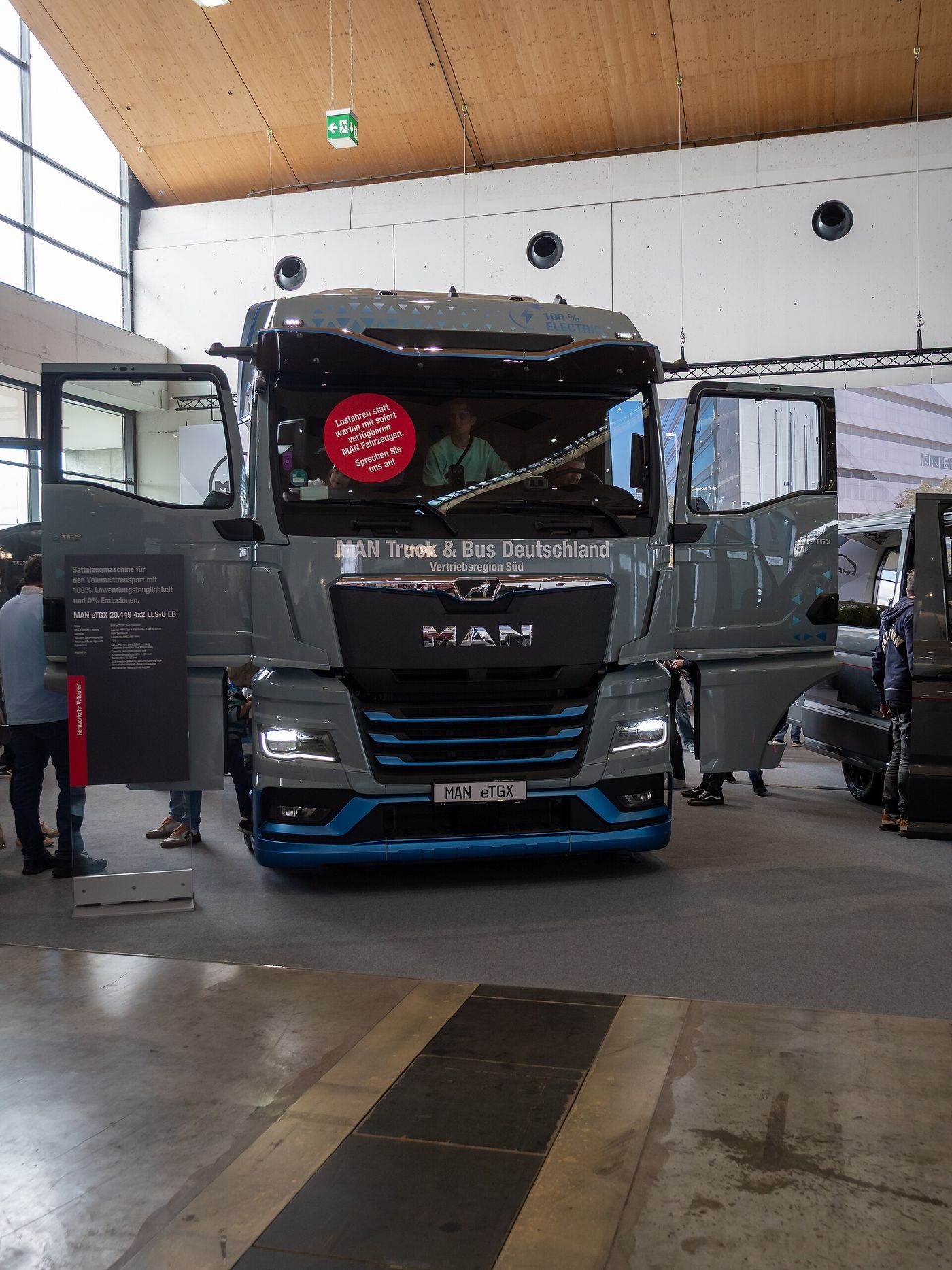
MAN eTGX
Six-pack 4x2 tractor: 534 kWh installed against 480 kWh usable, 570 km on MAN's stated basis, MCS at 750 kW since July 2026 — and a new eTGX shown at IAA 2026 with no order date.
- 2025—
- 2 configurations

Model overview
- Segment
- Long-haul tractor
- Produced
- 2025—
- Axle configurations
- 2 (4x2…)
- Transmission
- Central drive unit with a 2- or 4-speed transmission depending on power rating
- Gross combination
- 50 t
- Battery
- 480 kWh
- Battery installed
- 534 kWh
- Range
- 570 km
- Charging
- 375 kW (CCS)
- Electric motor
- 1×
Axle configurations: 4x2 · 6x2
The eTGX is the battery-electric version of MAN’s long-haul truck. It sits beside the diesel MAN TGX in the range and is built on the same assembly line in Munich. MAN opened sales on 30 October 2023, together with the eTGS for distribution work, and began deliveries with a handover in Leipzig on 15 October 2024. Series production started in mid-June 2025. Before that, in MAN’s words, it had “already manufactured almost 200 electric pre-series trucks and delivered them to customers”. The production year in the table, 2025, is the start of series production; it does not cover those pre-series trucks, which were delivered from October 2024. A year after series production began, MAN said around 1,300 heavy-series electric trucks had been built in Munich since then, a count that covers the eTGS as well as the eTGX.
There are now two trucks under the name. On 14 September 2026, at IAA Transportation in Hanover, MAN presented what its press release calls a “World premiere”: a new eTGX with a longer nose, a new battery generation and a seven-pack tractor. That release gives no date for orders, production or deliveries, and neither does the press kit it belongs to. So the table above describes the eTGX MAN builds and sells today. Its axle row covers the whole model, the 6x2 chassis included, while the two battery rows are for the six-pack 4x2 semitrailer tractor and the range row for its standard version. The table gives no power rating, for reasons set out below. The new truck has its own section further down, and its figures are announcements.
The battery figures: 534 installed, 480 usable
MAN builds its own battery packs at its Nuremberg plant and publishes both an installed and a usable figure for them. A pack of this generation “contains 89 kWh of energy, of which 80 kWh can be used”, MAN’s November 2023 release says. A semitrailer tractor carries four to six packs, and MAN’s eTGX table gives it 320 to 480 kWh. The charging table in the September 2026 eTruck brochure labels the same figures “Max. usable battery capacity” and writes the top one as 6x 80. For the six-pack truck MAN also gives the gross figure: the release on the first delivery describes a truck with six packs and 534 kWh, “of which 480 kWh can be used”. Those are the two battery figures in the table, and they belong to the same six-pack truck. MAN publishes no gross figure for four or five packs.
The brochure also explains the gap. Its footnote defines usable capacity at the beginning of the battery’s life, “with BoL and range-optimised design, i.e. DoD (Depth of Discharge) 90%”. 80 of 89 kWh is 89.9 per cent, which fits that 90 per cent; MAN states the depth of discharge, not the division. How other makers’ documents present the installed and usable figures is set out in installed vs usable battery capacity.
In MAN’s current tables, seven packs are a chassis option, not a tractor one. The brochure lists a seventh pack under MAN Individual, with 560 kWh usable and a production start it gives as “SOP 02/2026”. MAN’s eTGX table allows up to seven packs on the 6x2 chassis only, and its July 2026 release calls this “the seven-battery configuration available for chassis vehicles”, with 623 kWh in total.
MAN uses nickel-manganese-cobalt (NMC) cells. On battery life, its documents do not agree. The brochure gives “a forecast effective performance period of up to 1.6 million kilometres or up to 15 years (depending on use)”. MAN’s electric-trucks overview page gives the same distance but “up to 13 years”. MAN lists “a 3-year warranty for the driveline” among its “flexible MAN eMobility service products”, alongside service contracts and “individual purchase warranties”; its documents do not say that it comes with every truck. MAN says battery-specific maintenance intervals are calculated and determined individually for each vehicle, helped by continuous analysis of the battery data, and that MAN ServiceCare bundles this data into a maintenance plan. None of the documents opened for this page gives a battery warranty in years, cycles or state of health.
The 570 km range figure
The range in the table comes from the disclaimer on MAN’s eTGX page. It reads “4x2 standard semitrailer tractor (6 batteries): up to 570 km”. MAN says the range figures were “determined internally”, serve “as a rough estimate” and “may deviate from official values in accordance with EU regulations”. It adds that they are “maximum up-to values that can be achieved under optimum conditions”. MAN says customer-specific values must be calculated separately. The page then defines good operating conditions for this tractor as 20 °C ambient temperature, 60% payload and typical long-haul transport, primarily on motorways. MAN gives the figure for the standard tractor; no range is published for the current ultra version. The brochure repeats the 570 km with similar wording, figures “determined internally” that “represent a rough estimate”, but without the temperature and payload definition.
Other MAN documents print other distances, and they are not the same measurement:
- 800 km, “later up to 1,000 km”: the October 2023 sales release, which calls them “daily ranges”. MAN’s electric-trucks page explains a day’s distance of 600 to 800 km as travel “with a 480 kWh battery and a charging break of approx. 45 minutes”, and names no charging standard.
- 500 km without recharging: the June 2025 series-production release, for up to 534 kWh gross. It gives no basis and does not say how this relates to the 570 km.
- 740 km with an optional seventh battery: the same June 2025 release, again with no basis.
- Around 650 km with a seventh battery: the October 2024 first-delivery release, in the same sentence that gives the most powerful version as 544 HP (400 kW): “depending on the application, can achieve a range of around 650 kilometres without recharging when equipped with a seventh* high-voltage battery that will be available in the future”. No temperature or payload is stated, and the seventh battery it describes is a future item, whereas the release behind the 740 km bullet above calls it optional.
- 820 km and 830 km: MAN’s figures for the 4x2 box chassis with six packs, solo, in “typical distribution transport (high city and intercity share)”, and for the 6x2 swap-body chassis with seven, solo, in typical long haul; both at 20 °C and 60% payload. With a trailer MAN gives the swap-body chassis 600 km, but its stated conditions for that truck are for solo operation.
- Up to 570 km “between charging stops” “in a typical long-haul tractor-semitrailer configuration”, and more than 1,000 km a day: the July 2026 MCS release. It gives the daily figure in its paragraph on MCS charging times, says it can be achieved “within the same working time as with a diesel truck”, and states no further basis.
Only the figures in MAN’s range disclaimer come with defined conditions, and those conditions are not all the same: distribution work for the 820 km, long haul for the 570 km and 830 km. The 570 km is the one for the standard tractor. That is why it is the range in the table. The bases on which makers state electric-truck range are set out one at a time in how electric-truck range is declared.
MAN also publishes energy use, but only as fleet averages. The June 2025 release gives 97 kWh per 100 kilometres on average for the pre-series trucks. The September 2026 eTGL release says around 400 eTGX and eTGS trucks averaged around 93 kWh per 100 kilometres over more than nine million kilometres in just under a year. Both figures mix two models and many duty cycles, so neither is a test figure for the tractor.
Charging: CCS at 375 kW, MCS at 750 kW since July 2026
MAN rates the eTGX at up to 375 kW over CCS and up to 750 kW over MCS. The table carries the CCS figure, because MCS is an option that entered series production only at the end of July 2026. The brochure’s charging table gives the times for six packs. Over CCS at 500 A, 20 to 80 per cent takes approx. 53 minutes. Over MCS, at up to 750 kW and 1,000 A, it takes approx. 27 minutes. A footnote puts both “under optimal conditions, no restriction by charging station, battery preconditioned to 20°C, at BoL”. Maximum MCS power depends on the pack count: the same table gives up to 500 kW with four packs, 625 kW with five, and 750 kW with six or seven.
Which ports a truck has, and so which of those figures it can use, depends on its specification. MAN’s July 2026 release describes an MCS charging position at the front left, to which “additional CCS charging points” can optionally be added at the front right and, on chassis trucks, at the rear on both sides. None of the documents opened says whether a truck with MCS always has a CCS inlet as well.
The October 2023 release said MAN would offer MCS “right from the start of sales”. Series production came later: MAN’s release of 30 July 2026 announced the first series-built truck with an MCS port and step-by-step deliveries to customers in the nine countries it lists. It calls MAN “the first European manufacturer” to build MCS trucks in series; that claim is MAN’s. The September 2026 premiere release calls the MCS port “optional”. The July release gives charging from 20 to 80 per cent in “less than 30 minutes” for six batteries and 534 kWh. For the seven-battery chassis it gives “less than 40 minutes” to 80 per cent, without naming the starting charge.
Two MAN documents describe the same 45-minute stop in different words. The eTGX page says the truck “can be fully recharged easily in breaks of approx. 45 minutes”. The brochure says “about 45 minutes for empty battery packs to be largely charged”. Both tie it to megawatt charging at up to 750 kW. Fully and largely are not the same claim. Megawatt charging is covered in megawatt charging explained.
One central motor, three power ratings at launch
The eTGX drives through a central unit in the frame rather than an e-axle, a contrast MAN draws itself. MAN describes the unit as “the synchronous electric motor”, an inverter and a two- or four-speed transmission, driving the axles through “a conventional cardan shaft”. At the start of sales, in October 2023, MAN gave three ratings: 333 hp (245 kW), 449 hp (330 kW) and 544 hp (400 kW), with 800, 1,150 and 1,250 Nm of torque.
The web version of the October 2023 release prints the lowest rating as “333 hp (254 kW)”, while its own picture caption and both the English and German PDF editions read 245 kW. Other documents round the middle rating differently: the first-delivery release gives it as 450 HP (330 kW), and a 2024 release on a trade magazine’s comparison test pairs 330 kW with 1,150 Nm and “an automated four-speed gearbox”. How a maker’s horsepower relates to its kilowatts is covered in reading truck power figures.
Those three ratings are dated, and the table does not carry them. The 2024 first-delivery release still calls a 544 HP (400 kW) truck “the most powerful version of the MAN eTruck available”, but no MAN document from 2025 or 2026 opened for this page lists the ratings on sale now. Two releases of 14 September 2026 do not match the launch set. The eTGL release says the eTGL uses the same component toolkit as the eTGX and eTGS, including “the smallest of the three available drive variants with a 285 hp electric motor and two-speed transmission”. The IAA premiere release says MAN “now offers a complete drive portfolio of 333 to 598 hp for the eTGX and eTGS”. Neither lists the three launch ratings, and no MAN document opened explains how the 285 hp motor fits them. The table gives no power rating until a current MAN specification settles it.
The table also leaves continuous and peak output blank. MAN’s electric-trucks page speaks of “up to 400 kW continuous drive and continuous brake output”, which matches the top launch rating, and MAN gives no continuous-versus-peak pair for any rating. The 2023 release adds that maximum recuperation “corresponds to the drive power of the electric motor”.
Variants, wheelbases and weights
MAN’s eTGX table has three columns: a 4x2 semitrailer tractor, a 4x2 chassis and a 6x2 chassis. The virtual showroom on the same page lists the chassis as 6x2-4 and 6x2-2. In both of MAN’s tables the tractor is a 4x2; what the layouts mean is explained in axle configurations explained. MAN sells the tractor in a standard version and an “ultra” version for volume transport. The brochure gives the ultra tractor a “minimal height of 953 mm” and says it suits semitrailers with an interior height of 3,000 mm and up to 100 m³. MAN’s June 2025 release names automotive supply in Wolfsburg and Bavaria among the jobs it already does. MAN’s 2024 and 2025 releases give a fifth-wheel height of 950 mm. The brochure does not say what its minimal height is measured to.
The tractor wheelbase starts at 3,750 mm, which MAN calls the shortest among semitrailer tractors. MAN says this lets the tractor pull ISO or special trailers “without exceeding a train length of 16.50 m”. The brochure gives chassis wheelbases from 3,750 to 5,950 mm, and MAN offers the eTGX with ADR equipment of types AT and FL, for the transport of fuel and other hazardous goods. The corresponding vehicle design, MAN’s overview page says, “includes an ADR-compliant electric architecture with specialised wiring, speed limitation and additional safety and shut-off systems such as battery-powered emergency shut-off functions”.
MAN also describes two equipment areas that go with the cab and driveline. The instrument cluster is “an all-digital” 12.3-inch colour display, with what MAN calls “the semicircular scaling of the speedometer and rev counter” leaving room in the middle “for additional information such as electric PTOs”. A “calm display mode” shows only essential driving information; MAN says it can be switched on by hand and comes on by itself in reverse gear. On the driveline side, MAN offers “ultra compatible body interfaces” for “additional mechanical PTOs and electrical interfaces”, for equipment mounted on the vehicle.
Cab variants: GX, GM and GN
MAN offers the eTGX with a choice of three cabs, shared with the diesel TGX. MAN’s eTGX overview page compares the three under its own taglines. GX is “the maximum”, built “for journeys in international long-haul transport”, with what the page calls extra-large storage space, an extra-high interior and effective acoustic insulation. GM is “the generous”, for “a wide range of applications in long-haul transport”, with generous storage space and over 1.85 m of standing height. GN is “the spacious”, for “occasional overnight stays on the road”, with what MAN calls “very good superstructure capability” — room for a body mounted above the cab. Each cab’s own specification page names the eTGX as one of the “Available truck models” it fits, and gives its external dimensions: all three share a width of 2,440 mm and a length of 2,280 mm; their heights differ, at 2,150 mm for GX, 1,940 mm for GM and 1,660 mm for GN. GX and GM each seat two and sleep two; GN seats two and sleeps one. The brochure’s own summary of the new eTruck generation lists the same three letters together: “A variety of cabs (GX, GM, GN) with a comfortable rest area”.
On weight, MAN’s table prints a dash for the tractor’s gross vehicle weight and “Up to 50 t” for the gross combination. The two chassis columns read up to 20 t and up to 28 t gross vehicle weight, each with the same 50 t combination. That 50 t is a ceiling in MAN’s own words, not the plate on any one truck. What a combination may weigh on a given road depends on the rules that apply there, as set out in truck weights, GVW and GCW. Apart from a figure in the 2026 premiere release, discussed below, the documents opened publish no unladen weight or payload for the tractor. The 2023 release gives only a difference: fitting three, four or five packs instead of six reduces vehicle weight by up to 2.4 metric tons. Three packs are not offered on the tractor in MAN’s current tables.
The new eTGX shown at IAA Transportation 2026
Everything in this section comes from MAN’s release of 14 September 2026, and MAN has not said when any of it can be ordered or built.
Body and cab. The front is “pulled forward by 120 millimetres”. MAN says this makes use of “the EU length specifications for zero-emission vehicles”; how the EU length rules treat longer cabs is covered in aerodynamic cabs and the EU length rules. MAN claims “up to 20 per cent more powerful recuperation” and says the new truck is “up to three per cent more efficient than the previous model”. The windscreen frame is lower, and a new “low-visibility window” in the passenger door improves the driver’s direct view. New comfort items include a 230-volt socket of up to 1.2 kW and a mechanical night lock.
Battery. A new-generation pack has “a gross capacity of 92 kWh” and “88 kWh available for vehicle operation”. MAN puts the gain at ten per cent more usable energy and the usable share at 95 percent. 88 of 92 is 95.7 per cent, and 88 against the 80 kWh of today’s pack is exactly ten per cent more. MAN attributes the gain to “improvements in cell chemistry” and says pack size and weight are unchanged.
Range, 4x2. The release gives the 660 km twice. Early on, for “a typical 4x2 semitrailer tractor with six batteries and a total capacity of 552 kWh”, it says the range rises “to up to 660 kilometres”. In its battery section it describes the new eTGX “as a 4x2 ultra semitrailer tractor” with six packs, 552 kWh and a 3.75-metre wheelbase, and gives it “a maximum possible range of 660 kilometers, or well over 500 kilometers under real conditions in typical long-haul transport”. The German edition words this the same way and adds that it is the eTGX presented at the show. MAN states no temperature, no payload and no test procedure for any of these figures. MAN gives no usable total: six packs of 88 kWh would make 528 kWh.
Range, 6x2. MAN describes the 6x2 tractor as one “which will also be available in the future”. With a seventh pack and 644 kWh it “can reach up to 720 kilometres”, and MAN says “the typical range of over 600 kilometres” is achievable “under everyday long-haul transport conditions”. Again no basis is given, and seven packs of 88 kWh would make 616 kWh usable. The seventh pack sits crosswise behind the cab, and MAN gives this tractor a steerable trailing axle and a fifth-wheel load of 15 tonnes. The release calls the seventh battery for tractors a “concept”, demonstrated “using a current 6x2 semitrailer tractor”. MAN’s eTGX table lists only a 4x2 tractor, and nothing opened for this page settles whether a 6x2 eTGX tractor can be ordered now.
Drive. Three new ratings are listed: 440 kW (598 hp) with 480 kW of maximum recuperation, and 360 kW (490 hp) and 290 kW (349 hp) with up to 420 and 320 kW. The last of these does not add up: 349 hp and 290 kW do not match under the usual conversion. The German edition prints the same “349 PS (290 kW)”. The release is also inconsistent about timing. It says drive power “will reach up to 598 hp in the future”, but also that MAN “now offers a complete drive portfolio of 333 to 598 hp for the eTGX and eTGS”.
Weight. The release says “the 4x2 semitrailer tractor with an unladen weight of 10.7 tonnes offers a payload of up to 25 tonnes with a standard semitrailer”. The sentence follows the statement that battery weight is unchanged. It does not say how many packs that tractor carries, or whether the figure belongs to the new truck alone.
Quick answers
- What axle configurations does the MAN eTGX come in?
- 4x2, 6x2.
- When did production of the MAN eTGX start?
- Production of the MAN eTGX started in 2025.
- Which transmission does the MAN eTGX use?
- Transmission: Central drive unit with a 2- or 4-speed transmission depending on power rating.
- What is the gross combination weight of the MAN eTGX?
- Gross combination weight: 50 t.
- What battery capacity does the MAN eTGX have?
- Battery: 480 kWh; Battery installed: 534 kWh; Range: 570 km; Charging: 375 kW (CCS).
Articles that mention the MAN eTGX
- Electric tractor units: register of maker-declared values
- Megawatt Charging System (MCS) for electric trucks explained
- Charging electric trucks and buses: depot, opportunity and megawatt charging
- Electric-truck maintenance compared with diesel: what goes, what stays
- Installed vs usable battery capacity in electric trucks
- Regenerative braking in trucks and buses: levels, type approval and the annual test in Great Britain
- Battery chemistries in heavy trucks: what LFP, NMC and NCA are and which makers state which
- Electric trucks and tractor units explained: how they work, what makers declare, where they charge
More MAN on this site
Sources
- MAN eTGX — overview and technical data — MAN Truck & Bus
- The new MAN eTruck generation (brochure D111.3699/EN, 09/2026) — MAN Truck & Bus
- World premiere at the IAA: MAN eTGX with greater range, efficiency and safety (press release, 14 September 2026) — MAN Truck & Bus
- World premiere at the IAA: MAN eTGX with greater range, efficiency and safety (German edition, press release, 14 September 2026) — MAN Truck & Bus
- MAN starts series production of MCS-ready eTrucks (press release, 30 July 2026) — MAN Truck & Bus
- Sale of the new MAN eTruck starts (press release PDF, 30 October 2023) — MAN Truck & Bus
- MAN GX cab — specifications — MAN Truck & Bus
- MAN GM cab — specifications — MAN Truck & Bus
- MAN GN cab — specifications — MAN Truck & Bus
- MAN electric trucks: model overview — MAN Truck & Bus
- Driving.People.Partner: MAN at IAA Transportation 2026 (press kit, 14 September 2026) — MAN Truck & Bus
- One year of electric trucks from MAN (press release, 18 June 2026) — MAN Truck & Bus
- Electrified light series: MAN eTGL for urban and regional distribution transport (press release, 14 September 2026) — MAN Truck & Bus
- Historic: MAN starts series production of electric trucks (press release, 16 June 2025) — MAN Truck & Bus
- MAN enters a new electric era (press release, 15 October 2024) — MAN Truck & Bus
- MAN eTruck leads the way with electric trucks (press release, 26 August 2024) — MAN Truck & Bus
- MAN BatteryPacks now also for industrial applications (press release, 9 November 2023) — MAN Truck & Bus