MAN
MAN TGL
Two D08 engines, 4x2 only, and three separate plates from 7.5 to 12 tonnes — what the TGL is, where MAN's own documents stop, and what to check on a used one.
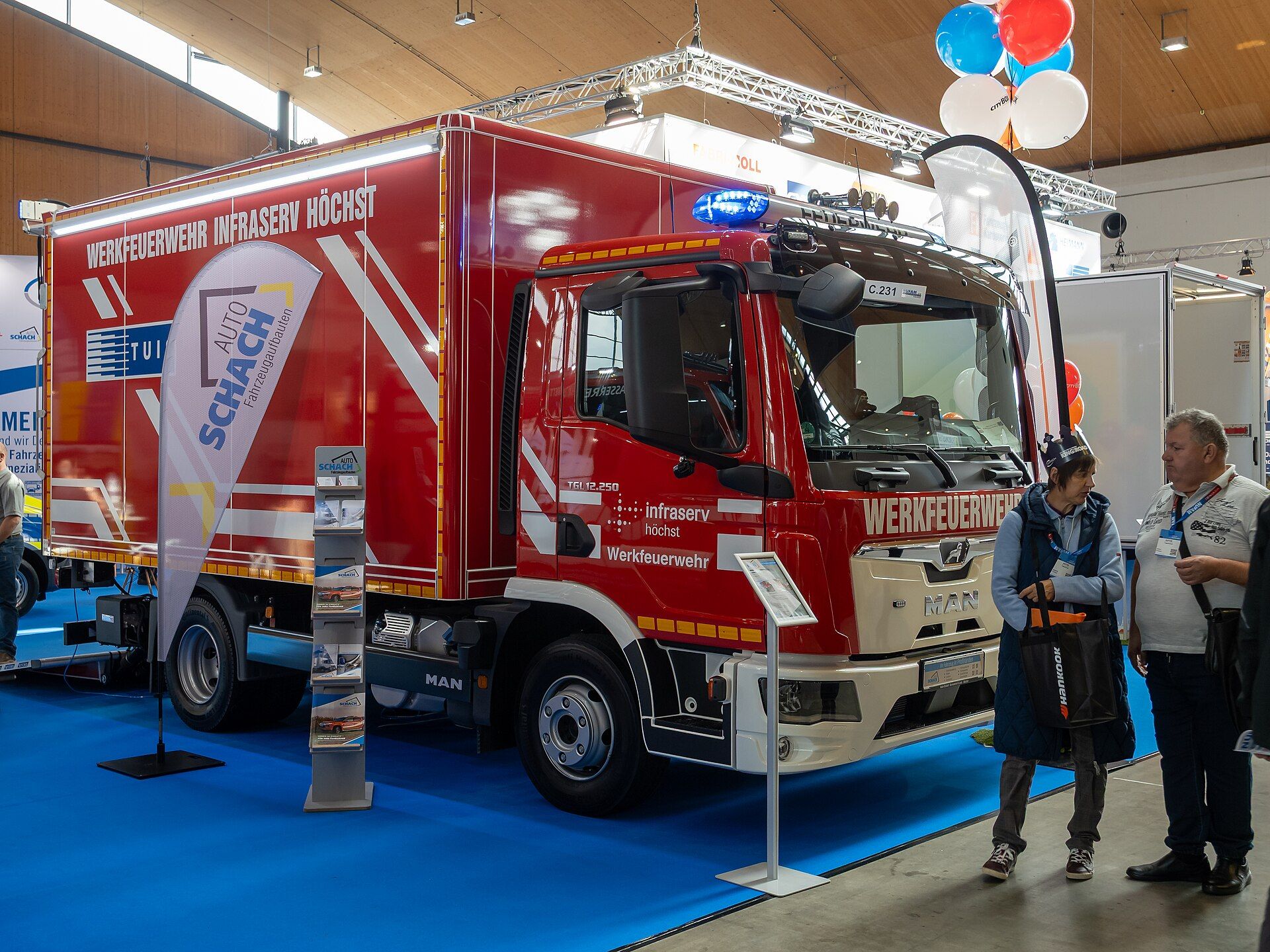
.jpg)
Model overview
Engine families
- Power
- 118–162 kW
- Torque
- 600–850 Nm
- Rated speed
- 2300 rpm
- Power
- 184 kW
- Torque
- 1050 Nm
- Rated speed
- 2200 rpm
The weights above are MAN Truck & Bus UK Ltd's GB plating, read from the four Euro 6 TGL bodybuilder sheets issued in May 2022, each of which prints an identical Design and UK Legal column. They are registration figures for the British market, not a pan-European catalogue. The ladder runs 7,500 kg gross vehicle against 18,750 kg gross train on the two 7.5 t sheets (TGL 8.160, 8.190 and 8.220), with maximum axle loads of 3,400 kg front and 5,200 kg rear and a 3,800 kg front upgrade listed as optional; 10,000 against 21,000 kg on the 10 t sheet (TGL 10.190, 10.220 and 10.250), axles 4,000 and 6,800 kg; and 12,000 against 24,000 kg on the 12 t sheet (TGL 12.190, 12.220 and 12.250), axles 4,700 and 8,700 kg. Every sheet footnotes the gross train weight as a maximum value subject to specification, and warns that tyre changes can affect legal weights. The 21 October 2020 press release gives the range as a whole a GVW of 7.5 t to 12 t. The lowest of the three plates is also a licence boundary: Article 4(4) of Directive 2006/126/EC closes driving licence category C1 at 7,500 kg maximum authorised mass, and Article 6 of Directive (EU) 2025/2205 — which by its Article 30(1) repeals 2006/126/EC with effect from 26 November 2029 — carries the same figure forward unchanged. Power steps, from the "For vehicle series" column of MAN's global TGM/TGL data sheet: D0834 at 118 kW (160 PS), 140 kW (190 PS) and 162 kW (220 PS), all three tagged TGL; D0836 at 184 kW (250 PS) tagged TGM/TGL, and at 213 kW (290 PS) and 235 kW (320 PS) tagged TGM only. Torque and rated speed come from the GB sheets: 600 Nm from 1,000 to 1,850 rpm at 160 PS, 750 Nm from 1,200 to 1,750 rpm at 190 PS and 850 Nm from 1,300 to 1,800 rpm at 220 PS, all three at 2,300 rpm rated; 1,050 Nm from 1,200 to 1,600 rpm at 250 PS, rated at 2,200 rpm. Those same sheets print "Capacity (cc) 4850" for the D0834 and 6871 for the D0836; the 6,871 cc agrees with the 6.9 litres on MAN's global page, the 4,850 cc does not agree with its 4.6 litres, and this record does not reconcile them. MAN's GB sheets do not offer the 250 PS D0836 at 7.5 tonnes — both 7.5 t sheets list D0834 ratings only, and no MAN document opened here breaks the engine offer down by plate for other markets: the global table tags the 250 PS step TGM/TGL with no plate qualifier, and its cab footnote reads "Engine tunnel height 260 mm for TGL with D0836, 140 mm for TGL with D0834" without reference to tonnage. The 12 t sheet costs the six-cylinder 186 kg over a D0834 build, gearbox included, against 16 kg saved by ordering the manual gearbox in place of the TipMatic. Nine wheelbases are published across the four sheets: 3,050, 3,600, 3,900, 4,200, 4,500, 4,850, 5,200, 5,550 and 6,700 mm. The 3,050 mm belongs to the 7.5 t tipper alone, the 7.5 t rigid stops at 5,550 mm, and the 6,700 mm appears on the 10 t and 12 t sheets with the 250 PS engine only. Wall-to-wall turning circles track the wheelbases from 12.6 to 23.2 m. Three final drives are published and none of them belongs to an engine: 3.70:1 at 190 and 220 PS and 3.36:1 at 250 PS on the 10 t and 12 t sheets; 3.36:1 at all three D0834 ratings on the 7.5 t rigid; and 4.11:1 at 160 and 190 PS on the 7.5 t tipper. Every sheet quotes a starting grade of 33 per cent or better for every rating it lists, a 35-litre AdBlue tank and a road speed limiter set at 89 km/h. Tyres are the same size on both axles and climb with the plate: 215/75R17.5 on the two 7.5 t sheets, 235/75R17.5 on the 10 t and 265/70R17.5 on the 12 t. The fuel tank is 150 litres on the three rigid sheets and 100 litres on the 7.5 t tipper. MAN's TGM/TGL overview page answers the question for the TGL by name — its FAQ heading reads "How big is the MAN TGL's tank?" — and gives tank sizes "typically between 120 and 200 litres, depending on the specific model and equipment configuration": a band the 100-litre tipper tank on MAN's own GB sheet falls below, and this record does not reconcile the two. The same overview page and the global specifications page both attribute a fourth gearbox to the TGM and the TGL jointly — "the converter automatic gearbox MAN PowerMatic" on the specifications page, "Both models are fitted with MAN PowerMatic gearboxes" on the overview. A converter automatic is not an automated manual, but no TGL-specific document opened here confirms one for this range and no GB sheet lists it, so it is recorded unresolved rather than published as a TGL transmission. Selective catalytic reduction, an exhaust brake, OBD-E, the Lane Guard System, Emergency Brake Assist and the Electronic Stability Programme are all listed as standard equipment, and the vehicle is declared suitable for EN15940 paraffinic fuel; no retarder appears on any of the four GB sheets. Four cabs are offered on the same chassis: CC compact day, TN normal-height sleeper, TM medium-height sleeper and DN crew cab.
The TGL is the light end of the truck range MAN launched in 2020, sold to the operator who needs a rigid chassis rather than a tractor unit. MAN’s press release of 21 October 2020 puts it at a gross vehicle weight of 7.5 t to 12 t, below the TGM and in a different business from the long-haul TGX. It is MAN Truck & Bus’s entry in the class that does the last leg of almost everything, bought as a bare chassis and bodied into a box, a curtain, a tipper or a municipal machine.
It comes with a documentary problem attached. On man.eu the TGL has no page of its own: the specifications page, the data sheet and the overview are all joint TGM/TGL documents, and the engine table carries a “For vehicle series” column because the two ranges do not share every row. Read that column and the split is clear; read past it and you inherit the TGM’s figures. Standalone TGL specifications do exist, but they are national — MAN Truck & Bus UK Ltd’s own index lists four of them, one per plate and body type, and they are where most of what follows comes from.
Two engines, and the ceiling is lower than the press release suggests
Two engines from MAN’s D08 family are offered. The D0834 is a four-cylinder of 4.6 litres in three steps — 118 kW (160 PS), 140 kW (190 PS) and 162 kW (220 PS) — all three tagged TGL on MAN’s data sheet. The GB bodybuilder sheets add what the global table omits — a rated speed of 2,300 rpm shared by all three, and torque with the band it is held over: 600 Nm from 1,000 to 1,850 rpm at 160 PS, 750 Nm from 1,200 to 1,750 rpm at 190 PS, 850 Nm from 1,300 to 1,800 rpm at 220 PS. The lowest rating holds its torque over the widest band — the opposite of what a power ladder implies, and exactly what reading a power figure is for.
The D0836 is the six-cylinder, 6.9 litres, and the TGL gets one step of it: 184 kW (250 PS), 1,050 Nm from 1,200 to 1,600 rpm, rated at 2,200 rpm. That is the top of the model. MAN’s own press release describes the launch as “six variants, ranging from 160 hp to 320 hp” — a trap sitting inside a primary source, because it covers the TGL and the TGM together. The 213 kW (290 PS) and 235 kW (320 PS) steps of the same D0836 are tagged for the TGM alone, and a TGL cannot be ordered with either.
The choice between the families is not only about power. On the 12 t sheet the D0836 costs 186 kg over a D0834 build, gearbox included, which on a truck plated at 12,000 kg comes straight out of the payload. MAN’s GB sheets do not offer it at 7.5 tonnes — both 7.5 t sheets list D0834 ratings only — and no MAN document opened here breaks the engine offer down by plate for other markets: the global table tags the 250 PS step TGM/TGL with no plate qualifier, and the cab footnote on the same page discusses engine tunnel height “for TGL with D0836” without reference to tonnage.
The four GB sheets head their engine tables “Euro 6” and MAN’s global table heads its column the same way, in both cases with no letter and with OBD-E among the standard features. The one lettered step anywhere in this material is in the October 2020 press release, which calls the D08 units “Euro 6d” — a sentence written for the TGL, TGM and TGS at once, so no sub-step is claimed here, and which step a vehicle actually holds is what Euro 6 and Euro 7 exists to unpick. The hardware is conventional: selective catalytic reduction with a 35-litre AdBlue tank on all four sheets, against 150 litres of fuel on the three rigids and 100 on the 7.5 t tipper — a ratio worth working out per sheet rather than for the model when reading SCR and AdBlue.
Gearboxes: the engine picks the box
On the GB sheets the transmission follows the engine. The D0834 gets a six-speed MAN TipMatic, the D0836 a twelve-speed, and the press release describes the same split as “6- or 12-speed variants of the MAN TipMatic”. Both TipMatics are automated manuals rather than true automatics, and one model carrying both shows plainly what the extra ratios buy: the six-speed spans a wide gap per shift behind an engine that pulls from 1,000 rpm, the twelve-speed splits the same range finely behind an engine with a narrower band.
A manual gearbox is still available, and which way round it appears says what the truck is for: on the 12 t rigid sheet it is an option saving 16 kg, on the 7.5 t tipper it is standard and the TipMatic is the option.
What we could not confirm
No dimension is published here, and that is deliberate. Across the four sheets MAN lists nine wheelbases — 3,050, 3,600, 3,900, 4,200, 4,500, 4,850, 5,200, 5,550 and 6,700 mm — with wall-to-wall turning circles tracking them from 12.6 to 23.2 m. Not one sheet carries all nine: the 3,050 mm is the tipper’s alone, the 7.5 t rigid stops at 5,550 mm, and the 6,700 mm appears on the 10 t and 12 t sheets and only behind the 250 PS engine. A single value in the table above would be one of nine choices presented as the model’s figure. Vehicle length is worse still: a bare chassis has none.
No Euro step beyond “Euro 6”. The sibling TGX record carries Euro 6e and no TGL document says it. The nearest thing to a letter here is the press release’s “Euro 6d”, which covers three ranges in one sentence; copying a letter across ranges, or across models, would be an invention dressed as consistency.
The displacement of the D0834 is contradicted by MAN’s own sheets. The global specifications page and the October 2020 press release both say 4.6 litres; all four GB bodybuilder sheets print “Capacity (cc) 4850”. Two MAN sources against one, so 4.6 appears above and the contradiction is recorded rather than smoothed over. The six-cylinder has no such problem: 6,871 cc on the GB sheets and 6.9 litres on the global page are the same engine twice.
Whether a torque converter can be had in a TGL. MAN’s global specifications page tells the reader that “these vehicles boast efficient and modern technology, such as the converter automatic gearbox MAN PowerMatic”, and the overview page is blunter: “Both models are fitted with MAN PowerMatic gearboxes, which offer automatic gear-shifting.” Both sentences are written for the TGM and the TGL at once. A converter automatic is not an automated manual, so this is not the same box as either TipMatic — but no TGL-specific document opened here confirms it for this range, and none of the four GB sheets lists it. It is recorded unresolved rather than published as a TGL transmission.
Nothing here is borrowed from the eTGL. The battery-electric version is a separate MAN model, and none of its figures belong on a diesel record.
One axle layout, three plates
The TGL is a 4x2 and nothing else: on MAN’s chassis matrix the 4x2 row alone reads TGM/TGL for both chassis and tipper. Two rows more carry a range name at all in both columns — 4x4 and 6x4, both TGM — and 6x2- reads TGM as a chassis only. Everything else on the matrix, 6x2 and 6x4- and 6x6 and every 8-wheeler entry, is blank for both ranges, so those are configurations MAN offers in neither rather than in the sibling. The model is the limiting case of the axle configuration ladder rather than an illustration of it.
What varies instead is the plate, and there are three. Every figure here is MAN Truck & Bus UK Ltd’s GB plating from the May 2022 sheets, which print identical Design and UK Legal columns: British registration figures, not a pan-European catalogue. The 7.5 t sheets — TGL 8.160, 8.190 and 8.220 — give 7,500 kg gross vehicle against 18,750 kg gross train, with maximum axle loads of 3,400 kg front and 5,200 kg rear and a 3,800 kg front upgrade listed as an option. The 10 t sheet — TGL 10.190, 10.220 and 10.250 — gives 10,000 against 21,000 kg, axles 4,000 and 6,800 kg. The 12 t sheet — TGL 12.190, 12.220 and 12.250 — gives 12,000 against 24,000 kg, axles 4,700 and 8,700 kg, which leaves 12,000 kg for a drawbar trailer and its load. That subtraction is our arithmetic and appears on no MAN document.
Three gross vehicle and gross combination pairs from one model on one axle layout shows plainly that the plate is a property of the build rather than of the badge. MAN footnotes the gross train weight as a maximum value subject to specification, and warns in the same block that tyre changes can affect legal weights. The rubber climbs with the plate and never differs between the axles: 215/75R17.5 on both 7.5 t sheets, 235/75R17.5 at 10 t, 265/70R17.5 at 12 t. That the size moves with the plate, on one model on one axle layout, is the clearest sign that a tyre here is part of the legal envelope and not only a label to read.
The 7,500 kg plate is a legal boundary as much as an engineering one: Article 4(4) of Directive 2006/126/EC closes driving licence category C1 at 7,500 kg maximum authorised mass — a threshold Directive (EU) 2025/2205, which repeals it with effect from 26 November 2029, carries forward unchanged in its own Article 6. Above it the driver needs category C, with the training consequences Driver CPC sets out and the obligations of an operator licence.
Cabs, and what stops the truck
Four cabs sit on the same chassis: CC compact day, TN normal-height sleeper, TM medium-height sleeper and DN crew. That is a working decision rather than a comfort one — the crew cab exists for municipal and utility gangs, and cab choice on a multi-drop vehicle is mostly about steps and door aperture.
Braking is by exhaust brake, standard on every rating, with no retarder listed on any of the four sheets — the honest answer for the class, since retarders and engine braking earn their keep on sustained descents and a 12-tonne rigid decelerates into stops instead. The 2022 sheets list the Lane Guard System, Emergency Brake Assist and the Electronic Stability Programme as standard, worth checking against what is now mandatory. MAN publishes three final drives across the four sheets, and no ratio belongs to an engine: the 10 t and 12 t sheets run 3.70:1 at 190 and 220 PS and 3.36:1 at 250 PS, the 7.5 t rigid runs 3.36:1 at all three of its four-cylinder ratings, and the 7.5 t tipper runs 4.11:1 at 160 and 190 PS. Every sheet quotes a starting grade of 33 per cent or better for every rating on it — enough to make axle ratio and final drive legible on a real vehicle.
Who this truck is right for
The TGL suits an operator running urban and regional distribution on a rigid chassis, and a municipal or utility fleet whose body supplier needs a plate-specific sheet to design against. The 7.5 t end keeps vehicles inside category C1; the 12 t end wins the payload argument. The choice is usually made by the licence and the yard rather than by the engine.
It is the wrong truck for heavy or off-road work: the moment the job wants a second drive axle the answer is the TGM or the TGS. It is wrong for trunking too, since 24 tonnes of combination is no substitute for a tractor unit.
Where it sits against its rivals
The Mercedes-Benz Atego, the DAF XB and the Iveco Eurocargo occupy the same class, and the choice between them turns on bodybuilder relationships, dealer coverage and residual value rather than on a specification advantage. The DAF is the XB and no longer the LF: DAF’s own model range page lists the LF nowhere, and the XB is the distribution truck standing in its place. The Atego has a record of its own here, built on Mercedes’ own documents, as does the Volvo FL in the same class; no figure-by-figure table is set out on this page, because those documents are not these documents and the comparison would be of publishing practice as much as of trucks. For the DAF XB and the Iveco Eurocargo this site has opened nothing comparable at all, so neither appears here in figures. Where MAN is strong is documentary: a national sheet per plate and body type, printing torque bands, rated speeds and axle ratios on one page, is more than most makers publish about a light rigid.
Buying used
Read the plate first, on the vehicle rather than inferred from the model name — the same TGL sits on 7,500, 10,000 and 12,000 kg chassis. Confirm the axle loads too: a truck bodied close to its front axle limit has less tolerance for where the load sits than the gross figure suggests.
Establish which engine is fitted. A D0836 means a heavier truck and a twelve-speed box; a D0834 a lighter one on six speeds. The gearbox is the tell and the axle is not: 3.36:1 sits behind the six on the 10 t and 12 t sheets and behind every four-cylinder rating on the 7.5 t rigid, so the ratio identifies no engine on its own. A 7.5-tonne vehicle advertised with a six-cylinder is a combination MAN’s GB sheets do not list, and worth confirming against the vehicle’s own plate. On a tipper, check whether the manual or the TipMatic is fitted, because the standard fitment runs the other way.
Body history matters more than mileage here, as in any used purchase. A tipper or municipal life is a different duty cycle from a box body on a delivery round, and it shows in the chassis and the brakes long before it shows on the odometer — which on a multi-drop vehicle understates wear badly, leaving engine hours as the honest measure. Check the emission system’s service record, and expect the air dryer and compressor to have been through a replacement cycle already.
Quick answers
- Which engines are available in the MAN TGL?
- The record for the MAN TGL covers these engine families: MAN D0834 (D08) (4.6 l), MAN D0836 (D08) (6.9 l). Output spans 118–184 kW and 600–1050 Nm.
- What axle configurations does the MAN TGL come in?
- 4x2.
- What emission standard does the MAN TGL meet?
- Euro 6.
Compared with
- Mercedes-Benz Atego
- DAF XB
- Iveco Eurocargo
Sources
- MAN TGM and MAN TGL — specifications — MAN Truck & Bus
- MAN TGM & MAN TGL — specifications data sheet — MAN Truck & Bus
- TGL 12 tonne 4x2 rigid — chassis specification — MAN Truck & Bus UK Ltd
- TGL 10 tonne 4x2 rigid — chassis specification — MAN Truck & Bus UK Ltd
- TGL 7.5 tonne 4x2 rigid — chassis specification — MAN Truck & Bus UK Ltd
- TGL 7.5 tonne 4x2 tipper — chassis specification — MAN Truck & Bus UK Ltd
- MAN TGL & TGM — cab specifications — MAN Truck & Bus UK Ltd
- Euro 6 vehicle specification sheets — index — MAN Truck & Bus UK Ltd
- MAN TGM and MAN TGL — overview — MAN Truck & Bus
- Reliable suppliers: the new MAN TGL, TGM and TGS for goods distribution — MAN Truck & Bus Press
- Directive 2006/126/EC on driving licences — Article 4(4) — EUR-Lex, Publications Office of the European Union
- Directive (EU) 2025/2205 on driving licences — Article 6 and Article 30(1), which repeals Directive 2006/126/EC — EUR-Lex, Publications Office of the European Union
- DAF model range — DAF Trucks