MAN
MAN Lion's City
Ten data sheets, seven body lengths and three drivelines on one city bus programme — the figures MAN publishes, the two its own documents contradict, and what it never states.
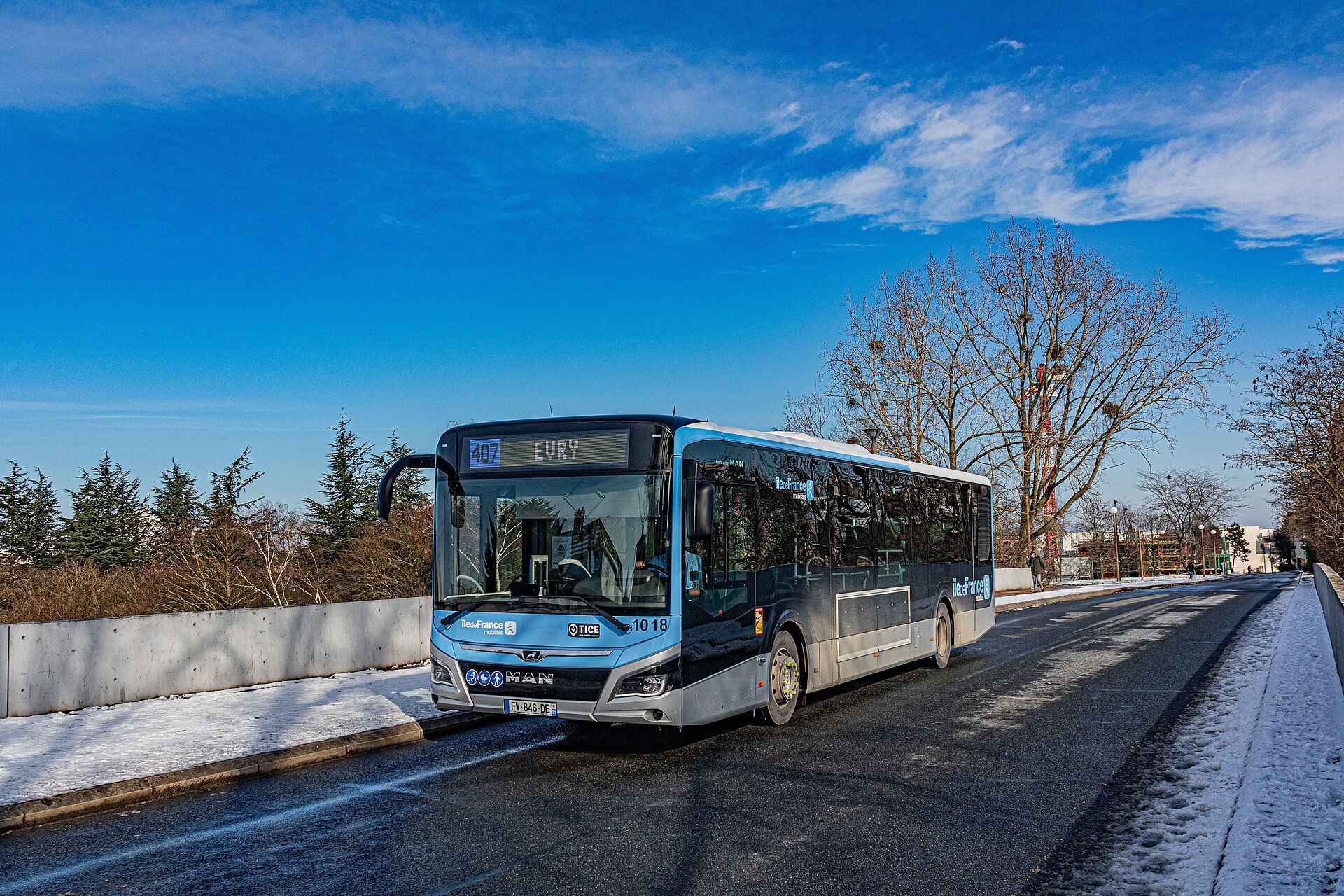

Model overview
Axle configurations: Two-axle (10 E, 12, 12 E, 12 E LE, 12 G) · Three-axle articulated (18, 18 E, 18 G, 19, 19 G)
Engine families
- Power
- 206–265 kW
- Torque
- 1200–1600 Nm
- Power
- 206–235 kW
- Torque
- 1200–1400 Nm
The figures above are the MAN Lion's City 12 with the D1556 LOH Euro 6. Nine more variants share the programme. The diesel D1556 is offered at three power steps on the 12 m bus — 206 kW with 1,200 Nm, 243 kW with 1,400 Nm and 265 kW with 1,600 Nm — and at the upper two only on the 18 and the 19. The gas E1856 runs on natural gas and biogas at 206 kW with 1,200 Nm and 235 kW with 1,400 Nm on the 12 G, and at 235 kW alone on the 18 G and 19 G; MAN gives its type 4 roof cylinders a capacity of up to 1,875 litres and a range of up to 500 km. Both combustion families take the same 6-speed automatic and both are offered with MAN EfficientHybrid, whose own table gives a 48 volt Ultra-Cap store of 40 Wh, a crankshaft starter generator of 12 kW and 220 Nm and an added 170 kg. The battery-electric variants are a separate driveline and are not in the grid above: a single-stage adapter gearbox, lithium-ion NMC packs on the roof, 160 kW continuous and 240 kW peak on the 10 E, 12 E and 12 E LE, with 2,100 Nm on the two 12 m variants and no torque row at all on the 10 E sheet, and 267 kW continuous with 3,500 Nm on the articulated 18 E, which MAN describes as having two driven axles and two electric central motors. Installed capacity is up to 356 kWh on the 10 E, up to 445 kWh on the 12 E LE, up to 534 kWh on the 12 E and up to 712 kWh on the 18 E; charging is by cable or pantograph at up to 150 kW, with a full charge in two and a half to five hours. Up to 380 km for the 12 E LE, 500 km for the 12 E and 460 km for the 18 E each carry a marker to MAN's footnote making them vehicle configuration and favourable-conditions figures rather than rated ranges; the 10 E sheet prints 300 km with no marker, and its own footnote turns on battery usage strategy instead. Two headline figures are contradicted by MAN's own documents and are left unresolved: the 18 E data sheet gives peak power as 400 kW where the electric-drive page gives 320 kW, and the 12 E and 12 E LE data sheets and the electric-drive page give 44 seats where the all-models page gives 45. Bodies run 10,575 mm (10 E), 12,185 mm (LC 12, 12 G), 12,200 mm (12 E, 12 E LE), 18,060 mm (18, 18 G), 18,100 mm (18 E), 18,730 mm (19 G) and 18,750 mm (19), all 2,550 mm wide, and 3,060 mm, 3,295 mm, 3,055 mm or 3,300 mm tall depending on driveline. Seats are 33, 37, 44, 49, 53 and 60 across the ten sheets. No MAN document opened states a gross vehicle weight, a kerb weight, an axle load, a wheel formula, a UN Regulation No 107 class or a turning circle for anything but the 10 E. No data sheet carries a standing figure either; the two that exist sit in MAN releases and describe single vehicles — 27 seats and 54 standing places for an exhibited two-door 10 E on 11 June 2025, and a since superseded "up to 120 passengers" total for the 18 E on 13 May 2020.
The Lion’s City is the city bus MAN builds for scheduled urban service, and it is not one vehicle: MAN publishes ten data sheets under the name, seven distinct body lengths across three drivelines, and those sheets are the whole of what the maker states in numbers. It announced the redesigned generation this page describes on 18 April 2018, in a release putting the world premiere at the BusDays open house and claiming about 1,130 kg off the 12 m variant against its D20-engined predecessor.
Everything below is read from those sheets and from MAN’s diesel-, gas- and electric-drive pages. The grid beside this page is the Lion’s City 12 with the D1556 LOH Euro 6, because a family record has to stand on one variant; the other nine are described here.
One body programme, seven lengths
The sheets run 10,575 mm for the 10 E, 12,185 mm for the diesel and gas 12 m buses, 12,200 mm for the electric ones, 18,060 mm for the 18 and 18 G, 18,100 mm for the 18 E, 18,730 mm for the 19 G and 18,750 mm for the 19 — seven distinct figures across ten sheets. MAN’s own all-models index prints the same bodies rounded to a tenth of a metre, which leaves five, and this page follows the sheets rather than the rounding. Every one is 2,550 mm wide, the maximum Annex I point 1.2(a) of Directive 96/53/EC allows. Height follows the driveline: 3,060 mm on the 12 m diesel, 3,055 mm on the 19, 3,295 mm on the gas buses whose cylinders sit in the roof and 3,300 mm on every electric variant, all well inside the 4.00 m of point 1.3.
Length is carried by the wheelbase: 4,395 mm on the 10 E, 6,005 mm on the 12 m bodies, and two figures rather than one on the long ones — 5,200 mm and 6,680 mm on the 18, 18 E and 18 G, 5,870 mm and 6,680 mm on the 19 and 19 G. Front and rear overhang read 2,775 mm and 3,405 mm on all ten sheets without exception, a programme figure rather than a measurement. Add the overhangs to the wheelbase and the published length returns exactly on six sheets, falling 15 mm short on the 12 E and 12 E LE, 20 mm on the 19 and 40 mm on the 18 E. That addition is ours; MAN makes it nowhere.
Against Annex I point 1.1, in force in its consolidated version of 14 August 2019, the 12 m buses sit inside even the lowest ceiling it sets — 13.50 m, for a bus with two axles — and the 19 sits exactly on the 18.75 m allowed for an articulated bus. MAN calls the 18 E an articulated bus in its 2020 sales-launch release; the 18, 18 G, 19 and 19 G print the same two-wheelbase row, and reading those as articulated too is ours, though point 1.1 leaves no other category open to a single bus of 18,060 mm. MAN publishes no wheel formula anywhere, so neither does this page; the notation is set out under axle configurations.
Three drivelines on one body
The same body takes a diesel, a natural-gas engine or a battery-electric drive, each on its own sheet — the cleanest side-by-side any single model here can offer on city bus propulsion.
The diesel D1556 is a 9.037-litre six-cylinder in line, offered at three steps on the 12 m bus — 206 kW with 1,200 Nm, 243 kW with 1,400 Nm and 265 kW with 1,600 Nm — and at the upper two only on the 18 and the 19.
The gas E1856 is a 9.514-litre six on natural gas and biogas: 206 kW with 1,200 Nm and 235 kW with 1,400 Nm on the 12 G, 235 kW alone on the 18 G and 19 G. Its type 4 cylinders hold up to 1,875 litres in the roof for a range MAN gives as up to 500 km — a compressed-gas city application, not the liquefied fuel discussed under LNG and bio-LNG.
Both take the same six-speed automatic, and the sheets designate both Euro 6 without naming a step within it — a designation rather than the substance of what Euro VI and Euro 7 require. Both are also offered with MAN EfficientHybrid, whose own table is unusually complete: a 48 volt Ultra-Cap store of 40 Wh, an air-cooled crankshaft starter generator rated 12 kW and 220 Nm, and 170 kg added.
The electric variants
The Lion’s City E replaces the engine and gearbox rows with a single-stage adapter gearbox and lithium-ion NMC packs on the roof, which removes the engine tower and buys back rear-end space. The 10 E, 12 E and 12 E LE are rated 160 kW continuous and 240 kW peak; the 12 E and 12 E LE add 2,100 Nm and the 10 E’s sheet carries no torque row at all. The articulated 18 E is 267 kW continuous with 3,500 Nm, on what MAN calls two driven axles and two electric central motors.
Capacity is modular and MAN states the trade-off outright: more packs means more range, fewer means more passengers and a shorter charge. Installed capacity runs up to 356 kWh on the 10 E, up to 445 kWh on the 12 E LE, up to 534 kWh on the 12 E and up to 712 kWh on the 18 E. Charging is by cable or pantograph at up to 150 kW, with a full charge in two and a half to five hours — an order of magnitude below the ambition of megawatt charging.
Those figures sit in the record’s notes rather than the grid: a grid showing a 9-litre diesel beside a 534 kWh pack would read as one impossible bus.
What we could not confirm
MAN publishes no gross vehicle weight for any Lion’s City. The only figure anywhere is “a higher permissible gross weight of up to 30 tonnes” in the 18 E sales-launch release of 13 May 2020, whose other numbers the current sheet has superseded — 320 to 480 kW against today’s 267 kW continuous and a peak MAN’s two documents disagree on, 640 kWh installed against up to 712 kWh, 200 km of range against 460 km. Its “up to 120 passengers” has no current counterpart at all: that is a total including standees, where the 18 E sheet’s 60 is a seat maximum, so the two are not the same quantity and MAN publishes no passenger total for the bus it sells today. The weight belongs to a vehicle the current sheet has replaced, so this page carries none.
Two headline figures are contradicted inside MAN’s own documentation and neither is resolved here. The 18 E data sheet prints peak power as 400 kW; the electric-drive page prints the articulated bus at 267/320 kW. The 12 E and 12 E LE sheets and that same page give 44 seats; the all-models page gives 45. Both readings of each are recorded and neither preferred.
A third disagreement sits between the sheets and MAN’s own launch release. The sheets name no step within Euro 6, but the release of 18 April 2018 says the new D1556 already met the Euro 6d standard applying from 1 September 2019 (our translation from the French), and spells the engine LOG where every current sheet prints LOH. Neither point is resolved here.
Range carries a qualifier, but not the same one and not on every figure. Up to 380 km for the 12 E LE, 500 km for the 12 E and 460 km for the 18 E each carry a marker to a footnote reading “Depending on the vehicle configuration and under favourable operating conditions”. The 10 E sheet prints 300 km with no marker at all, and the one footnote it carries is worded differently — “Depending on the battery usage strategy and under favourable operating conditions” — a different lever, since MAN names two battery usage strategies, Reliable Range and Maximum Range, on its electric-drive page. The 2020 release quoted a reliable 200 km for the same articulated bus. None of the three marked figures is a rated range, and the 10 E sheet says nothing at all about what its 300 km is.
Turning circle is published for one variant, in prose rather than a table: 17.2 metres for the 10 E, which MAN calls record-breaking — its own superlative, unchecked here, and there is none for the 12 m or the long bodies. No sheet carries a kerb weight, an axle load, a floor or entry height, a tyre size, a rated engine speed, a usable battery capacity as distinct from installed, or a charging connector standard. Those rows are blank on purpose.
Doors and seats, and what the seat row counts
Doors are a tick matrix rather than text, and the pattern is clean: the 12 m bodies and the 10 E are offered 2-door or 3-door, the five long bodies 3-door or 4-door, and the low-entry 12 E LE 2-door only. How door counts meet exit requirements is set out under bus doors and emergency exits.
Seats run 33 on the 10 E, 37 on the 12 and 12 G, 44 on the 12 E and 12 E LE, 49 on the 18 and 18 G, 53 on the 19 and 19 G and 60 on the 18 E. On the English electric sheets that row reads “Passenger capacity”, which it is not: the German sheets label the identical row “Max. Sitzplätze”, maximum seats, exactly as the English combustion sheets do. It is a seat count, and this page reads it as one. No data sheet carries a standing figure. Two exist in MAN releases and neither describes the range: the UITP Summit release of 11 June 2025 gives 27 seats and 54 standing places for one exhibited two-door 10 E, which is a configuration rather than a model figure, and the release of 13 May 2020 gives a since superseded “up to 120 passengers” total for the 18 E. Deriving a standing figure for any other variant by subtraction would be arithmetic MAN has not authorised.
MAN states no UN Regulation No 107 class for any Lion’s City. Its only class statement is marketing prose calling the 12 E LE suitable for urban transport (class 1) and regional transport in surrounding areas (class 2) — a sales description, not an approval. The framework it gestures at is set out under bus classes and bus accessibility.
Who this bus is right for
The 12 m diesel is the default for stopping urban work with a fuelled depot and an unremarkable route profile. The 12 G answers a gas fleet rather than a range problem: its cylinders cost roof height and buy a fuel decision. The 10 E exists for streets a 12 m bus cannot work, and gives up seats to get there. The 18 E answers a frequency ceiling — when headways cannot be cut further, capacity has to come from the vehicle. The 12 E LE is the odd one out, a low-entry electric aimed at the boundary between town and country. These choices settle on whole-life cost, the ground covered in bus fleet operating costs.
Where it sits against its rivals
Against the Mercedes-Benz Citaro the comparison is closest, and the documents differ more than the buses: Mercedes publishes weights, axle loads, entry heights and turning circles that MAN does not, while MAN publishes a wider spread of drivelines on one sheet set. The Solaris Urbino 12 electric competes hardest on the battery side and does state a plated weight. The Iveco Urbanway is the third name usually on the same list.
What to check on a used one
Identify the variant from the vehicle documents, not by eye: a 12 and a 12 G look alike and differ in roof height, fuel system and engine family. Measure the height on the vehicle, because 3,060 mm and 3,300 mm are different depot problems.
Take the plated weight from the registration certificate, since MAN publishes none, and ask which door configuration was ordered: most bodies are offered in two. On a combustion bus, ask for the complete emission-system record; how the SCR system and AdBlue have been maintained is a fair proxy for the rest of the vehicle. On an electric one, ask for the battery pack count, since installed capacity is an ordering option rather than a model constant. The discipline that applies to buying a used coach applies here too: the paperwork is the vehicle.
Quick answers
- Which engines are available in the MAN Lion's City?
- The record for the MAN Lion's City covers these engine families: MAN D1556 LOH Euro 6 (9.037 l), MAN E1856 LOH Euro 6 (9.514 l). Output spans 206–265 kW and 1200–1600 Nm.
- What axle configurations does the MAN Lion's City come in?
- Two-axle (10 E, 12, 12 E, 12 E LE, 12 G), Three-axle articulated (18, 18 E, 18 G, 19, 19 G).
- What emission standard does the MAN Lion's City meet?
- Euro 6.
Compared with
- Mercedes-Benz Citaro
- Solaris Urbino 12 electric
- Iveco Urbanway
Sources
- MAN Lion's City 12 — data sheet (man_lions_city_datenblatt_12_EN.pdf) — MAN Truck & Bus
- MAN Lion's City — all models and specifications — MAN Truck & Bus
- MAN Lion's City E — electric drive — MAN Truck & Bus
- MAN Lion's City G — gas drive — MAN Truck & Bus
- Le nouveau MAN Lion's City: allégé et renouvelé (press release, 18 April 2018) — MAN Truck & Bus — salle de presse France
- Bigger, more powerful and more efficient: MAN Lion's City 18 E celebrates sales launch and première (13 May 2020) — MAN Truck & Bus Press
- UITP Summit 2025: MAN Lion's City E with new battery generation celebrates world premiere (11 June 2025) — MAN Truck & Bus Press
- Council Directive 96/53/EC, consolidated to 14.8.2019 — Annex I points 1.1, 1.2 and 1.3 — Official Journal of the European Union
- MAN Lion's City 12 G — data sheet (man_lions_city_datenblatt_12-g_EN.pdf) — MAN Truck & Bus
- MAN Lion's City 12 E — data sheet (man_lions_city_datenblatt_12-e_EN.pdf) — MAN Truck & Bus
- MAN Lion's City 18 E — data sheet (man_lions_city_datenblatt_18-E_EN.pdf) — MAN Truck & Bus
- MAN Lion's City 19 — data sheet (man_lions_city_datenblatt_19_EN.pdf) — MAN Truck & Bus
- MAN Lion's City 12 E — German data sheet (man_datenblatt_lionscity_12-e_DE.pdf) — MAN Truck & Bus
- MAN Lion's City — diesel drive, including the MAN EfficientHybrid technical data table — MAN Truck & Bus