Bus Accessibility Under UN Regulation 107
How UN Regulation 107 makes Annex 8 accessibility compulsory for Class I buses (step heights, ramps, lifts, wheelchair spaces), defines low-floor, and binds other classes only on what is fitted.
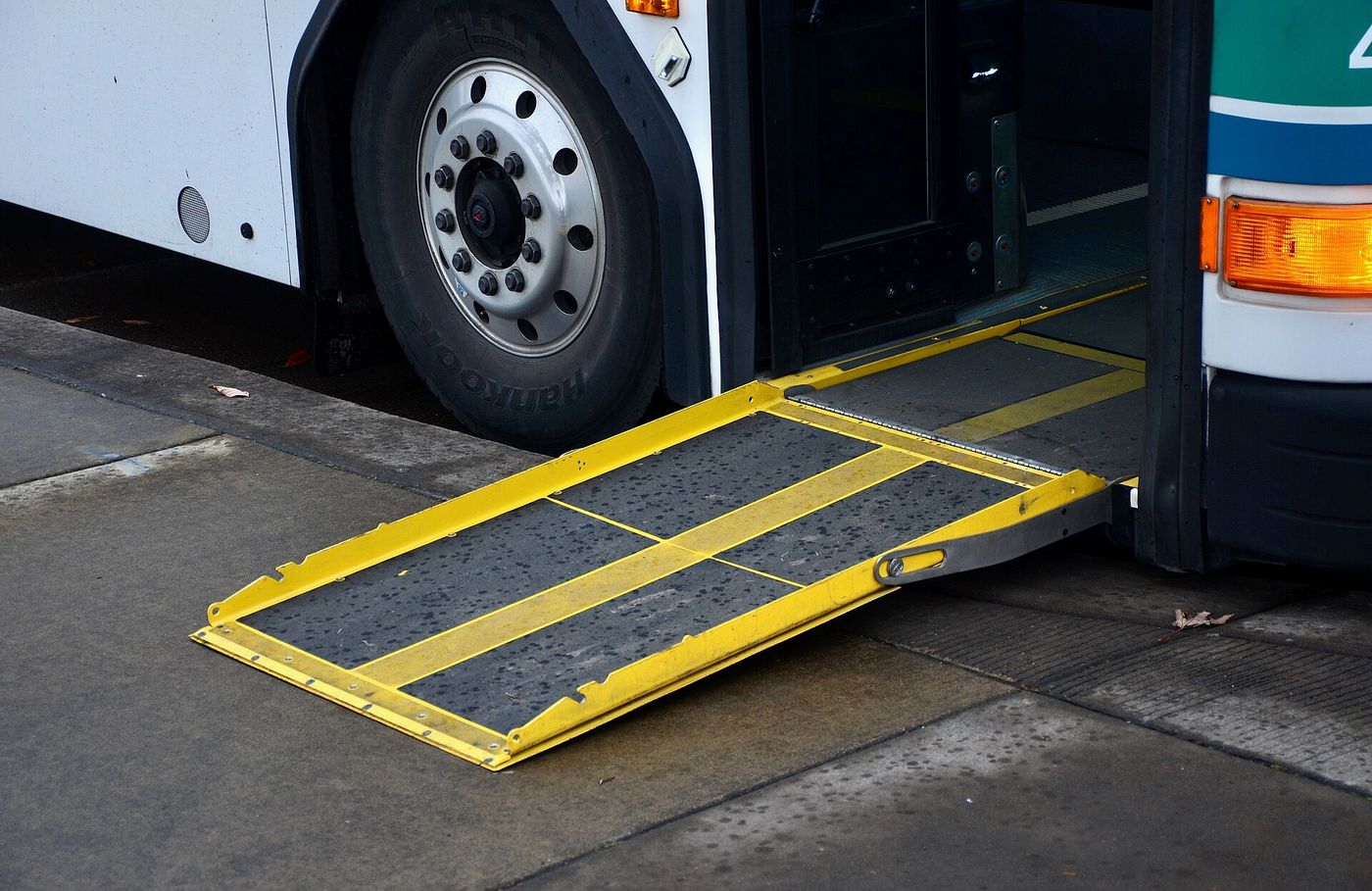
Bus accessibility under UN Regulation No. 107 is a class split, not one standard for all buses: Annex 8 is compulsory for Class I vehicles, while for every other class the regulation leaves the choice of solution to Contracting Parties and binds the relevant Annex 8 requirements on any feature or device for people with reduced mobility and/or wheelchair users actually fitted.
The class split decides everything
Paragraph 2.1.1 divides vehicles with a capacity exceeding 22 passengers in addition to the driver into three classes: Class I, constructed with areas for standing passengers to allow frequent movement; Class II, constructed principally for seated passengers and designed to allow standing passengers in the gangway and/or in an area which does not exceed the space provided for two double seats; Class III, exclusively for seated passengers. At 22 passengers or fewer in addition to the driver, paragraph 2.1.2 gives Class A, designed to carry standing passengers, and Class B, which is not. Under paragraph 2.1.1.4 a vehicle may be regarded as belonging in more than one class, and then “it may be approved for each Class to which it corresponds”.
Paragraph 5.2 requires Class I vehicles to be accessible for people with reduced mobility, including at least one wheelchair user and one unfolded pram or pushchair, according to Annex 8. Paragraph 5.3 covers the rest: Contracting Parties “shall be free to choose the most appropriate solution to achieve improved accessibility” in other classes, but features or devices for people with reduced mobility and/or wheelchair users fitted to such a vehicle “shall comply with the relevant requirements of Annex 8”. Under paragraph 5.4 nothing in the regulation prevents the national authorities of a Contracting Party from reserving certain types of operation for vehicles equipped in accordance with Annex 8. Both choices are given to Contracting Parties and their national authorities.
Low-floor is defined in the regulation; low-entry is not
Paragraph 2.1.4 defines a low-floor vehicle as one of Class I, II or A in which at least 35 per cent of the area available for standing passengers — its forward section in an articulated vehicle, its lower deck in a double-decker — forms an area without steps and includes access to at least one service door. A Class III coach falls outside it because 2.1.4 names only Classes I, II and A; having no standing area to measure follows from the class, it is not the test.
The term low-entry appears nowhere in the regulation. Paragraph 2.2.1(d) names the bodywork concepts that separate one vehicle type from another as single/double-deck, articulated and low-floor, and the information document in Annex 1 asks for the type of bodywork in the same terms. MAN, which places its Lion’s Intercity LE in the Low Entry class, describes a low-floor area and a raised rear section; in regulatory terms such a bus is a low-floor vehicle only if it passes the 35 per cent test.
Step heights and the kneeling function
Annex 8 paragraph 3.1 provides that the height of the first step from the ground of at least one service door “shall not exceed 250 mm” for Classes I and A and 320 mm for Classes II, III and B, and where only one service door meets this requirement “there shall be no barrier or sign which prevents that door from being used as both an entrance and an exit”; as an alternative for Classes I and A, the first step “shall not exceed 270 mm in two door openings, one entrance and one exit”. Steps in the access passage at those doors, and throughout the entire gangway, “shall be not more than 200 mm” for Classes I and A and 250 mm for Classes II, III and B.
The same paragraph separates layouts: in low-floor vehicles “only a kneeling system, but not a retractable step, may be engaged”; in other vehicles “either a kneeling system and/or a retractable step may be engaged”. Paragraph 2.31 defines kneeling as a system which lowers and lifts totally or partially the body of a vehicle relative to the normal position of travel, and under 3.11.2.4 any kneeling system fitted shall not allow the vehicle to be driven at more than 5 km/h while it is lower than the normal height of travel.
MAN’s October 2021 launch release gives the City version of the Lion’s Intercity LE, on 275/70 R22.5 tyres, an entry height of 320 mm with a platformless design in the low-floor area; the Intercity version has that tyre format only as an option, and on its standard 295/80 R22.5 tyres the figure is 380 mm. MAN’s October 2022 release repeats the City version’s 320 mm. The two MAN figures are 60 mm apart (our arithmetic), and MAN states each against its tyre size. Mercedes-Benz publishes the same kind of figure for the Citaro, 320 mm at the first two doors on 275/70 R22.5 tyres. These are manufacturer entry heights, and neither maker says how they were measured; the R107 first-step height is measured under Annex 3 paragraph 7.7.7.3 on level ground, at mass in running order, with the tyre equipment and pressure the manufacturer specifies for the technically permissible maximum laden mass.
Ramps and lifts
Paragraph 3.11.4.1.3 carries two modal verbs. The useable surface of a ramp “shall be at least 800 mm wide”; the slope, extended or folded out onto a kerb of 150 mm in height, “should not exceed 12 per cent”, and extended or folded out to the ground “should not exceed 36 per cent”, and “a kneeling system may be used to achieve this test”. The load figure is a shall: under 3.11.4.1.5 any ramp “shall be capable of operating safely with a load of 300 kg”. Under 3.11.3.1.2 a lift platform shall be not less than 800 mm wide and not less than 1 200 mm long and “capable of operating when carrying a mass of at least 300 kg”; under 3.11.1.2, in the event of power failure, lifts and ramps “shall be capable of manual operation”.
Wheelchair space and priority seats
Paragraph 3.6.1 requires, for each wheelchair user provided for, a special area at least 750 mm wide, 1 300 mm long and 1 400 mm high, slip-resistant, with a slope that “shall not exceed 5 per cent” fore and aft and 3 per cent laterally. The limits are not absolute: they “may be exceeded” at the rear end of the area where differently directed slopes merge, provided such areas total no more than 25 per cent of the wheelchair area, and for a rearward-facing wheelchair complying with 3.8.4 the longitudinal slope “shall not exceed 8 per cent” provided it inclines upwards from the front end to the rear end of the area.
The reference wheelchair in Annex 4 Figure 21 is 1 200 mm long, 700 mm wide and 1 090 mm high, and 3.6.4 requires that a wheelchair user can move freely and easily with it from the outside of the vehicle, through at least one door for wheelchair access, into the special area; 3.6.4.1 defines that as space to manoeuvre without the assistance of a person, and no steps, gaps or stanchions which could be an obstacle. Under 3.6.2 there “shall be at least one doorway through which wheelchair users can pass”, and in Class I at least one wheelchair access door “shall be a service door”; the wheelchair access door “shall bear” a boarding device complying with 3.11.3 (a lift) or 3.11.4 (a ramp). Under 3.6.3 the minimum width of all doors providing wheelchair access “shall be 900 mm”, which “may be reduced by 100 mm” when measured at the level of handholds, and a wheelchair access door that is not a service door shall have a minimum height of 1 400 mm.
Annex 3 paragraph 7.7.8.5.3 sets the minimum number of priority seats: four in Class I, two in Class II, one in Class A, and two and one where Class III and Class B vehicles are subject to Annex 8. Annex 8 paragraph 3.2.6.1 puts the foot space at a priority seating position in Classes I and A level with the adjacent gangway, but 3.2.6.2 limits that, for Class I vehicles not exceeding 2.35 m in width, to two of the required positions; for the rest the vertical distance to the gangway “shall be not more than 250 mm”.
Why Class III coaches sit outside the mandate
A Class III coach carries seated passengers only and is not reached by the paragraph 5.2 mandate. What remains is 5.3, binding on any feature or device for people with reduced mobility and/or wheelchair users actually fitted, and 5.4.
In the UK’s Public Service Vehicles Accessibility Regulations 2000 (PSVAR), regulation 2 limits “bus” and “coach” to vehicles with a capacity exceeding 22 passengers in addition to the driver, and regulation 3 has required certificates since 31 December 2000. A single-deck bus over 7.5 tonnes in use on or after that date requires a certificate relating to Schedules 1 and 2 (reg 3(2)); a double-deck bus the same from the same date, with no weight threshold (reg 3(5)); a coach a Schedule 3 certificate from 31 December 2000 (reg 3(6)) and a Schedule 1 certificate from 1 January 2005 (reg 3(7)). Single-deck buses of 7.5 tonnes or less fall under reg 3(3) and 3(4), where the exception for earlier vehicles ran until 1 January 2015. The dates 1 January 2016, 2017 and 2020 are not start dates: they are the dates until which a vehicle first used before 31 December 2000 (1 January 2005 for the Schedule 1 coach requirement), or manufactured before 1 October 2000 (1 October 2004), did not require the certificate. And reg 3(9)(b) confines the regime: “used” or “in use” means used to provide a local service or a scheduled service, and regulation 2 excludes a tour service from a scheduled service — so PSVAR reaches a coach when it is used to provide a local or scheduled service, subject to regulation 4, under which the regulation 3 requirements do not apply to vehicles in listed classes, among them a vehicle used in accordance with section 19 of the Transport Act 1985 and one more than twenty years past its first use on a road that is not used to provide a local or scheduled service “for more than 20 days in any calendar year”.
Regulation (EU) No 181/2011 is EU law; legislation.gov.uk publishes a UK version kept up to date with UK amendments, in which S.I. 2019/141 inserted “in the United Kingdom or” into the Article 2(1) scope test. Article 2(1) applies the regulation to passengers on regular services for non-specified categories of passengers with a scheduled distance of 250 km or more; under Article 2(2), Article 9 and Article 10(1), among others, also apply to regular services shorter than 250 km. Article 9 prohibits refusing a reservation, ticket or boarding on grounds of disability or reduced mobility — but under Article 10(1) carriers, travel agents and tour operators “may refuse” in order to meet applicable safety requirements established by international, Union or national law, or health and safety requirements established by the competent authorities, or where the design of the vehicle or the infrastructure, bus stops and terminals included, makes it physically impossible to take the person on board, alight or carry them in a safe and operationally feasible manner. Where the refusal is of a reservation or a ticket, Article 10(2) requires them to inform the person of any acceptable alternative service operated by the carrier, and under 10(3) a person who holds a reservation or ticket, has complied with Article 14(1)(a) and is nonetheless refused permission to board must be offered the choice between reimbursement, and where relevant a return service free of charge to the first point of departure, and, except where not feasible, continuation of the journey or re-routing; the right to reimbursement of the money paid for the ticket “shall not be affected by the failure to notify” under Article 14(1)(a). Subject to the access conditions in Article 11(1), Article 13(1) requires free assistance at terminals designated by Member States, and Article 14(1) makes it conditional on the need being notified “at the latest 36 hours before the assistance is needed” and on the person presenting at the designated point; where no such notification is made, Article 14(4) still requires carriers, terminal managing bodies, travel agents and tour operators to “make every reasonable effort” to ensure the assistance is provided so that the person is able to board, change or alight. Under Article 18(1), without prejudice to Article 2(2), Member States “may exempt domestic regular services” from all or some of the provisions of this chapter, provided their national rules give disabled persons and persons with reduced mobility at least the same level of protection. Which of those duties reaches a given service, and which fall away below the 250 km line, is set out under bus and coach passenger rights.
What the floor choice carries
Annex 11 counts each wheelchair space as 250 kg, “representing the mass of a wheelchair and user”, and Annex 3 paragraphs 7.2.2.2.9 and 7.2.2.2.10 deduct its surface from the area for standing passengers when it is considered occupied or is dedicated solely to wheelchair users. By our arithmetic, a minimum 750 by 1 300 mm space is 0.975 m², the area of 7.8 standing passengers at the 0.125 m² conventional space per standing passenger that Annex 11 sets for Classes I and A.
The regulation does not choose a floor for a route; it sets what each choice must meet. A Class I vehicle carries the Annex 8 mandate: a first step at at least one service door that “shall not exceed 250 mm” (or, as the alternative, 270 mm in two door openings, one entrance and one exit), steps of not more than 200 mm in the access passage and throughout the gangway, and a lift or ramp at the wheelchair access door. If the vehicle is low-floor under 2.1.4, Annex 8 paragraph 3.1 lets only a kneeling system, not a retractable step, be engaged; in other vehicles a kneeling system and/or a retractable step may be. MAN’s own Low Entry model shows the trade on the seating side: the Intercity version of the Lion’s Intercity LE “always has platforms in the front section”, which MAN says gives it at least ten more seats than the City version. Class III carries no R107 mandate, but any feature or device for people with reduced mobility and/or wheelchair users fitted must comply with the relevant Annex 8 requirements, and PSVAR applies once the coach is used to provide a local or scheduled service, subject to the exemptions in its regulation 4.
The 11 series of amendments sets the transition: under paragraph 10.36, from 1 September 2027 Contracting Parties are not obliged to accept type approvals to any preceding series of amendments first issued after that date; 10.37 requires them to accept 10-series approvals first issued before 1 September 2027 until 1 September 2030; and 10.39 requires continued acceptance of approvals to the 06 to 10 series for vehicles not affected by the changes the 11 series introduced.
The Department for Transport recorded 30,558 buses used by local bus operators in England as at March 2025, 99 per cent of them issued with an accessibility certificate.
Quick answers
- Which buses must be accessible under UN Regulation No. 107?
- It is a class split. Paragraph 5.2 makes Annex 8 accessibility compulsory for Class I vehicles, including at least one wheelchair user and one unfolded pram or pushchair. For every other class, paragraph 5.3 leaves the choice of solution to Contracting Parties, but any feature or device for people with reduced mobility and/or wheelchair users that is fitted 'shall comply with the relevant requirements of Annex 8'; a Class III coach is not reached by the mandate.
- What is the difference between a low-floor and a low-entry bus?
- Low-floor is defined in R107 (paragraph 2.1.4): a Class I, II or A vehicle in which at least 35% of the area available for standing passengers forms an area without steps and includes access to at least one service door. Low-entry appears nowhere in the regulation — MAN uses it for a bus with a low-floor area and a raised rear section, and in regulatory terms such a bus is low-floor only if it passes the 35% test.
- What do the ramp and wheelchair-space rules require?
- A ramp’s useable surface 'shall be at least 800 mm wide' and any ramp 'shall be capable of operating safely with a load of 300 kg'; its slope onto a 150 mm kerb 'should not exceed 12 per cent'. Each wheelchair space must be at least 750 mm wide, 1,300 mm long and 1,400 mm high, with a fore-and-aft slope that 'shall not exceed 5 per cent', subject to the exceptions in paragraph 3.6.1. The minimum number of priority seats is four in Class I and two in Class II.
- Are coaches required to be wheelchair-accessible?
- Not under the R107 paragraph 5.2 mandate, which does not reach Class III — but any feature or device for people with reduced mobility and/or wheelchair users that is fitted must comply with the relevant Annex 8 requirements (paragraph 5.3). The UK's PSVAR requires certificates for a coach when it is used to provide a local or scheduled service, subject to the exemptions in its regulation 4, and Regulation (EU) No 181/2011 adds passenger-rights duties on regular services of 250 km or more, with Articles 9 and 10(1) also applying below that distance; under its Article 18(1) Member States 'may exempt domestic regular services' from all or some of its disability provisions, provided their national rules give at least the same level of protection.
Sources
- UN Regulation No. 107 — Uniform provisions concerning the approval of category M2 or M3 vehicles with regard to their general construction [2026/139], incorporating all valid text up to the 10 series (in force 8 October 2022) and the 11 series (in force May 2026); authentic texts ECE/TRANS/WP.29/2019/10, /2019/12, /2020/14, /2021/26, /2022/53 and /2025/105 — Official Journal of the European Union, L series, 2026/139, 29 January 2026 (UNECE text)
- Regulation (EU) No 181/2011 concerning the rights of passengers in bus and coach transport — Articles 2, 9, 10, 13, 14 and 18 (EU text) — Official Journal of the European Union
- Regulation (EU) No 181/2011, Article 2 — UK version ("in the United Kingdom or" inserted by S.I. 2019/141) — legislation.gov.uk, The National Archives
- The Public Service Vehicles Accessibility Regulations 2000 (SI 2000/1970), regulation 3 (Application), latest available version — legislation.gov.uk, The National Archives
- The Public Service Vehicles Accessibility Regulations 2000 (SI 2000/1970), regulation 2 (Interpretation), latest available version — legislation.gov.uk, The National Archives
- The Public Service Vehicles Accessibility Regulations 2000 (SI 2000/1970), regulation 4 (Exemptions), latest available version — legislation.gov.uk, The National Archives
- Annual bus statistics: year ending March 2025 (revised) — UK Department for Transport
- Flexible in City and Intercity use: New MAN Lion's Intercity LE sets benchmark in Low Entry class (5 October 2021) — MAN Truck & Bus SE
- City bus with a view: MAN Lion's Intercity LE now also comes in a City version with MAN EfficientHybrid (26 October 2022) — MAN Truck & Bus SE