Bus classes under UN R107: Class I, II, III, A and B
UN R107 sorts buses by capacity: Classes I, II and III carry over 22 passengers, A and B 22 or fewer. Each sets rules for standing, doors and gangways.
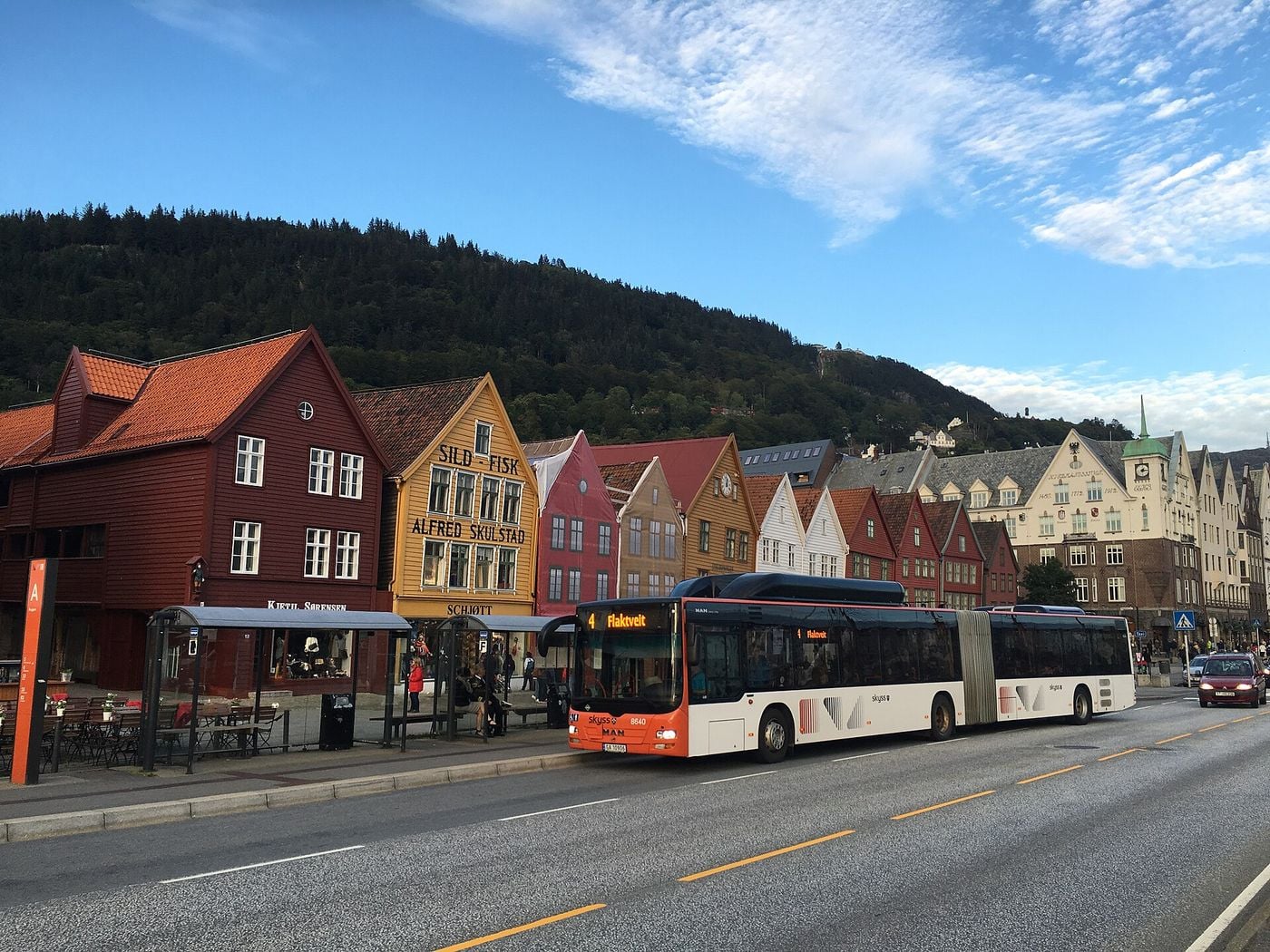
A bus class under UN Regulation No. 107 is a type-approval status, not a marketing label. It decides whether standing passengers are allowed and the space each is counted at, the minimum number of service doors, the gangway gauge and the mass the approval assumes per passenger.
Where the classes come from
Regulation (EU) 2018/858, Article 4, splits passenger vehicles by seat count and mass: M2 covers vehicles with more than eight seating positions besides the driver’s and a maximum mass not exceeding 5 tonnes, M3 the same seat count above 5 tonnes, both “regardless of whether those motor vehicles have space for standing passengers”. Neither says anything about how the vehicle is constructed for standing passengers.
UN Regulation No. 107 does. It applies to every single-deck, double-deck, rigid or articulated M2 or M3 vehicle (paragraph 1.1), excluding secure prisoner transport, ambulances, off-road vehicles and vehicles specially designed for carrying school children (paragraph 1.2). It then divides them on capacity: above 22 passengers in addition to the driver, Classes I, II and III (paragraph 2.1.1); at 22 or fewer, Classes A and B (paragraph 2.1.2). Under paragraph 2.1.1.4 a vehicle “may be regarded as belonging in more than one Class” and “may be approved for each Class to which it corresponds”. Figures below come from the text the Official Journal republished on 29 January 2026 (2026/139), which incorporates all valid text up to the 10 series of amendments, in force since 8 October 2022, and the 11 series, in force since May 2026.
Class I: built for standing passengers
Paragraph 2.1.1.1 defines Class I as vehicles constructed with areas for standing passengers, to allow frequent passenger movement. Capacity then becomes arithmetic: Annex 11, paragraph 3.2.3.2.1 sets the conventional space for one standing passenger at 0.125 m² in Classes I and A, and passenger mass at 68 kg.
That arithmetic runs in two stages. Annex 3, paragraph 7.2.2.1 derives the total passenger area S0 by deducting from the floor, among other items, the driver’s compartment, door steps, space reserved solely for goods or baggage, staircases and — paragraph 7.2.2.1.3 — any part where vertical clearance falls below 1,350 mm, a dimension that in Classes A and B “may be reduced to 1 200 mm”. Paragraph 7.2.2.2 then derives the standing area S1 from S0, for Classes A, I and II only, deducting among other items excessive slopes, anything not accessible to a standing passenger when every seat is occupied, any area lower than the gangway height of paragraph 7.7.5.1, the floor forward of the driver’s seat, the 300 mm in front of every non-folding seat — a dimension that for a sideways-facing seat “may be reduced to 225 mm”, with no wheel-arch condition (paragraph 7.2.2.2.5) — and any surface that will not take a 400 × 300 mm rectangle.
Door counts scale hard: for Classes I and A, paragraph 7.6.1.1 requires at least one service door for 9 to 45 passengers, two for 46 to 70, three for 71 to 100 (two if double-deck) and four above 100. Each rigid section of an articulated vehicle needs at least one, the front section of a Class I articulated vehicle two. That table runs alongside a separate one for total exits, and the two are set out together in bus doors and emergency exits.
Class I has the largest gangway gauge of the five classes: for a single-deck vehicle, Annex 4, Figure 6 makes it 1,900 mm tall overall, with a 450 mm lower cylinder and a 550 mm upper cylinder, and notes to the figure let the height drop by 100 mm and the lower cylinder to 400 mm in parts of the gangway towards the rear. Gangway slope is capped at 8 per cent longitudinally and 5 per cent transversely (paragraph 7.7.6); Annex 4, Figure 8 caps the first step from the ground at 340 mm and each further step at 250 mm (300 mm at a door behind the rearmost axle). Because Class I is subject to Annex 8 (below), its steps in the access passage at the Annex 8 door(s), and throughout the entire gangway, are capped lower still, at 200 mm (Annex 8, paragraph 3.1). Seat spacing is the smallest the Regulation permits, 650 mm between squabs — a figure Class I shares with Classes A and B (paragraph 7.7.8.4.1).
Paragraph 5.2 sets Class I’s own accessibility duty: it must be accessible for people with reduced mobility, “including at least one wheelchair user and one unfolded pram or pushchair”, per Annex 8: a wheelchair space at least 750 mm wide, 1,300 mm long and 1,400 mm high; at least one wheelchair access door that is a service door, fitted with a boarding device, a lift or a ramp — a ramp’s usable surface at least 800 mm wide and its slope onto a 150 mm kerb one that “should not exceed 12 per cent” (the Regulation’s word is “should”, not “shall”); a first step of no more than 250 mm at at least one service door, or of no more than 270 mm at two door openings, one entrance and one exit; four priority seats (paragraph 7.7.8.5.3) — Classes II and A need priority seats too, two and one respectively, as their own sections below state. A low-floor vehicle (paragraph 2.1.4) is a Class I, II or A vehicle in which at least 35 per cent of the area available for standing passengers — on an articulated vehicle its forward section, on a double-decker its lower deck — forms an area without steps and includes access to at least one service door. Because the definition needs a class, a maker’s own “low-floor” does not settle it: for the Mercedes-Benz Citaro, whether paragraph 2.1.4 reaches a given bus turns on a class its data sheet does not state.
Class II: seated principally, standing allowed
Paragraph 2.1.1.2 defines Class II as constructed principally for the carriage of seated passengers, but designed to allow standing passengers in the gangway and/or in an area not exceeding the space provided for two double seats. Makers describe vehicles across the boundary in their own words. MAN calls its Lion’s City 12 E LE suitable “for both urban transport (class 1) and for regional transport in surrounding areas (class 2)”, but that is a sales description rather than an approval, and no MAN document opened for that page ties any Lion’s City to an R107 class. Iveco states Class II and Class III availability for the Crossway in brochure prose, while no data sheet for the normal-floor Crossway assigns a class to a variant; only a separate Low Entry ELEC sheet is headed “Classe II”.
The mass assumptions move with it: 71 kg per passenger including 3 kg of hand baggage, 0.15 m² of conventional standing space. Doors relax to one up to 70 passengers, two from 71 to 100, three above 100. The gangway gauge keeps the 1,900 mm height and 550 mm upper cylinder but narrows the lower cylinder to 350 mm. Seat spacing rises to 680 mm, the first step from the ground may reach 380 mm at at least one service door (400 mm at the others, 430 mm on solely mechanical suspension), and two priority seats are required.
Declared baggage mass is not a Class II feature: Annex 11, paragraph 3.2.3.2.1 sets B at no less than 100 kg per cubic metre of baggage compartment volume and roof baggage BX at no less than 75 kg/m² for any vehicle so equipped, whatever its class. Its one exception follows the body, not the class: double-deck vehicles “shall not be equipped for the carriage of baggage on the roof”, so their BX is zero. Class II shares with Classes III and B escape hatches beyond the emergency doors and windows — one up to 30 passengers, two above — and inclusion in UN Regulation No. 66 on superstructure strength, which in the text the EU published in 2011 (02 series of amendments) applies to single-deck rigid or articulated M2 and M3 vehicles of those three classes above 16 passengers. Class I sits outside that scope, though under paragraph 1.2, at the manufacturer’s request, the Regulation “may also apply” to any other M2 or M3 vehicle. The fire rules split the classes differently again: in a vehicle with a combustion engine or combustion heater behind the driver’s compartment, engine-compartment fire suppression is mandatory for Classes I, II and III alike, while the mandatory scope of the materials rules in UN Regulation No. 118 stops at M3 Classes II and III, as bus fire safety under R107 and R118 sets out.
Class III: seated only
Paragraph 2.1.1.3 is a single line: vehicles constructed exclusively for the carriage of seated passengers. Annex 11 turns that into arithmetic, because for Classes III and B the standing area S1 is zero: no Ssp value, no standing capacity to declare. Classes III and B are also the pair whose seats “shall be equipped with safety-belts or restraint systems” under paragraph 8.1.1 of UN Regulation No 16, in the text the Official Journal published in 2018 (07 series; the UNECE consolidation has since added the 08 series, in force since 28 May 2019, with 8.1.1 unchanged) (safety belts); Class I and A vehicles “may be fitted” with them, and Contracting Parties “may demand” them in Class II.
The consequences run opposite to Class I. One service door satisfies the door table at any capacity — though paragraph 7.6.1.1 opens by requiring at least two doors in any vehicle, two service doors or one service door and one emergency door, and paragraph 7.6.1.4 scales total exits with the passengers and crew in each compartment, from two at 1 to 8 to eleven above 130. The gangway gauge drops to a 450 mm upper and 300 mm lower cylinder, and paragraph 7.7.5.3 lets laterally movable seats narrow the aisle to a 220 mm lower cylinder provided a control at each seat returns it to 300 mm. Longitudinal slope may reach 12.5 per cent; passenger mass is 71 kg with hand baggage; minimum seat spacing 680 mm.
Accessibility is not mandated. Paragraph 5.3 leaves Contracting Parties “free to choose the most appropriate solution” to improve access outside Class I, but any feature fitted must comply with Annex 8 — and a Class III vehicle subject to Annex 8 needs at least two priority seats (paragraph 7.7.8.5.3).
Classes A and B: 22 passengers or fewer
Below 23 passengers the question is binary: Class A vehicles are designed to carry standing passengers and shall have provision for them, Class B vehicles are not and have none.
Class A shares several of Class I’s numbers: 68 kg per passenger, 0.125 m² per standing passenger, a 1,900 mm gangway gauge height (over a 350 mm lower cylinder, as in Class II), the 8 per cent slope limit; it needs one priority seat. Class B’s gangway gauge is 1,500 mm tall with a 300 mm lower cylinder, and Annex 7, which Classes A and B “may” follow in place of the main exit dimensions, sets the service door entry height at 1,500 mm for Class B against 1,650 mm for Class A. A single-deck Class B vehicle above 16 passengers falls within R66’s scope; Class A does not.
What the road allows
On the road, Directive 96/53/EC sets the limits: 13.50 m for a two-axle bus, 15.00 m with more axles, 18.75 m for an articulated bus with a single articulated section — the Directive does not apply to an articulated bus with more than one (Article 1(3)); 2.55 m wide, 4.00 m high. Two-axle buses are limited to 19.5 tonnes, three-axle buses (point 2.3.2, a category that, unlike the two-axle point 2.3.1, does not exclude buses) to 25 tonnes, or 26 tonnes where the driving axle carries twin tyres and air suspension, and three-axle articulated buses to 28 tonnes, but weights bind more narrowly than dimensions. Article 3(1) bars a Member State from refusing another Member State’s vehicle on weight or dimension grounds in international traffic, but in national traffic on dimension grounds only, and for national passenger transport Article 4(2)(b) lets a Member State authorise vehicles that do not conform to the height of point 1.3 or the weights of point 2. The 25/26 and 28 tonnes each rise by the weight the technology adds: up to 1 tonne for an alternatively fuelled vehicle, 2 tonnes for a zero-emission one, with no equivalent allowance for two-axle buses in the text consolidated to 14 August 2019. R107 adds that the driving axles must carry at least 25 per cent of maximum mass M; the front axle at least 20 per cent on rigid Class I and A vehicles and 25 per cent on rigid Class II, III and B, falling back to 20 on three-axle Class II and III vehicles with two steered axles (Annex 11, paragraph 3.2.3.3).
Choosing a class
What the Regulation offers for the choice is its definitions. Class I is built “to allow frequent passenger movement” and is the only class that must take a wheelchair user; Class II allows standing passengers only in the gangway and/or an area no larger than two double seats; Class III carries seated passengers only; below 23 passengers, the A-versus-B line is whether the vehicle has provision for standing passengers. Vehicles specially designed for the carriage of school children fall outside the Regulation altogether (paragraph 1.2.4), a group taken up in school transport vehicles. Whatever the class, Annex 11, paragraph 3.3.1 requires every vehicle to be marked clearly inside, visible to the driver in his seating position, with its maximum seating places and, if any, its maximum standing places and wheelchairs.
Procurement narrows it further. Directive (EU) 2019/1161 amended Directive 2009/33/EC, whose Article 3(2)(b) now excludes vehicles of category M3 “other than Class I and Class A vehicles” as defined in Regulation (EC) No 661/2009, which used R107’s terms for those two classes and was repealed from 6 July 2022 by Regulation (EU) 2019/2144. Table 4 of the Annex, whose bus column covers M3, therefore reaches Class I and Class A buses only. Table 4 sets, Member State by Member State, the minimum share of clean vehicles among the buses covered by the contracts of Article 3: the top band — 45 per cent to the end of 2025, 65 per cent from 2026 to 2030 — applies to thirteen rows, twelve Member States plus a United Kingdom row the consolidated text still carries, and the lowest row is Romania’s, at 24 and 33 per cent. Half of each target must be met by zero-emission buses; for the first period, which ended with 2025, that was cut to a quarter where more than 80 per cent of the buses covered by a Member State’s contracts were double-deckers.
ACEA recorded 38,238 new EU bus registrations in 2025, up 7.5 per cent, with electrically-chargeable vehicles at 23.8 per cent and diesel at 62.1 per cent. Its Vehicles on European Roads report of January 2026 puts the average age of buses operating in the EU at 12.2 years, with only six Member States running a bus fleet younger than ten years (no data for Bulgaria).
Quick answers
- What are the bus classes under UN Regulation No. 107?
- UN R107 divides M2 and M3 buses by capacity and construction, not by how they are used. Above 22 passengers in addition to the driver there are Class I (built with areas for standing passengers, to allow frequent passenger movement), Class II (constructed principally for seated passengers but designed to allow limited standing) and Class III (constructed exclusively for seated passengers). At 22 or fewer there are Class A (with provision for standing passengers) and Class B (without).
- What is the difference between Class I, Class II and Class III?
- Class I is built with areas for standing passengers, to allow frequent passenger movement. Class II is principally for seated passengers but designed to allow standing in the gangway and/or in an area no larger than the space for two double seats. Class III is constructed exclusively for seated passengers, with no standing capacity to declare.
- Which bus classes must have seat belts?
- Classes III and B: under paragraph 8.1.1 of UN Regulation No 16, in the text the EU published in 2018 (07 series; the UNECE consolidation has since added the 08 series, in force since 28 May 2019, with 8.1.1 unchanged), their seats 'shall be equipped with safety-belts or restraint systems'. Class I and A vehicles 'may be fitted' with them, and Contracting Parties 'may demand' them in Class II. In the text the EU published in 2011, UN Regulation No 66 on superstructure strength applies to single-deck Classes II, III and B above 16 passengers; Class I falls outside that scope, though at the manufacturer's request the Regulation 'may also apply' to it.
- How heavy and how long can a bus be under EU rules?
- Directive 96/53/EC sets 19.5 tonnes for a two-axle bus, 25 tonnes for a three-axle bus (26 tonnes where the driving axle carries twin tyres and air suspension), and 28 tonnes for a three-axle articulated bus; the 25/26 and 28 tonnes each rise by the weight of the technology, up to 1 tonne for an alternatively fuelled vehicle and 2 tonnes for a zero-emission one, with no equivalent allowance for the two-axle bus. These are the Directive's limits for international traffic (Article 3(1)); for national passenger transport, Article 4(2)(b) lets a Member State authorise vehicles that do not conform to them. Length is capped at 13.50 m (two axles), 15.00 m (more than two axles) and 18.75 m for an articulated bus with a single articulated section — the Directive does not apply to an articulated bus with more than one (Article 1(3)). UN Regulation No 107 separately requires the driving axles to carry at least 25 per cent of the maximum mass M.
Models in this article
Sources
- UN Regulation No. 107 — Uniform provisions concerning the approval of category M2 or M3 vehicles with regard to their general construction [2026/139] (OJ L, 29.1.2026), incorporating all valid text up to the 10 and 11 series of amendments — Official Journal of the European Union / UNECE
- Regulation (EU) 2018/858 on the approval and market surveillance of motor vehicles — Article 4, vehicle categories — Official Journal of the European Union
- Directive 96/53/EC laying down maximum authorised dimensions and weights for road vehicles (consolidated to 14.8.2019) — Articles 3 and 4, Annex I — Official Journal of the European Union
- UN Regulation No 66 — Approval of large passenger vehicles with regard to the strength of their superstructure (OJ L 84, 30.3.2011), incorporating the 02 series of amendments — paragraphs 1.1 and 1.2 — Official Journal of the European Union / UNECE
- UN Regulation No 16 — Safety-belts, restraint systems, child restraint systems and ISOFIX child restraint systems; and vehicles equipped with them (OJ L 109, 27.4.2018), incorporating up to Supplement 2 to the 07 series of amendments — paragraph 8.1.1 — Official Journal of the European Union / UNECE
- UN Regulation No 16, Revision 10 (UNECE E/ECE/324/Rev.1/Add.15/Rev.10), incorporating the 08 series of amendments, entry into force 28 May 2019 — paragraph 8.1.1 unchanged from the 07-series text — UNECE
- Directive 2009/33/EC on the promotion of clean road transport vehicles, consolidated text as amended by Directive (EU) 2019/1161 — Article 3(2)(b) and Annex Table 4 — Official Journal of the European Union
- Directive (EU) 2019/1161 amending Directive 2009/33/EC on the promotion of clean and energy-efficient road transport vehicles — Official Journal of the European Union
- Regulation (EC) No 661/2009 concerning type-approval requirements for the general safety of motor vehicles — Article 3, points 2 and 3 (no longer in force) — Official Journal of the European Union
- Regulation (EU) 2019/2144 on general safety type-approval requirements — Articles 18 and 19, repeal of Regulation (EC) No 661/2009 — Official Journal of the European Union
- New commercial vehicle registrations: vans -8.8%, trucks -6.2%, buses +7.5% in 2025 — ACEA — European Automobile Manufacturers' Association
- Report — Vehicles on European roads 2026 (January 2026), key figures and table 'Buses by age' — ACEA — European Automobile Manufacturers' Association