segments
Bus Fire Safety Under R107 and R118: Two Separate Regimes
With an engine or combustion heater behind the driver, UN R107 makes fire suppression mandatory for Classes I, II and III, city buses included; UN R118's rules bind only M3 Classes II and III.
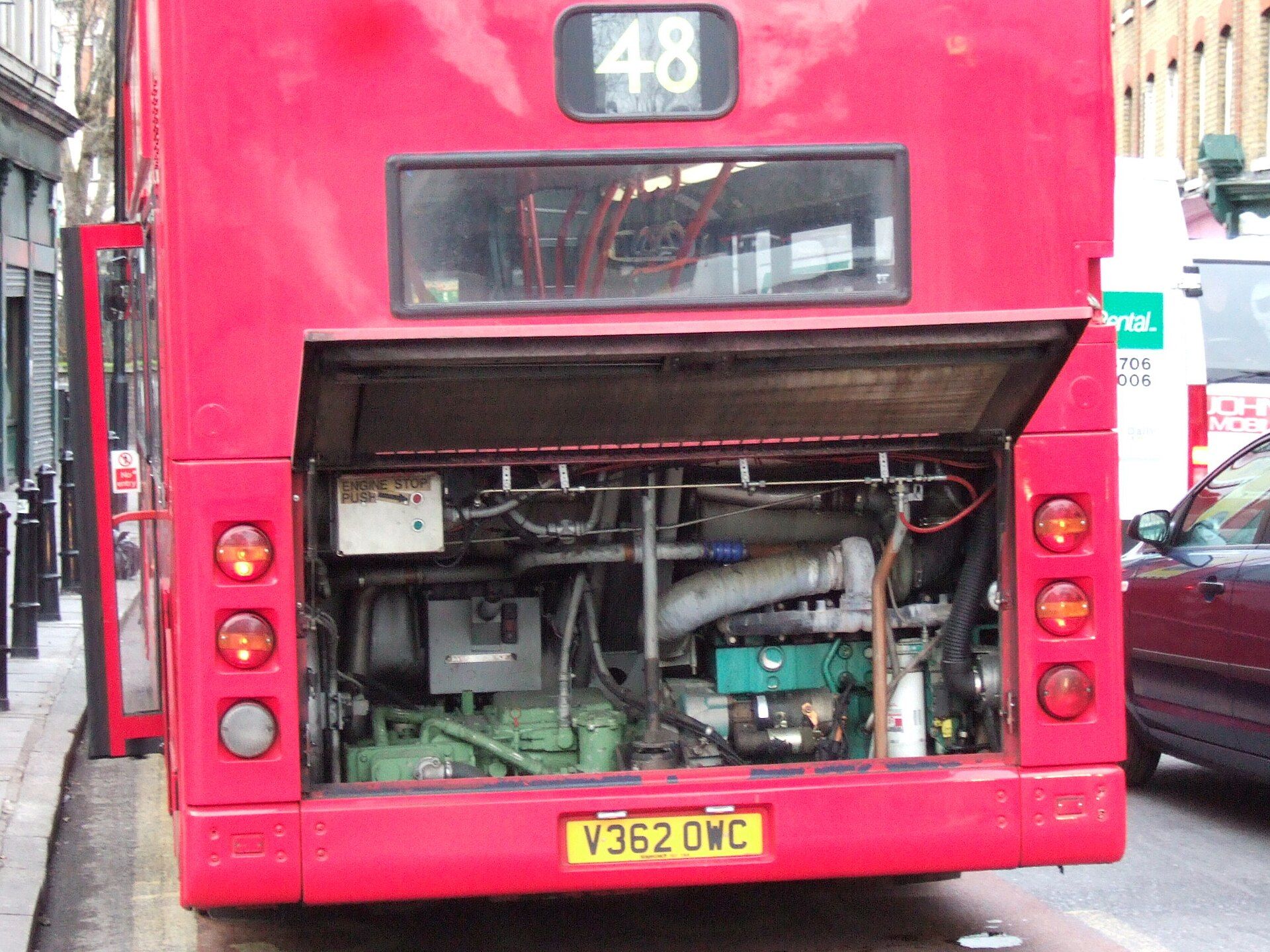
A suppression bottle in the engine bay reads as coach equipment. It is the fitting the trade expects on a long-distance vehicle and not on a city bus, and the assumption survives because the paragraph is rarely opened. UN Regulation No. 107, Annex 3, paragraph 7.5.1.5 says the opposite. Where a vehicle has an internal combustion engine or a combustion heater located to the rear of the driver’s compartment, two consecutive sentences divide the fleet: vehicles of Classes I, II and III shall be equipped with a fire suppression system in the engine compartment and each compartment where a combustion heater is located; vehicles of Classes A and B may be. Class I is the city bus. On that layout it sits inside the mandate, and the boundary people imagine — coach yes, urban bus no — appears nowhere in the paragraph.
The class boundary is real, but it belongs to the other fire regime. A bus is governed by two of them, written in two different instruments, and they do not share a line.
Two regimes, and they do not share a boundary
The first regime is about the fire: detecting excess temperature where the heat sources are, and putting it out. It lives in UN Regulation No. 107, whose paragraph 5.1 requires all vehicles to comply with Annex 3, a separately approved fire suppression system to comply with Annex 13 Part 1, and a system approved in a specific engine compartment to comply with Annex 13 Part 2. Paragraph 1.1 of the Regulation reaches every single-deck, double-deck, rigid or articulated vehicle of category M2 or M3, and paragraph 1.2 lifts out only secure transport of persons, ambulances, off-road vehicles and vehicles specially designed for the carriage of school children.
The second regime is about the fuel load: what the vehicle is lined and wired with, and how fast it burns. That is UN Regulation No. 118, and its paragraph 1.1 applies to the burning behaviour — ignitibility, burning rate and melting behaviour — and to the capability to repel fuel or lubricants of materials used in vehicles of categories M3, Classes II and III.
The division is one of depth rather than of subject, and it is worth saying so before the class line is drawn, because R107 does not leave materials alone. Annex 3, paragraph 7.5.1.1 forbids flammable sound-proofing material, or material liable to become impregnated with fuel, lubricant or other combustible material, in the engine compartment unless the material is covered by an impermeable sheet; paragraph 7.5.5 forbids flammable material within 100 mm of an exhaust system component, any high voltage electrical equipment or any other significant source of heat unless the material is effectively shielded, and defines flammable, for that purpose, as not designed to withstand the temperatures likely to be encountered in that location. Those two bind every vehicle inside R107’s scope, Class I included. What R118 adds — the tested burning rate, the melting behaviour, the cable and lining requirements — is the layer that stops at Classes II and III.
Both instruments count buses in classes, but they do not take the classes from the same place. R107 defines its own, at paragraphs 2.1.1 and 2.1.2 and set out in bus classes under R107: above 22 passengers in addition to the driver, Classes I, II and III; at 22 or fewer, Classes A and B. R118 defines none of them — the footnote to its paragraph 1.1 sends the reader to the Consolidated Resolution on the Construction of Vehicles (R.E.3.), document ECE/TRANS/WP.29/78/Rev.7, paragraph 2. The suppression regime cuts at 22 passengers in addition to the driver. The materials regime keeps only Classes II and III, and only in category M3 — which leaves Class I outside R118’s own mandatory scope alongside Classes A and B.
What paragraph 7.5.1.5 actually requires
The paragraph opens with a condition, not a class. In the case of vehicles having an internal combustion engine or a combustion heater located to the rear of the driver’s compartment, the compartment shall be equipped with an alarm system giving the driver both an acoustic and a visual signal and activating the hazard warning signal, on excess temperature in the engine compartment and in each compartment where a combustion heater is located. Only then does the class list arrive, attached to the suppression system rather than the alarm.
That condition is where a modern fleet gets interesting. It is written as an engine or a combustion heater, so either is enough. A battery-electric bus with no combustion heater is outside the wording; the same bus specified with a fuel-fired auxiliary heater is back inside it, for each compartment where such a heater is located. Anyone weighing city bus propulsion options is choosing between two regulatory positions as well as two energy costs.
Detection is defined rather than assumed. Paragraph 7.5.1.5.1 requires the alarm and the suppression system to be activated automatically through a fire detection system designed to detect a temperature in excess of the reference temperature occurring during normal operation as declared by the manufacturer, with that detection verified by the Technical Service at type approval; the suppression system may alternatively be activated automatically by other means as long as it activates the alarm. The declared figure is not left in a workshop file — the information document at Annex 1, Part 1, Appendix 1, item 4.4 carries a field for the reference temperature for the detection system.
Paragraph 7.5.1.5.2 then deems that satisfied if three families of area are monitored for excess temperature: places where leaking flammable fluid could reach exposed components at or above its ignition temperature, such as the supercharger or the exhaust system; places where it could reach shielded components such as an independent heating device; and places where it could reach components whose temperature in case of failure may reach that point, the alternator being the Regulation’s own example. Paragraph 7.5.1.5.3 keeps both systems operational from the operation of the engine start device until the engine stop device is operated, regardless of the vehicle’s attitude, and keeps the alarm operational whenever the combustion heater is running.
Fitting one is an analysis, not a bracket
Paragraph 7.5.1.5.4.1 requires installation according to the system manufacturer’s installation manual. Paragraph 7.5.1.5.4.2 requires something harder: an analysis conducted before installation to fix the location and direction of the discharge points, so that spray pattern, direction and throwing distance cover the identified fire hazards and the system works regardless of the vehicle’s attitude. The analysis has to take in, as a minimum, components whose surface may exceed the auto-ignition temperature of what is present in the compartment, electrical components and cables carrying enough current or voltage to ignite, and hoses and containers holding flammable liquid or gas, particularly pressurised ones. It shall be fully documented, and paragraphs 3.4.1.1 and 3.4.1.2 put that documentation into the approval application itself.
Paragraph 7.5.1.5.4.3 scales the system from the tested one on the total gross volume of the engine and combustion heater compartments, measured without subtracting the volume of the engine and its components. More extinguishing agent and/or more discharge points and/or a longer discharge tube and/or more propellant gas than the scaling model requires are acceptable; the system pressure has to stay as tested.
Annex 13 sets the performance behind that scaling, and it does so twice over, because its two parts answer to the two approval routes named in paragraph 5.1. Part 1, for a system approved as a component, runs four tests — high-load fire, low-load fire, high-load fire with fan, and re-ignition. In its high-load and low-load tests the fires shall be fully extinguished at the latest in the minute after activation or before the extinguishing agent has been fully used, whichever happens first, and each test passes on the first attempt, or on two of three where the first fails. Part 2, for a system approved in a specific engine compartment, is worded differently on both counts: the fires shall be fully extinguished either in the minute after activation or upon end of the discharge of the suppression system, and where the first attempt fails, the second and third must both succeed. Its fan test is conditional as well, run only if a fan is fitted in the engine compartment and/or the combustion heater compartment. What both parts share is the re-ignition figure: re-ignition shall not occur within 45 seconds of the fire being fully extinguished.
The class line sits in the materials
UN R118 is where the city bus drops out of the UN text’s mandatory scope. Paragraph 1.1 binds the Regulation to M3 Classes II and III, and paragraph 1.1.1 then adds that at the request of the manufacturer it may also apply to vehicles of category M3, Class I. So an M3 Class I urban bus is outside the mandatory scope of UN R118 itself, though its builder can elect into it. In the EU that election is beside the point: Annex II of Regulation (EU) 2019/2144 marks row F16 against M3 with nothing in its additional-provisions cell and no class column anywhere in the table, so a Class I bus type-approved in the Union is inside R118 whether or not its builder asked. Under R107 it sits inside the suppression mandate either way, wherever an internal combustion engine or a combustion heater is located to the rear of the driver’s compartment. The requirements at stake are concrete: paragraph 6.2.1 is satisfied if the horizontal burning rate is not more than 100 mm/minute or if the flame extinguishes before reaching the last measuring point; 6.2.3 sets the same 100 mm/minute for the vertical rate, or extinguishment before the destruction of one of the first marker threads; 6.2.2 requires that material more than 500 mm above the seat cushion and on the ceiling, and insulation in the engine compartment and any separate heating compartment, form no drop that ignites the cotton wool; 6.2.4 lets an average critical heat flux at extinguishment of 20 kW/m2 or more, when tested to ISO 5658-2, stand in for 6.2.2 and 6.2.3 provided no burning drops appear; 6.2.5 puts all insulation installed in the engine compartment and any separate heating compartment through the fuel and lubricant test and limits the weight gain of the sample to 1 g; 6.2.6 and 6.2.7 pull in every electrical cable, cable sleeve and cable conduit longer than 100 mm. Paragraph 5.2.1 draws the interior boundary generously: the materials inside it and no more than 13 mm beyond.
In the EU the two regimes are applied through Regulation (EU) 2019/2144, whose Annex II lists the requirements referred to in Article 4(5) and Article 5(3). Its columns work at category level and nothing finer — there is no class column anywhere in the table. Row F14 marks M2 and M3, which is exactly R107’s own scope. Row F16 marks M3 and components, which is broader than R118’s own M3 Classes II and III — the widening already noted. The class boundary this whole piece turns on lives in the UN text, and nowhere in the EU table.
| Entry | Act | Marked A in Annex II |
|---|---|---|
| A14 Fuel tank safety | UN Regulation No 34 | M1, M2, M3, N1, N2, N3, O1–O4, and the S T U column |
| A19 In-use electric safety | UN Regulation No 100 | M1, M2, M3, N1, N2, N3 |
| F14 General bus construction | UN Regulation No 107 | M2, M3 |
| F16 Flammability in buses | UN Regulation No 118 | M3, Component |
The two entries above them are not bus-specific: UN Regulation No 34 on fuel tank safety and UN Regulation No 100 on in-use electric safety reach M2 and M3 alongside cars and trucks.
Three class lists in one section
Read Annex 3 section 7.5 end to end and the classes stop lining up. Paragraph 7.5.6 requires an alarm detecting excess temperature or smoke in toilet compartments, driver’s sleeping compartments and other separate compartments, with the same acoustic and visual signal and the same hazard warning signal under 7.5.6.2 — and it names no class at all. Paragraph 7.5.4.1 asks for extinguisher space of not less than 15 dm3 in Classes I, II and III and not less than 8 dm3 in Classes A and B, one space near the driver’s seat and an additional one on the upper deck of a double-decker, plus at least 7 dm3 for a first-aid kit under 7.5.4.2; 7.5.4.3 permits both to be secured against theft or vandalism if their location is clearly marked and they can be extracted easily. Note what that requires: the space, not the equipment.
Paragraph 7.5.7.1 uses a third list again. For vehicles of Classes I, II, III and B with the engine to the rear of the driver’s compartment, activation of an alarm system shall automatically activate the emergency lighting system of paragraph 7.8.3 if fitted, and after a single positive action of the driver on any door control in the driver’s compartment all power-operated doors on the side of the vehicle nearer the side of the road corresponding to the direction of traffic it is designed for shall open and remain open — when stationary or at up to 3 km/h, with repeated use of the control not reversing the movement. Class A is absent from that list although it appears in the suppression paragraph. The way those doors are counted and sized is a separate question, set out in bus doors and emergency exits.
The EU directive that used to carry this
None of it is an EU technical text. Directive 2001/85/EC once carried the Union’s own special provisions for vehicles with more than eight seats besides the driver’s; EUR-Lex records it as no longer in force, repealed by Regulation (EC) No 661/2009. That Regulation is itself recorded as no longer in force, with its end of validity at 5 July 2022, repealed by Article 18 of Regulation (EU) 2019/2144, which applies from 6 July 2022. What survives is the referral: the Annex II table above, pointing at UN texts.
For a buyer, the practical consequence is that the fire specification travels with the approval rather than with the model year. R107 approvals are granted to a series of amendments, and the earlier transitional steps are counted in months from a series entering into force rather than in calendar dates — paragraphs 10.2 and 10.3 use 24 and 36 months, 10.11 and 10.13 use 48 and 60. The class those fire duties hang on is recorded on the information document at item 5.1 — which is why buying a used coach and reading a coach specification sheet both start with the approval file rather than the brochure.
Quick answers
- Do city buses need a fire suppression system, or only coaches?
- Both do. UN Regulation No. 107, Annex 3, paragraph 7.5.1.5 requires a fire suppression system on vehicles of Classes I, II and III where an internal combustion engine or a combustion heater sits behind the driver's compartment. Only Classes A and B — 22 passengers or fewer in addition to the driver — are left with the option.
- Which regulation covers bus interior material flammability?
- UN Regulation No. 118. Its paragraph 1.1 binds it to materials used in vehicles of category M3, Classes II and III, and paragraph 1.1.1 adds that at the request of the manufacturer it may also apply to vehicles of category M3, Class I. In the EU, Regulation (EU) 2019/2144 Annex II row F16 applies it to category M3 and to components.
- Does a battery-electric bus need engine-compartment fire suppression?
- Paragraph 7.5.1.5 is triggered by an internal combustion engine or a combustion heater located to the rear of the driver's compartment. A battery-electric bus with neither is outside that wording; one carrying a fuel-fired heater falls inside it for each compartment where such a heater is located.
- How fast must a bus fire suppression system put a fire out?
- It depends which part of UN R107 Annex 13 the system was approved under. In Part 1, for a system approved as a component, the high-load and low-load fires shall be fully extinguished at the latest in the minute after activation or before the extinguishing agent has been fully used, whichever happens first. In Part 2, for a system approved in a specific engine compartment, they shall be fully extinguished either in the minute after activation or upon end of the discharge of the suppression system. Both parts require that re-ignition shall not occur within 45 seconds of the fire being fully extinguished.
- Does UN R107 require a fire extinguisher to be carried on a bus?
- It requires the space, not the extinguisher. Paragraph 7.5.4.1 asks for not less than 15 dm3 for each required extinguisher in Classes I, II and III and not less than 8 dm3 in Classes A and B, one of them near the driver's seat, with an additional space on the upper deck of a double-decker.
Sources
- UN Regulation No. 107 — Uniform provisions concerning the approval of category M2 or M3 vehicles with regard to their general construction [2026/139], incorporating all valid text up to the 11 series of amendments — Official Journal of the European Union / UNECE
- UN Regulation No 118 — Uniform provisions concerning the burning behaviour and/or the capability to repel fuel or lubricant of materials used in the construction of certain categories of motor vehicles [2026/535], incorporating all valid text up to Supplement 2 to the 04 series of amendments — Official Journal of the European Union / UNECE
- Regulation (EU) 2019/2144 on general safety type-approval requirements — Annex II, the list of requirements referred to in Article 4(5) and Article 5(3) — Official Journal of the European Union
- Regulation (EC) No 661/2009 concerning type-approval requirements for the general safety of motor vehicles — recorded as no longer in force — Official Journal of the European Union
- Directive 2001/85/EC relating to special provisions for vehicles used for the carriage of passengers comprising more than eight seats in addition to the driver's seat — recorded as no longer in force — Official Journal of the European Union