operating
School transport vehicles: the category Europe never built
UN Regulation No. 107 excludes vehicles specially designed for schoolchildren from its requirements, so Europe has no school bus type. What governs the school run instead.
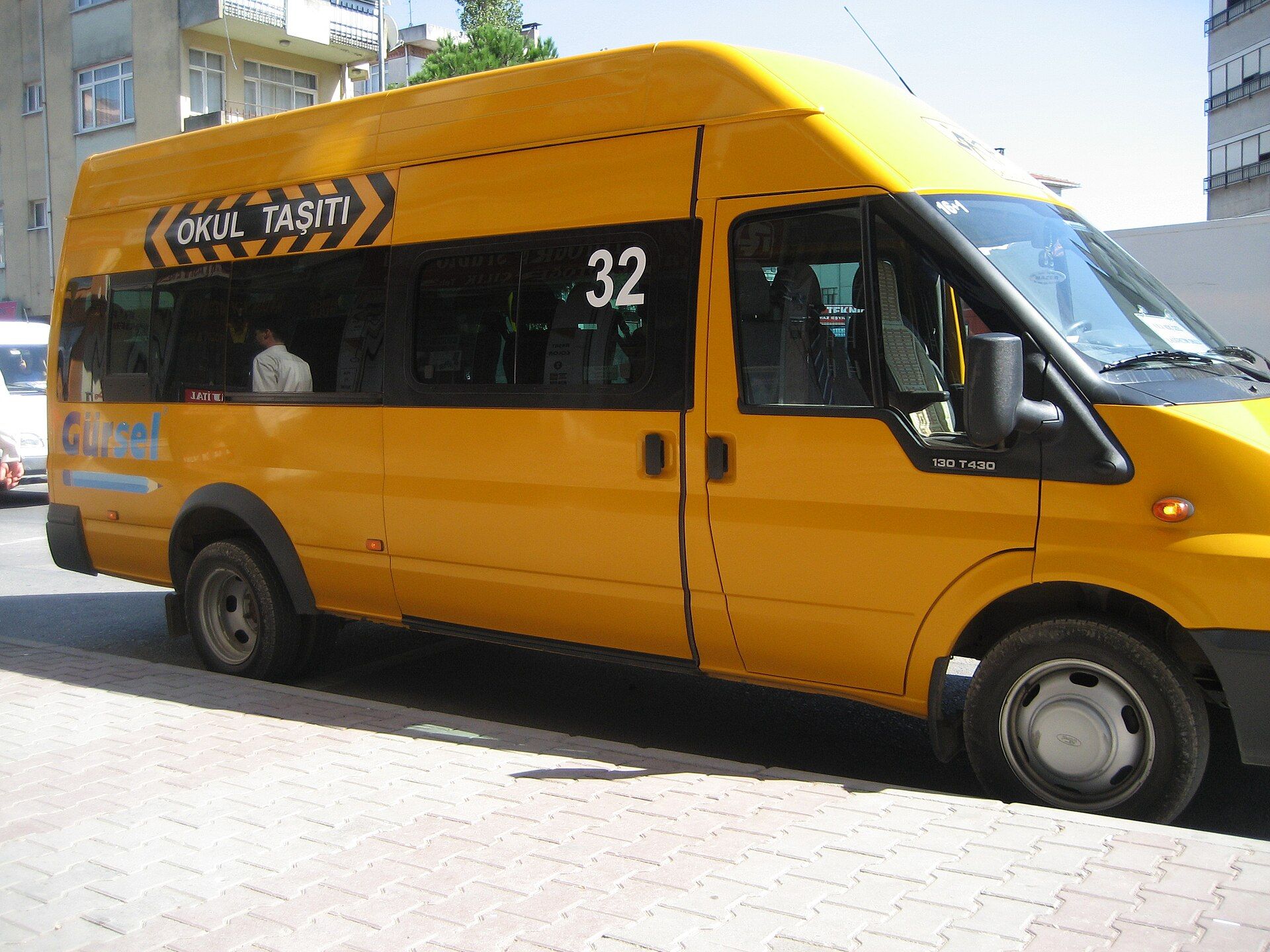
Ask what makes a bus a school bus in Europe and there is no document to point at. The vehicle is everywhere — a minibus at a gate at eight in the morning, a coach on a rural contract — but the construction rule that governs every other bus on the continent deals with it by writing it out of scope. What is left is an ordinary M2 or M3 vehicle, and a national rule that decides for itself what to bolt onto it — in Turkey, a rear marking and a detailed equipment list.
The construction regulation names the vehicle only to exclude it
UN Regulation No. 107 is the general construction standard for buses and coaches. Paragraph 1.1 sets a scope with no gaps in it: the Regulation applies to every single-deck, double-deck, rigid or articulated vehicle of category M2 or M3.
Paragraph 1.2 then removes four things. The requirements do not apply to vehicles designed for the secure transport of persons, for example prisoners (1.2.1); to vehicles specially designed for the carriage of injured or sick persons, that is ambulances (1.2.2); to off-road vehicles (1.2.3); or, at 1.2.4, to vehicles specially designed for the carriage of school children.
That is the whole of the European treatment. Paragraph 1.3 keeps a further group only partly inside — police, security and armed forces vehicles among them — applying the requirements “only to the extent that they are compatible with their intended use and function”. The school vehicle gets no such qualifier. It is named, excluded, and never mentioned again.
The exclusion matters because R107 is not an optional document. Regulation (EU) 2019/2144, which has applied since 6 July 2022, carries two lists of UN Regulations and they do different work. The binding one is Annex II, “List of the requirements referred to in Article 4(5) and Article 5(3) as well as the dates referred to in Article 16”: its row F14, “General bus construction”, names UN Regulation No 107 and marks it A in the M2 and M3 columns, A being defined in the notes to that table as the 6 July 2022 date for the prohibition of the registration of vehicles. Annex I is the other list, “List of UN Regulations referred to in Article 4(2)”, and Article 4(2) says only that a type-approval to a Regulation on it counts as an EU type-approval; its entry for number 107 records the subject “General construction of category M2 and M3 vehicles”, the 07 series of amendments, OJ L 52, 23.2.2018, p. 1, and, in a column headed scope covered by the UN Regulation, M2 and M3.
The 07 series named there is a floor rather than a ceiling. The notes printed under the same table say that compliance with a series of amendments adopted after the one indicated shall be accepted as an alternative, and the Regulation has since been republished in full: UN Regulation No. 107 [2026/139], OJ L, 2026/139 of 29 January 2026, in force, incorporating text up to the 11 series of amendments. Nothing this article quotes moves with it — paragraphs 1.1 to 1.4 and 2.1 read the same in the 07-series and the 11-series texts, which is our comparison of the two published versions rather than a statement either of them makes.
A bus must therefore meet R107 unless it is specially designed for schoolchildren, in which case the R107 requirements fall away and nothing replaces them at European level.
What operators actually buy instead
School transport is therefore bought out of the ordinary catalogue. The vehicle is specified as a Class I, II or III bus, or as a Class A or B vehicle where capacity does not exceed 22 passengers besides the driver, and the class fixes doors, gangways and standing capacity — the subject of bus classes under UN R107.
Paragraph 2.1.1 divides vehicles carrying more than 22 passengers besides the driver into Class I, constructed with areas for standing passengers; Class II, principally for seated passengers but allowing standing in the gangway and/or in an area not exceeding the space of two double seats; and Class III, exclusively for seated passengers. Nothing in that list is a school category. A rural contract runs on a Class III coach because the route is long and everybody sits; a town contract runs on a Class I bus because the vehicle does other work in the day. What the operator is specifying is the set of trade-offs described in coach specifications, costed like any other contract in bus fleet operating costs. Makers name the mission even where the regulation will not: the Pop version of the Iveco Crossway is sold as the school-transport variant of an ordinary intercity bus, with child-transport pictograms in its standard equipment list.
The belt rules: wearing is European, fitting has moved
The clearest European rule aimed at the child on board is a use rule, not a construction rule. Directive 91/671/EEC, in the consolidated text of 20 March 2014, is in force. Its Article 2(2)(a) requires member states to demand that all occupants aged three and over of M2 and M3 vehicles in use shall use the safety systems provided while they are seated. Article 2(2)(b) adds an information duty, discharged by one or more of four means: the driver; the conductor, courier or official designated as group leader; audio-visual means; or signs and/or the member state’s pictogram.
“The safety systems provided” is doing quiet work in that sentence. The duty is to use what is fitted; it does not itself fit anything. Article 6 keeps a standing power for member states to grant exemptions with the Commission’s agreement, its last indent covering the specific conditions of use of M2 and M3 vehicles for local transport in urban and built-up areas, or in which standing is allowed.
The fitting rule has moved, and anyone quoting the old one is quoting a repeal. Directive 2005/40/EC, which amended Directive 77/541/EEC to say which bus classes had to be equipped with belts, is recorded on EUR-Lex as no longer in force, end of validity 31 October 2014; 77/541/EEC was repealed by Regulation (EC) No 661/2009, and 661/2009 by Article 18(1) of Regulation (EU) 2019/2144. The requirement now runs through Annex II of 2019/2144, rows A5 “Safety-belts and restraint systems” and A6 “Safety-belt reminders”, each naming UN Regulation No. 16 and each marked A against M1, M2, M3, N1, N2 and N3. Annex I carries the same Regulation under the fuller title — safety belts, restraint systems, child restraint systems and ISOFIX child restraint systems, 07 series of amendments, OJ L 109, 27.4.2018, p. 1 — against categories M and N, but that entry does no more than make a UN approval count as an EU one. The class-by-class question is followed further in bus seat belts.
The school-run exemption had a five-year life
There was once a European rule written for school transport, and it was written to expire. Directive 2003/20/EC inserted Article 6a into 91/671/EEC, letting member states grant temporary exemptions, with the Commission’s agreement, so that “for local transport operations, particularly for school buses, a greater number of seated children may be transported in M2 and M3 vehicles than there are seats available fitted with safety belts.”
The second sentence is the one to read: “The period of validity of such exemptions, set by the Member State, may not be more than five years from 9 May 2003.” Five years from 9 May 2003 is 9 May 2008. That subtraction is ours — the Directive gives only the start date and the maximum length — but it fixes the outer limit of any exemption granted under the article.
Turkey: the same vehicle, defined by its fittings
Turkey shows what a country puts in that empty space, because it writes the whole thing down in one instrument. The Okul Servis Araçları Yönetmeliği was published in the Resmî Gazete of 25 October 2017, No. 30221, and has been amended nine times since, most recently on 19 August 2025 (No. 32991).
Its definition, in Article 3(1)(f), is worth reading beside R107 paragraph 1.2.4: a school service vehicle is a commercially registered vehicle intended for the carriage of passengers, generally used in the carriage of students and children within pre-school education and compulsory education, which meets the conditions laid down in the Regulation. The distinction is use against construction. R107 had to ask how a vehicle was designed and so could exclude a design; Turkey asks what the vehicle is used for and then attaches a list to it. Not a construction type — an ordinary passenger vehicle, put to a particular use, plus a list.
Article 4(1) is the list. At the rear, a reflective band carrying the words OKUL TAŞITI in the colour, size and shape of the annexed specimen (a); also at the rear, a lamp of at least 30 cm diameter showing red during boarding and alighting, with the word DUR readable in large black letters when it is lit, and its switching arrangement separate from the brake lamps (b). Glass and windows within reach of children fixed, and interior metalwork covered (c). Doors may be power-operated by the driver or hand-operated, and where they are power-operated the open or closed state must reach the driver by optical and/or acoustic signals (d). Maintenance every six months on top of the statutory periodic inspection (e). A vehicle tracking system whose records are kept at least thirty days (ı). A three-point belt and the necessary protective equipment for every student and child (i). A seat-occupancy sensor in every seat, to standards set by the transport ministry (l). Interior and exterior cameras with a recorder, covering all seats (m). No tinted film on the windows (n), and no glass other than transparent glass that shows the interior (o).
Article 4(1)(ğ) then allows the same vehicle to run staff transport when it is not carrying children, provided the school work is not disrupted, and forbids the use of the school vehicle’s light signals while it does. That sentence describes the reality better than anything else in the instrument: this is not a school bus, it is a bus doing school work with its markings switched off.
Age is the hard constraint. Article 4(1)(f) says the vehicle shall not be older than twelve years, counted from the first calendar year following the date of manufacture. A sentence added on 29 November 2024 (No. 32737) softens the edge rather than the limit: a vehicle that meets the age condition but loses it during the contract period may be kept in service, provided this does not run past the current school year.
The retrofit calendar that is still running
The list did not arrive all at once. Provisional Article 2(1), as replaced on 29 November 2024, sets out what older vehicles still owe, and in each case the requirement bites at the first periodic inspection after the date shown.
| Requirement | Model year of the vehicle | Required from |
|---|---|---|
| Art. 4(1)(m) cameras and 4(1)(o) transparent glass | 2017 and earlier | 1 March 2025 |
| Art. 4(1)(i) three-point belts and 4(1)(l) seat sensors | 2017 | 1 July 2029 |
| Art. 4(1)(i) three-point belts and 4(1)(l) seat sensors | 2016 | 1 July 2028 |
| Art. 4(1)(i) three-point belts and 4(1)(l) seat sensors | 2015 and earlier | 1 July 2027 |
The people, and the provision that is suspended
Article 9 puts as much weight on the crew as Article 4 does on the vehicle. A driver must have passed their twenty-sixth birthday and not their sixty-sixth (9(1)(a)); must have held a class D licence for at least two years or a class D1 licence for at least five, and obtain a yearly fitness report from a family physician (9(1)(c), as amended on 29 November 2024); must produce a psychotechnical report every five years (9(1)(ç)); and must hold the domestic passenger transport driver’s vocational competence certificate (9(1)(e)). An addition of 19 August 2025 lets up to one year of class B time count towards the D requirement and up to three towards the D1 requirement.
The guide attendant — the rehber personel, the second adult whose job is the pavement rather than the road — must have passed twenty-two and not sixty-one, and be at least an upper-secondary graduate, or a primary-school graduate who has completed a course approved by the Ministry of National Education (9(2)(a)). The attendant wears a yellow high-visibility vest to TS EN ISO 20471 with the word REHBER front and back (9(2)(f)), and uses signalling aids such as a light wand or a stop-go sign while escorting children (9(2)(g)).
One caution for anyone reading the consolidated text as a checklist. The operator’s duty in Article 5(2)(b) to carry a guide attendant when the vehicle has aboard a child or student attending pre-school education, primary education, a crèche, a day-care centre or a child club is printed with a note that its execution was stayed by a decision of the Eighth Chamber of the Council of State dated 2 February 2022 (E.:2021/5662).
The stay reaches that provision and stops there, which is worth saying plainly because the sentence is the one an operator will act on. Article 5(2)(ğ), amended on 25 August 2021 and printed with no stay or annulment note, still obliges the operator to employ in its vehicles drivers and guide personnel holding the certificate described in Article 6(2)(b). Article 3(1)(h) still defines the guide attendant as the official who is to be present in a school service vehicle besides the driver, excluding only those carrying students to upper-secondary and higher-education institutions. What the decision suspended is the specific trigger in 5(2)(b) — this age group, therefore this attendant — not the figure of the attendant, and not the qualifications in Article 9(2).
One structural point survives all of that. There is no school-bus type approval in Europe, and Turkey does not create one either. The vehicle underneath is an ordinary bus, and everything that makes it a school vehicle — the band, the lamp, the belts, the second adult, the age ceiling — is bolted on by whoever writes the national rule. The document to read before signing is not a European approval certificate, because there is none.
Quick answers
- Is there a school bus type approval in Europe?
- No. UN Regulation No. 107, the construction regulation for M2 and M3 buses, states in paragraph 1.2.4 that its requirements do not apply to vehicles specially designed for the carriage of school children. The regulation names the vehicle only in order to exclude it, and puts nothing in its place.
- Do children have to wear seat belts on a coach or bus?
- Yes, where belts are provided. Article 2(2)(a) of Directive 91/671/EEC as amended requires member states to make all occupants aged three and over of M2 and M3 vehicles use the safety systems provided while they are seated.
- Can a school bus carry more children than it has belted seats?
- Not under the temporary exemption that once allowed it. Article 6a of Directive 91/671/EEC, inserted by Directive 2003/20/EC, capped the validity of such exemptions at five years from 9 May 2003, so none granted under it could run beyond 9 May 2008 — that date is our subtraction, not the Directive's wording.
- How old can a school service vehicle be in Turkey?
- Twelve years. Article 4(1)(f) of the Okul Servis Araçları Yönetmeliği says the vehicle shall not be older than twelve, counted from the first calendar year following the date of manufacture, and a 2024 amendment lets a vehicle that crosses the line mid-contract finish the current school year.
- What equipment must a Turkish school service vehicle carry?
- Article 4(1) lists the fittings: a three-point belt for every student and child, a seat-occupancy sensor in every seat, interior and exterior cameras covering all seats, a tracking system whose records are kept at least thirty days, a rear lamp of at least 30 cm diameter reading DUR, and an OKUL TAŞITI reflective band at the rear.
Sources
- UN Regulation No. 107 — Uniform provisions concerning the approval of category M2 or M3 vehicles with regard to their general construction [2026/139] (OJ L, 2026/139, 29.1.2026), in force, incorporating text up to the 11 series of amendments — paragraphs 1.1 to 1.4 and 2.1, which stand unchanged from the 07 series — Official Journal of the European Union / UNECE
- Regulation No 107 of the UNECE (OJ L 52, 23.2.2018, p. 1), incorporating text up to Supplement 1 to the 07 series — document record for the version Annex I to Regulation (EU) 2019/2144 cites — Official Journal of the European Union / UNECE
- Regulation (EU) 2019/2144 on type-approval requirements for motor vehicles — Article 4, Article 18, Article 19, Annex I and Annex II — Official Journal of the European Union
- Council Directive 91/671/EEC on the compulsory use of safety belts and child restraint systems in vehicles, consolidated text of 20 March 2014 — Articles 2, 6 and 6a — Official Journal of the European Union
- Directive 2003/20/EC of the European Parliament and of the Council of 8 April 2003 amending Council Directive 91/671/EEC — Official Journal of the European Union
- Directive 2005/40/EC amending Directive 77/541/EEC on safety belts and restraint systems of motor vehicles — document record showing end of validity — Official Journal of the European Union
- Okul Servis Araçları Yönetmeliği (School Service Vehicles Regulation), consolidated text as amended to Official Gazette 19/8/2025 No. 32991 — Mevzuat Bilgi Sistemi, Republic of Türkiye
- Okul Servis Araçları Yönetmeliği, as first published in Resmî Gazete of 25 October 2017, No. 30221 — Resmî Gazete, Republic of Türkiye