Iveco
Iveco Crossway
Three lengths, five versions and four fuels on one intercity nameplate — what the Crossway data sheets publish, where two editions of them disagree, and what to check used.
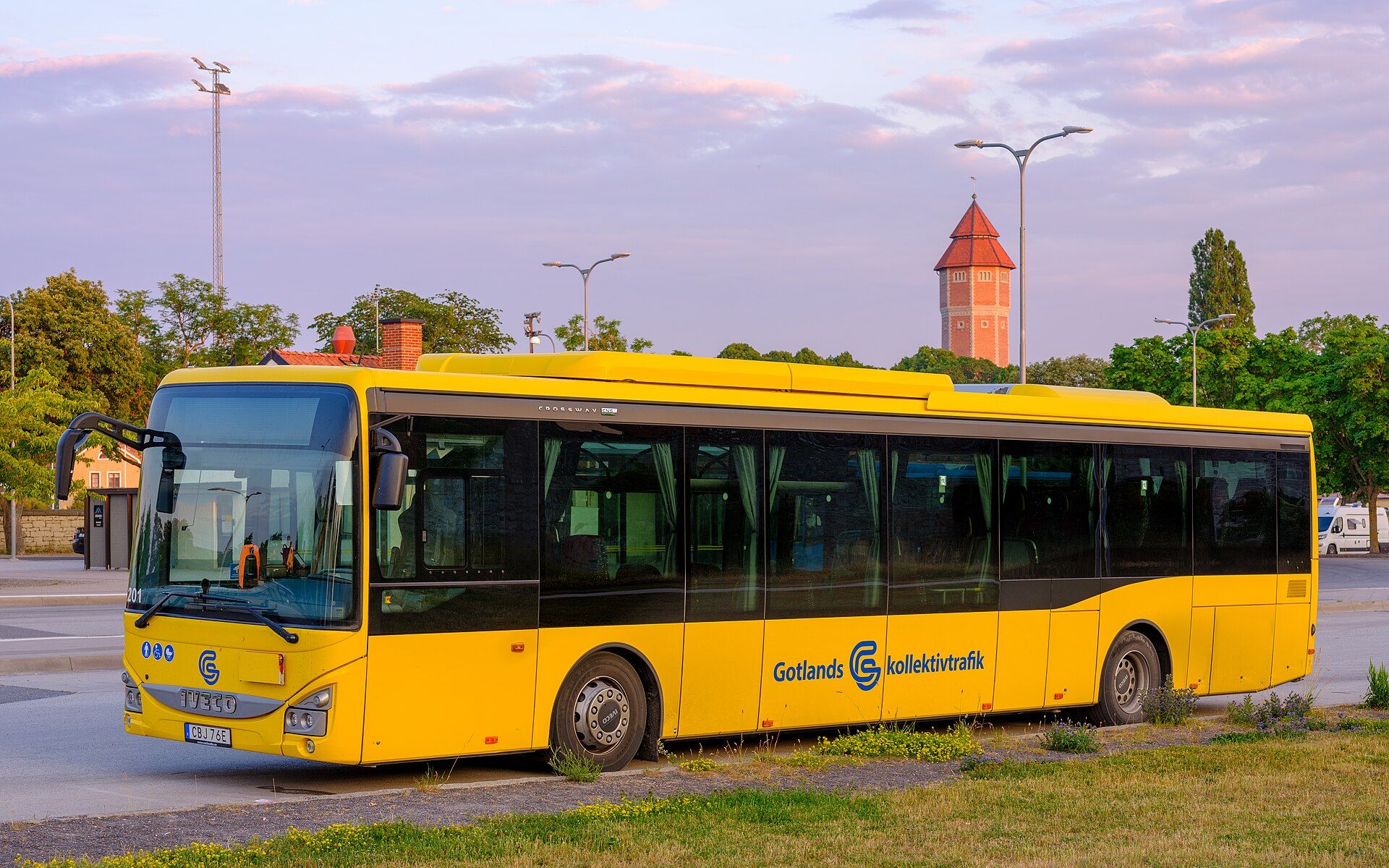

Model overview
Engine families
- Power
- 265–294 kW
- Torque
- 1600–1700 Nm
- Rated speed
- 2200 rpm
- Power
- 235 kW
- Torque
- 1100 Nm
- Rated speed
- 2500 rpm
- Power
- 265 kW
- Rated speed
- 2200 rpm
The grid is the 12 m Crossway Line. Lengths across the range are 10,757 mm, 12,097 mm and 12,962 mm on wheelbases of 5,300 mm, 6,200 mm and 7,065 mm, all 2,550 mm wide, with front and rear overhangs of 2,165 / 3,292 mm and 2,605 / 3,292 mm and front and rear tracks of 2,068 / 1,814 mm. Height is 3,370 / 3,460 mm on the Line and Pop sheets of both editions, labelled "sans / avec AC"; the High Value sheet prints the same pair as "avec AC intégrée / avec AC de toit", so 3,370 mm is not a without-air-conditioning figure there. The natural-gas body is a flat 3,460 mm on the French sheets and 3,455 mm on the international one with its bottles integrated into the roof, and the Mild Hybrid stands at a single 3,582 mm. Interior aisle height is 2,280 mm and the front and middle door access heights are 344 mm each. Approach and departure angles are 8.3 and 8 degrees. Iveco publishes turning RADII and no circle: curb to curb 7,820 mm, 8,990 mm and 10,120 mm across the three lengths, and wall to wall 9,250 mm, 10,770 mm and 11,900 mm. Luggage compartment volume on the French sheets is 3, 5.1 and 6.1 cubic metres without a ramp and 2, 4.1 and 5.1 with one, against 3.5, 5.7 and 6.8 on the international sheets, which print no ramp variant; interior racks are 2.4, 2.8 and 3 cubic metres. Gross vehicle weight is 19,000 kg with the Cursor 9 and 18,000 kg with the Tector 7, under a footnote that maximum axle load and GVW depend on the registration country. Iveco prints no wheel formula on any Crossway document opened; the 4x2 above is this site's reading of a sheet that lists two axles, one of them driven, and is not Iveco's notation. Power is 265 kW (360 hp) at 2,200 rpm and 294 kW (400 cv) at 2,200 rpm for the Cursor 9 and 235 kW (320 hp) at 2,500 rpm for the Tector 7, with 1,600 Nm and 1,700 Nm at 1,200 rpm and 1,100 Nm at 1,250 to 1,600 rpm; the 294 kW column appears on the High Value sheet alone, and the Line, Pop, CNG and Mild Hybrid sheets top out at 265 kW. The natural-gas Cursor 9 is 265 kW (360 hp) at 2,200 rpm on both editions, and its torque is the disagreement recorded above — 1,620 Nm on the French MY2024 sheets and in the brochure, 1,600 Nm on the international sheet. The brochure states the fuel compatibilities: Tector 7 for diesel, HVO, XTL and B100, Cursor 9 for diesel, HVO and XTL, Cursor 9 CNG for natural gas and biomethane. The mild-hybrid machine is not an engine and is not listed as one above: the French Mild Hybrid sheet gives it as 25 kW continuous and 35 kW peak with 300 Nm, and the brochure describes the system as a 48 V battery with a 35 kW generator coupled to the gearbox. Seat counts differ by document and each is printed, not derived: 47, 55 and 61 on the French MY2024 Line; 47 and 55 with a 59-seat 13 m layout and a 61 maximum on the international Line; 47, 55 and 61 with a 63 maximum on the international Pop; 47, 57 and 63 on the French Pop; 55 at 12 m and 59 at 13 m with a 63 maximum shown as 57+4+2 on the international CNG sheet; and 47, 57 and 63 on the French Mild Hybrid, whose own footnote reads "55 ou 61 en version LINE". The French MY2024 diesel sheet gives the rear axle as a Meritor U17X with central single reduction at a series ratio of 4.63 (8x37), the front as an R175E with independent wheels and ZF 8098 steering, tyres as 295/80 R 22.5, a 310 l fuel tank and an 80 l AdBlue tank; the international sheet instead prints a 220 litre diesel tank, 350 litres on the 10.8 m, with the same 80 litre AdBlue tank. Gas capacity is the fifth edition disagreement: the three French MY2024 CNG sheets give "4 bouteilles longitudinales de 315 litres (1260 litres)", while the international CNG sheet prints 1,280 litres in Class III cylinders as the standard fitment with 1,260 litres in Class IV in the OPTIONAL column beside it. Both editions give NGV1 and NGV2 filling and a gas system to UN Regulation No 110, and both list the ZF Ecolife 2 as the standard gearbox with the Voith NXT as the option and no manual at all. Braking is EBS and ESP with discs front and rear, a decompression engine brake and an electromagnetic retarder coupled to the brake pedal that can be decoupled for hand control, with a hydraulic retarder integrated in either automatic. Aftertreatment is HI-SCR on the Tector 7 and HI-eSCR on the international sheet, with a diesel oxidation catalyst, particulate filter, selective catalytic reduction and clean-up catalyst. The French sheets list the General Safety Regulation set item by item under the heading "EQUIPEMENT DE SECURITE GSR – B (2019/2144)" — BSIS, MOIS, REV, ISA, DDAW, TPMS, ESS and cyber security as standard — with left-hand BSIS optional and AEBS optional and marked "obligatoire en Classe III". Accessibility on the normal-floor bus is a preparation rather than a fitting: "Prédisposition UFR aménagement de l'espace réservé (R107 annexe VIII)" and two PMR seats are standard and the wheelchair lift is an option. The door marked "interdit UFR" on those sheets is the 800 mm single-leaf middle door they list in their OPTION column, beside a 1,200 mm two-leaf middle door as standard — the same narrow door that the international Line and CNG sheets fit as standard, which is why no single middle-door width is stated in this record. The CROSSWAY ELEC has no data sheet. Its brochure and the Iveco Group release of 3 December 2024 give 12 and 13 m bodies, 3 to 6 packs of 69 kWh NMC cells assembled by FPT Industrial, "jusqu'à 415 kWh" with six of them and no total published for the 3, 4 or 5 pack builds, a range of 450 to 500 km at six packs, a 290 kW Siemens Elfa III motor with 3,000 Nm, depot charging through one CCS Combo 2 socket, up to 57 passengers at 12 m and 63 at 13 m including five seats at the rear, and, with four packs, luggage volumes of 6.2 and 5.1 cubic metres plus 3 and 2.8 cubic metres of interior racks. The release adds that the electric driveline is the same as the Low Entry ELEC's, that deliveries began in 2025 and that the vehicle shown in Lyon was a 13 m car with four packs seating 61. Iveco states Class II and Class III availability twice — for the 10.8, 12 and 13 m Cursor 9 diesel in the brochure and for the 12 and 13 m ELEC in its own brochure — but no data sheet assigns a UN Regulation No 107 class to any variant, so no class is recorded here. From the anniversary page, all of it Iveco's own account: unveiled at AUTOTEC in Brno in June 2006 after a preview in Litomyšl, in three lengths of 10.6, 12 and 12.8 m; built at Vysoké Mýto; "more than 70,000 units produced across multiple generations", the range restyled in 2013 and given a new front end in 2023; present in more than 45 countries; five versions today, Low Entry, Pop, Line, HV and Pro; natural gas since 2017, hybrid since 2022, B100 since 2024 and battery-electric in 2023 and 2024; a three-axle 14.5 m Low Entry added in 2017. Iveco's claim that one out of every two intercity coaches sold in Europe is a Crossway was not checked against any source outside Iveco.
The Crossway is Iveco Bus’s intercity bus and, by the company’s own account, its largest commercial success: unveiled at the AUTOTEC trade fair in Brno in June 2006 in lengths of 10.6, 12 and 12.8 m, and more than 70,000 built since, which Iveco’s anniversary page counts “across multiple generations” — the same page records a restyle in 2013 and a new front end in 2023. It is sold in more than 45 countries and produced at Vysoké Mýto in the Czech Republic. Iveco also claims that one out of every two intercity coaches sold in Europe is a Crossway — its own figure, not checked here against any source outside the company.
What makes it worth a page is the spread rather than the volume. One nameplate covers three lengths, five versions and four ways of moving the bus, and Iveco publishes a data sheet for almost every combination. This page is written off ten of them — three English international sheets dated September 2023 and seven French MY2024 sheets — plus two brochures and two press releases. Every figure below is therefore the MY2024 bus, not the one launched in 2006. Those two families of document disagree in five places, printed below rather than settled.
Three lengths, five versions
The bodies measure 10,757 mm, 12,097 mm and 12,962 mm on wheelbases of 5,300 mm, 6,200 mm and 7,065 mm, all 2,550 mm wide. Height is 3,370 mm and 3,460 mm — labelled without and with air conditioning on the Line and Pop sheets, and the same pair labelled with integrated air conditioning against with roof air conditioning on the High Value sheet. Two doors are fitted, front and middle, with access heights of 344 mm at each.
Iveco lists five versions: Low Entry, Pop, Line, HV and Pro. Only the middle three appear on the normal-floor sheets used here, and the Low Entry is a different vehicle rather than a trim level. Pop is the school-transport version, sold as such and carrying child-transport pictograms as standard equipment — the clearest case this library has of the vehicle described in school transport, where Europe writes no school-bus type approval and the operator buys an ordinary bus with fittings bolted on. Line is the standard intercity specification; High Value is offered at 12 and 13 m only.
Seat counts are the first place the editions part company. The French MY2024 Line sheet prints 47, 55 and 61 across the three lengths; the international Line sheet prints 47 and 55, then a 13 m layout of 59 with a 61 maximum; the international Pop prints 47, 55 and 61 with a 63 maximum; the French Pop prints 47, 57 and 63. Each is a printed layout, not a derived number, and which applies is an ordering question.
The engine programme
Two diesel families, both six cylinders in line with common rail, both declared Euro VI Step E in the title bar of every sheet — the step placed in sequence in Euro 6 and Euro 7.
The Tector 7 is the smaller and, on the French Line sheet, the standard engine: 6.7 litres, 235 kW (320 hp) at 2,500 rpm, 1,100 Nm from 1,250 to 1,600 rpm. It is the lighter installation and the one Iveco marks compatible with B100 as well as HVO and XTL. The Cursor 9 is 8.7 litres in two steps. Every version sheet carries 265 kW (360 hp) at 2,200 rpm with 1,600 Nm at 1,200 rpm; only the first column of the High Value sheet carries 294 kW (400 cv) with 1,700 Nm. The Line, Pop, CNG and Mild Hybrid sheets all stop at 265 kW, so the top step is not a range-wide option and is not presented as one here.
Behind either engine the French sheet gives a ZF 6-speed manual as standard, with a ZF Ecolife 2 six-speed or a Voith NXT seven-speed automatic as options, both with an integrated hydraulic retarder. That cuts against the grain twice: the automatics are torque-converter units, not the automated manuals described in automated manual transmissions, and the standard gearbox on an MY2024 intercity bus is still a manual. Braking adds a decompression engine brake and an electromagnetic retarder coupled to the brake pedal that can be decoupled for hand control, the layered arrangement in retarders and engine braking. The rear axle is a Meritor U17X at a series ratio of 4.63 (8x37), a rare published final drive figure on a European bus. Aftertreatment is named HI-SCR on the French sheets and HI-eSCR on the international ones, with an 80 l AdBlue tank either way — the architecture covered in SCR and AdBlue.
Gas, mild hybrid, and the electric one with no data sheet
The natural-gas Crossway uses a Cursor 9 CNG at 265 kW, filled through NGV1 and NGV2 connectors, to a gas system Iveco declares compliant with UN Regulation No 110. How much gas it carries is one of the disagreements: the French MY2024 CNG sheets print four longitudinal bottles of 315 litres, 1,260 litres in all, while the international CNG sheet makes 1,280 litres in Class III cylinders the standard fitment and lists 1,260 litres in Class IV beside it as an option. The bottles sit in the roof, which is why the gas bus stands at 3,455 mm on the international sheet and 3,460 mm on the French one instead of towering over the diesel. Iveco marks the same engine compatible with biomethane, the vehicle side of the argument in LNG and bio-LNG. Its gearbox list is shorter: Ecolife 2 standard, Voith NXT optional, no manual at all.
The Mild Hybrid sheet rates the machine on the gearbox at 25 kW continuous and 35 kW peak with 300 Nm and lists a 1 kWh lithium battery at the roof; it prints no voltage anywhere. The 48 V figure comes from the range brochure, which describes the system as a 48 V battery with a 35 kW generator coupled to the gearbox. It is not an engine and is not treated as one here; the roof rises to 3,582 mm to accommodate it.
The Crossway ELEC is the gap. No data sheet for it exists on any Iveco market site checked — the French page lists seven and none is electric, the international folder holds three and none is electric. What exists is a six-page brochure and the Iveco Group release of 3 December 2024, both saying the same thing: 12 and 13 m bodies, three to six packs of 69 kWh NMC cells assembled by FPT Industrial, up to 415 kWh with six of them, a range of 450 to 500 km on six packs, a 290 kW Siemens Elfa III motor with 3,000 Nm, and depot charging through a single CCS Combo 2 socket. All of that is brochure prose rather than a table. A bus that charges overnight on one socket is also the opposite pole from the megawatt charging case, and the diesel-to-gas-to-battery ladder on one nameplate is the argument made in city bus propulsion.
What we could not confirm
Iveco prints no wheel formula on any Crossway document opened. The sheets list two axles and never write a formula, so the 4x2 above is this site’s reading of a two-axle sheet with one driven axle, not Iveco’s notation — the vocabulary is set out in axle configurations.
There is no turning circle either. Iveco publishes two radii per length — curb to curb 7,820 mm, 8,990 mm and 10,120 mm, wall to wall 9,250 mm, 10,770 mm and 11,900 mm — and doubling one into a diameter would be arithmetic of ours presented as Iveco’s figure. Radius against diameter, kerb against wall, is the first thing a coach data sheet has to be read for.
Five figures are live disagreements, left standing. The gas engine’s torque is 1,620 Nm on all three French MY2024 sheets and in the brochure and 1,600 Nm on the international sheet, so it carries no torque figure above at all. The middle door is 1,200 mm as standard on every French sheet and in the international Pop’s dimension table, and 800 mm on the international Line and CNG sheets with the wider door an option. The seat counts set out above are the third. The diesel tank splits the same way: 310 l on the French sheets, 220 l on the international ones with 350 l for the 10.8 m. And the gas tank is the fifth, 1,260 litres against 1,280, also set out above.
Two rows on the international CNG sheet are not carried at all, because they disagree with themselves rather than with another edition. Its aisle height row prints a figure the French sheets contradict at 2,280 mm for the same body, so only the French figure is used and the international one is not repeated here; and its gearbox row reads “C9: Automatic ZF Ecolife / T7: Mechanical ZF Ecolife”, which contradicts itself, since the Ecolife is a torque-converter automatic.
Three things are simply absent. No standing capacity is published, and no total passenger figure exists to subtract seats from. No document assigns a UN Regulation No 107 class to a variant: Iveco states Class II and Class III availability twice in brochure prose, once for the diesel range and once for the ELEC, but that is a sales description rather than an approval, and the difference is the subject of bus classes. And the ELEC’s battery is a six-pack total with no installed-against-usable split and no figure at all for the three-, four- or five-pack builds, its range a span rather than a figure, and its motor one unqualified 290 kW rating. Iveco attaches neither a continuous nor a peak label to it; the press release calls the ELEC’s driveline identical to the Low Entry ELEC’s, and that vehicle’s data sheet prints the same 290 kW in its maximum row against ECE R85, so the figure is carried above as a maximum and not as a continuous output.
One trap deserves naming, because it is the easiest error to make here. The Crossway Low Entry ELEC is a separate vehicle with its own data sheet, its own 17,900 kg plate, its own battery counts of 485 kWh and 416 kWh and its own motor ratings. None of that belongs to the bus described above.
Weights and access
Gross vehicle weight is 19,000 kg with the Cursor 9 and 18,000 kg with the Tector 7, under a footnote that permitted axle load and gross weight depend on the country of registration. The French Pop sheet prints its front and rear axle loads in the reverse order of every other sheet, including its own international twin, so no axle load is published here in either direction.
Accessibility is a preparation rather than a fitting: the French sheets list the reserved-space preparation to R107 Annex VIII and two PMR seats as standard and the wheelchair lift as an option. The narrow 800 mm single-leaf middle door those sheets offer as an option, against their 1,200 mm two-leaf standard, is itself marked “interdit UFR” — incompatible with a wheelchair position — and that narrow door is the standard fitting on the international Line and CNG sheets. Read beside the Low Entry that is the argument of bus accessibility inside one nameplate, and the standard-against-optional door width is why door layout is an ordering decision rather than a model feature. The same sheets head their safety block with the General Safety Regulation reference 2019/2144 and name the set item by item — BSIS, MOIS, REV, ISA, DDAW, TPMS and ESS standard, left-hand BSIS and automatic emergency braking optional — the list explained in mandatory driver assistance systems.
Who this bus is right for
The Crossway suits an operator running a mixed book from one depot: scheduled interurban services, school contracts and employee transport, on routes where passengers sit and the day is measured in hours rather than motorway kilometres. The version ladder is the reason — Pop, Line and High Value are one bus specified for three missions, so a fleet can buy across all three and still share parts, training and driver familiarity.
It suits an operator less well where the duty is genuinely urban: this is a normal-floor bus with a 344 mm first step and a lift on the options list. And it suits badly anyone expecting the specification to come off a catalogue, because the door width, the seat count and the gearbox all change between editions of the maker’s own paperwork.
Where it sits against its rivals
The Mercedes-Benz Intouro, the MAN Lion’s Intercity and the Setra MultiClass 500 are what a European interurban operator actually cross-shops against it. This site holds no verified specification record for those three, so no figure-by-figure comparison is offered rather than one assembled from dealer listings. What the documents do show is the Crossway’s own position: two diesel engine families, four fuel paths on a single body, and a ZF 6-speed manual as the standard gearbox on the French MY2024 sheets with both automatics as options. That is a low-cost, high-optionality proposition rather than a premium one, and it fits a bus Iveco says it sells in more than 45 countries with very different roads.
What to check on a used one
Start with the engine, because it decides the plate. A Tector 7 bus is rated at 18,000 kg and a Cursor 9 bus at 19,000 kg, and the two look identical from the kerb. Read the registration document alongside the wider checks in buying a used coach.
Then establish which gearbox is fitted. A manual, an Ecolife 2 and a Voith NXT are three different vehicles to drive and three different maintenance propositions, and only the automatics bring the integrated hydraulic retarder. Ask about the middle door too: 800 mm and 1,200 mm are both factory-standard depending on which sheet the bus was ordered from, and the narrow one rules out a wheelchair position.
On a gas bus the bottles and their certification have no equivalent on the diesel, and keeping them in date belongs in the operating cost model from the start. On a mild hybrid the 48 V machine is a motor-generator on the gearbox, not a second engine. And the tyre size is 295/80 R 22.5 across the range, which makes a mismatched set easy to spot and worth asking about.
Quick answers
- Which engines are available in the Iveco Crossway?
- The record for the Iveco Crossway covers these engine families: IVECO Cursor 9 Euro VI (8.7 l), IVECO Tector 7 Euro VI (6.7 l), IVECO Cursor 9 CNG Euro VI (8.7 l). Output spans 235–294 kW.
- What emission standard does the Iveco Crossway meet?
- Euro VI Step E.
Compared with
- Mercedes-Benz Intouro
- MAN Lion's Intercity
- Setra MultiClass 500
Sources
- CROSSWAY LINE 10.8/12/13 m — DIESEL EURO VI STEP E (international data sheet, footer SEPT 2023) — Iveco Bus
- CROSSWAY LINE 10.8/12/13 m — DIESEL EURO VI STEP E — MY2024 (fiche technique) — Iveco Bus France
- CROSSWAY HIGH VALUE 12/13 m — DIESEL EURO VI STEP E — MY2024 (fiche technique) — Iveco Bus France
- CROSSWAY LINE 12/13 m — GNC EURO VI STEP E — MY2024 (fiche technique) — Iveco Bus France
- CROSSWAY MILD HYBRID 10.8/12/13 m — DIESEL EURO VI STEP E — MY2024 (fiche technique) — Iveco Bus France
- CROSSWAY — brochure de gamme (PUBLICATION CROSSWAY_FR 04/25) — Iveco Bus
- CROSSWAY ELEC — brochure — Iveco Bus
- European premiere: unveiling of the IVECO BUS CROSSWAY ELEC, a powerful new solution to decarbonize the intercity mobility — Iveco Group
- The iconic IVECO BUS CROSSWAY turns 20: two decades of serving passenger mobility — Iveco Bus
- CROSSWAY POP 10.8/12/13 m — DIESEL EURO VI STEP E (international data sheet) — Iveco Bus
- CROSSWAY LINE / POP 12/13 m — NATURAL GAS EURO VI STEP E (international data sheet) — Iveco Bus
- CROSSWAY POP 10.8/12/13 m — DIESEL EURO VI STEP E — MY2024 (fiche technique) — Iveco Bus France
- Crossway — gamme interurbaine (product page and data sheet index) — Iveco Bus France
- CROSSWAY LOW ENTRY LINE 12/13 m — ELEC — MY2024 (fiche technique; a different vehicle, cited so its figures can be told apart from this one's) — Iveco Bus France