Iveco
Iveco Urbanway
Iveco Bus's Urbanway city bus in 12 and 18 m with Cursor 9 diesel, CNG and 48 V mild hybrid drivelines: dimensions, weights, gas tanks, seats and equipment.
- 228–265 kW
- Euro VI Step E
- 12.09 m
- 20 t
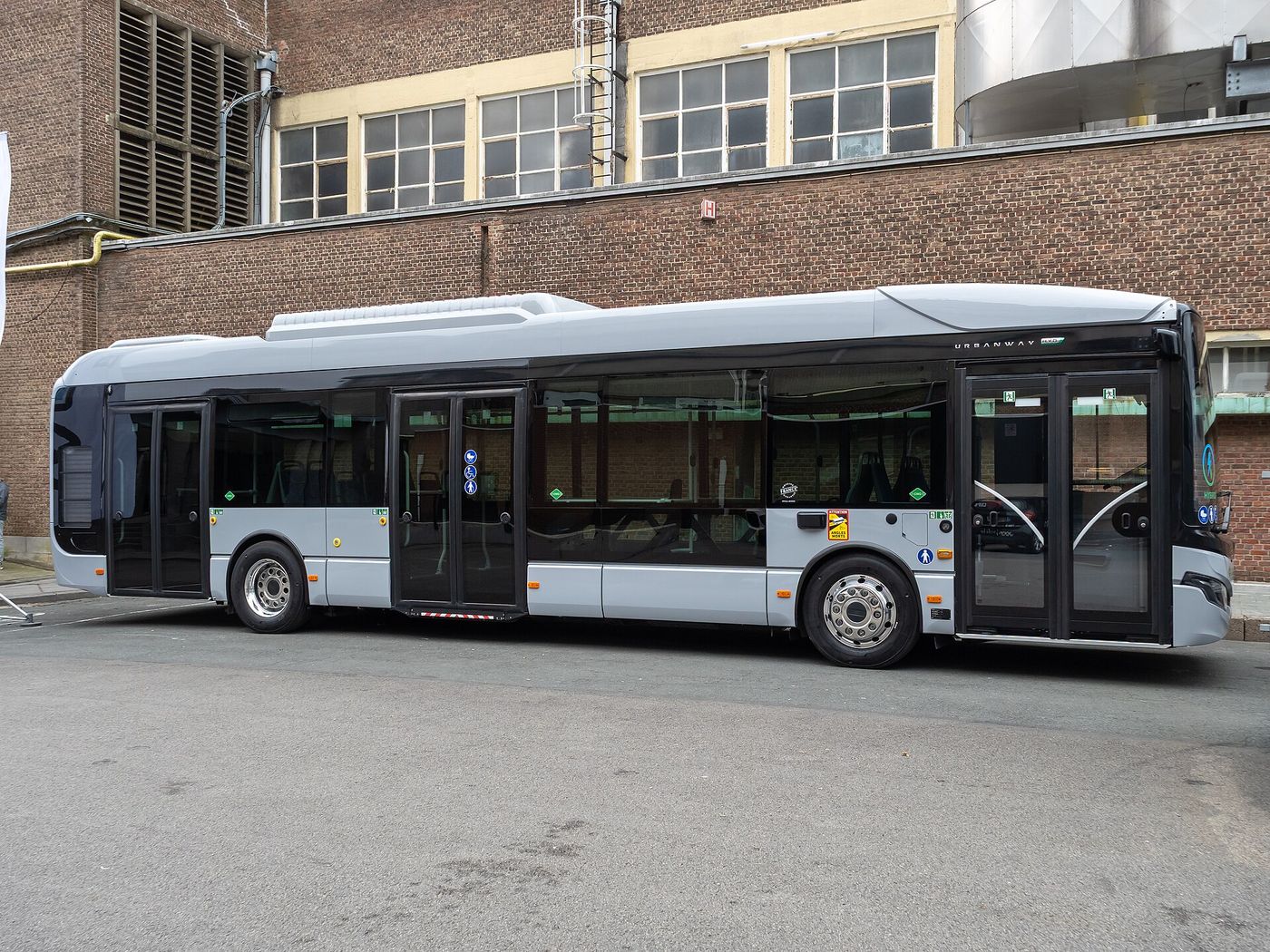

Model overview
- Segment
- Bus
- Emission
- Euro VI Step E
- Transmission
- Automatic ZF Ecolife 2 (diesel and CNG; Voith Diwa NXT optional on CNG); automatic Voith Diwa NXT with 7 gears (mild hybrids)
- Gross vehicle
- 20 000 kg
- Length
- 12 090 mm
- Wheelbase
- 6 120 mm
- Capacity
- 20–31 (3 doors) or 27–36 (2 doors) at 12 m; 29–46 (4 doors) or 36–51 (3 doors) at 18 m
- Doors
- 2 or 3 doors (12 m), 3 or 4 doors (18 m), opening inwards
Engine families
- Power
- 228–265 kW
- Torque
- 1300–1650 Nm
- Power
- 228–265 kW
- Torque
- 1300–1640 Nm
The Urbanway is Iveco Bus’s low-floor city bus, built in lengths of 12 m and 18 m with a Cursor 9 engine that runs on diesel or compressed natural gas, on its own or with a 48 V mild hybrid system. Iveco’s brochure says the Urbanway is “tailored to be integrated in a multimodal mobility context”, lists “4 energies (CNG, CNG Hybrid, Hybrid Diesel, Diesel)” and “2 lengths (12 m, 18 m)”, and adds that it is “also available as a Bus Rapid Transit system (BRT version) named Crealis”. The figures on this page come from Iveco Bus’s four international technical sheets for the Urbanway — diesel 12 m, CNG 12 and 18 m, mild hybrid diesel 12 and 18 m, and mild hybrid CNG 12 and 18 m — which print no date and whose PDF files were created on 6 October 2023; from the English Urbanway brochure, footed PUBLICATION URBANWAY_EN 02/25; and from the Urbanway product page on Iveco Bus’s worldwide site, undated and read on 27 October 2026.
Lengths, energies and the Crealis
The brochure’s range overview lists the Urbanway CNG and the Urbanway Hybrid at 12 m (12,090 mm) and 18 m (18,000 mm), and the Urbanway Diesel/XTL at 12 m only, each entry marked “CL. 1*”. The technical sheets follow the same split: the diesel sheet covers the 12 m bus alone, while the CNG, mild hybrid diesel and mild hybrid CNG sheets each have a 12 m and an 18 m column. The brochure’s hybrid page says the Urbanway Hybrid “is now available in 12 m and 18 m for both Diesel and Natural Gas versions”. The product page gives “Fom 10.5 to 18 m length, 4 different drivelines”, and some equipment lines of the two mild hybrid sheets refer to a “10-12 m” bus; no document opened has a column for a 10.5 m Urbanway.
In the brochure’s words, the Urbanway “offers alternative fuels on top of Diesel (XTL)”, with hybrid versions in CNG and diesel and “CNG versions compatible with biomethane”. The product page groups the drivelines under “Natural Gas & Biomethane”, “Diesel & Biofuels” and “Hybrid”, and says the buses with the Cursor 9 Euro VI step E engine are “fully compatible with the new HVO and XTL fuels”. Paraffinic fuels are described in what is HVO, and diesel, gas and hybrid drivelines in city buses in city bus propulsion.
The Crealis is the Urbanway’s BRT version; the brochure calls it “the BRT system of Urbanway”. Its range overview gives the Crealis 12,567 mm at 12 m and 18,447 mm at 18 m, in CNG and Hybrid form at both lengths and in Diesel/XTL form at 12 m, with the same 228 kW (310 hp) and 265 kW (360 hp) as the Urbanway. The product page names “CNG, Full Hybrid, HVO, and biogas” among the Crealis engine options, and says the BRT concept “was developed in the late 1990s”.
Dimensions and weights
| Data sheet row | 12 m | 18 m |
|---|---|---|
| Overall length | 12,090 mm | 18,000 mm |
| Overall width | 2,510 mm | 2,510 mm |
| Overall height, diesel sheet | 3,066 mm | no 18 m column |
| Overall height, mild hybrid diesel sheet | 3,165 mm | 3,165 mm |
| Overall height, CNG and mild hybrid CNG sheets (CNG 3 / CNG 4) | 3,300 / 3,327 mm | 3,300 / 3,327 mm |
| Wheelbase | 6,120 mm | 5,355 / 6,675 mm |
| Front / rear overhang | 2,720 / 3,250 mm | 2,720 / 3,250 mm |
| Inside headroom (CNG and mild hybrid sheets) | 2,378 mm | 2,378 mm |
| 1st step height, front / middle / rear door | 320 / 330 / 340 mm | 320 / 330 / 340 mm |
| Width of front / centre / rear doors | 1,200 mm | 1,200 mm |
| Front / rear track | 2,087 / 1,870 mm | 2,087 / 1,870 mm |
| External turning circle | 10,785 mm | 11,405 mm |
| Internal turning circle | 4,046 mm | 4,941 mm |
| Kerb-to-kerb turning radius | 8,982 mm | 9,891 mm |
| Approach / departure angle | 7.4° / 7° | 7.4° / 7° |
| Maximum authorised front axle weight | 7,245 kg / 7,500 kg (specific tyres) | 7,245 kg / 7,500 kg (specific tyres) |
| Maximum authorised middle axle weight | n.a. | 11,500 kg |
| Maximum authorised rear axle weight | 13,000 kg | 13,000 kg |
| Maximum authorised GVW | 20,000 kg | 30,000 kg |
The four sheets print the same length, width, wheelbase, overhangs, door and track figures, turning rows, angles and weights; they differ in height. The CNG heights carry a footnote reading “CNG 3 / CNG 4”, and the gas-tank lists of the same sheets name CNG3 and CNG4 bottles. The diesel sheet leaves its inside headroom row blank and is the only sheet with rows for floor slope, floor height and ground clearance under the skirt: the floor height is printed as “0,340 mm” and the other two rows are blank. A footnote on every sheet reads “Max depending on registration country”. No document opened gives a kerb weight.
Seats and doors
| Length | Doors | Seats |
|---|---|---|
| 12 m | 3 | 20 to 31 |
| 12 m | 2 | 27 to 36 |
| 18 m | 4 | 29 to 46 |
| 18 m | 3 | 36 to 51 |
The layouts are footnoted “+ 1 (12 m) or 2 (18 m) wheelchair / pushchair area”, on the diesel sheet “+ 1 wheelchair / pushchair area”; no sheet gives a number of standing passengers. The equipment lists give a “2 or 3 doors configuration” on the diesel sheet, “2 doors (12 m) and 3 doors (18 m)” on the two CNG sheets and “2 doors (10-12 m) and 3 doors (18 m)” on the mild hybrid diesel sheet, beside drawings of a 12 m bus with 3 doors and an 18 m bus with 4 doors on the CNG sheets. The doors open inwards, with a manual ramp at the second door; pneumatic or electric doors, external sliding doors (except at the front) and an electric wheelchair ramp are options. Iveco’s product page says the “wide low floor space enables fast passenger flow while ensuring full disabled access”; access requirements are described in bus accessibility.
Engine
Every version uses the Cursor 9, which the brochure credits to FPT: 8,710 cm³, six cylinders in line, mounted longitudinally at the rear, with common rail injection named on the mild hybrid diesel sheet. Every sheet’s title carries “Euro VI/E GSR B”.
| Sheet | 12 m | 18 m |
|---|---|---|
| Diesel | 228 kW at 2,200 rpm; 1,300 Nm at 1,100 rpm | no 18 m column |
| Mild hybrid diesel | 228 kW (310 hp); 1,300 Nm at 1,100 rpm | 265 kW (360 hp); 1,650 Nm at 1,200 rpm |
| CNG | 228 kW (310 hp); 1,300 Nm at 1,100 rpm | 265 kW (360 hp); 1,640 Nm at 1,100 rpm |
| Mild hybrid CNG | 228 kW (310 hp); 1,300 Nm at 1,100 rpm | 265 kW (360 hp); 1,640 Nm at 1,100 rpm |
The diesel sheet alone prints a speed for the power figure. The brochure says the longitudinal engine installation is standardised across the range and, for the gas version, lists a “Cursor 9 CNG longitudinal engine” with “Standardization with Crossway Cursor 9 CNG”; the intercity bus is described on the Iveco Crossway page and the engine family in FPT Cursor 9. The product page speaks of a “Smart Hi-SCR Technology” and of “Euro VI technology with no regeneration”.
All four sheets list the exhaust pipe on the roof, an aftertreatment system and automatic engine fire detection, with an extinguisher with water on the diesel and mild hybrid diesel sheets. An exhaust pipe toward the ground and centralised filling for water and oil are options; the mild hybrid CNG sheet lists the centralised filling in its standard column as well.
Mild hybrid system
The two mild hybrid sheets list a 48 V electric motor of 25 kW continuous and 35 kW peak with 300 Nm and a 48 V lithium battery of 1 kWh, with the battery and its cooling modules at the back of the roof. The brochure describes the system as “a 48 V battery and a 35 kW generator connected to the gearbox”, run by a control unit, and its diagram adds a 24 / 48 V converter. In the brochure’s account the system assists the combustion engine, recovers energy when braking and enables Stop&Start, and it lists “No exhaust gas emitted when stationary” with the engine off, and “Operation of the vehicle similar to a Diesel or CNG model”. The product page adds that “all auxiliary devices have been optimized to improve energy consumption”. The mild hybrid sheets list one 150 A alternator, against two on the diesel and CNG sheets.
Fuel and gas tanks
The diesel and mild hybrid diesel carry 250 litres of diesel and 50 litres of urea, filled on the right-hand side next to the front door, with a 300 litre diesel tank as an option. The CNG and mild hybrid CNG sheets give the gas storage in lengthwise and crosswise bottles of two types, CNG3 and CNG4:
| Length | Standard | Options |
|---|---|---|
| 12 m | 4 lengthwise bottles, 1,280 litres (CNG3) | 4 lengthwise and 2 crosswise bottles, 1,610 litres (CNG3); 4 lengthwise bottles, 1,360 litres (CNG4) |
| 18 m | 4 lengthwise and 2 crosswise bottles, 1,610 litres (CNG3) | 4 lengthwise and 4 crosswise bottles, 1,940 litres (CNG3) |
Filling is through an NGV1 connector at the rear on the right-hand side, with NGV2 or NGV1 and NGV2 as options.
Gearbox, axles, suspension and brakes
The diesel and CNG sheets list an automatic ZF Ecolife 2 gearbox, with a Voith Diwa NXT as an option on the CNG sheet; both mild hybrid sheets list an automatic Voith Diwa NXT with 7 gears. Every sheet lists a 3 or 6 touch gearbox selector. The rear axle is a lowered ZF AV 133 EP at a ratio of 5.76, with 6.20 as an option on the mild hybrid CNG sheet, and the maximum speed allowed without a speed limiter is 100 km/h. The front axle has independent suspension (RI75) and the steering is a Bosch worm-type unit with integrated power steering. Suspension is full air with self-levelling, kneeling and a raising function.
Compressed air comes from a dual-cylinder compressor of 630 cm³ with an air dryer and oil separator, feeding steel air tanks of 4x30 l on the 12 m bus and 6x30 l on the 18 m bus. The service brake is pneumatically controlled, with disc brakes front and rear, EBS (ABS with ASR), two independent circuits front and rear, a low-air-pressure warning on the parking brakes and a Hill Holder. The standard retarder entry is a hydraulic speed limiter in the gearbox, linked to the service brake, with a manual control retarder as an option. Tyres are 275/70 R22.5, 148/145 J, with other sizes and brands as options.
Body, interior and driver’s area
The sheets give the Urbanway as “Vehicle Type M3 Class 1 (Eu type approval)” and “ECE R107 and R66 compliant”; the classes are set out in bus classes. The structure is steel with K.T.L. anti-corrosion treatment, self-supporting and made of 6 (12 m) or 10 (18 m) panels bolted together, with a sheet-metal roof panel, polyester front and rear faces, modular aluminium side panels, polyester bumpers and lower side panels, and three separate opening panels to the rear engine compartment. The product page says the body is built of bolted panels that can be removed one by one and that the shell is made of bolted steel sub-elements “that can be easily unscrewed for disposal”.
The passenger area has STER seats with plastic trim, a pushchair space combined with the wheelchair area, a polyurethane roof centre with extruded aluminium air channels, painted or stainless steel handrails, and 7 (12 m) or 11 (18 m) stop buttons with a stop box at the front; fabric seats, other seat suppliers and a 6 kg fire extinguisher are options. Standard glazing is tinted, with tilting or sliding upper windows, and the floor is heated by 2 (12 m) or 4 (18 m) heaters; roof air conditioning, an air-conditioning reheating unit, a programmable independent heater of 30 kW, one or two additional heaters, air extractors, double glazing and electric roof hatches are options. The product page mentions “dedicated air vents and over-door air curtains”, and coloured ambient lighting as a customisable option. Electrical equipment includes full multiplexing, 2 batteries of 225 Ah on a sliding tray, a FENWICK plug for battery loading and LED lighting for the daytime running lights, side markers, rear lights, driver area and door accesses.
The driver’s cockpit is described as “EBSF compliant”, with an elevated driver position two steps up, an electromagnetic door lock, a dashboard adjustable on the steering column, upper driver’s facilities of motorbike-helmet size, 4 orientable air ducts and an air-suspended ISRI seat on a turntable. A fully closing driver’s door, heated electric mirrors and camera mirrors are options. The product page refers to a climate control system with 6 air vents in the driver’s area.
Safety and driver assistance
Under “ADAS GSR B” every sheet lists as standard a moving off information system (MOIS), a blind spot information system on the right side (BSIS), intelligent speed assistance (ISA), reverse detection, driver drowsiness and attention warning (DDAW), tyre pressure monitoring (TPMS), an alcohol testing standard interface and a secure gateway; blind spot information on both sides is an option. The GSR systems are listed in mandatory driver assistance systems. The brochure places four of them, BSIS, MOIS, ISA and DDAW, in the new front face: a radar in the front face and a camera behind the windscreen that together detect vulnerable road users approaching from the front and the sides, and road signals, with a light sensor in the camera that switches the headlights on automatically. The product page says Iveco Bus is developing technologies for blind-spot identification, warnings against collisions with pedestrians and cyclists, tyre-pressure monitoring, preparation for alcohol testing and on-board cybersecurity.
Connectivity
The sheets list remote software upgrades and the IVECO ON portal, “providing driving style evaluation, vehicle and fleet monitoring”, as standard, with an onboard telematics screen, fleet management through the TiGR Web API or Verizon Connect, and minimum or advanced ITxPT equipment as options. The product page says the Urbanway range is labelled ITxPT. The brochure says the Smart Pack is included as series equipment in all IVECO BUS heavy range vehicles, describes a Premium Pack for fleet management, and calls the TiGR Web API, specified by the European ITxPT association, “a standardized multi-brand fleet management data stream”.
Model line and Iveco’s CO2 figures
No document opened gives a launch date or a production plant for the Urbanway. The product page refers to the bus as the “URBANWAY E6 Step E”, and the brochure sets its CO2 figures against earlier models: -5% for the Cursor 9 diesel and -18% for the diesel mild hybrid against “the previous generation of the Diesel model”, and -10% for the Cursor 9 CNG and -23% for the CNG mild hybrid against “the previous generation of the CNG model”. The brochure’s hybrid page gives “Up to 6% reduction in CO2 emissions” without naming a reference vehicle. Its CNG page says that “Over the last 25 years, IVECO BUS CNG technology has become a mature solution” and that “the use of biomethane cuts CO2 emissions by 80% or more”.
Source notes
The overview figures are the 12 m diesel Urbanway’s, from the international technical sheet LOW FLOOR CURSOR 9 DIESEL Euro VI/E GSR B – 12m (document code DTHQBCL2021). Three further international sheets cover the CNG (DTHQBGL2021), mild hybrid diesel (DTHQBCLMH2021) and mild hybrid CNG (DTHQBGLMH2021) Urbanway in 12 and 18 m; none of the four prints a date, and their PDF files were created on 6 October 2023. All four give a length of 12,090 mm (12 m) and 18,000 mm (18 m), a width of 2,510 mm, front and rear overhangs of 2,720 / 3,250 mm, a wheelbase of 6,120 mm (12 m) and 5,355 / 6,675 mm (18 m), step heights of 320 / 330 / 340 mm at the front, middle and rear doors, a door width of 1,200 mm, front and rear tracks of 2,087 / 1,870 mm and approach and departure angles of 7.4° / 7°. Overall height is 3,066 mm on the diesel sheet, 3,165 mm on the mild hybrid diesel sheet and 3,300 / 3,327 mm on the two CNG sheets, footnoted CNG 3 / CNG 4; inside headroom is 2,378 mm on the CNG and both mild hybrid sheets, and the diesel sheet leaves that row blank. The diesel sheet alone has rows for floor height, printed as “0,340 mm”, and for floor slope and ground clearance under the skirt, which are blank. The turning rows read external turning circle 10,785 mm (12 m) and 11,405 mm (18 m), internal turning circle 4,046 mm and 4,941 mm, and kerb-to-kerb turning radius 8,982 mm and 9,891 mm. Maximum authorised axle weights are 7,245 kg at the front, or 7,500 kg with specific tyres, 11,500 kg at the middle axle of the 18 m bus and 13,000 kg at the rear; maximum authorised GVW is 20,000 kg (12 m) and 30,000 kg (18 m), and a footnote reads “Max depending on registration country”. Seat layouts are 20 to 31 seats with 3 doors and 27 to 36 with 2 doors at 12 m, and 29 to 46 with 4 doors and 36 to 51 with 3 doors at 18 m, each plus 1 (12 m) or 2 (18 m) wheelchair or pushchair areas. The Cursor 9 has a displacement of 8,710 cm³ and six cylinders in line, mounted longitudinally at the rear. The diesel sheet gives 228 kW at 2,200 rpm and 1,300 Nm at 1,100 rpm; the CNG and both mild hybrid sheets give 228 kW (310 hp) with 1,300 Nm at 1,100 rpm at 12 m and 265 kW (360 hp) at 18 m, with 1,640 Nm at 1,100 rpm on the CNG sheets and 1,650 Nm at 1,200 rpm on the mild hybrid diesel sheet. The mild hybrid sheets list a 48 V electric motor of 25 kW continuous and 35 kW peak with 300 Nm and a 48 V lithium battery of 1 kWh, with the battery and cooling modules at the back of the roof; the brochure describes the system as a 48 V battery and a 35 kW generator connected to the gearbox, with a 24 / 48 V converter. The gearbox is an automatic ZF Ecolife 2 on the diesel and CNG sheets, with a Voith Diwa NXT as an option on the CNG sheet, and an automatic Voith Diwa NXT with 7 gears on both mild hybrid sheets. The rear axle is a lowered ZF AV 133 EP at a ratio of 5.76, with 6.20 as an option on the mild hybrid CNG sheet; the maximum speed allowed without speed limiter is 100 km/h. The diesel and mild hybrid diesel carry 250 litres of diesel and 50 litres of urea, with a 300 litre diesel tank as an option. Standard gas storage is 4 lengthwise bottles of 1,280 litres (CNG3) at 12 m and 4 lengthwise and 2 crosswise bottles of 1,610 litres (CNG3) at 18 m; the options are 1,610 litres (CNG3) and 1,360 litres (CNG4) at 12 m and 4 lengthwise and 4 crosswise bottles of 1,940 litres (CNG3) at 18 m. The air compressor is a dual-cylinder unit of 630 cm³, with steel air tanks of 4x30 l (12 m) and 6x30 l (18 m). Electrical equipment includes 2 batteries of 225 Ah and alternators of 2x150 A (diesel and CNG) or 1x150 A (mild hybrid), with 3x150 A or 2x150 A as options; a programmable independent heater of 30 kW is optional. Tyres are 275/70 R22.5, 148/145 J; the driver’s seat is an air-suspended ISRI 6860/885 (875 with belt) on a turntable. The brochure (PUBLICATION URBANWAY_EN 02/25) gives 12,090 mm and 18,000 mm for the Urbanway and 12,567 mm and 18,447 mm for the Crealis, each with 228 kW (310 hp) at 12 m and 265 kW (360 hp) at 18 m, and lists Iveco’s CO2 figures: -5% for the Cursor 9 diesel and -18% for the diesel mild hybrid against the previous generation of the Diesel model, and -10% for the Cursor 9 CNG and -23% for the CNG mild hybrid against the previous generation of the CNG model; its hybrid page gives “Up to 6% reduction in CO2 emissions”, and its CNG page says biomethane cuts CO2 emissions “by 80% or more” and refers to 25 years of Iveco Bus CNG technology. The product page, read on 27 October 2026, gives “Fom 10.5 to 18 m length, 4 different drivelines” and a climate control system with 6 air vents in the driver’s area, where the sheets list 4 orientable air ducts for the driver. No document opened gives a launch date, a production plant, kerb weights or standee numbers.
Quick answers
- Which engines are available in the Iveco Urbanway?
- The record for the Iveco Urbanway covers these engine families: FPT Cursor 9 Euro VI/E (8.71 l), FPT Cursor 9 CNG Euro VI/E (8.71 l). Output spans 228–265 kW and 1300–1650 Nm.
- What emission standard does the Iveco Urbanway meet?
- Euro VI Step E.
- Which transmission does the Iveco Urbanway use?
- Transmission: Automatic ZF Ecolife 2 (diesel and CNG; Voith Diwa NXT optional on CNG); automatic Voith Diwa NXT with 7 gears (mild hybrids).
- What is the gross vehicle weight of the Iveco Urbanway?
- Gross vehicle weight: 20 000 kg.
- How long is the Iveco Urbanway?
- Length: 12 090 mm; Wheelbase: 6 120 mm.
- How many passengers does the Iveco Urbanway carry?
- Capacity: 20–31 (3 doors) or 27–36 (2 doors) at 12 m; 29–46 (4 doors) or 36–51 (3 doors) at 18 m.
Articles that mention the Iveco Urbanway
More Iveco on this site
Sources
- URBANWAY — Low Floor Cursor 9 Diesel Euro VI/E GSR B, 12 m (international technical sheet, code DTHQBCL2021) — Iveco Bus
- URBANWAY — Low Floor Cursor 9 CNG Euro VI/E GSR B, 12 m and 18 m (international technical sheet, code DTHQBGL2021) — Iveco Bus
- URBANWAY — Low Floor Cursor 9 Diesel Hybrid Euro VI/E GSR B, 12 m and 18 m (international technical sheet, code DTHQBCLMH2021) — Iveco Bus
- URBANWAY — Low Floor Cursor 9 CNG Hybrid Euro VI/E GSR B, 12 m and 18 m (international technical sheet, code DTHQBGLMH2021) — Iveco Bus
- Urbanway — brochure (PUBLICATION URBANWAY_EN 02/25) — Iveco Bus
- URBANWAY City Bus — product page (worldwide site) — Iveco Bus