Iveco
Iveco Eurocargo
Seven diesel power steps across two Tector families, a gas engine with no published kilowatt figure, and plain automatics where the tractor pages of this site have automated manuals.
.jpg)
Model overview
Axle configurations: 4x2 · 4x4
Engine families
- Power
- 118–152 kW
- Torque
- 680–750 Nm
- Power
- 162–235 kW
- Torque
- 800–1100 Nm
- Rated speed
- 2500 rpm
Diesel steps, from the engine table printed identically in the UK 05/25, master 05/24 and MY26 07/26 brochures. Tector 5, four in line, 4,5 litres: 118 kW (160 hp) at 2.200 rpm with 680 Nm from 1.100 to 1.600 rpm; 137 kW (190 hp) at 2.200 rpm with 700 Nm from 1.100 to 1.600 rpm; 152 kW (210 hp) at 2.500 rpm with 750 Nm from 1.400 to 1.800 rpm. Tector 7, six in line, 6,7 litres: 162 kW (220 hp) with 800 Nm from 1.250 to 1.900 rpm; 185 kW (250 hp) with 850 Nm from 1.250 to 2.050 rpm; 206 kW (281 hp) with 1.000 Nm from 1.250 to 1.950 rpm; 235 kW (320 hp) with 1.100 Nm from 1.250 to 1.900 rpm, all four at 2.500 rpm. The brochures summarise this as seven power levels from 160 to 320 hp. Three documents disagree on one of the seven: the European brochures call 206 kW 281 hp, IVECO's own engine specification sheet calls the same 206 kW 280 HP, and the Australian sheets call it 207 kW (280hp). Natural gas. A 6,7 litre CNG engine at 220, 250 and 280 hp with 800, 850 and 1.000 Nm; no kilowatt figure is published for it anywhere this record could read. Its ladder is narrower than the diesel one: 110EL at 11.000 kg and 120EL at 12.000 kg on the one-access-step cab, 19.000 kg GCW, 220 and 250 hp only; 120E, 140E, 150E, 160E, 180E and 190EL on the two-step cab at 26.000 kg GCW, with the 180E and 190EL restricted to 250 and 280 hp. Tanks are 6 x 115 litre on the side members for a range of up to 600 km, or up to 900 km with an additional 3 x 140 litre behind the cab. IVECO's brochures say that thanks to the EU derogation, 18 t CNG vehicles can have a bonus mass to match the increase in tare weight and that vehicles below 18 t have optional higher GVW plating available to compensate; they name neither a figure nor an instrument. The master edition adds that the gas vehicle is PIEK Quiet Truck Test certified at less than 72 dB. Model ladder, 4x2 diesel, one-access-step cab: 75E at 7.500 kg and 80EL at 8.000 kg against 16.500 kg maximum GCW, on the Tector 5 at 160, 190 and 210 hp; 80E at 8.000 kg, 90E at 9.000 kg and 100E at 10.000 kg against 18.000 kg GCW, on the Tector 5 at 190 and 210 hp or the Tector 7 at 220 hp; 110EL at 11.000 kg and 120EL at 12.000 kg against the same 18.000 kg, on the Tector 5 at 190 and 210 hp or the Tector 7 at 220 and 250 hp. The engine column in that table is one merged cell per GCW block, vertically centred against the models beside it, so the six-cylinder belongs to every model in its block and not only to the row its line happens to sit on. Two-access-step cab: 120E at 12.000 kg and 140E at 14.000 kg against 26.000 kg; 150E at 15.000 kg, 160E at 16.000 kg, 180E at 18.000 kg and 190EL at 19.000 kg against 35.000 kg. That ladder is diesel only. The same model codes on CNG are plated lower in the same brochures: every two-access-step gas model, 120E to 190EL, is 26.000 kg maximum GCW and the one-access-step 110EL and 120EL are 19.000 kg, so gcwT 35 above is a diesel figure. Off-road 4x4: 110E at 11.500 kg and 120E at 12.000 kg against 21.000 kg GCW, 150E at 15.000 kg against 24.000 kg, on the Tector 7 at 250, 280 and 320 hp with a 6-speed manual or the 8-speed ZF. Wheelbases run 2.790 to 6.570 mm across 17 values; per block they are 3.105 - 4.815 mm on the 75E and 2.790 - 4.815 mm on the 80EL, which the 16.500 kg block prints as two separate rows; 2.790 - 4.815 mm on the 80E, 90E and 100E; 2.790 - 6.570 mm on the 110EL and 120EL, 3.105 - 6.570 mm on the 120E to 160E two-step models, 3.690 - 6.570 mm on the 180E and 190EL and 3.240 - 4.150 mm on the 4x4. CNG wheelbases are 3.105 - 6.570 mm on the one-step cab and 3.465 or 3.690 to 6.570 mm on the two-step. IVECO summarises the range as 11 GVWs, 17 wheelbases, 7 engine powers, 2 fuel types, 4 transmission types, 4 suspension types and 4 cab types, giving over 11.000 vehicle combinations. MY26 driver assistance, listed by acronym on pages 6 and 7 of that edition: LDWS, EVSC, AEBS, REV reversing detection with a camera and the centre display, an alcohol interlock interface, ADDW, ISA, BSIS, TPMS, ESS and MOIS, under a "General Safety Regulations" note. Adaptive Cruise Control is printed in the same panel but carries its only asterisk, footnoted "*On request.", and is not a General Safety Regulation requirement. Cabs are coded MLC day low roof, MLL sleeper in low and high roof and MLD crew cab, each offered with one or two access steps; the step count, not the cab, splits the model table. Suspensions are parabolic or reinforced parabolic leaf, semi-elliptical leaf, and air on the rear axle only or on both axles under ECAS control. The MY26 edition adds a provision for a third axle on 16-ton and 18-ton models, integrated at conversion and managed as on an original 6x2 vehicle, and sandwich PTOs on automatic transmissions. Engine hardware, from IVECO's ENGINE TECHNICAL SPECIFICATIONS sheet, which is pages 14 and 15 of the 28 November 2013 Euro VI press kit reissued as a standalone PDF: bore 104 mm and stroke 132 mm on both families, 4 valves per cylinder OHV, Common Rail at 1.600 bar, wastegate turbocharging, dry weight 400 kg for the Tector 5 and 530 kg for the Tector 7, EGR "None", and an aftertreatment train given as HI-eSCR (DOC + pDPF + SCR + CUC) with oil change at 80.000 km and DPF service at 300.000 km. That sheet is 2013 data and its engine table differs from the current brochures: it puts all three Tector 5 steps at 2.500 rpm and gives them 580, 680 and 750 Nm where the brochures give 680, 700 and 750 Nm, and it heads the Tector 5 block "Max. power (HP): 206 @ 2,500 rpm" while tabling 152 kW (210 HP) below. It is used here for bore, stroke, injection pressure, dry weight and aftertreatment only, and the aftertreatment description is 2013 documentation rather than a current statement: none of the three current brochures contains the words SCR, EGR, DPF, AdBlue or particulate at all, and IVECO's later documents spell the system HI-SCR — the 2022 press kit and the 2025 Australian release both use that form. The 2013 press kit states, on its page 5, that "The Euro VI's 4 cylinder 210 HP Tector 5 engine replaces the 6 cylinder 220 HP Tector 6 on the Euro V, guaranteeing lower fuel consumption whilst maintaining high performance", and quantifies that swap earlier on the same page as a reduction in fuel consumption equivalent to 4,5 per cent across all missions. Its payload sentence is a separate claim, and a different comparison: the FPT engine and after-treatment are "even lighter compared to those of the engines produced by the main competitors, ensuring a greater vehicle payload compared to the market average" — IVECO against its rivals, not the four-cylinder against the six. It also states that HI-eSCR reduces NOx by more than 95 per cent without exhaust gas recirculation and without an actively regenerated particulate filter, that TÜV certified a 2,33 per cent fuel consumption reduction for the system, and that engine braking reaches a maximum of 100 and 150 in the Tector 5 and Tector 7 respectively — the document prints the unit as "kwh", which is a unit of energy, so no braking power figure is claimed from it. The same kit gives the 2013 transmission offer as six manual ZF gearboxes with 5, 6 and 9 gears, four automated Eurotronic ZF gearboxes with 6 and 12 gears and three Allison automatics with 5 gears, and a body length range of 4.265 to 10.175 mm with a 52 degree steering angle; the current brochures offer 6- and 9-speed manuals, an 8-speed ZF automatic and a 6-speed Allison automatic, and name no automated gearbox at all. No IVECO document that opens describes how either automatic is built. The word converter does not appear in the three brochures at all; it appears in the Australian sheets only as "24V Negative To Earth 24V-12V Converter In Cab", which is the electrical converter; and in the 2013 press kit only of the Allison, as "The Allison automated transmissions with torque converter are available for the entire 4x2 range". A torque converter is therefore recorded here for the Allison of 2013 and for nothing else; printed gear-ratio tables are not evidence of one, since an automated manual has a ratio table too. The 15 November 2023 release states the range as 7.5-19 tonnes, wheelbases from 2,790mm up to 6,570mm, that the 8-speed automatic ZF8-HP is set to become the default choice providing a reduction in fuel consumption of up to 5%, and up to 1.100 L of gas cylinder capacity. Australian data, which is a separate ladder and is not European: IVECO Trucks Australia spec sheets dated 01/26 give ML140E28/P at 14.000 kg GVM and 17.500 kg GCM (22.000 kg with the Tipper Pack) on 207 kW (280hp) and 1.000 Nm; ML150E32D/P at 15.000 and up to 28.000 kg; ML160E32/P at 16.000 and up to 28.000 kg; ML180E32/P at 18.000 kg with 28.000 kg GCM behind the ZF8AP but 22.000 kg behind the Allison 3000; and the 4x4 ML150E32W at 15.000 and 19.000 kg on a 6-speed manual. Those sheets publish a ZF8AP eight-speed ratio set of 4.890, 3.123, 2.033, 1.639, 1.254, 1.000, 0.840 and 0.639 with 4.250 reverse, an Allison 3000 set of 3.49, 1.86, 1.41, 1.00, 0.75 and 0.65 with 5.03 reverse, and rear axle ratios that move with the model: 3.9 with the ZF and 3.73 with the Allison on the ML140, 4.13 and 3.40 on the ML150 and ML160, 5.29 and 4.63 on the ML180, and 5.72 on the 4x4. They also give ventilated disc brakes of 377 x 45 mm on the 4x2 against drums on the 4x4, an exhaust brake with air dryer and a water-cooled 360 cc compressor, a 30 L AdBlue tank, tyres of 285/70R19.5 on the ML140, 305/70R19.5 on the ML150 and ML160 and 315/80R22.5 on the ML180, kerb-to-kerb turning diameters of 15.540 to 19.260 mm on the ML140 and 20.510 to 23.440 mm on the ML180, and engine oil change intervals of 80.000 km for long range transport, 60.000 km for short and medium range and 40.000 km for heavy-duty use in mainly urban areas or off-road. History: IVECO dates the launch to 1991 twice in writing, in the 28 November 2013 press kit and in the 2021 release marking the 600,000th Eurocargo built at Brescia, which also calls it Bertone-designed. The 2013 kit's own milestone list runs 1991 EuroCargo launch, 1992 International Truck of the Year, 1997 MY 97, 1999 the EL range for urban distribution, 2001 the Eurocargo Tector, 2003 MY 2003, 2006 the Euro 4 and Euro 5 models, 2008 a new Eurocargo and 2013 the Euro VI vehicle; its prose puts the Tector engine at 2000 where its own table says 2001. The Brescia plant is given as about 2,300 employees in 2013 and around 1600 in 2021.
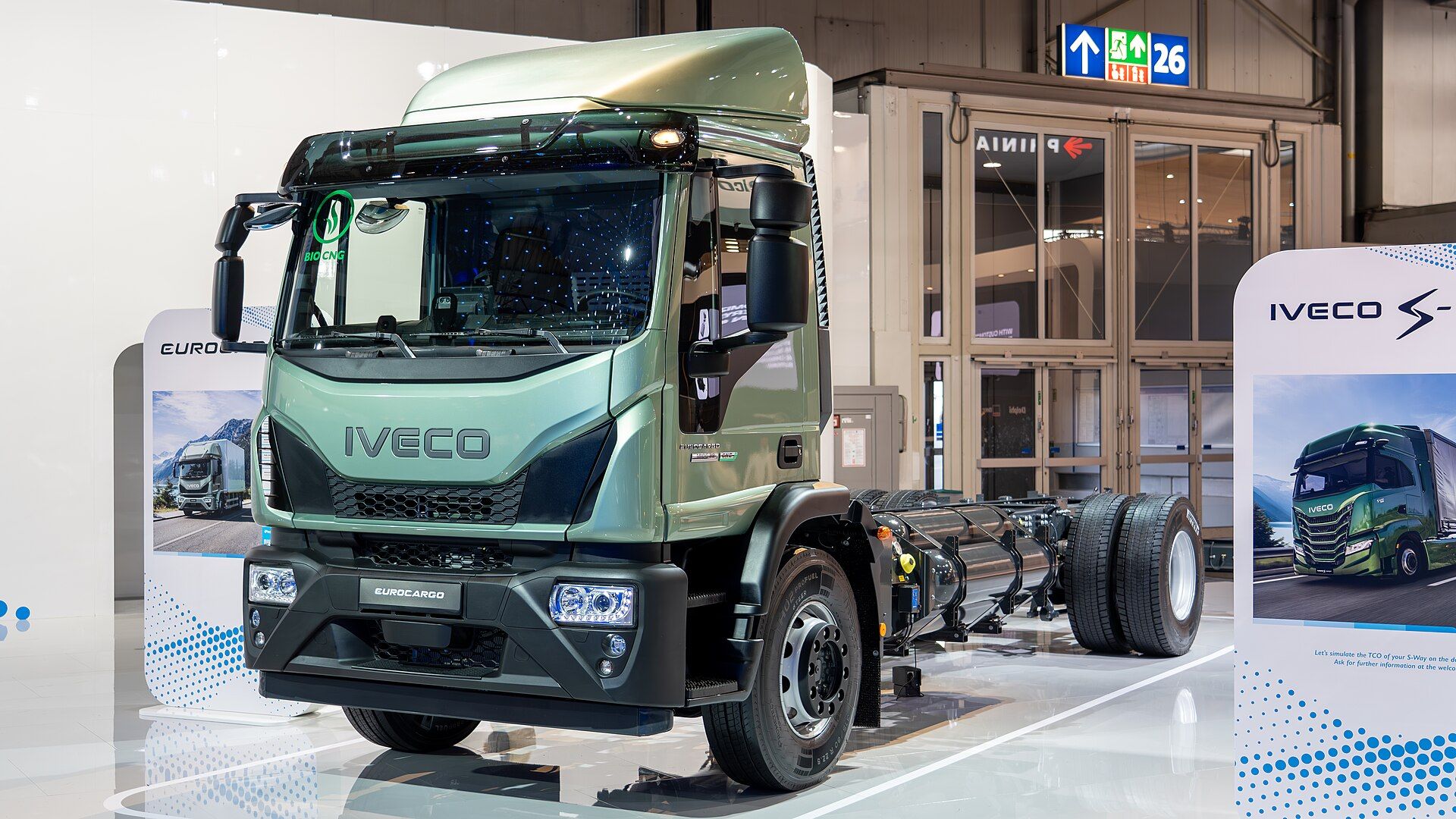
The Eurocargo is Iveco’s medium-duty truck, the range the company lists between the Daily below it and the S-Way above, and it is built at Brescia. Iveco states the launch year in writing twice: in the press kit issued in London on 28 November 2013, and in the 2021 release marking the 600,000th Eurocargo off the Brescia line, which credits the body design to Bertone. It took International Truck of the Year in 1992 and is still in production.
A Eurocargo can be anything from a 1991 rigid to a truck ordered this year, and nothing below applies to the middle of that span. Everything here is the current European line-up, read in three Iveco brochures printing the same tables: the UK edition M2330901UK of 05/25, the master edition of 05/24 and the Model Year 26 edition M2645901MASTER of 07/26.
Two diesel families, and the four-cylinder is not the runt
Seven power steps are split across two engines, and choosing between them is the real decision. The Tector 5 is a four-cylinder of 4.5 litres in three steps: 118 kW (160 hp) and 137 kW (190 hp), both at 2,200 rpm, and 152 kW (210 hp) at 2,500 rpm, with 680, 700 and 750 Nm. The 2013 press kit records that the Euro VI four-cylinder at 210 hp replaced the Euro V six-cylinder Tector 6 of 220 hp, and gives the reason as fuel: a 4.5 per cent consumption reduction across all missions. Its payload claim is a separate sentence, and is made against competitors’ engines rather than against its own six.
The Tector 7 is a six-cylinder of 6.7 litres in four steps, all at 2,500 rpm: 162 kW (220 hp), 185 kW (250 hp), 206 kW (281 hp) and 235 kW (320 hp), with 800, 850, 1,000 and 1,100 Nm. Its bands are broad — the 250 hp step holds 850 Nm from 1,250 to 2,050 rpm — which on a truck accelerating from a kerb all day matters more than the peak.
Both were described as HI-eSCR engines in Iveco’s engine specification sheet, which is pages 14 and 15 of the 2013 Euro VI press kit reissued as a standalone PDF. That sheet lists exhaust gas recirculation as “None” and the aftertreatment train as DOC, passive DPF, SCR and clean-up catalyst, and the kit describes the system as cutting nitrogen oxides by more than 95 per cent without an actively regenerated particulate filter. Most trucks in this library run SCR alongside exhaust gas recirculation; this one, on its maker’s 2013 statement, used none. None of the three current brochures describes the aftertreatment at all, and Iveco’s later releases name the system HI-SCR rather than HI-eSCR, so that is the 2013 position and not a checked description of a Model Year 26 truck.
The gas engine, and the number Iveco will not print
A 6.7-litre CNG engine is offered across most of the range at 220, 250 and 280 hp with 800, 850 and 1,000 Nm. Iveco publishes no kilowatt figure for it in any document this page could open, which is why the table above has no gas row: converting the horsepower would produce a number this site invented rather than read. Tanks are six 115-litre cylinders on the side members for up to 600 km, or up to 900 km with an additional three 140-litre cylinders behind the cab: the 900 km figure is the two sets together, not the rear three alone. The master brochure certifies the vehicle to the PIEK quiet truck test at under 72 dB. All three brochures say that thanks to the EU derogation, 18 t CNG vehicles can have a bonus mass to match the increase in tare weight; they name neither a figure nor an instrument, so neither does this page. The biomethane case and its toll and CO2 class belong elsewhere.
Two automatics and not one automated manual
Here the Eurocargo contradicts most of this site. The current offer is 6- and 9-speed manuals, an 8-speed ZF automatic and a 6-speed Allison automatic, and no current brochure lists an automated manual at all. Nor does any of them say how either automatic is built: Iveco names a torque converter once, in the 2013 press kit and only of the Allison, which it then offered across the whole 4x2 range. Iveco’s Australian sheets print both ratio sets, ZF8AP 4.890 to 0.639 and Allison 3000 3.49 to 0.65. The 2023 release says the 8-speed ZF8-HP is set to become the default choice with a fuel saving of up to 5%. In 2013 the range did include a 12-speed automated Eurotronic.
The final drive follows the gearbox rather than the engine: on the Australian sheets the same 320 hp Tector 7 gets 4.13:1 behind the ZF and 3.40:1 behind the Allison on one model, 5.29:1 against 4.63:1 on another.
What we could not confirm
No European dimension is published, and none is shown here. Iveco gives no overall length, width, height or single wheelbase in any document that opens. Its Australian sheets do, and they show why one figure would be false: overall length runs from 7,717 to 10,147 mm across four wheelbases of a single 14 t model, and maximum width over the fenders is 2,342 mm, 2,411 mm or 2,455 mm depending on the model.
The turning circle is blank on purpose. The 2023 release calls it a best-in-class 11m turning circle with no wheelbase, no model and no measurement basis. The 2013 press kit had qualified the same claim — less than 11 metres with a 2,790 mm wheelbase — and the qualifier was dropped rather than earned. Iveco’s Australian kerb-to-kerb turning diameters run from 15,540 mm to 23,440 mm across builds.
No rated speed is shown for the Tector 5, because the family has two: the 160 and 190 hp steps are stated at 2,200 rpm and the 210 hp step at 2,500 rpm. The Tector 7 keeps 2,500 rpm because all four steps carry it.
The emission step is “Euro VI” and nothing more. All three brochures head the table “Euro VI engines” with no letter. Iveco Trucks Australia writes “Euro 6 SCR”, and one Australian release, about the Australian-market truck, says “Euro6 (Step E)” — not evidence for the European vehicle. Which lettered step a truck holds is a question for its certificate of conformity.
Three Iveco documents disagree about one engine step. The European brochures call 206 kW 281 hp; Iveco’s own engine sheet calls the same 206 kW 280 HP; the Australian sheets call it 207 kW and 280hp. The table above follows the brochures, and the disagreement shows why a power figure needs its source attached.
Eleven plates, and a combination ladder that jumps
The Eurocargo publishes its weights as a ladder rather than a number. Gross vehicle weight climbs from 7,500 kg on the 75E through 8,000, 9,000, 10,000, 11,000, 12,000, 14,000, 15,000, 16,000 and 18,000 kg to 19,000 kg on the 190EL. On diesel, maximum gross combination weight does not track it smoothly: 16,500 kg on the lightest pair, 18,000 kg on the next five, 26,000 kg on the 120E and 140E, and 35,000 kg from the 150E up. The same model codes on CNG are plated lower — 26,000 kg on every two-access-step gas model and 19,000 kg on the one-step pair. That step is the whole gross vehicle against gross combination lesson in one table — a 15,000 kg truck and a 14,000 kg truck differ, by our subtraction, by one tonne of vehicle and nine tonnes of combination. At the top, a 19,000 kg rigid rated to 35,000 kg has 16,000 kg of trailer behind it, again our subtraction rather than an Iveco statement, and that is a serious drawbar outfit.
The axle configurations are 4x2 and 4x4, and that is the complete factory list. The off-road 4x4 is a 110E at 11,500 kg and a 120E at 12,000 kg against 21,000 kg gross combination, and a 150E at 15,000 kg against 24,000 kg. The MY26 brochure adds a provision for a third axle on 16-ton and 18-ton models, fitted at conversion and “managed as on an original 6x2 vehicle” — which is the brochure conceding that it is not one, and a reason not to buy a converted three-axle Eurocargo as a factory 6x2.
Cab, steps and the assistance package
Four cab families are coded MLC day low roof, MLL sleeper in low and high roof and MLD crew cab, each in one- and two-access-step forms — and it is the step count, not the cab, that splits the model tables. That is the right variable to sort a multi-drop vehicle by, because the cab on a distribution truck is an ergonomics decision before it is a comfort one.
The MY26 brochure lists the whole General Safety Regulation set by acronym — AEBS, LDWS, EVSC, REV with camera, BSIS, MOIS, ADDW, ISA, ESS, TPMS and an alcohol interlock interface — which is unusually explicit for a 7.5-tonne chassis. Adaptive cruise control sits alongside them in the same panel, but it is not a General Safety Regulation item and the brochure marks it “on request”. The Australian sheets list an exhaust brake with an air dryer and a water-cooled 360 cc compressor as standard; the 2013 kit gives a maximum engine braking figure for each family but prints the unit as “kwh”, a unit of energy, so no braking power is claimed here.
Who this truck is right for
The Eurocargo suits an operator ordering a bare chassis for a bodybuilder and choosing between eleven plated weights rather than trim levels: urban and regional distribution, municipal work, tippers, refuse, fire appliances. The automatic gearboxes are the reason. An automatic is the wrong gearbox for a motorway tractor and the right one for a vehicle launching from rest hundreds of times a shift. It is the wrong truck where trunking is disguised as distribution: above 19,000 kg gross vehicle there is no Eurocargo, and a buyer who needs three axles from the factory must look elsewhere.
Where it sits against its rivals
The Mercedes-Benz Atego is the closest comparison and the one most European buyers run against it. The MAN TGL makes the same four-versus-six-cylinder choice and answers it with an automated gearbox where the Eurocargo answers it with an ordinary automatic — the sharpest contrast in this class. The Volvo FL competes from the same weights. What the Eurocargo has that the others do not is a combination-weight ladder a buyer can read off one page, and a factory 4x4 in the same brochure.
Buying used
Start with the gearbox, because on this truck it is the specification, and the Australian sheets show the plate moving with the choice: the same 18 t model is rated at 28,000 kg gross combination behind the ZF and 22,000 kg behind the Allison. Read the plated figures for the vehicle in front of you rather than inferring them from the badge, which is the discipline any used truck purchase needs.
Ask what body the chassis has carried and for how long. Iveco’s Australian sheets split the engine oil change interval by duty: 80,000 km for long-range transport, 60,000 km for short and medium range, and 40,000 km for heavy-duty use in mainly urban areas or off-road. At the same odometer reading, the third interval means twice the service events of the first.
Check the running gear. The Australian sheets run 19.5-inch wheels at the lighter end and 22.5-inch at 18 tonnes — 285/70R19.5, 305/70R19.5 and 315/80R22.5 — and what the tyre label says counts for more in stop-start traffic than on a trunker. On a gas vehicle, establish the cylinder certification dates first: the tanks are a dated, inspectable component and their paperwork travels with the truck.
Quick answers
- Which engines are available in the Iveco Eurocargo?
- The record for the Iveco Eurocargo covers these engine families: IVECO Tector 5 (4.5 l), IVECO Tector 7 (6.7 l). Output spans 118–235 kW and 680–1100 Nm.
- What axle configurations does the Iveco Eurocargo come in?
- 4x2, 4x4.
- What emission standard does the Iveco Eurocargo meet?
- Euro VI.
Compared with
- Mercedes-Benz Atego
- MAN TGL
- Volvo FL
Sources
- IVECO Eurocargo brochure — UK edition, publication M2330901UK 05/25 — IVECO
- IVECO Eurocargo brochure — Model Year 26, publication M2645901MASTER 07/26 — IVECO
- New Eurocargo introduces new technology and natural gas across the range — Iveco S.p.A.
- Eurocargo Euro VI. Perfect for every situation — press kit, London, 28 November 2013 — Iveco S.p.A.
- IVECO Eurocargo 4x2 spec sheets, edition 01/26 — IVECO Trucks Australia
- IVECO Eurocargo brochure — international master edition, publication M2330901MASTER 05/24 — IVECO
- IVECO Eurocargo 4x4 — product page with specification table — IVECO UK
- Engine technical specifications — FPT Industrial Tector 5 and Tector 7 — IVECO
- IVECO Eurocargo 4x4 ML150 spec sheet, edition 01/26 — IVECO Trucks Australia
- IVECO launches new medium duty Eurocargo range — IVECO Trucks Australia
- IVECO celebrates the 600,000th Eurocargo built at its iconic Brescia plant — Iveco S.p.A.
- IVECO outlines its renewed Brand Ambition at IVECO Experience 2026 — Iveco S.p.A.