Iveco
Iveco T-Way
Two FPT diesels across four ratings, six axle configurations from 4x4 to 8x8, and the gross combination weight Iveco publishes nowhere in Europe.
.jpg)
Model overview
Axle configurations: 4x4 · 6x4 · 6x4x4 · 6x6 · 8x4 · 8x8
Engine families
- Power
- 265 kW
- Torque
- 1650 Nm
- Power
- 338–397 kW
- Torque
- 2300–2500 Nm
Iveco publishes a gross vehicle weight range rather than a figure — 18-41 t for the rigid, 18-34.5 t for the artic — and no European gross combination weight at all, so both weight rows above are empty. The line-up tables carry what the weight rows cannot. Partial wheel drive covers the 6x4 and 8x4 rigids and the 6x4 artic, on disc brakes front and rear, with wheelbases of 3.300-4.500 mm on the 6x4 rigid, 4.250-5.820 mm on the 8x4 and a single 3.300 mm on the artic; the 6x4 rigid takes a hub-reduction rear axle and the 8x4 single or hub reduction. All-wheel drive covers the 4x4, 6x4x4, 6x6 and 8x8 rigids and the 4x4 and 6x6 artics, all on hub reduction, all on drums except the 6x4x4's mixed drum and disc, with wheelbases of 3.800-4.500 mm on the 4x4 rigid, 3.800-4.000 on the 6x4x4, 3.500-4.500 on the 6x6 and 4.750-5.020 on the 8x8. The same tables carry an Engine/Gearbox row, and it is narrower than the engine table's availability column: the C9 is marked on the 4x4 and 6x6 rigids alone, and the 6x4 and 8x4 rigids, the 6x4x4 and 8x8 rigids and all three artics are XC13 only. Their Cab roof row lists AD against every configuration and AT against all but the 8x8 rigid, though the launch release calls AD and AT cab lengths rather than roofs — "AD short cab and AT long cab with standard or high roof". The launch press release adds a 10 mm high-resistance steel frame with a rail bending moment of 177 kNm, a front axle capacity of up to 9 t, hub reduction on the rear axle as standard, a kerb weight 325 kg below the Trakker's — a saving that release credits to the new single-piece casting tandem support on the rear axles, so a tandem-chassis figure — the HI-TRACTION hydrostatic front drive operating to 25 km/h, and a sandwich power take-off delivering up to 2,300 Nm. Iveco credits the XCursor 13 with 2.500 bar injection pressure, a 10% lower engine weight and a durability standard of up to 1,6 million kilometres, 33% greater than its predecessor, and quotes up to 530 kW of retardation from the engine brake. Figures for one named vehicle in one non-European market, from the IVECO Australia AD410T51 8x4 cab-chassis data sheet: GVM 41,000 kg and GCM 60,000 kg, wheelbase 5820 mm, overall length 10019 mm, maximum width over fenders 2500 mm, overall height to top of cab unladen 3163 mm, turning circle kerb to kerb 21300 mm, a front axle and suspension capacity of 16,000 kg and a rear tandem axle and suspension capacity of 26,000 kg — component ratings from that sheet's axle section and not plated axle loads, since together they exceed its own plated GVM — drive axle ratio 3.79, Hi-Tronix 16TX 2440 TO with ratios from 14.68 to 0.82, chassis rails 309x80x10 mm at 610 N/mm2, 550 L of fuel against 50 L of AdBlue, tyres 385/65 R22.5 front and 315/80 R22.5 rear. Iveco documents disagree on power take-off torque: the launch press release says up to 2,300 Nm for the sandwich PTO, that sheet says 2,000 Nm for the sandwich unit and 800 Nm for the rear engine PTO. The other two Australian sheets rate the AD190T36W 4x4 at GVM 20,500 kg on the same 360 hp / 265 kW / 1,650 Nm C9 rating the European table carries, and the AD380T45W 6x6 at GVM 32,000 kg on a 450 hp / 331 kW / 2,200 Nm rating that appears in none of the European documents cited here. Both of those sheets publish an overall length per wheelbase rather than one figure — 7932, 7077 or 6672 mm on the 4x4 and 9597, 9327 or 8697 mm on the 6x6 — each 2500 mm wide over the fenders and 3213 mm high to the top of the cab unladen.
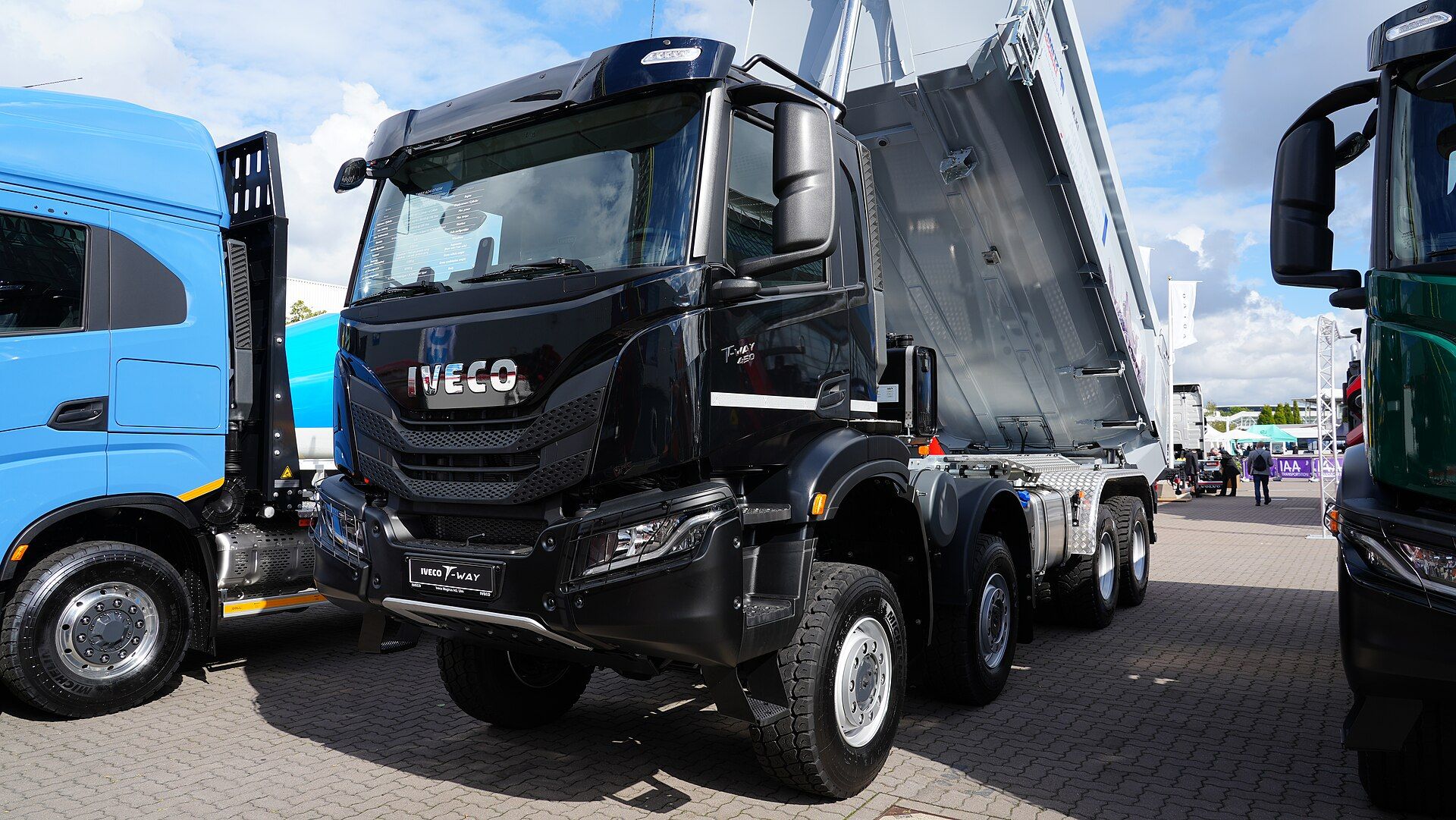
The T-Way is the off-road end of Iveco’s heavy range. Iveco presented it to its dealer network and the international trade press on 28 April 2021 as the vehicle that takes over from the Trakker. It sits beside the X-Way, the range’s light off-road vehicle; the T-Way is for quarries, mines, construction sites and ground nobody has prepared.
It shares the WAY range with the on-road S-Way and the X-Way, and both engines below come from FPT Industrial, a brand inside the same Iveco Group described in who builds trucks in Europe.
Two engines, and the availability column matters more than the power
Iveco publishes one engine table for the T-Way, four ratings across two families. The interesting part is not the power column but the two on the right, marking which ratings come with partial and which with all-wheel drive.
The Cursor 9, labelled C9, is the 8.7-litre; FPT publishes it as a six-cylinder. It appears in the T-Way at exactly one rating — 360 hp, 265 kW, 1,650 Nm — behind a wastegate turbo, and the availability column offers it on all-wheel-drive chassis only. Iveco says it suits lighter configurations.
The XCursor 13, labelled XC13, is the 12.9-litre with a variable-geometry turbo, and six cylinders as well — FPT prints the count on its own rating card for the 460. Three ratings appear in the T-Way: 460 hp at 338 kW and 2,300 Nm, 500 hp at 368 kW and 2,400 Nm, and 540 hp at 397 kW and 2,500 Nm. Here the availability columns split. The 460 comes on both drive layouts; the 500 and the 540 are partial wheel drive only.
Read the two together and the range narrows sharply: the availability column leaves all-wheel drive the 360 hp Cursor 9 and the 460 hp XCursor 13 and nothing else. The line-up tables then narrow the Cursor 9 again — its row is marked on the 4x4 and the 6x6 rigid and struck out everywhere else, so the 6x4x4, the 8x8 and both all-wheel-drive tractors are XCursor 13 only. Iveco’s own summary chips carry the consequence: 360-540 hp on the rigid page, 460-540 hp on the tractor page. The top two ratings belong to chassis driving the rear axles alone, which a buyer working down from a power figure discovers late.
Every rating is published over a band rather than at a point — the Cursor 9 holds its power from 1,530 to 2,200 rpm, the XCursor 13’s steps peak across 1,600–1,650 and 1,500–1,650 — the honest way to publish it and the awkward way to compare it, for the reasons in how truck power figures are measured. Torque arrives lower still, from 1,200 rpm on the Cursor 9 and 770 on the 460, and Iveco draws the conclusion itself: torque at low engine speeds permits faster rear axle ratios and so lower engine speeds when cruising, the trade set out in axle ratios and final drive. It credits the XCursor 13 with 2,500 bar injection pressure and durability of up to 1.6 million kilometres, 33% more than its predecessor.
The line-up table is the specification
Six configurations are listed, in two groups that differ in almost every row. Partial wheel drive covers the 6x4 and 8x4 rigids and the 6x4 artic; all-wheel drive covers the 4x4, 6x4x4, 6x6 and 8x8 rigids and the 4x4 and 6x6 artics. Axle configurations explained covers the notation; what Iveco adds to it is a table of what changes with each layout — rear axle type, suspension, brakes and wheelbase — rather than the formula alone.
Every partial-wheel-drive chassis is listed with disc brakes front and rear; the all-wheel-drive ones run drums, except the 6x4x4, which mixes drum and disc. Hub reduction is the standard rear axle across the range, as the launch release states outright, and the 8x4 is the only configuration also offered with single reduction. Wheelbases come per configuration and mostly as ranges: 3,300–4,500 mm on the 6x4 rigid, 4,250–5,820 on the 8x4, 3,800–4,500 on the 4x4, 3,800–4,000 on the 6x4x4, 3,500–4,500 on the 6x6 and 4,750–5,020 on the 8x8; only the artic is published at single values. The next row is headed Cab roof and carries two cab variants, AT and AD: AD against every configuration, AT against all of them but the 8x8 rigid, which is AD alone. The launch release calls them cab lengths rather than roofs — AD short, AT long, each with a standard or high roof — and Iveco reconciles the two descriptions nowhere this page could open.
Under all of them is a 10 mm high-resistance steel frame, rated by the launch release at a rail bending moment of 177 kNm, with a front axle capacity of up to 9 tonnes. The same release takes 325 kg out of the Trakker’s kerb weight, but credits the saving to the new single-piece tandem support on the rear axles: a tandem-chassis figure, not one that follows the 4x4.
Gearbox, traction and braking
The current gearbox is the Traxon 2, a 12-speed automated unit with rocking, off-road and creep modes and four speeds in reverse — the off-road dialect of automated manual transmissions. Rocking works a stuck vehicle free; creep holds walking pace under a loading shovel.
Between the two groups sits HI-TRACTION, a hydrostatic front drive Iveco offers on 6x4 rigid and articulated models. The driver arms it; on rear axle slip it engages the front wheels itself. The launch release puts its ceiling at 25 km/h, offers it for missions that need all-wheel drive only occasionally, and claims fuel and payload benefits against a full all-wheel-drive chassis.
Braking carries the MY2024 truck’s largest claim. Iveco’s page puts up to 530 kW of retardation on a “Super Engine Brake”; the brochure says a “High Performance Engine Brake” can substitute the intarder in most missions; one unit or two, neither document says. Most missions, not all — and Iveco’s own Australian 8x4 sheet specifies a transmission intarder and a three-level engine brake on the same vehicle, which is what retarders and engine braking predicts for a truck that descends loaded.
Weights, and the number Iveco does not publish
Iveco publishes a gross vehicle weight range and no gross combination weight at all: 18–41 t for the rigid, 18–34.5 t for the artic. Ranges, not figures, which is why the weight rows above are empty rather than filled with a plausible number.
Neither UK sub-page, nor the MY2024 brochure, nor the launch release states one. The German, Spanish and Turkish pages carry the same engine and line-up tables as the UK sub-pages — headed in PS, CV and hp respectively — and no combination weight either. The figures that do exist are Australian: 44,000 kg on the 4x4 sheet and 60,000 kg on both the 6x6 and the 8x4. Those are ADR mass ratings for a non-European market, and reading them as a European plating is the confusion gross vehicle and gross combination weight exists to prevent. For a European buyer the figure is a question for the order sheet, not the brochure.
What we could not confirm
The top power figure. The prose above the engine table on both UK sub-pages says the top rating produces up to 580 hp and 2,500 Nm. The same sentence in the MY2024 brochure says 540 hp, and the table on all three documents stops at 540 hp, 397 kW and 2,500 Nm. FPT publishes up to 580 hp and 2,800 Nm for the XC13 as an engine family, and lists that family as going to the S-Way, the X-Way and the T-Way alike; it attaches no model to the 580 hp rating. The T-Way’s own table stops at 540 hp, and this page follows the table.
The 510 hp figure. The 2021 launch rating with the Cursor 13, which the launch release presents as exceeding the Trakker’s by 10 hp and the Australian 8x4 sheet still prints as 510 hp and 375 kW. A different model year and a different engine.
The rated speed. The documents disagree: the Australian 4x4 sheet reads 360 hp at 2,200 rpm with 1,650 Nm at 925 rpm, where the European table puts the same engine’s torque at 1,200–1,530 rpm. That row is blank rather than picked.
The Euro VI step. Both UK sub-pages state Euro VI plainly, and the step is supportable one notch further — the same page writes “Euro VI/E” of the Cursor family, FPT’s Cursor 9 page says Step E, all three Australian sheets print Euro VI Step E. But no European T-Way table names a step, so the record stops where the range-wide document does. See Euro 6 and Euro 7.
What 6x4x4 denotes, and which gearbox supersedes which. Iveco puts 6x4x4 in the all-wheel-drive column and explains the third digit nowhere this page could open. The same silence covers the gearbox: current pages name only the Traxon 2, the launch release 12- and 16-speed HI-TRONIX units, the Australian sheets a 16-speed Hi-Tronix with ratios from 14.68 down to 0.82. Iveco never names the gearbox’s manufacturer, and neither does this page.
Power take-off torque, and the dimensions. The launch release gives the sandwich PTO up to 2,300 Nm, the Australian 8x4 sheet 2,000 Nm with 800 Nm at the rear engine PTO. No European document publishes a vehicle length, width or height. The ones that do exist are on the Australian sheets and each belongs to a single named vehicle: the AD410T51 8x4 is listed at 10,019 mm overall length, 2,500 mm maximum width over the fenders, 3,163 mm to the top of the cab unladen and a turning circle of 21,300 mm; the AD190T36W 4x4 at 7,932, 7,077 or 6,672 mm long — one figure per wheelbase — and 3,213 mm high. A length published three times over for one Australian variant is not the model’s length, which is why those rows are empty above and the figures sit here instead.
Who this truck is right for
Tipper, mixer, crane and drain-emptier fleets working where there is no road — Iveco’s own mission list is exactly that. The case for it is the standard hub-reduction rear axle, the frame, and a genuine 6x6 or 8x8.
It is the wrong truck for a vehicle that reaches a prepared site on a made road. Drums instead of discs on every all-wheel-drive chassis but the 6x4x4, the tare of a driven front axle and the fuel to carry it are paid on every kilometre whether the ground needs them or not, and the partial-wheel-drive 6x4 with HI-TRACTION exists precisely for the fleet that has been buying all-wheel drive out of caution.
Where it sits against its rivals
The Arocs, the FMX and the TGS are the direct answers, each its maker’s construction derivative of a long-haul family and each with its own record here. No scored comparison is offered, because the useful comparison is not a total: put the availability columns side by side rather than the power figures, and ask each manufacturer which ratings survive the drive layout you need. Then ask for the approved combination weight for that exact chassis in writing, because on this vehicle the maker publishes none.
Buying used
Ask which drive layout and which engine, and check the pair against the line-up table for that configuration rather than the engine table’s availability column alone — the column allows the Cursor 9 on all-wheel drive at large, the line-up table allows it on two chassis. A combination neither table carries is worth a question; the answer usually explains what the truck was built for.
Ask what sits behind the gearbox. An intarder and an engine brake on the same vehicle points to loaded descents; an engine brake alone points to a truck sold on the MY2024 argument that the intarder is no longer needed. Ask about the power take-off too — the sandwich and rear engine units are different installations with different ratings, and the body was designed around one.
Emission-system history matters as much here as on any Euro VI vehicle: the Australian sheet sets an oxidation catalyst, particulate filter, selective catalytic reduction and clean-up catalyst against 550 litres of fuel and 50 litres of AdBlue, a ratio worth reading alongside SCR and AdBlue. Check which driver assistance functions are fitted, too — the mandatory systems are dated rather than universal.
Duty cycle beats the odometer here, the qualification depreciation and book value puts on a mileage figure, and the standard used-truck checks apply unchanged. Off-road casings — the IVECO Australia AD410T51 8x4 sheet specifies 385/65 R22.5 front and 315/80 R22.5 rear, where no European document this page could open names a size at all — wear and price differently from the road tyres in tyre labelling, and the air dryer and compressor work harder on a site vehicle than its mileage suggests.
Quick answers
- Which engines are available in the Iveco T-Way?
- The record for the Iveco T-Way covers these engine families: FPT Cursor 9 (C9) (8.7 l), FPT XCursor 13 (XC13) (12.9 l). Output spans 265–397 kW and 1650–2500 Nm.
- What axle configurations does the Iveco T-Way come in?
- 4x4, 6x4, 6x4x4, 6x6, 8x4, 8x8.
- What emission standard does the Iveco T-Way meet?
- Euro VI.
Compared with
- Mercedes-Benz Arocs
- Volvo FMX
- MAN TGS
Sources
- IVECO T-Way Rigid — engine line-up and configuration tables — IVECO
- IVECO T-Way Artic — engine line-up and configuration tables — IVECO
- IVECO T-Way brochure, model year 2024 (H2332601MASTER, 11/23) — IVECO
- New IVECO T-WAY: the toughest vehicle engineered for the most extreme off-road missions — IVECO Press Office
- IVECO T-Way 8x4 Cab Chassis data sheet (AD410T51) — IVECO Australia
- IVECO T-Way 6x6 Cab Chassis data sheet (AD380T45W) — IVECO Australia
- IVECO T-Way 4x4 Cab Chassis data sheet (AD190T36W) — IVECO Australia
- Cursor 9 truck engine — FPT Industrial
- XCursor 13 truck engine — FPT Industrial
- FPT Industrial powers the new IVECO MY24 range — FPT Industrial