European truck cabs: day cabs, sleeper cabs and flat floors
A day cab has no bunk, a sleeper adds a berth and a long-haul sleeper has two berths and standing height; cab names do not translate between makers.
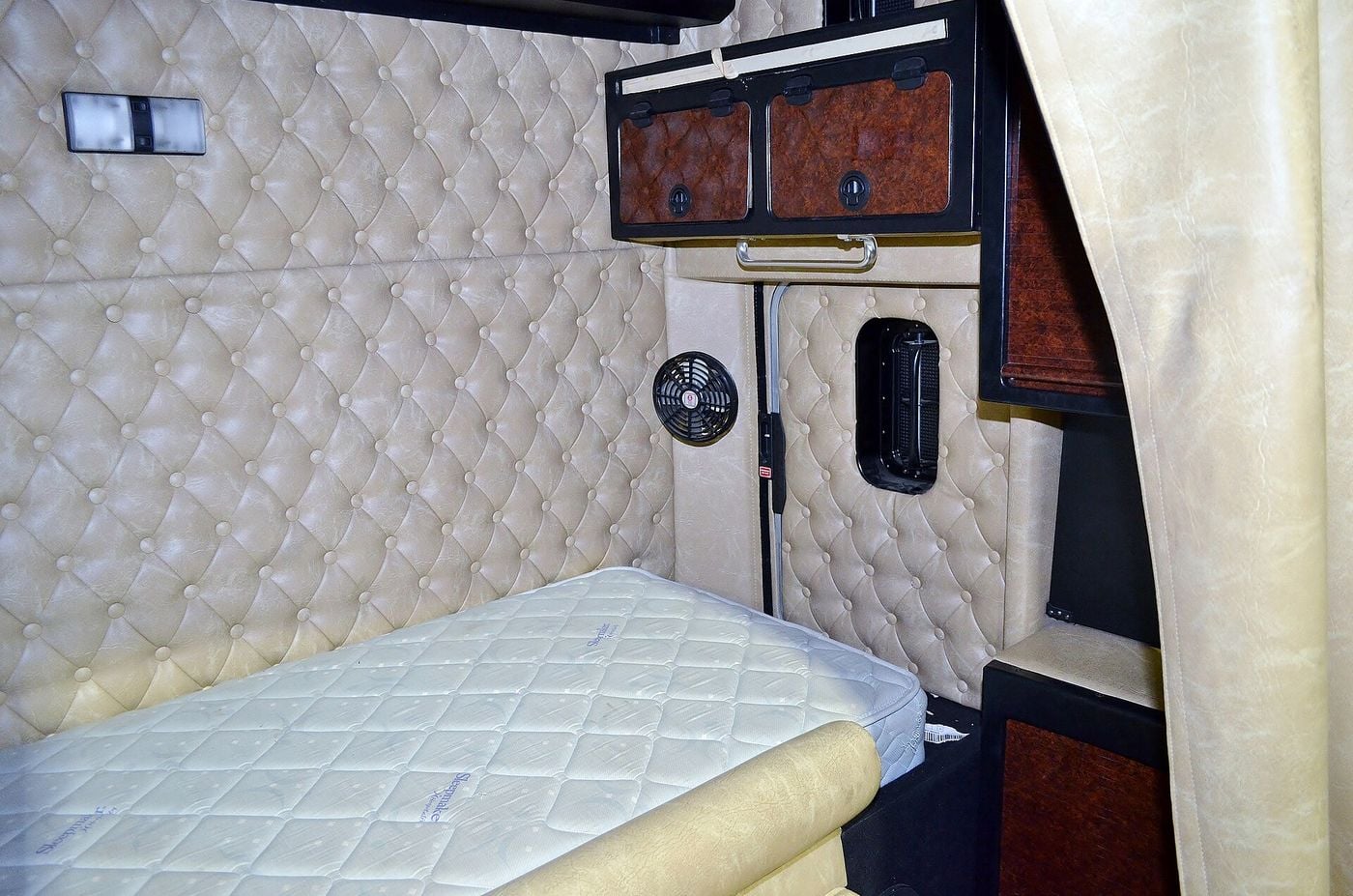
Truck cabs fall into three basic classes by whether the driver sleeps in them: a day cab has no bunk and is for work where the driver goes home; a sleeper cab adds a berth for the occasional night out; and a long-haul sleeper has two berths, standing height and storage counted in hundreds of litres. European trucks put the cab over the engine, because a bonnet in front would cost load length, and cab widths barely differ: the DAF XG+ and the Actros L’s GigaSpace cab are both 2,500 mm wide. What separates one sleeper cab from another is standing height inside — 220 cm in Volvo’s FH Globetrotter XL, up to 2,220 mm in DAF’s XG+ — and whether the floor is flat.
The cab classes at a glance, with figures the makers publish:
| Class | What it is | Example |
|---|---|---|
| Day cab | No bunk; for distribution, construction, tipper and municipal work, where the driver goes home | DAF XD Day Cab: 2,030 mm long, two entrance steps |
| Sleeper cab | A berth for the occasional night out | MAN’s GN cab, for occasional overnight stays on the road |
| Long-haul sleeper | Two berths, standing height, storage counted in hundreds of litres | Volvo FH Globetrotter XL: 220 cm interior height, 211 cm over the engine compartment cover, 180 litres in the overhead units above the windscreen; DAF XG+: up to 2,220 mm standing height |
| Low-entry cab | Sits lower on the chassis and is glazed for a better view of nearby pedestrians and cyclists; for urban, refuse and municipal work | Scania L-series: a kneeling function that lowers the suspension by 100 mm, boarding steps 790 mm wide |
A cab designation on a spec sheet — GigaSpace, Globetrotter XL, XG+, GX, L-series — is a marketing name attached to a set of hard numbers: how tall it is inside, whether the floor is flat, how high the driver sits above the road, and whether anyone can sleep in it. The names do not translate between manufacturers. A cab one maker calls high-roof can have less standing room than another maker’s middle option, and the only way to compare them is to go past the name to the figure underneath. This is what the terms describe and which of them matter for which work.
The box is fixed before the designer starts
Every European cab is drawn inside the same envelope. Council Directive 96/53/EC caps an articulated vehicle at 16.5 metres and a road train at 18.75 metres, width at 2.55 metres — 2.60 metres for temperature-controlled bodies — height at 4 metres, and weight at 40 tonnes, or up to 44 tonnes for a three-axle tractor with a two- or three-axle semi-trailer carrying containers or swap bodies up to 45 feet in intermodal transport (42 tonnes for a two-axle tractor in the same role).
Two consequences follow. First, cab width is not much of a differentiator: DAF specifies the XG+ cab at 2,500 mm wide and Mercedes-Benz gives the same 2,500 mm for the Actros L’s GigaSpace cab — each 50 mm short of the Directive’s 2,550 mm cap, by our arithmetic — so “wide cab” claims are describing much the same figure. Second, until recently every millimetre of cab length was a millimetre of trailer you did not get — the deck itself being fixed by a separate limit measured from the kingpin. That is the whole reason European trucks are cab-over-engine: the driver sits above the front axle and the engine because a bonnet in front would cost load length. North American conventionals exist because length there is regulated differently.
Day cab, sleeper cab or long-haul sleeper: what is the difference?
The first question a designation answers is whether the driver sleeps in it.
A day cab or short cab has no bunk. It is for distribution, construction, tipper and municipal work — anything where the driver goes home. It is the shortest and lightest option, and on weight-critical work every kilo it saves is payload you can sell.
A sleeper adds a berth for the occasional night out rather than a way of life. MAN describes its GN cab exactly that way: for occasional overnight stays on the road.
A long-haul sleeper is where the money goes. Two berths, standing height, and storage counted in hundreds of litres — Volvo’s own fact sheet for the FH Globetrotter XL lists 180 litres in the overhead units above the windscreen alone, plus a rear overhead unit of 154 or 245 litres depending on specification.
MAN’s cab ladder shows how granular this gets in practice: CC for compact distribution and construction work, NN and DN for municipal and utility bodies, TN for payload-optimised tankers, silo and refrigerated bodies, TM for payload in national long-haul, then GN, GM and GX for long-distance work. The letters are the useful part. The showroom names are not.
Standing height is two numbers, not one
Exterior roof height sells trucks; interior standing height is what the driver lives with, and it is usually quoted as a range because it changes across the cab. Volvo’s fact sheet for the FH-XHSL — the Globetrotter XL — gives an interior height of 220 cm, and 211 cm over the engine compartment cover. That 9 cm is the engine tunnel.
DAF publishes the same idea as a ladder across its New Generation range: 1,900 to 2,075 mm of standing height in the XF, 1,980 to 2,105 mm in the XG, and up to 2,220 mm in the XG+. MAN quotes over 1.85 m for the GM. Mercedes removes the tunnel entirely in the largest Actros L cabs, which is what a flat floor means in practice: you can cross the cab without climbing over anything.
So when comparing two trucks, compare interior standing height measured at the same place, and ask separately whether the floor is flat. Those two answers describe the cab better than any name.
The extra length that arrived in 2015
Directive (EU) 2015/719 inserted Article 9a into 96/53/EC, allowing cabs to exceed the maximum lengths where the extra length buys aerodynamics and driver vision. It came with two conditions worth knowing: any exceeding of the maximum lengths shall not result in an increase in the load capacity of those vehicles, and the vehicles shall be approved, before being placed on the market, in accordance with the type-approval rules — the geometry and paperwork that permission actually requires are set out in aerodynamic cabs and the length rules. The Commission was directed to weigh vulnerable road users and the improvement of their visibility to drivers, in particular by reducing drivers’ blind spots.
Manufacturers have spent that allowance in different places. DAF’s New Generation adds 160 mm of elongation at the front for aerodynamics and, on the XG and XG+, 330 mm of extra length at the rear for space to work and sleep. Mercedes extended the ProCabin front end by 80 millimetres and credits the aerodynamic work with up to three percent in fuel savings. Same rule, two strategies: DAF bought interior volume, Mercedes bought drag.
For a buyer this is the sharpest line in the used market. A cab from before this generation is shorter, less slippery and smaller inside, and no options list closes the gap.
Low-entry cabs are a different class, not a smaller one
A low-entry cab is not a long-haul cab with the roof taken off. It sits lower on the chassis and is glazed differently. Scania’s L-series is the clearest example: a City Safe Window, described as a low-level door window that gives the driver a better view of nearby pedestrians and cyclists; a City Door that swings inward so the driver can leave on the passenger side on a busy road; a kneeling function that lowers the suspension by 100 mm when the parking brake is applied; and 790 mm wide boarding steps.
DAF quantifies the same trade from the other direction. The New Generation XF sits on a cab datum 75 mm lower than its predecessor, while the XG and XG+ sit 125 mm higher than the XF. Height inside is bought with vision downward. There is no configuration that gives you both.
Regulation (EU) 2019/2144, the EU General Safety Regulation, turns this into a compliance question rather than a preference. Improved direct vision for heavy goods vehicles falls in the regulation’s final phase, in 2029 — one of the four separate timetables in Annex II — and the low-entry cabs on sale now are that requirement arriving early. For refuse, urban distribution and municipal work it is already the right answer on its own merits. London runs a separate permit scheme of its own on direct vision; see London Direct Vision Standard.
What holds the cab up
UN/ECE Regulation No 29 sets the structural standard. Test A is a frontal impact and applies only to cab-over-engine vehicles. Test B strikes the A-pillars to simulate a 90-degree rollover with subsequent impact. Test C loads the roof for a 180-degree rollover. A category N3 vehicle with the cab over the engine has to pass all three, and each test must leave a survival space around the manikin on the seat.
Cab tilt is a related spec worth knowing: Volvo quotes a generous 70-degree tilt on the FH for engine access.
Matching the cab to the work
For multi-drop urban, refuse and municipal work, the low-entry cab’s vision and step height are the job. The chassis, bodies and electric versions makers offer for refuse work are set out in refuse collection vehicles.
For regional distribution where the driver is home nightly, a day cab or short sleeper is the standard choice. The distribution ranges publish the day cab as a working dimension rather than a lesser trim: DAF gives the XD Day Cab as 2,030 mm long with two entrance steps.
For international long-haul, take the flat floor, the standing height above 2.1 metres and the two berths described above.
Quick answers
- What is the difference between a day cab, a sleeper and a long-haul sleeper?
- A day cab has no bunk and is for work where the driver goes home — the shortest, lightest option. A sleeper adds a berth for the occasional night out. A long-haul sleeper has two berths, standing height and storage in hundreds of litres: Volvo’s FH Globetrotter XL lists 180 litres in the overhead units above the windscreen alone.
- Why are European long-haul trucks cab-over-engine?
- Directive 96/53/EC caps an articulated vehicle at 16.5 metres and a road train at 18.75 metres, and until 2015 every millimetre of cab length was a millimetre of trailer lost. The driver sits above the front axle and engine because a bonnet would cost load length; North American conventionals exist because length is regulated differently there.
- What changed for truck cabs in 2015?
- Directive (EU) 2015/719 added Article 9a to 96/53/EC, letting cabs exceed the maximum lengths where the extra length buys aerodynamics and driver vision, provided any such exceeding "shall not result in an increase in the load capacity" and the vehicles, before being placed on the market, "shall be approved in accordance with the rules on type-approval". DAF spent it on interior volume — 330 mm at the rear of the XG — while Mercedes spent 80 mm on the ProCabin front for drag.
- What is a low-entry cab for?
- A low-entry cab sits lower on the chassis and is glazed for a better view of nearby pedestrians and cyclists — Scania’s L-series adds a City Safe Window and a kneeling function that lowers the suspension by 100 mm. Regulation (EU) 2019/2144 makes improved direct vision mandatory in a phase in 2029, so these cabs are that requirement arriving early.
Models in this article
Sources
- Directive (EU) 2015/719 amending Council Directive 96/53/EC on maximum authorised dimensions and weights — EUR-Lex, European Union
- UN/ECE Regulation No 29 — protection of the occupants of the cab of a commercial vehicle — EUR-Lex / UNECE
- DAF is starting the future with New Generation XF, XG and XG+ — DAF Trucks N.V.
- Fact sheet: Cab FH-XHSL (Globetrotter XL) — Volvo Trucks
- Mercedes-Benz Actros L ProCabin: focus on aerodynamics, efficiency and driver comfort — Daimler Truck Newsroom
- L-series low entry truck — Scania
- MAN cabs — overview of models — MAN Truck & Bus
- Briefing: Revision of Directive 96/53/EC on maximum authorised weights and dimensions — European Transport Safety Council (ETSC)
- What you need to know about the EU's updated safety regulations for trucks (Regulation (EU) 2019/2144) — Volvo Trucks