DAF
DAF XD
Two PACCAR engine families, five axle configurations and a plate that follows the build rather than the badge — what the XD is, and what to check on a used one.
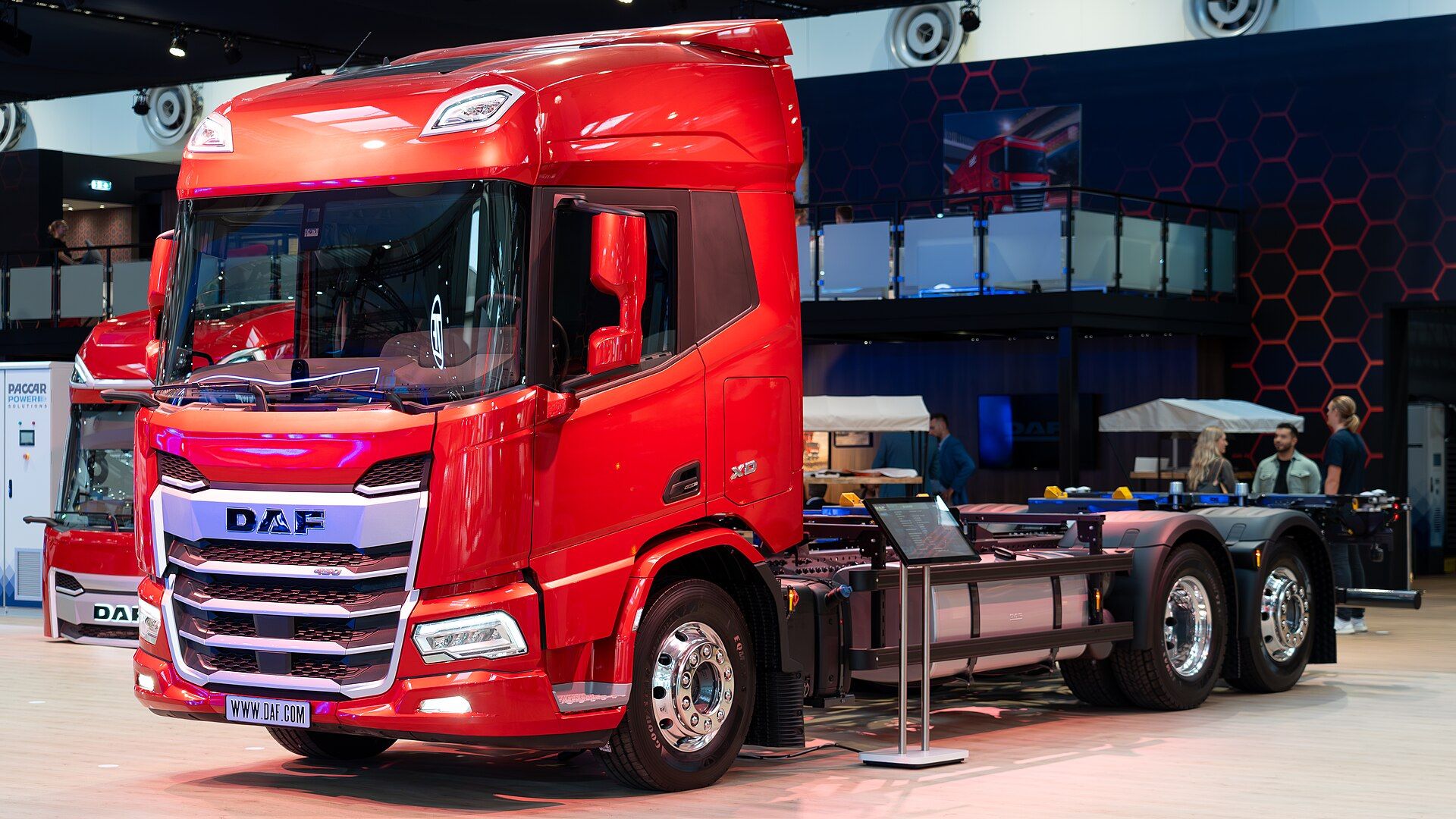
.jpg)
Model overview
Axle configurations: 4x2 · 6x2 · 6x4 · 8x2 · 8x4
Engine families
- Power
- 167–227 kW
- Torque
- 890–1190 Nm
- Power
- 220–330 kW
- Torque
- 1350–2350 Nm
Power steps, from the PACCAR infosheets: PX-7 at 167 kW (XD 230), 189 kW (XD 260), 212 kW (XD 290) and 227 kW (XD 310); MX-11 at 220 kW (XD 300), 251 kW (XD 340), 270 kW (XD 370), 300 kW (XD 410) and 330 kW (XD 450). PX-7 torque runs 890, 990, 1,090 and 1,190 Nm. MX-11 torque runs 1,350, 1,500, 1,950, 2,150 and 2,350 Nm, the upper three of those held between 900 and 1,125 rpm with a second, lower band of 1,800, 2,000 and 2,200 Nm from 900 to 1,400 rpm; DAF tunes the two lowest ratings for urban, regional and national distribution with solo vehicles or combinations up to 32-36 tonnes GCM, and the three highest for one-stop delivery types of application with GCMs ranging from 36 to 44 tonnes. The configuration sheets of 10 July 2025 give 1,450 Nm for the same 220 kW rating the infosheet puts at 1,350 Nm, and this page does not reconcile them. The gross weights above were read from the FAN 6x2 rigid XD 300 sheet; they are properties of that build and do not carry across configurations. The FA 4x2 rigid is 18,000 kg GVM against 19,000 kg GCM on the sheet DAF titles "FA 4X2 Rigid, 19t" (XD 230, chassis weight related technical GVM 19,000 kg), and 18,000 against 38,000 kg on the sheet titled "FA 4X2 Rigid" (XD 300, technical GVM 20,500 kg); both carry maximum axle loads of 8,000 kg front and 11,500 kg rear, and DAF calls the combination figure driveline-related, holding across every engine rating listed on each sheet. The FAT 6x4 rigid in XD 300 form is 26,000 and 32,000 kg; the FAD 8x4 in XD 370 form 32,000 and 35,500 kg; the FAX 8x2 in XD 370 form 32,000 and 38,000 kg. Maximum axle loads on the FAN are 8,000 kg front and 19,000 kg rear, and the same sheet lists optional driveline-related maximum GCM from 27,000 to 60,000 kg, each designated class 2 or class 3. The Day Cab is 2,030 mm long and 2,500 mm wide; Sleeper and Sleeper High cabs are also offered. The PX-7's exhaust brake is standard and delivers up to 165 kW of braking power, with the PX Engine Brake a listed option for which DAF publishes no braking figure. DAF's XD efficiency page says all MX-11 variants are multi-torque, delivering up to 150 Nm more torque in top gear; the engine infosheet does not carry that figure, and attaches its two-value torque table to the three upper ratings only.
The XD is DAF’s distribution and vocational truck: the part of the New Generation range that sits below the XF, XG and XG+ long-haul tractors and does the work those trucks never see. DAF announced it in June 2022 for an unveiling at the IAA that September, said production was planned to start that autumn, and European transport journalists voted it International Truck of the Year 2023.
A distribution rigid is bought on different terms from a long-haul tractor unit, and the difference is worth stating before any figure reaches the page. A distribution buyer is usually ordering a bare chassis that a bodybuilder will finish — a box, a curtain, a tipper, a refuse body — and the questions that decide the order are how much the finished vehicle is allowed to weigh, how many axles carry that weight, and how tightly the thing turns in a yard. Engine power matters, but it is rarely the first question. DAF publishes a separate specification sheet for each axle layout and engine entry point — twenty of them for the XD — which is finer-grained than anything else this site has opened, and is why this page can be exact about weights where other model pages have to generalise. It is not a sheet per orderable configuration: one document covers a range of wheelbases and cabs, and the three entry points are XD 230, XD 300 and XD 370, with no separate sheet for the badges in between. Every weight below comes from DAF Trucks Ltd’s GB sheets, edition 202545A of 10 July 2025, which footnote both figures as holding in conformity with registration documents.
Two engine families, and the split is the whole decision
The XD is sold with two PACCAR engines, and choosing between them is the single consequential decision in the specification.
The PX-7 is the smaller of the two, in four steps: 167 kW (badged XD 230), 189 kW (XD 260), 212 kW (XD 290) and 227 kW (XD 310), with torque running from 890 to 1,190 Nm. DAF describes it as suited to rigid trucks, used in application classes up to 19 tonnes or drawbar applications, and pre-eminently suitable for inner-city distribution work. Its standard exhaust brake delivers, in DAF’s own wording, up to 165 kW of braking power — a ceiling rather than a nameplate rating, on a truck that spends its day decelerating into delivery points rather than holding a descent. A PX Engine Brake appears alongside it in the options list on the XD 230 sheet, with no braking figure published for it.
The MX-11 is the larger engine, in five steps: 220 kW (XD 300), 251 kW (XD 340), 270 kW (XD 370), 300 kW (XD 410) and 330 kW (XD 450). DAF tunes it in two directions and says so plainly in its own engine infosheet: the 220 and 251 kW ratings are optimised for urban, regional and national distribution, with solo vehicles or combinations up to 32-36 tonnes GCM, and the 270, 300 and 330 kW ratings for one-stop delivery types of application, with GCMs ranging from 36 to 44 tonnes. Both tonnage figures are gross combination weights in the source, not vehicle weights. The split is a more useful statement than any power figure, because it tells you which half of the range the maker thinks your job belongs in.
DAF states “Euro 6” for both engines on its own specification sheets and names no sub-step anywhere this site could read it, so none is claimed here — the same position the XG+ page takes. On a heavy vehicle the legal category is Euro VI and it comes in lettered steps, and which step a given truck holds is exactly what Euro 6 and Euro 7 exists to unpick.
Multi-torque, and why one number is not the whole answer
DAF’s XD efficiency page is where the claim lives: all MX-11 variants are multi-torque, delivering up to 150 Nm more torque in top gear. The engine infosheet is narrower and does not carry that figure at all. What it does carry is two torque values rather than one for the three upper ratings — 1,950, 2,150 and 2,350 Nm held between 900 and 1,125 rpm, against a lower band of 1,800, 2,000 and 2,200 Nm from 900 to 1,400 rpm — with the higher number available in the highest gear on a direct-drive gearbox and in the two highest gears on an overdrive gearbox. The configuration sheets settle it for a given build: the 220 kW XD 300 sheets print “Engine MX-11, multi torque” in the driveline line itself.
This is not marketing decoration. It is a driveline protection strategy that has a side effect the buyer can use: the engine will hold a tall gear on a gradient instead of dropping down, which is worth more in a delivery cycle than the peak figure suggests. It is also why a quoted torque figure needs a gear attached to it before two offers can be compared.
The gearboxes follow the engines, and DAF’s own words for them are worth keeping straight. The PX-7 comes with an eight-speed PowerLine, which DAF calls a fully automatic gearbox; the MX-11 with the twelve-speed TraXon, which DAF calls automated. A six-speed automatic is listed as an option on the XD 300 sheets. The distinction between an automated manual and a true automatic is worth holding on to when reading a used advert, because the two behave and cost differently and the words are used loosely — including in the other direction from DAF’s, so an advert offering an automated PowerLine is describing a gearbox its maker calls something else.
What we could not confirm
Engine displacement is not shown. No displacement figure appears in this record. The field was made optional in the site’s schema for this model specifically, and the row here is deliberately empty rather than filled in.
Rated speed is blank for both families, because no one figure covers either. The MX-11 infosheet puts the 220 kW rating at 1,675 rpm; the configuration sheet for the same rating, dated 10 July 2025, puts it at 1,600. On the PX-7 side the disagreement is internal to the range: the infosheet gives 2,300 rpm for the 189, 212 and 227 kW ratings and, in a footnote attached to the 167 kW rating alone, a band of 1,900 to 2,300 rpm — while the configuration sheet gives that same 167 kW rating a flat 1,900 rpm. DAF does publish rated speeds. They differ by rating and between documents, one field cannot hold four of them, and picking one would be a choice dressed as a fact, so the row is empty.
The two documents also disagree on torque at the bottom of the MX-11 range. The infosheet gives 1,350 Nm for the 220 kW rating; the July 2025 configuration sheets give 1,450 Nm for the same rating over the same 900 to 1,400 rpm band. The table on this page follows the infosheet, because it is one document with one internally consistent set of columns. The contradiction is recorded rather than resolved.
The driveline weight difference between a PX-7 build and an MX-11 build is not stated. It is a figure operators ask about and it appears in no DAF document that opens.
Axles and weights: the plate follows the build, not the badge
DAF lists XD specification sheets in five axle configurations — 4x2, 6x2, 6x4, 8x2 and 8x4 — across rigids and tractors. The weights shown on this page belong to one of them, the FAN 6x2 rigid in XD 300 form: 26,000 kg gross vehicle and 38,000 kg gross combination, with maximum axle loads of 8,000 kg front and 19,000 kg rear.
Read across the sheets and the point makes itself. Two XD 4x2 rigids are plated at the same 18,000 kg gross vehicle, with the same 8,000 kg front and 11,500 kg rear axle loads, and their gross combination figures are 19,000 kg on the XD 230 sheet against 38,000 kg on the XD 300 sheet. The second figure is exactly twice the first — our arithmetic, not a DAF statement — and what separates the two documents is not simply the engine. DAF titles one “FA 4X2 Rigid, 19t” and gives it a chassis weight related technical GVM of 19,000 kg; it titles the other “FA 4X2 Rigid” and gives it 20,500 kg, with a different gearbox and a different rear axle ratio. DAF’s own label for the combination figure is driveline related max GCM, and on each sheet that figure holds across every engine rating listed — four PX-7 ratings on the first, five MX-11 ratings on the second. It is the driveline the truck was ordered with, not the badge on the door, and the sheets say so.
The rest of the range reads the same way, with the engine attached to each pair: the FAT 6x4 rigid in XD 300 form is 26,000 and 32,000 kg; the FAD 8x4 in XD 370 form 32,000 and 35,500 kg; the FAX 8x2, also XD 370, 32,000 and 38,000 kg. The 6x2 sheet additionally lists driveline related max GCM as an option from 27,000 up to 60,000 kg, each step designated class 2 or class 3. Those are ratings of what the driveline is approved to pull, not weights the combination may be operated at: DAF footnotes both the GVM and the GCM as figures in conformity with registration documents, and what a vehicle is allowed to weigh on a given road is a question of weights law and national derogations rather than of the specification sheet.
If you take one thing from this page, take that: on a distribution rigid the gross vehicle and gross combination figures are properties of the specification, not of the model name, and a number quoted without the configuration it belongs to is not yet information.
Cabs, and what the buyer is choosing between
Three cabs are offered: Day Cab, Sleeper Cab and Sleeper High Cab. The Day Cab measures 2,030 mm long and 2,500 mm wide with two entrance steps, which for a truck doing twenty drops a day is the figure that matters — step count and door aperture decide how tired the driver is by mid-afternoon, and cab choice on a distribution vehicle is an ergonomics decision far more than a comfort one. The sleeper cabs exist because a good deal of what the industry calls distribution is in fact regional work with nights out.
DAF also sells an XDC, the vocational version announced alongside the XD at the same show. It is a separate model and the figures on this page are the XD’s.
Who this truck is right for
The XD is right for regional and urban distribution fleets buying a rigid rather than a tractor, and for municipal and vocational buyers whose body supplier needs a chassis with a published, configuration-specific weight sheet to work from. DAF offers the PX-7 half for application classes up to 19 tonnes or drawbar applications, where the number of stops per shift matters more than the reserve under the floor; drawbar work is the maker’s own wording for this engine, not a reason to look at the bigger one. The upper MX-11 ratings are tuned instead for one-stop delivery at 36 to 44 tonnes GCM, and the maker’s own split at 36 tonnes GCM is a better guide than the power ladder.
It is the wrong truck if the job is international long-haul at 40 tonnes. That is what the XF, XG and XG+ are for, and paying for a distribution chassis to do trunking work is a mismatch in both directions.
Where it sits against its rivals
Against the Volvo FM the comparison is the closest of the three: both are mid-range chassis sold into the same distribution and vocational work, and the decision usually turns on bodybuilder relationships and dealer coverage rather than the specification. The Scania P-series and the MAN TGS compete on the same ground from the heavier end of their makers’ distribution ranges. This site has not opened comparable per-configuration weight documents for any of the three, so no figure-by-figure comparison is offered here — that absence is the comparison.
DAF’s advantage in this comparison is documentary rather than mechanical: a published sheet for each axle layout and engine entry point makes it unusually easy to check what a given build is actually plated at before ordering, which is exactly the question this class of buyer needs answered.
Buying used
Read the plated gross combination weight on the registration document before anything else, and read it for the build in front of you rather than inferring it from the badge. The engine is one input and not the deciding one: the 6x2 sheet carries the same five MX-11 ratings against driveline options from 27,000 to 60,000 kg, so the engine narrows the answer without giving it. Set that plated figure against the trailer the truck is actually going to pull — a check that works the same on a PX-7 drawbar outfit as on an MX-11 at 38 tonnes, and the same principle as in any used truck purchase.
Ask what body the chassis has carried. A tipper or refuse life is a different duty cycle from a box body on a supermarket run, and it shows in the chassis, the suspension and the brakes long before it shows in the mileage. On a multi-drop truck the odometer understates the wear badly: engine hours and stop counts are the honest measures, and the service record is where you find them.
Check the emission system’s history is complete, and find out which Euro VI step the vehicle holds rather than accepting the “Euro 6” on the sheet as an answer. Expect the air dryer and compressor to have been through a replacement cycle already on a high-hour distribution truck — their condition is a fair proxy for how the whole air system has been treated.
Quick answers
- Which engines are available in the DAF XD?
- The record for the DAF XD covers these engine families: PACCAR PX-7, PACCAR MX-11. Output spans 167–330 kW and 890–2350 Nm.
- What axle configurations does the DAF XD come in?
- 4x2, 6x2, 6x4, 8x2, 8x4.
- What emission standard does the DAF XD meet?
- Euro 6.
Compared with
- Volvo FM
- Scania P-series
- MAN TGS
Sources
- DAF XD specification sheet — FAN 6x2 rigid, XD 300 — DAF Trucks Ltd
- DAF XD specification sheets — index of configurations — DAF Trucks Ltd
- PACCAR MX-11 engines infosheet — DAF Trucks N.V.
- PACCAR PX-7 engines infosheet — DAF Trucks N.V.
- New Generation DAF XD will be unveiled at IAA 2022 — DAF Trucks N.V.
- DAF XD specification sheet — FA 4x2 rigid 19 t, XD 230 — DAF Trucks Ltd
- DAF XD specification sheet — FA 4x2 rigid, XD 300 — DAF Trucks Ltd
- DAF XD specification sheet — FAT 6x4 rigid, XD 300 — DAF Trucks Ltd
- DAF XD specification sheet — FAD 8x4 rigid, XD 370 — DAF Trucks Ltd
- DAF XD specification sheet — FAX 8x2 rigid, XD 370 — DAF Trucks Ltd
- New Generation DAF XD — the power of efficiency — DAF Trucks N.V.
- DAF Trucks in 2022: superb performance in a challenging year — DAF Trucks N.V.