DAF
DAF XB
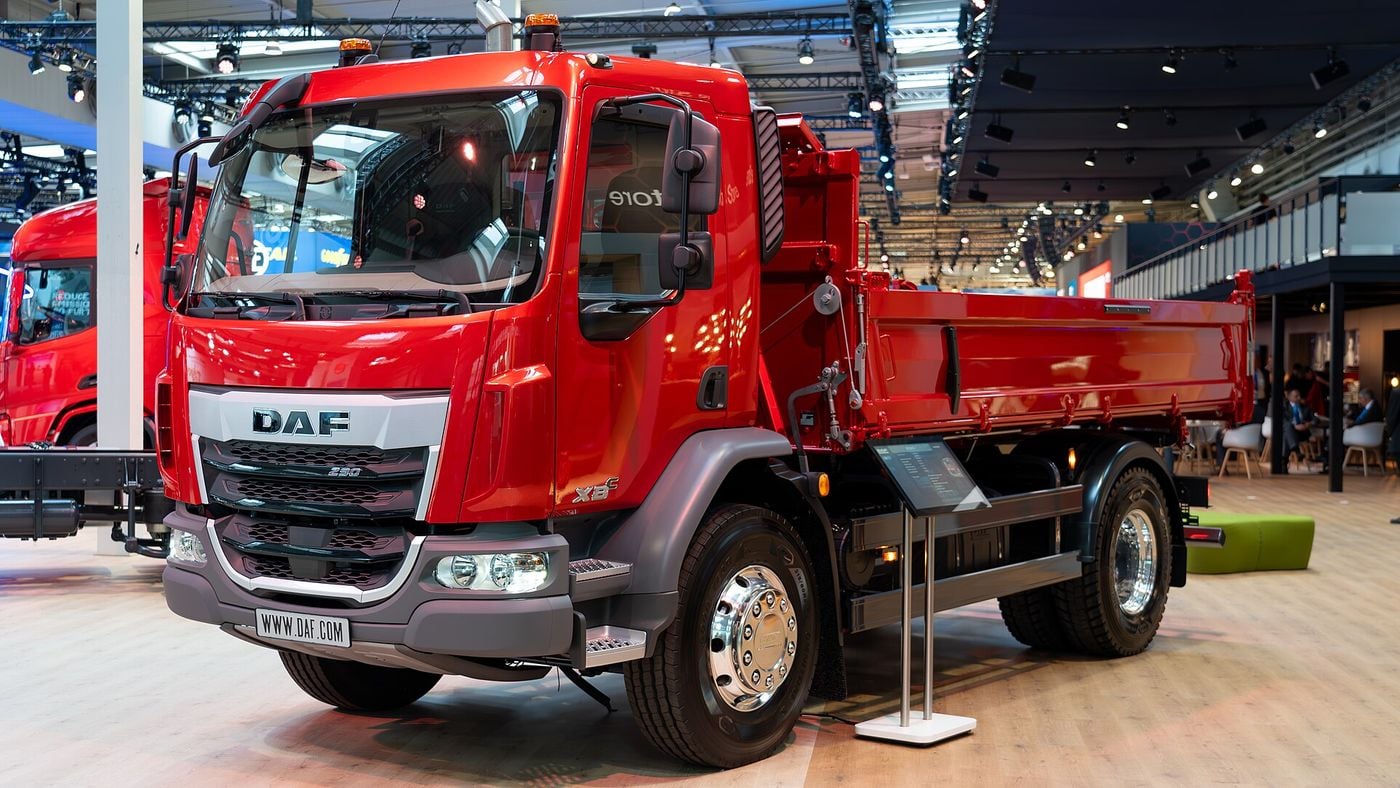
The DAF XB is DAF's New Generation city distribution truck of 7.5 to 19 tonnes, with PACCAR PX-5 and PX-7 engines from 124 to 227 kW, an XBC construction version and the XB Electric.
- 2023—
- 4x2
- 124–227 kW
- Euro 6

Model overview
- Segment
- Distribution
- Produced
- 2023—
- Axle configurations
- 1 (4x2…)
- Emission
- Euro 6
- Transmission
- PowerLine 8-speed fully automatic; 6- or 9-speed manual, or a 5-speed Allison automatic for special applications
- Gross combination
- 19 t (FA 4x2 rigid, 19t (XB 230))
- Gross vehicle
- 18 000 kg
Engine families
- Power
- 124–153 kW
- Torque
- 700–800 Nm
- Power
- 167–227 kW
- Torque
- 900–1200 Nm
The XB is DAF’s city and regional distribution truck: the part of the New Generation range that sits below the XD and the XF, XG and XG+ long-haul models. DAF announced it on 23 August 2023 at Eindhoven as “a full series of distribution vehicles in the 7.5 up to 19 tonnes class”, and said the series would enter production in the fourth quarter of 2023; in DAF’s own words the XB, with the XBC construction truck, “completes” the New Generation DAF product range. DAF’s GB specification sheets list the XB only as a 4x2, as a rigid or a tractor; the weights are GB registration figures.
Cabs
The XB has a short cab built for city work. On the XB 230 FA 4x2 rigid 19t sheet the Day Cab is 2,130 mm wide and comes with a steel bumper and tinted glass as standard, with an Extended Day Cab and a Sleeper Cab listed as options. DAF’s launch press release names Day, Extended Day and Sleeper Cabs, and says the XB shares the soft-woven seat upholstery, the steering wheel and the level of fit and finish with the DAF XD, XF, XG and XG+. The cab interior on the 19t sheet is right-hand drive, with a mechanically adjustable steering column, an air-suspended driver seat, a fixed velour co-driver seat and a storage box on the engine tunnel; left-hand drive and a lower bunk are among the options.
Two engine families
The diesel XB is sold with two PACCAR engines, both developing peak torque at low engine speeds and both HVO-ready — DAF states a CO2 reduction of up to 90 per cent on a “well-to-wheel” basis with HVO.
The PX-5 is a 4.5-litre four-cylinder unit, the smaller of the two, in three steps: 124 kW (170 hp) with 700 Nm at 1,100–1,700 rpm, 139 kW (190 hp) with 750 Nm at 1,200–1,700 rpm, and 153 kW (210 hp) with 800 Nm at 1,300–1,700 rpm.
The PX-7 is a 6.7-litre six-cylinder unit, the larger of the two, in four steps: 167 kW (230 hp) with 900 Nm at 900–1,800 rpm, 189 kW (260 hp) with 1,000 Nm at 1,000–1,700 rpm, 212 kW (290 hp) with 1,100 Nm at 1,100–1,600 rpm, and 227 kW (310 hp) with 1,200 Nm at 1,200–1,500 rpm. DAF gives the family’s range as outputs from 124 kW (170 hp) to 227 kW (310 hp).
The engine badges round the horsepower: the GB sheets print the three PX-5 steps as 124/139/153 kW (169/189/208 hp) and the four PX-7 steps as 167/189/212/227 kW (227/257/287/308 hp). The two documents differ on the base PX-7: the model’s engine table gives the 167 kW (230) rating 900 Nm at 900–1,800 rpm, while the 19t FA 4x2 sheet’s driveline line gives that rating 890 Nm at 1,000–1,700 rpm and 167 kW at 1,900 rpm. DAF states “Euro 6” on its sheets and names no sub-step.
Transmission
The XB’s standard gearbox is the 8-speed PowerLine, which DAF calls a fully automatic transmission, offered with both the PX-5 and the PX-7; DAF describes powershifting without torque interruption and an “urge-to-move” feature on releasing the brake pedal. Six- and nine-speed manual gearboxes are available across the series, and a 5-speed fully automatic Allison gearbox can be ordered for special applications. On the 19t sheet the standard PowerLine has a ratio spread of 4.89 to 0.64 and a 5.13 rear axle ratio, with rear axle ratios from 3.70 to 5.63 and a mechanical differential lock listed as options.
Axles, suspension and brakes
On the 19t FA 4x2 rigid sheet the front axle is type 152N with a 100 mm vertical offset, on parabolic leaf suspension with shock absorbers and a stabiliser, rated at a maximum 7.5 tonnes. The standard driven rear axle is the single-reduction SR1132, also on parabolic leaf suspension, rated at a maximum 11.5 tonnes; rear air suspension on the SR1132, an SR1344 air-suspended axle and a 13.00 t rear axle load are listed as options. The brake system has a standard exhaust brake, and a park-brake control with a test position and a spoken warning is optional. Standard tyres are 315/70R22.5, front and driven rear, made by Goodyear.
Dimensions and weights
DAF publishes a GB specification sheet for each weight class and body entry point. The XB’s rigid classes run from 7.5 to 19 tonnes, with a 4x2 tractor alongside them; the weights below are as each sheet prints them, and DAF footnotes both the gross vehicle mass and the gross combination mass as figures in conformity with registration documents.
| Configuration | GVM | GCM | Max front axle | Max rear axle |
|---|---|---|---|---|
| FA 4x2 rigid, 7.5 t (XB 190) | 7,500 kg | 7,500 kg | 3,600 kg | 5,000 kg |
| FA 4x2 rigid, 10 t | 10,000 kg | 10,000 kg | 4,000 kg | 7,200 kg |
| FA 4x2 rigid, 12 t | 12,000 kg | 12,000 kg | 4,500 kg | 8,500 kg |
| FA 4x2 rigid, 14 t | 14,000 kg | 14,000 kg | 5,000 kg | 9,400 kg |
| FA 4x2 rigid, 16 t | 16,000 kg | 16,000 kg | 6,000 kg | 10,500 kg |
| FA 4x2 rigid, 19 t (XB 230) | 18,000 kg | 19,000 kg | 7,500 kg | 11,500 kg |
| FT 4x2 tractor, 13 t (XB 230) | 13,000 kg | 21,000 kg | 4,500 kg | 9,400 kg |
The 8-tonne Chassis/Body sheet gives the same 7,500 kg GVM against a 7,490 kg GCM, and a separate 16-tonne sheet is drawn up for a road sweeper on the same 16,000 kg figures. On the 19t sheet DAF prints the chassis-weight-related technical GVM as a maximum of 19,000 kg, with 18,000 kg as an option, and calls the driveline-related technical GCM equal to the GVM, while listing optional driveline-related GCM steps of 22,500, 26,000, 28,000 and 32,000 kg, the last designated class 3.
The 19t Day Cab sheet lists wheelbase steps from 3.45 m to 6.90 m, each with its own rear overhang, and DAF’s turning-circle figures on that sheet run from 12.96 m between kerbs and 14.09 m between walls at the shortest wheelbase to 22.43 m and 23.66 m at the longest. The launch press release gives the range’s wheelbases as up to 6.9 m and its chassis lengths as allowing superstructures of over 9 m. The standard side-member height on the 19t sheet is 270 mm, and the launch press release notes a new chassis grid pattern and pre-defined layouts with repositioned fuel tanks, exhaust systems, batteries and air tanks for road sweepers and tippers.
Tanks
On the 19t FA 4x2 rigid sheet the standard fuel tank is a 200-litre plastic tank, with a 30-litre AdBlue tank on the right-hand side of the chassis. The 24-volt electrical system is an 80 A alternator with two 125 Ah batteries; a 100 A alternator and two 175 Ah batteries are listed as options.
Safety and driver-assistance systems
DAF lists an Advanced Emergency Braking System that, in DAF’s wording, can provide up to full autonomous emergency braking against stationary and moving vehicles from a speed of up to 80 km/h, using a radar and a camera. The XB also carries Drive-off Assist, which warns of vulnerable road users in front of the vehicle; an Event Data Recorder, which records images and data when the AEBS warning is activated; DAF Turn Assist, which warns of cyclists and pedestrians in the blind spot; DAF Drowsiness Detection; Speed Limit Recognition; and a Lane Departure Warning System, which the launch press release names Lane Change Assist. On the 19t sheet the standard safety set is speed-limit recognition, DAF drowsiness detection and Drive-off Assist, with a driver airbag and two seat-belt tensioners and EC-ADR packages among the options. Standard communication equipment on that sheet is an FMS connector, a Stoneridge G2V2A digital tachograph and a Driver Performance Assistant. DAF’s brochure gives the XB a 3-Star Direct Vision Standard rating and says all XB models (7.5t, 12t, 16t) are ready for London.
Bodies and the XBC
DAF offers the XB with a range of factory-fitted PACCAR bodies — Box Bodies, Curtain Siders and an Aerobody — which DAF says it builds in-house and assembles on a dedicated line at its Leyland facility. DAF introduced the ex-factory bodies in a press release of 10 July 2025. The brochure gives a 7.3 m box body that takes up to 18 Euro pallets, and states a load length of up to 9 m thanks to the short cab; the product page offers the body range on the 12-tonne chassis.
Alongside the on-road XB, DAF builds the XBC for construction work, which it can configure as a tipper, skip loader or concrete mixer. According to DAF’s launch press release the XBC has a 19-tonne chassis, a ground clearance of 255 mm, an approach angle of 25 degrees, a steel front radiator plate and a lava-grey steel bumper; the brochure adds that it is offered as an 18-tonne or a 19-tonne version and meets N3G (EU off-road) homologation.
XB Electric
The XB Electric is the battery-electric version, which DAF describes as sharing the diesel XB’s driver comfort, drivability, efficiency and safety features. DAF offers it in 12, 16 and 19-tonne versions — the 12-tonne one on 17.5-inch wheels with a single entry step — with wheelbases from 4.2 m. DAF gives the e-motor either 120 or 190 kW of nominal power, with a nominal torque of 950 or 1,850 Nm and a peak of 2,600 or 3,500 Nm; the six-page brochure instead states the nominal torque as 1,000 or 2,000 Nm, with the same 2,600 and 3,500 Nm peaks. The energy is stored in a cobalt- and magnesium-free lithium iron phosphate (LFP) battery of up to two packs, which DAF gives a gross energy content of 141 up to 282 kWh, for a range of up to 350 km. DAF’s Combined Charging System rapid-charges the battery at 650 V DC and 150 kW, taking 40 to 70 minutes from 20 to 80 per cent. The figures elsewhere on this page are the diesel XB’s; the electric drive is described further in electric trucks explained.
Source notes
Engine ratings are DAF’s own XB product-page and launch-press-release table: PX-5 at 124 kW (170 hp) / 700 Nm, 139 kW (190 hp) / 750 Nm and 153 kW (210 hp) / 800 Nm; PX-7 at 167 kW (230 hp) / 900 Nm, 189 kW (260 hp) / 1,000 Nm, 212 kW (290 hp) / 1,100 Nm and 227 kW (310 hp) / 1,200 Nm. The GB sheets print the badges with the measured horsepower — 169/189/208 hp for the PX-5 and 227/257/287/308 hp for the PX-7 — and the 19t sheet’s driveline line gives the 167 kW rating 890 Nm at 1,000–1,700 rpm and 167 kW at 1,900 rpm, against the 900 Nm at 900–1,800 rpm of the engine table. All weights are DAF Trucks Ltd GB sheets of edition 202545A, 10 July 2025, footnoted as holding in conformity with registration documents; each is a property of its build. The rigid classes are 7,500/7,500, 10,000/10,000, 12,000/12,000, 14,000/14,000, 16,000/16,000 and 18,000/19,000 kg GVM/GCM, and the 4x2 tractor is 13,000/21,000 kg; the 19t sheet lists optional driveline-related GCM of 22,500, 26,000, 28,000 and 32,000 kg. The 19t FA 4x2 rigid sheet (016F5803AAAA) gives the detail quoted above: a 2,130 mm cab width, a 152N front axle and an SR1132 rear axle, 315/70R22.5 Goodyear tyres, a 200-litre plastic fuel tank and a 30-litre AdBlue tank, a 3.75 m standard wheelbase with wheelbase steps to 6.90 m, a 270 mm side-member height, and an 80 A alternator with two 125 Ah batteries. The XBC construction figures (255 mm ground clearance, 25-degree approach angle, 18- or 19-tonne chassis, N3G homologation) and the XB Electric figures (120 or 190 kW, 950 or 1,850 Nm nominal with 2,600 or 3,500 Nm peak, 141 to 282 kWh LFP battery, up to 350 km, 650 V DC / 150 kW charging) are from DAF’s press release, product pages and brochure; the brochure’s 1,000/2,000 Nm nominal figures differ from the 950/1,850 Nm of the press release and the Electric page.
Quick answers
- Which engines are available in the DAF XB?
- The record for the DAF XB covers these engine families: PACCAR PX-5 (4.5 l), PACCAR PX-7 (6.7 l). Output spans 124–227 kW and 700–1200 Nm.
- What axle configurations does the DAF XB come in?
- 4x2.
- What emission standard does the DAF XB meet?
- Euro 6.
- When did production of the DAF XB start?
- Production of the DAF XB started in 2023.
- Which transmission does the DAF XB use?
- Transmission: PowerLine 8-speed fully automatic; 6- or 9-speed manual, or a 5-speed Allison automatic for special applications.
- What is the gross combination weight of the DAF XB?
- Gross combination weight: 19 t (FA 4x2 rigid, 19t (XB 230)).
- What is the gross vehicle weight of the DAF XB?
- Gross vehicle weight: 18 000 kg.
DAF models on this site, side by side
| Segment | Produced | Axle configurations | Power | Torque | Gross combination | |
|---|---|---|---|---|---|---|
| DAF XB | Distribution | 2023— | 4x2 | 124–227 kW | 700–1200 Nm | 19 t |
| DAF XD | Distribution | 2022— | 5 configurations | 167–330 kW | 890–2350 Nm | 38 t |
| DAF XF | Long-haul tractor | 2021— | 5 configurations | 270–390 kW | 1950–2700 Nm | 44 t |
| DAF XG | Long-haul tractor | 2021— | 4 configurations | 315–390 kW | 2300–2700 Nm | 44 t |
| DAF XG+ | Long-haul tractor | 2021— | 4 configurations | 315–390 kW | 2300–2700 Nm |
More DAF on this site
Sources
- New Generation DAF XB — DAF Trucks Ltd
- New Generation DAF XB Electric — DAF Trucks Ltd
- New Generation DAF XB — brochure (EN, ref HQ-EN-0826) — DAF Trucks N.V.
- DAF XB specification sheet — XB 230 FA 4X2 Rigid, 19t — DAF Trucks Ltd
- DAF XB specification sheets — index of configurations — DAF Trucks Ltd
- DAF announces New Generation DAF XB city distribution trucks — DAF Trucks N.V.
- DAF Trucks introduces XB with ex-factory bodies — DAF Trucks N.V.