Refuse collection vehicles: rear, side and front loaders, chassis and EN 1501
What EN 1501 covers for rear, side and front loaders, how EU type approval codes a refuse truck, and the chassis, bodies and electric versions makers publish.
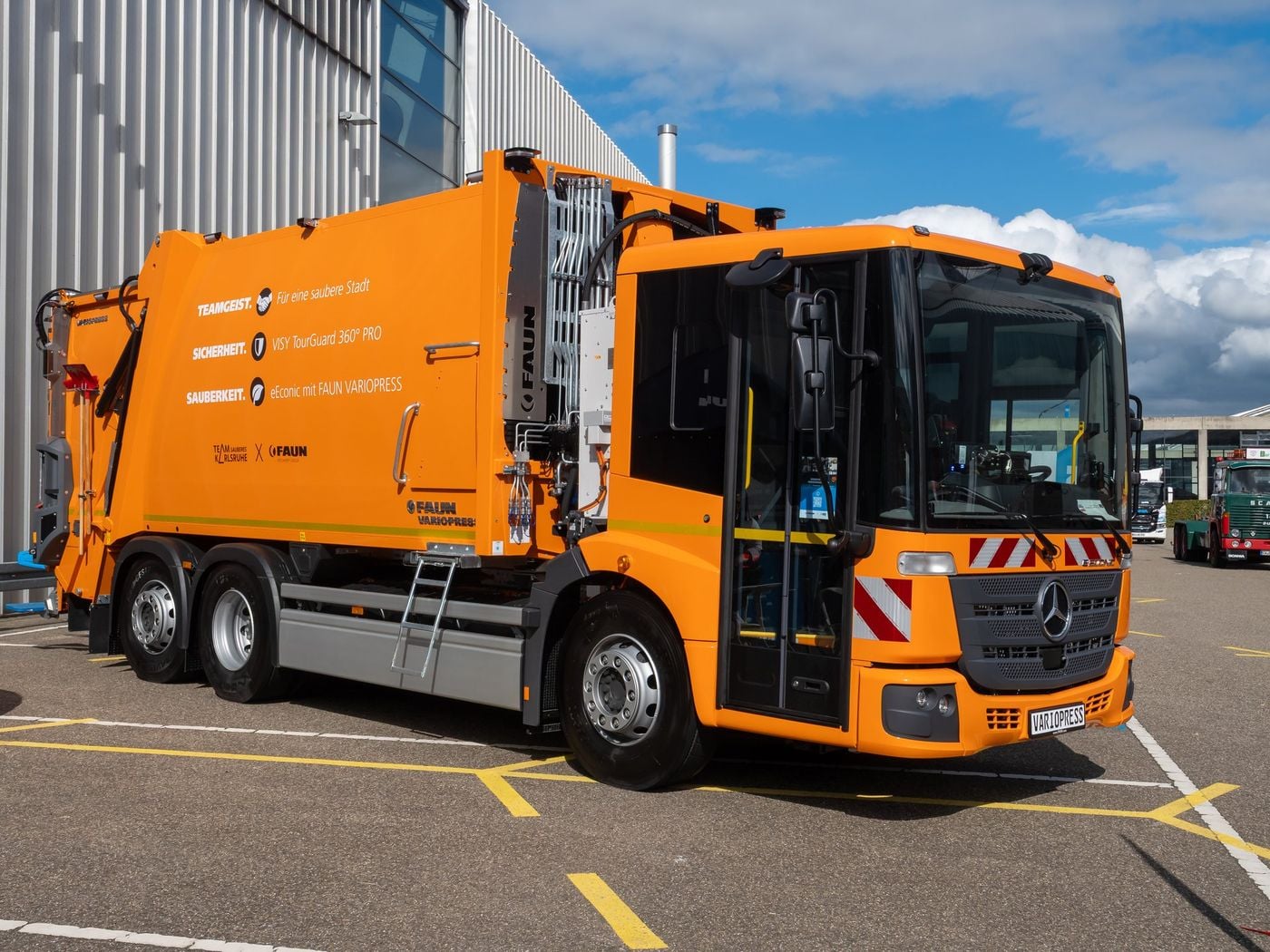
A refuse collection vehicle (RCV) is a truck chassis with a body built to collect and carry waste, and usually a lifting device that tips bins and containers into it. In Europe its safety requirements are set out in the EN 1501 standard series. The chassis comes from the truck makers, several of which offer low-entry cabs, steered rear axles and electric drives for the work, and the body from specialist body builders. This page sets out what the standards cover, how EU type approval names the vehicle, and what makers and body builders publish. It does not rank or recommend any of them.
Rear, side and front loaders
EN 1501 divides refuse collection vehicles by where the waste goes in. Part 1 covers rear loaded RCVs, part 2 side loaded and part 3 front loaded ones, and part 5 covers the lifting devices that empty refuse containers into them. Part 4, cited in part 5 as a 2007 edition, is the noise test code. The containers have a standard series of their own, EN 840 (2020 editions): two-wheeled bins up to 400 l in part 1, four-wheeled containers up to 1,300 l with flat or dome lids in parts 2 and 3, and four-wheeled containers with flat lids up to 1,700 l in part 4. EN 1501-5 covers emptying containers made to EN 840, EN 12574 and EN 13071, and those described as paladin, diamond and skip containers, and no others.
Parts 1, 2, 3 and 5 in force are 2021 editions. Parts 1 to 3 leave out the lifting device and its interface with the body, which belong to part 5, and they refer loader cranes, which some RCVs carry, to EN 12999. Parts 2 and 3 also apply to compactors operated on a truck for collection. Each part excludes severe operating conditions, though not with the same figure: parts 1 and 2 exclude temperatures below -25 °C, parts 3 and 5 below -20 °C, and all four exclude temperatures above +40 °C, wind above 75 km/h and potentially explosive atmospheres.
A revision for the Machinery Regulation
The series is being revised. DIN published drafts of parts 1, 2, 3 and 5 in August 2025, and the CEN-CENELEC Work Programme 2026 says that CEN/TC 183 “will continue the revision of the EN 1501 series […] to incorporate and cover the new and updated Essential Health and Safety Requirements of the Machinery Regulation (EU) 2023/1230”. That Regulation applies from 20 January 2027: the text first published in the Official Journal said 14 January 2027, and a corrigendum published on 4 July 2023 changed the date. The iTeh catalogue gives the draft of part 1 a planned publication date of 2 March 2027; for the other three drafts we found no date.
Type approval: a bodywork code, not a special purpose category
Regulation (EU) 2018/858, as published in 2018, does not list refuse collection vehicles among its special purpose vehicles, the group that includes motor caravans, ambulances and mobile cranes. They appear in its bodywork coding instead: for N-category vehicles such as a lorry or a chassis-cab, the two-letter bodywork code can be supplemented by two digits, and “18 Refuse collection vehicle” is one of them. We did not check later amendments to Annex I of the Regulation for this article. The same list gives concrete mixers and concrete pump vehicles their own digits; see truck mixers and concrete pumps. Fire engines have the digits 31; see fire engines on truck chassis. Tippers have the digits 10; see tipper trucks. The list also has 19 for street sweepers, cleansing and drain clearing; see sewer-cleaning and vacuum trucks and road sweepers and water tankers.
What the chassis has to offer
The makers describe much the same features for refuse work: a low-entry cab with one or two steps, for a crew that climbs in and out all through the round; seats for up to three crew besides the driver; a steered rear or tag axle to tighten the turning circle; in some cases a narrow version; an automatic or automated gearbox; and a power take-off, mechanical or electric, to drive the body’s hydraulics. As an example of the weight classes, Mercedes-Benz gives the Econic 18 t on two axles, 26 t on three and 32 t on four. Axle layouts such as 6x2*4 are explained in axle configurations explained, cab types in truck cabs explained.
Chassis the makers offer for refuse collection
In alphabetical order, as each maker presents it:
- DAF. The XD Electric infosheet lists rigids from 4x2 to 8x4, an installed battery capacity of 210 to 525 kWh, PACCAR EX-D1 and EX-D2 motors from 170 to 350 kW, an ePTO of 25 or 90 kW and DC charging at 150 or 325 kW. In 2025 Amsterdam ordered 40 XD Electric 6x2 FAN for waste collection, for delivery in 2026, with three of a possible five LFP battery packs of 105 kWh each, a 90 kW ePTO and a low entry “with only two ergonomically positioned steps”.
- Dennis Eagle Elite+. Dennis Eagle’s own refuse chassis, designed for its Olympus bodies but able to take other makers’ bodies: 2,500 mm wide, or 2,250 mm in the narrow version, with a walk-through cab and “just one anti-slip step”, a 7.7-litre Volvo Euro 6 engine of 280 or 320 bhp and an Allison six-speed automatic, as a 4x2, a 6x2 (mid-lift, mid-steer or rear-steer), a 6x4 and an 8x4. The electric eCollect comes as a 6x2 rear-steer of 27,000 kg with 300 kWh and as a 4x2 of 18,000 kg with 180 kWh.
- Ford Trucks. Ford’s Turkish page lists refuse trucks on the 1833 DC, 2533 DC, 2633 DC (rear-steerable), 2645T HR, 3233S HR and 3245S HR, from 12–13 m³ bodies at 18 t to 30–31 m³ at 32 t, and a 58 m³ refuse transfer semi-trailer behind the 1845T tractor. It says TS EN 1501 is offered for its 4x2 and 6x2 configurations. The introduction names 4x2, 6x2 and 8x2 configurations, while every model card lists 4x2.
- Iveco Eurocargo. Iveco presents the Eurocargo for municipal work, from waste collection to road cleaning; its municipal versions run from 7.5 to 19 t, 4x2, diesel or CNG, with manual, ZF automatic or Allison automatic gearboxes and day, sleeper or crew cabs.
- MAN. MAN offers a “TipMatic COLLECT” gearshift program, developed for the stop-start cycle of rear and side loaders, and cabs with low step units for municipal work. It pictures its electric eTGS as a waste collector and reports that a fully electric MAN rear loader has been in daily service in Judenburg since the end of 2025, covering up to 120 km a round (180 km at peak) while emptying up to 800 bins, at around 1.6 to 2 kWh per kilometre depending on topography and bin weight. MAN says its electric PTOs and high-voltage interfaces supply bodies with up to 90 kW.
- Mercedes-Benz Econic and eEconic. The Econic is a low-entry truck whose cab takes “only two steps”, with an inward-opening folding door on the side away from the traffic, a raising and lowering function on both axles, an 18, 26 or 32 t gross vehicle weight, a 7.7-litre diesel of 200 to 260 kW and an Allison automatic or PowerShift gearbox. The electric eEconic is a 27 t 6x2 with a trailing axle, 330 kW continuous and 400 kW peak, an installed battery capacity of 336 kWh — the same page also describes three packs of around 105 kWh each — and ZF’s electrically driven eWorX PTO of 33 kW continuous and 58 kW peak.
- Renault Trucks. Renault presents the D, D Wide and Low Entry Cab for urban collection, “notably the 6x2*4 version of Renault Trucks D Wide”, across a range from 3.3 to 32 t, and a natural-gas D Wide with a 239 kW engine. The electric E-Tech D Wide LEC has a cab 200 mm lower than the standard one, 4x2 or 6x2 layouts and a range of up to 335 km; a 26 t 6x2 version shown in 2023 had 375 kWh and a single entry step.
- Scania. Scania recommends its L-, P- and G-series for waste work and shows a “Scania L 320 6x2*4 Refuse Collector”. The L-series has a low-entry cab whose kneeling function lowers the suspension by 100 mm when the parking brake is applied, standard on the one-step version.
- Volvo. Volvo offers the FE with an optional low-entry cab (diesel up to 350 hp, CNG 320 hp, electric up to 225 kW), the FM in diesel, gas and electric versions, and the electric FM Low Entry with 360 kWh, 330 kW, up to 32 t and three PTOs (electrical, mechanical and transmission). Its electric line-up for refuse collection also includes the FL Electric.
Bodies and bin lifts
Body builders publish volumes, widths and lifting forces, and some of them name the electric chassis their bodies are built for:
- Dennis Eagle Olympus (rear loader): 10 to 27 m³, body widths of 2,230 or 2,530 mm, for gross vehicle weights of 18 to 32 t.
- FAUN VARIOPRESS (rear loader): 7 to 30 m³ for chassis 2.00 to 2.55 m wide, bins from 60 l to 1.1 m³ and, with special lifters, bulk containers up to 7 m³; FAUN calls its drive concept ideally suited for all electric chassis. The ROTOPRESS, with a rotating drum, has 8 to 25 m³.
- Terberg Environmental SpeedLINE (side loaders): the SLF 3 has a body of up to 32 m³, a lifting capacity of up to 1,000 kg and takes containers of 60 to 2,300 l; the SLF 4 has up to 28 m³ and up to 1,500 kg and takes containers of up to 3,200 l.
- Zoeller X Family (rear loaders): the MEDIUM X4 has 18 to 25 m³ as standard and up to 30 m³ in the higher X4H version, the MEDIUM X2 19 to 26 m³ and up to 31 m³ as the X2H. Zoeller’s DELTA PREMIUM 2325/2525 lifter is rated at 2 × 1,500 N for bins of 80 to 340 l and 7,000 N for containers of 500 to 1,300 l. Its Electric Power Move drives the body and lifter from a 40 kW electric motor built into the front of the body; Zoeller lists it as compatible with the Mercedes-Benz eActros and eEconic, MAN eTGS, Volvo FM Low Entry Electric and DAF Electric.
Electric refuse trucks
| Battery | Drive power | Body drive | Range as stated | |
|---|---|---|---|---|
| DAF XD Electric | 210–525 kWh installed | 170–350 kW | ePTO, 25 or 90 kW | — |
| Dennis Eagle eCollect 4x2 | 180 kWh | — | electrically driven hydraulic pump | — |
| Dennis Eagle eCollect 6x2 | 300 kWh | — | electrically driven hydraulic pump | — |
| Mercedes-Benz eEconic | 336 kWh installed | 330 kW continuous, 400 kW peak | ZF eWorX, 33 kW continuous | up to 100 km inner-city, 150 km mixed collection (simulation) |
| Renault Trucks E-Tech D Wide LEC | 375 kWh (26 t 6x2 shown in 2023) | 260 kW continuous, 370 kW peak | — | up to 335 km |
| Volvo FL Electric | 280–565 kWh | 130 kW continuous | electro-mechanical PTO | up to 450 km |
| Volvo FE Electric | 280–375 kWh | 225 kW continuous | electro-mechanical PTO | up to 275 km |
| Volvo FM Low Entry | 360 kWh | 330 kW continuous | electrical, mechanical and transmission PTOs | up to 200 km |
On the electric chassis the body is driven either by a separate electric motor — an electric or electro-mechanical PTO, or an electrically driven pump — or, on some Volvo models, by a gearbox-mounted PTO as on a diesel truck. Battery figures are not always given on the same basis: DAF lists 462 kWh available for its 525 kWh installed option, and why the two differ is explained in installed vs usable battery capacity. The range figures are not comparable either. Mercedes-Benz derives the eEconic’s 100 and 150 km from an internal simulation on VECTO municipal and mixed cycles, MAN’s 120 km per round comes from daily operation in Judenburg, and the other makers do not say on the pages we read which cycle their figures assume; see how electric truck range is declared.
Some makers also cite the London Direct Vision Standard: Dennis Eagle says the standard rates the Elite+ higher than any other vehicle, Mercedes-Benz says Transport for London has awarded the Econic five stars, and DAF and Volvo say their trucks can be specified for a five-star rating.
Quick answers
- What is the European standard for refuse collection vehicles?
- EN 1501. Part 1 covers rear loaders, part 2 side loaders, part 3 front loaders and part 5 the lifting devices that empty containers into them; those four parts are 2021 editions. CEN/TC 183 is revising them for the EU Machinery Regulation (EU) 2023/1230, which applies from 20 January 2027.
- What is the difference between a rear, side and front loader?
- Where the waste goes into the body: through the tailgate at the rear, from the side, or from the front. EN 1501 has a part for each, and the lifting device that tips the containers has a part of its own, EN 1501-5.
- Is a refuse truck a special purpose vehicle in EU type approval?
- Not in Regulation (EU) 2018/858 as published in 2018. Its list of special purpose vehicles does not name refuse collection vehicles; they appear as the two-digit bodywork supplement "18 Refuse collection vehicle", added to the bodywork code of an N-category vehicle such as a lorry or a chassis-cab.
- How big is the body of a refuse truck?
- The rear-loader bodies on this page run from 7 m³ (the smallest FAUN VARIOPRESS) to 31 m³ (the Zoeller MEDIUM X2H); the Dennis Eagle Olympus is 10–27 m³. Ford Trucks lists refuse trucks with 12–13 m³ bodies at 18 t and 30–31 m³ bodies at 32 t.
- Which chassis are used for refuse trucks?
- The makers on this page offer the DAF XD Electric, Dennis Eagle Elite+, Ford Trucks 1833 to 3245S, Iveco Eurocargo, MAN eTGS, Mercedes-Benz Econic and eEconic, Renault Trucks D, D Wide and Low Entry Cab, Scania L-series and Volvo FE, FM and FM Low Entry, in diesel, gas or electric versions, several with low-entry cabs.
Models in this article
Sources
- SS-EN 1501-1:2021 Refuse collection vehicles — General requirements and safety requirements — Part 1: Rear loaded refuse collection vehicles — catalogue entry — Swedish Institute for Standards (SIS)
- SS-EN 1501-2:2021 Refuse collection vehicles — Part 2: Side loaded refuse collection vehicles — catalogue entry — Swedish Institute for Standards (SIS)
- SS-EN 1501-3:2021 Refuse collection vehicles — Part 3: Front loaded refuse collection vehicles — catalogue entry — Swedish Institute for Standards (SIS)
- SS-EN 1501-5:2021 Refuse collection vehicles — Part 5: Lifting devices for refuse collection vehicles — catalogue entry — Swedish Institute for Standards (SIS)
- SS-EN 840-1:2020 Mobile waste and recycling containers — Part 1: Containers with 2 wheels with a capacity up to 400 l — catalogue entry — Swedish Institute for Standards (SIS)
- SS-EN 840-2:2020 Mobile waste and recycling containers — Part 2: Containers with 4 wheels with a capacity up to 1 300 l with flat lid(s) — catalogue entry — Swedish Institute for Standards (SIS)
- SS-EN 840-3:2020 Mobile waste and recycling containers — Part 3: Containers with 4 wheels with a capacity up to 1 300 l with dome lid(s) — catalogue entry — Swedish Institute for Standards (SIS)
- SS-EN 840-4:2020 Mobile waste and recycling containers — Part 4: Containers with 4 wheels with a capacity up to 1 700 l with flat lid(s) — catalogue entry — Swedish Institute for Standards (SIS)
- Draft standards of the Standards Committee Municipal Technology (NKT): DIN EN 1501-1, -2, -3 and -5, edition 2025-08 — DIN
- prEN 1501-1 Refuse collection vehicles — Part 1: Rear loaded refuse collection vehicles — catalogue entry of the draft — iTeh Standards
- Work Programme 2026 — Sustainability: waste management — CEN and CENELEC
- Regulation (EU) 2023/1230 on machinery (OJ L 165, 29.6.2023) — Publications Office of the European Union
- Corrigendum to Regulation (EU) 2023/1230 on machinery (OJ L 169, 4.7.2023) — Publications Office of the European Union
- Regulation (EU) 2018/858 on the approval and market surveillance of motor vehicles and their trailers (OJ L 151, 14.6.2018) — Annex I — Publications Office of the European Union
- City of Amsterdam orders 40 fully electric DAFs (19 August 2025) — DAF Trucks
- DAF XD Electric — configuration and options (infosheet) — DAF Trucks
- Elite+ chassis — Dennis Eagle
- eCollect — Dennis Eagle
- Olympus body — Dennis Eagle
- Çöp kamyonu — kamu ve üstyapı çözümleri — Ford Trucks Türkiye
- IVECO Eurocargo 4x2 — IVECO UK
- Waste collection goes electric (18 May 2026) — MAN Truck & Bus
- MAN municipal vehicles — MAN Truck & Bus
- Econic — waste disposal — Mercedes-Benz Special Trucks
- eEconic — waste disposal — Mercedes-Benz Special Trucks
- Econic — technical data — Mercedes-Benz Trucks
- Refuse and waste collection trucks — Renault Trucks UK
- Renault Trucks E-Tech D Wide LEC — Renault Trucks UK
- Renault Trucks premieres its first eRCV low entry cab with bus door at RWM Expo 2023 — Renault Trucks UK
- Waste handling — Scania
- L-series low entry truck — Scania
- Waste and recycling trucks — Volvo Trucks
- A complete range of electric trucks for garbage collection and waste management (1 October 2025) — Volvo Trucks
- Volvo FM Low Entry — Volvo Trucks
- VARIOPRESS — brochure (02/25) — FAUN Umwelttechnik
- ROTOPRESS — brochure — FAUN Umwelttechnik
- Our X Family — Zöller-Kipper
- Products — Electric Power Move — Zöller-Kipper
- ZOELLER-DELTA System 2325/2525 — data sheet (09/2025) — Zöller-Kipper
- Side loaders — Terberg Environmental