Sewer-cleaning and vacuum trucks: combination units, ADR vacuum tanks, chassis and body builders
What vacuum tankers and combination sewer cleaners are, why no EN standard covers them, the ADR rules for vacuum-operated waste tanks, the chassis, the body builders and electric units.
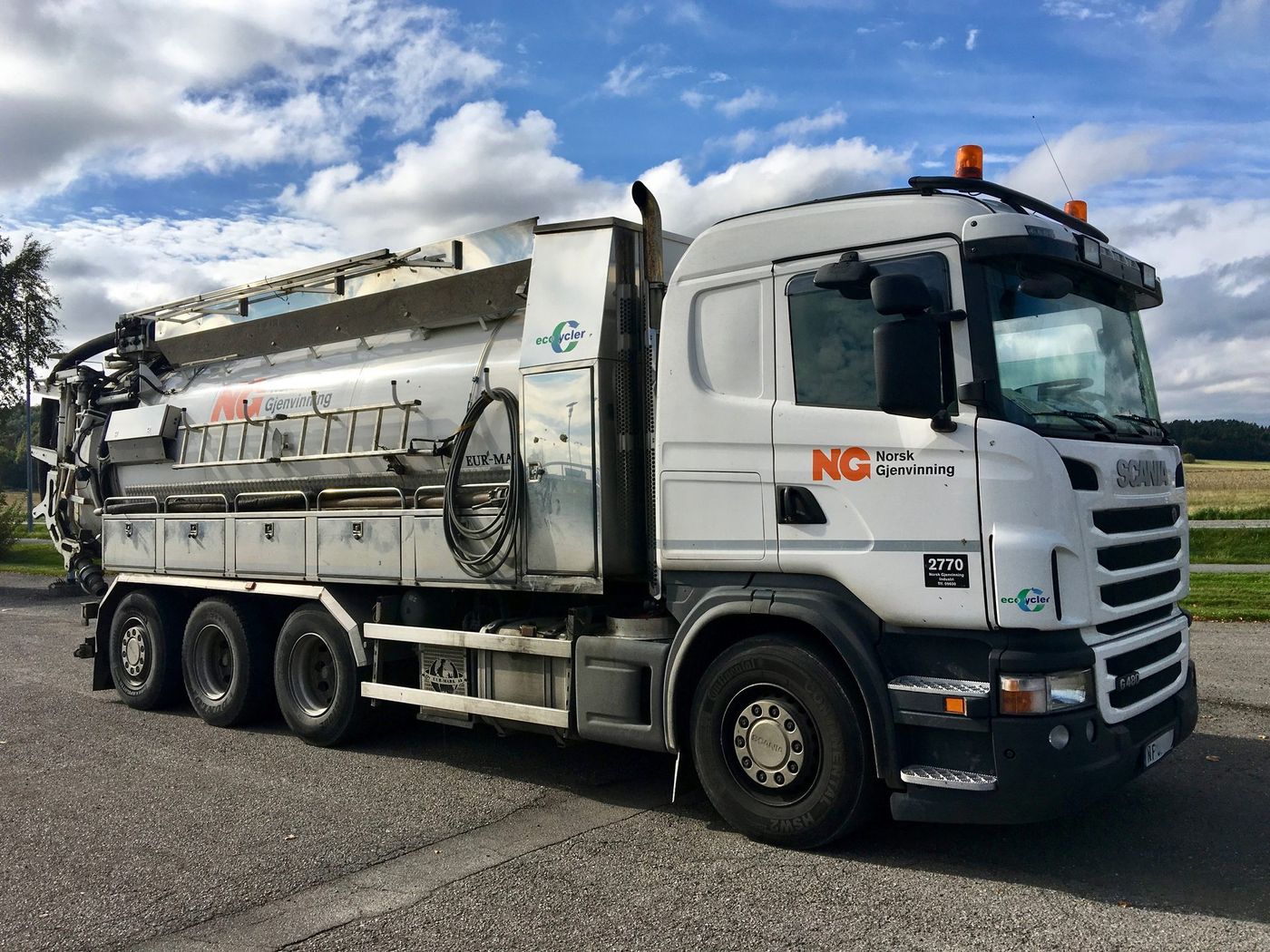
A vacuum tanker sucks liquid waste and sludge into a tank with a vacuum pump. A combination sewer cleaner adds a high-pressure water pump and a hose reel to jet sewers clean, and a recycling unit filters the sewage water on board and reuses it for jetting. The chassis comes from a truck maker; the tank, pumps and booms come from a body builder, which drives the pumps from the truck’s power take-off (PTO) or a transfer gearbox, or sometimes from a separate engine. This page sets out which standards and dangerous-goods rules apply, what truck makers and body builders publish, and which electric units are running. It does not rank or recommend any of them.
Standards: none for the vehicle
We found no European standard for sewer-cleaning, combination or vacuum trucks in the catalogues of the Swedish, British and German standards bodies or in searches. Germany had one: DIN SPEC 30755:2017, a pre-standard setting requirements for suction and high-pressure flushing vehicles, has been withdrawn, as have the older DIN 30702-5 terms for such vehicles.
The jetting equipment has its own standards. EN 1829-1:2021 sets safety requirements for mobile and fixed high-pressure water jet machines whose maximum working pressure is above the upper limit of EN 60335-2-79, currently 35 MPa, and EN 1829-2:2008 covers their hoses, hose lines and connectors; neither scope text we read mentions sewers or vehicles. EN 14654-3:2021 covers the cleaning of drains and sewers as an activity — work programmes and the choice of technique — not the vehicle.
Dangerous waste: ADR vacuum-operated waste tanks
When the waste is dangerous goods, ADR applies. It defines a vacuum-operated waste tank as a fixed or demountable tank, tank-container or tank swap body used mainly for dangerous waste and built and equipped for filling and discharging as chapter 6.10 requires; a tank that fully meets chapter 6.7 or 6.8 is not one. Under chapter 4.5, wastes of classes 3, 4.1, 5.1, 6.1, 6.2, 8 and 9 may be carried in such tanks where chapter 4.3 permits carriage in tanks, and wastes of substances assigned tank code L4BH, or a code permitted by the hierarchy of tank codes, may go in vacuum-operated waste tanks with “A” or “B” in the third part of their tank code, as entered in the approval certificate.
Chapter 6.10 asks for a calculation pressure of 1.3 times the filling or discharge pressure but at least 4 bar, a design for a negative internal pressure of 1 bar, a safety valve preceded by a bursting disc, a pressure or vacuum gauge, a level indicator for each compartment, a flame arrester on vacuum-pump openings when flammable wastes are carried, and an internal inspection at least every three years for fixed or demountable tanks and every two and a half years for tank-containers and tank swap bodies. The approval certificate of the vehicle must name it a vacuum-operated waste tank-vehicle. We read these provisions in the official Turkish edition of ADR 2025 because the UNECE files could not be downloaded; the wording here is our translation.
Body builders state their side. KOKS designs its EcoVac combination units for tank codes S4AH and L4AH, and DISAB gives the same codes for its ADR vacuum loaders; Kaiser, Rivard and KROLL offer ADR versions. None of the Turkish builders whose pages we read states an ADR approval. Vehicle classes, plates and tunnel codes are explained in ADR explained.
Type approval
In EU type approval, Regulation (EU) 2018/858, as published in 2018, has no special purpose category for these vehicles. Its list of two-digit bodywork supplements includes “11 Tank”, “12 Tank intended for transport of dangerous goods” and “19 Street sweeper, cleansing and drain clearing”; which of them a given sewer truck carries is settled in its type approval. The same list has tippers under 10 and refuse collection vehicles under 18; see tipper trucks and refuse collection vehicles. Street sweepers also come under 19; see road sweepers and water tankers.
Chassis the makers offer
In alphabetical order, as each maker presents it; for BMC we found no page, and the Turkish builder Teknik Tanker lists a BMC Pro 935 among its chassis:
- DAF. DAF names sewer cleaning among the applications of its four-axle XD and XF with single drive, next to heavy container transport and heavy waste collection, and offers engine PTOs, a front-of-engine PTO and a range of gearbox PTOs.
- Ford Trucks. Ford’s Turkish pages offer vacuum tankers and combination sewer cleaners as 4x2, 6x2, 8x2, 6x4 and 8x4 with tanks of 8,000 to 18,000 l. The vacuum tanker cards run from 8,000 l on the 18-tonne 1833 DC 4x2 to 18,000 l on 8x2 and 8x4 chassis, and the combination cards from 8,000 to 16,000 l.
- Iveco. Iveco names gully cleaning among the specialised missions for the 50 kW electric PTO of its eDaily; we found no Iveco page dedicated to sewer trucks.
- MAN. MAN lists sewer cleaning among the tasks of its municipal vehicles, which it equips ex works with PTO, body and interface provisions; Wiedemann offers MAN TGS 6x2-4 chassis with an OMSI PTO for its bodies.
- Mercedes-Benz. Mercedes-Benz names rinsing channels among municipal tasks but has no page for sewer trucks; Wiedemann builds its POWER VAC e-tec gully emptier on the eEconic, and Müller Umwelttechnik a CANALMASTER on an Actros 2543 L 6x2.
- Renault Trucks. Renault Trucks France presents the C range for sewer-cleaning and suction-excavator bodies with up to 22.8 t of payload and a C 8x4 tare of 9,200 kg that it calls the lightest on the market, the DTI 11 engine of up to 460 hp with engine or gearbox PTOs, and rear overhangs configurable in 50 mm steps.
- Scania. Scania’s body builder booklet for vacuum sewer trucks shows a G 410 B6x2*4NB with engine and gearbox PTO preparations, rear overhangs in 10 mm steps and a 50 mm row of frame holes. Scania France has signed a contract to convert sewer-cleaning trucks of the Ortec group, which runs 700 high-pressure units of all makes, to electric drive.
- Volvo. Volvo UK announced in July 2024 four FMX Electric 6x2 vacuum tankers with six batteries and 540 kWh, using a gearbox-driven PTO, and three FE Electric 4x2 combination units for gully, sewer and drain work with three batteries, 270 kWh and an electric PTO, all bodied by Whale Tankers.
Wheel formulae such as 6x2*4 are explained in axle configurations.
Bodies and body builders
| Builder and model | Tank | Vacuum pump | Jetting pump | Chassis stated |
|---|---|---|---|---|
| Kaiser AquaStar (recycler) | 13,300 l (26 t) to 17,500 l (40 t) | liquid ring, 1,600–4,000 m³/h | 320–500 l/min, max. 200 bar | depends on the chassis |
| Wiedemann SUPER 1000 (demonstrator, one-tank recycler) | 9 m³ sludge, 4 m³ water, 1 m³ fresh water | liquid ring, 4,000 m³/h at 400 mbar | 413 l/min, 175 bar | DAF XF 530 FAN 6x2 |
| KOKS EcoVac Low Pressure Combi | 12 m³ plus 1.5 m³ clean water | liquid ring, 3,100 m³/h | 350 l/min, 175 bar | 3 axles, max. 450 hp, 28 t |
| KOKS EcoVac High Pressure Combi | 12 m³ plus 1.5 m³ clean water | 3,100 m³/h | 110 l/min, 1,000 bar | 3 axles, max. 400 hp |
| Rivard EUROPA | 11,700 l steel tank with a movable partition | lobe pumps, 2,500 or 3,980 m³/h at free flow | 211–240 l/min at 190 bar, or 232 l/min at 250 bar | 26 t or 32 t |
| KROLL / Hellmers combination units | — | up to 4,000 m³/h | up to 600 l/min, up to 400 bar | 2, 3 or 4 axles |
| KARBA KRB-KOM32-96 | 15,000 l (6,000 clean, 9,000 waste) | 2,400–9,500 m³/h | 350–480 l/min at 170–230 bar | vehicle of at least 32,000 kg |
| Nurmak combination unit | 13,000 l (7,000 waste, 6,000 clean) | 4,100 m³/h | 413 l/min, 170 bar | Scania G450 6x4 |
Kaiser’s ROTOMAX recycling system cleans the water with an oscillating rotary filter drum, and Wiedemann dates its first sewer cleaner with water recycling to 1977. Rivard says it uses the truck’s energy for all body components, while KROLL drives its pumps from the chassis PTO or a separate engine.
Electric sewer trucks
| Vehicle | Chassis | Battery | Body drive | Tank or pumps |
|---|---|---|---|---|
| Kaiser AquaStar EV (recycler) | Designwerk DW E-Truck 26E 6x2, 26 t | 508 kWh installed, 432 kWh usable | two electric drives of 104 kW continuous each | 9,200 l sludge, 2,700 l fresh water |
| Wiedemann SUPER 1000 e-tec (one-tank recycler) | MAN TGS | up to 560 kWh | — | — |
| Wiedemann POWER VAC e-tec (gully emptier) | Mercedes-Benz eEconic | 336 kWh | electric PTO, 33 kW continuous, 58 kW peak | 7 m³ sludge, 2.5 m³ water |
| Whale Tankers vacuum tanker | Volvo FMX Electric 6x2 | 540 kWh | gearbox-driven PTO | — |
| Whale Tankers combination unit | Volvo FE Electric 4x2 | 270 kWh | electric PTO | — |
| Bucher CityFlex CM40e | Volvo FL Electric 4x2 | 265 kWh | — | 3.8–4 m³; 127 l/min at 160 bar |
| DISAB e-Futurion Q10 (vacuum loader) | Volvo 6x2 | 540 kWh, 400 kWh usable | 490 kW motor | 8,500 m³/h vacuum pump |
| Rivard sewer cleaner | Renault Trucks E-Tech D Wide, 19 t | 4 × 94 kWh | — | — |
| Iveco eDaily for gully cleaning and other missions | eDaily 72C, 7.2 t | 148 kWh | electric PTO, 50 kW | — |
Kaiser calls its AquaStar EV the world’s first electric sewer cleaning vehicle with water recycling, Wiedemann calls the SUPER 1000 e-tec the first fully electric sewer cleaner with water recycling built as a one-tank system, and Renault Trucks and Rivard call theirs the first fully electric unit in France; we report these claims as the makers state them. Gross and usable battery capacity are explained in installed vs usable battery capacity.
Quick answers
- What is the difference between a vacuum tanker and a combination sewer cleaner?
- A vacuum tanker sucks liquid waste and sludge into its tank with a vacuum pump. A combination unit adds a high-pressure water pump and a hose reel for jetting sewers, with separate or movable compartments for sludge and clean water; a recycling unit filters the sewage water on board and reuses it for jetting, as Kaiser's AquaStar and Wiedemann's SUPER 1000 do.
- Is there a European standard for sewer-cleaning trucks?
- We found none for the vehicle. Germany's DIN SPEC 30755:2017 on suction and high-pressure flushing vehicles has been withdrawn. EN 1829-1:2021 covers high-pressure water jet machines and EN 14654-3:2021 the cleaning of drains and sewers as an activity, but neither is a vehicle standard.
- Which ADR rules apply to a vacuum tanker for dangerous waste?
- ADR chapter 4.5 sets which wastes may be carried in vacuum-operated waste tanks — classes 3, 4.1, 5.1, 6.1, 6.2, 8 and 9 where tank carriage is permitted — and chapter 6.10 how the tanks are built: a calculation pressure of at least 4 bar, a design for 1 bar of vacuum, a safety valve behind a bursting disc, and an internal inspection at least every three years, or every two and a half years for tank-containers and tank swap bodies.
- How large is the tank of a sewer truck?
- Ford Trucks lists 8,000 l on its 18-tonne 4x2 and 18,000 l on its 8x2 and 8x4 chassis; Kaiser gives its AquaStar 13,300 l on 26 t up to 17,500 l on 40 t; KOKS's EcoVac combination units have 12 m³ plus 1.5 m³ of clean water.
- Are there electric sewer-cleaning trucks?
- Yes. Kaiser's AquaStar EV has 508 kWh installed on a Designwerk 6x2; Wiedemann offers the SUPER 1000 e-tec on the MAN TGS with up to 560 kWh and the POWER VAC e-tec on the Mercedes-Benz eEconic with 336 kWh; Volvo UK has FMX Electric vacuum tankers with 540 kWh; and Bucher builds the CityFlex CM40e on the Volvo FL Electric with 265 kWh.
Models in this article
Sources
- SS-EN 1829-1:2021 High-pressure water jet machines — Safety requirements — Part 1: Machines — catalogue entry — Swedish Institute for Standards (SIS)
- BS EN 1829-1:2021 — catalogue entry — BSI Knowledge
- SS-EN 1829-2:2008 High-pressure water jet machines — Part 2: Hoses, hose lines and connectors — catalogue entry — Swedish Institute for Standards (SIS)
- DIN SPEC 30755:2017-06 Saugfahrzeuge und Hochdruck-Spülfahrzeuge — Anforderungen (withdrawn) — DIN Media
- SS-EN 14654-3:2021 Drain and sewer systems outside buildings — Part 3: Drain and sewer cleaning — catalogue entry — Swedish Institute for Standards (SIS)
- ADR 2025 Cilt I — Tehlikeli Malların Karayoluyla Uluslararası Taşımacılığına İlişkin Avrupa Anlaşması (official Turkish edition) — Republic of Türkiye, Ministry of Transport and Infrastructure (UHDGM)
- ADR 2025 Cilt II (official Turkish edition) — Republic of Türkiye, Ministry of Transport and Infrastructure (UHDGM)
- Regulation (EU) 2018/858 on the approval and market surveillance of motor vehicles and their trailers (OJ L 151, 14.6.2018) — Annex I — Publications Office of the European Union
- DAF launches full series of New Generation vocational trucks (5 April 2023) — DAF Trucks
- Vidanjör üstyapı çözümleri — Ford Trucks Türkiye
- Kombine kanal temizleyici üstyapı çözümleri — Ford Trucks Türkiye
- IVECO supports customers on the road of electro-mobility with its IVECO S-eWay and eDaily ranges (2023) — IVECO
- Municipal vehicles — MAN Truck & Bus
- Municipal vehicles — Mercedes-Benz Trucks
- Des camions adaptés aux travaux d'assainissement — Renault Trucks France
- La première hydrocureuse 100 % électrique est une Renault Trucks (16 February 2024) — Renault Trucks France
- Vacuum Sewer — bodybuilding made easier (booklet, 2019) — Scania
- Scania remotorise en électrique les hydrocureurs du Groupe Ortec (2024) — Scania France
- Electric vacuum tankers and MVCs enter the market with Dawsongroup emc (4 July 2024) — Volvo Trucks UK
- AquaStar — KAISER
- AquaStar EV (product page and brochure) — KAISER
- SUPER 1000 e-tec — WIEDEMANN enviro tec
- POWER VAC e-tec — WIEDEMANN enviro tec
- Trucks to go (stock and demonstration vehicles) — WIEDEMANN enviro tec
- KOKS EcoVac Low Pressure Combi — KOKS
- KOKS EcoVac High Pressure Combi — KOKS
- EUROPA — Rivard
- Saug-Spülfahrzeuge — KROLL Fahrzeugbau
- e-Futurion Q10 — DISAB
- CityFlex CM40e — Bucher Municipal
- Standart tip kombineler — KARBA
- Kombine kanal açma aracı — Nurmak
- Vidanjör (models and chassis table) — Teknik Tanker