Volvo
Volvo FMX
Two diesel families across eight power steps, ten axle configurations and rear axles approved to 150 tonnes — what the FMX is and how to specify one.
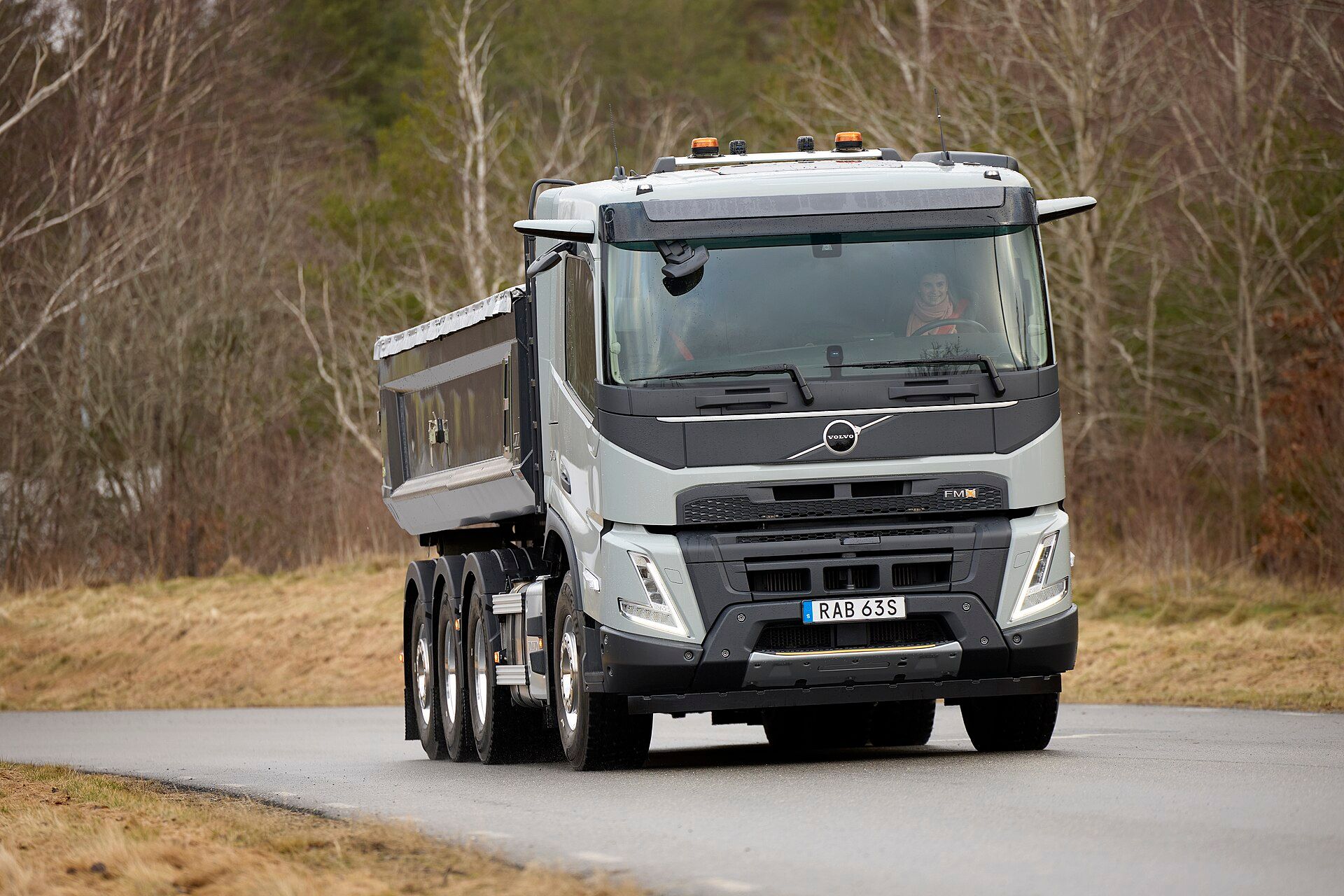
.jpg)
Model overview
Axle configurations: 4x2 · 4x4 · 6x2 · 6x4 · 6x6 · 8x2 · 8x4 · 8x6 · 10x4 · 10x6
Engine families
- Power
- 246–338 kW
- Torque
- 1600–2200 Nm
- Power
- 309–397 kW
- Torque
- 2100–2600 Nm
Both weights above belong to one named vehicle: the FMX13 6x4 tractor on rear air suspension, plated in Great Britain at 26,000 kg gross vehicle and 44,000 kg gross combination. The FMX13 8x4 rigid on the same suspension is plated at 32,000 kg gross vehicle against a design figure of 37,000 kg, and its two front axles at 16,000 kg plated and design alike, with the 20-tonne front pair an ordering option on that sheet. Approved combination weight follows the axle and the gearbox rather than the model name: the rear axle table runs from 44 t on the RSS1344C/E to 150 t on the 38-tonne RTH3815 bogie — the launch release, the model overview and the rear-axle-ratio table all call it a bogie, and only the "Axle" cell of the rear axle table says Solo — and the ATO2612 I-Shift is approved to 100 t. Volvo quotes 300 mm ground clearance for the construction rear air suspension. Engine braking, both engines quoted at 2,300 r/min: exhaust brake effect 155 kW on the D11 and 175 kW on the D13, engine brake effect 270 kW and 340 kW. The specification table marks the engine brake row an option and states no fitment for the exhaust brake; all three GB data sheets mark the exhaust brake, code EBR-EPG, optional equipment. Crawler ratios come from those sheets: ASO-C 19:1 direct-top and 17:1 overdrive, ASO-ULC 32:1 in either box.
Every other model page on this site is a long-haul tractor. The FMX is not one. It is Volvo’s construction truck, launched in its current form in February 2020 on an entirely new cab platform, and almost everything that separates it from the FM it is built alongside is aimed at ground nobody has prepared: chassis height, front axle capacity, a driven front axle, and a rear axle range that runs far past anything a motorway vehicle needs.
Volvo lists it for building and construction, mining and quarry, forest and timber, fire and rescue, and public services and utilities. That list is the specification brief, and it explains why the interesting numbers on this page are not the engine ones.
Two diesel families, eight power steps
The FMX is sold with two diesel engines, and Volvo publishes both a kilowatt and a newton-metre figure for every single step of each — which, among the manufacturers this site has checked, is unusual enough to be worth saying out loud.
The D11 is the 10.8-litre. Four steps, 246–338 kW, 1,600–2,200 Nm. It is the lighter and cheaper engine. Volvo’s global overview recommends “the 380 hp engine” for assignments with many stops and starts, crediting the saving to its lower 1,800 Nm torque level — and the only 380 hp step in the power/torque table, the only one at 1,800 Nm, is a D11, though the overview sentence sits under a heading about the 13-litre. That is one more reason to read the table rather than the prose around it. The advice itself describes a tipper shuttling between a quarry and a site exactly: the engine spends its life accelerating a full load from rest, not holding one gear across a motorway stage.
The D13 is the 12.8-litre. Four more steps, 309–397 kW, 2,100–2,600 Nm. You take it when combination weight or sustained gradient makes torque the binding constraint — heavy tippers, low-loader tractors, anything working at the top of the axle ratings discussed below.
Both are six-cylinder, both are Euro VI — Volvo’s table writes it “Euro 6” — and Volvo footnotes both output columns “Net output according to: EC 582/2011”, the net measurement basis explained in how truck power figures are measured.
Both are also published with two grades of engine braking, and the D13 is the stronger at each: an exhaust brake effect of 175 kW against the D11’s 155 kW, and an engine brake effect of 340 kW against 270 kW, all four quoted at 2,300 r/min. Neither is a given. Volvo’s table asterisks the engine brake row “option” and says nothing at all about how the exhaust brake is fitted; the three Great Britain data sheets settle that half, listing the exhaust brake as code EBR-EPG under optional equipment. On a loaded descent out of a quarry the gap between the two engines is worth more than a power step, and which brake was actually ordered matters as much as which engine — the same conversation as retarders and engine braking.
The rear axle is the specification
On a long-haul tractor the engine is the headline and the axle is a footnote. On the FMX it is the other way round, because the rear axle is what decides how much the truck may be rated to pull.
Volvo publishes the whole rear axle table: single-reduction types with an RSS or RTS code and hub-reduction types with RSH or RTH, each with a maximum axle or bogie load and its own approved combination weight. The spread is the point. The RSS1344C/E carries a 44 t approval; the RTH3815, the 38-tonne bogie Volvo introduced with this generation, carries 150 t. The 2020 launch release put the same figure in plain words: the heaviest addition to the chassis range was a 38-tonne bogie allowing a gross combination weight of up to 150 tonnes. What a single reduction and a hub reduction actually do to the ratio is set out in axle ratios and final drive, and the FMX axles are among the examples used there.
Two warnings come with that 150. First, the gearbox has its own ceiling and it is lower: the ATO2612 I-Shift is approved to 100 t. Second, and more important, a driveline approval is not a plate. It is the manufacturer saying the hardware will survive the load, which is a different question from what a member state will licence you to move on a public road — the distinction set out in gross vehicle and gross combination weight.
Ten axle configurations, and one option they cost you
Ten configurations are listed, from 4x2 to 10x6, including 4x4, 6x6, 8x6 and 10x6 with a driven front axle. If the notation is not second nature, axle configurations explained covers it; this page will not repeat it.
The FMX-specific detail is what a driven front axle costs. Volvo says Automatic Traction Control engages it only when it is needed and disengages it when the terrain permits, and it is standard on every configuration that has one. But Volvo Dynamic Steering — the active steering system, and the platform for Lane Keeping Assist and remote External Steering — is available for every axle configuration except those with a driven front axle. A buyer who wants both is choosing between them, and that is a decision made at order time and never afterwards.
The chassis is the product
Volvo offers four chassis heights and quotes 300 mm ground clearance for the construction rear air suspension. The technical front axle capacity runs to 10 tonnes, or 20 tonnes on double front axles — a capacity, not a plate: the FMX13 8x4 rigid data sheet plates its two front axles at 16,000 kg and carries the 20-tonne pair as an ordering option. Pusher axles are offered at up to 9 tonnes, fixed or actively steered; tag axles at up to 10 tonnes, fixed with single or dual wheels, self-steered or actively steered. I-Shift is offered with crawler gears and with ultra-low crawler gears, and it is the Great Britain data sheets rather than the specification table that give the ratios: 19:1 in the direct-top box and 17:1 in the overdrive for the crawler, 32:1 in either box for the ultra-low. That last one is the ratio for starting a loaded vehicle on a gradient it has no business being on.
Six cabs are listed, from a low day cab specified for mining, refrigerated bodies, pumps and cranes up to a Globetrotter and a crew cab. The low variants exist to buy load space above the cab rather than comfort inside it, which inverts the usual cab logic for this class of work.
What we could not confirm
The Euro VI step. Volvo’s specification table heads both diesel columns “Euro 6” and stops. All three Great Britain model-range data sheets cited here mark a code EU6SCR, “Emission level - Euro VI step E”, as standard equipment — but each of those sheets specifies one vehicle for one market, and the document that does describe the range names no step. So this page names none either.
The rated speed. The specification table gives a single figure, 1,700 r/min, for every D11 step, but two different bands for the D13: 1,404–1,700 r/min for the 420, 460 and 500 hp steps and 1,458–1,700 r/min for the 540. The data sheets state the bands differently again. Volvo documents disagree with each other, so the rated-speed row is blank rather than picked.
Which list of D11 power steps. The specification page publishes two. The power/torque table gives 330, 380, 430 and 460 hp with a kilowatt and a newton-metre figure for each; the powertrain combinations table further down the same page heads its D11 columns 330, 370, 410 and 450 hp and publishes no kilowatts or newton-metres at all. The record follows the power/torque table, which is both the table carrying the measured figures and the list the cited FMX11 data sheet repeats — but Volvo has not reconciled the two, and the 380 hp argument above rests on the first table rather than on the page as a whole.
The top of the diesel range. Volvo’s global overview page says the 13-litre delivers up to 560 hp and 2,900 Nm. The per-step table stops at 540 hp and 397 kW, and no kilowatt figure is published anywhere that opens for the step above. A converted horsepower number would look like a manufacturer figure and would not be one, so it is not here.
A gearbox weight ceiling beyond the ATO2612. The specification table approves the AT2612 to 100 t; the option text on data sheet FMX 84RF 3A calls the same box suitable for gross train weights up to 60 tonne only. The same sheet gives the PT2606 Powertronic a maximum permitted combination weight of 130,000 kg, where the specification table approves it to 60 t. Four numbers from two Volvo documents for two gearboxes, so this page quotes only the figure both state the same way.
The FMX Electric. It is a separate vehicle with its own battery, motor and range, and the two Volvo pages that describe it do not agree on its continuous power or its range. None of its figures appear on this page.
Weights, and which vehicle they belong to
The weights in the table above belong to one named vehicle, the FMX13 6x4 tractor on rear air suspension, plated in Great Britain. Change the configuration and they change: the 8x4 rigid on the same suspension is plated at 32,000 kg gross vehicle against a design figure of 37,000 kg. The data sheets say the rest themselves — legal weights differ from country to country, and the gap between the plated and design columns is where that difference lives.
Who this truck is right for
Tipper, mixer, hook-loader and low-loader fleets whose vehicles leave the tarmac, and buyers who need a specific rear axle rating rather than a specific engine. If the work is genuinely off-road, the driven front axle and the chassis height are the reasons to be here and nothing else substitutes for them.
It is the wrong truck for a vehicle that spends its life on made roads at 40 tonnes. The chassis height, the heavy axles and the ground clearance are all paid for in kerb weight and fuel, and an FH or an FM will do that job for less. Buying an FMX because it looks tougher is buying capability you will carry and never use.
Where it sits against its rivals
The Arocs, the TGS and Scania’s XT range are the direct answers, and each is the construction derivative of a long-haul family in the same way the FMX is. This site has not yet verified their axle and weight tables against manufacturer documents, so no scored comparison is offered here — what can be said is what to compare. Put the rear axle tables side by side, not the engine tables. Ask each manufacturer for the combination weight approved for the specific axle and gearbox you are quoted, and for the plated figures on the configuration you actually intend to order.
Buying used
Ask which rear axle is fitted before you ask anything else. Two visually identical FMX tippers can be rated a long way apart, and no amount of paperwork about the engine tells you which one you are standing in front of. The axle code is on the vehicle and in the build specification, and it is the fastest route to understanding what the truck was bought to do.
Then ask which gearbox, and match the two. An overdrive I-Shift and a direct-top box arrive at the same road speed on different axle ratios, and a crawler specification is evidence of the terrain the previous operator worked on.
Duty cycle matters more here than mileage. A quarry vehicle at moderate distance has had a harder life than a road-going tipper at twice the reading, and the standard used-truck checks need to be read against that. Confirm the cab generation as well: the current cab dates from 2020 and the one before it looks similar enough at a distance to catch a hurried buyer. The air dryer and compressor have usually been through a replacement cycle on a construction vehicle before the odometer suggests they should, and their condition is a fair reading of how the whole air system was treated.
Quick answers
- Which engines are available in the Volvo FMX?
- The record for the Volvo FMX covers these engine families: Volvo D11 (10.8 l), Volvo D13 (12.8 l). Output spans 246–397 kW and 1600–2600 Nm.
- What axle configurations does the Volvo FMX come in?
- 4x2, 4x4, 6x2, 6x4, 6x6, 8x2, 8x4, 8x6, 10x4, 10x6.
- What emission standard does the Volvo FMX meet?
- Euro VI.
Compared with
- Mercedes-Benz Arocs
- MAN TGS
- Scania XT
Sources
- Volvo FMX specifications — engines, gearboxes, rear axles, chassis — Volvo Trucks
- Volvo FMX — model overview — Volvo Trucks
- Volvo Trucks takes its most robust construction truck into the future with the new Volvo FMX — Volvo Trucks
- Model range data sheet — FMX13 6x4 Tractor, rear air suspension (FMX 64T 3A) — Volvo Trucks
- Model range data sheet — FMX 13 8x4 Rigid, rear air suspension (FMX 84RF 3A) — Volvo Trucks
- Model range data sheet — FMX11 8x4 Rigid, rear air suspension (FMX 84RF 1A) — Volvo Trucks