Volvo
Volvo FM
The 2020-generation Volvo FM with D11, D13 and G13 engines and the battery-electric FM Electric: cabs, I-Shift gearboxes, axles and weights as Volvo's own documents give them.
- 2021—
- 6 configurations
- 246–368 kW
- Euro VI

Model overview
- Segment
- Long-haul tractor
- Produced
- 2021—
- Axle configurations
- 6 (4x2…)
- Emission
- Euro VI
- Transmission
- Volvo I-Shift automated 12-speed (AT2412, AT2612, ATO2612); I-Shift Dual Clutch SPO2812 with the D13 460 and 500 hp; Powertronic 6-speed (PT2106, PT2606) on the GB data sheets only; FM Electric: eight-speed powershift in the electric drive unit
- Gross combination
- 44 t (FM 13 6x4 tractor, GB data sheet FM 64T 3A)
- Battery
- 460 kWh
- Battery installed
- 360–540 kWh
- Range
- 470 km
- Charging
- 350 kW (CCS)
- Electric motor
- 300/350/400/470/540 kW · 2×
Axle configurations: 4x2 · 6x2 · 6x4 · 8x2 · 8x4 · 10x4
Engine families
- Power
- 246–338 kW
- Torque
- 1600–2200 Nm
- Power
- 309–368 kW
- Torque
- 2100–2500 Nm
- Power
- 309–368 kW
- Torque
- 2100–2550 Nm
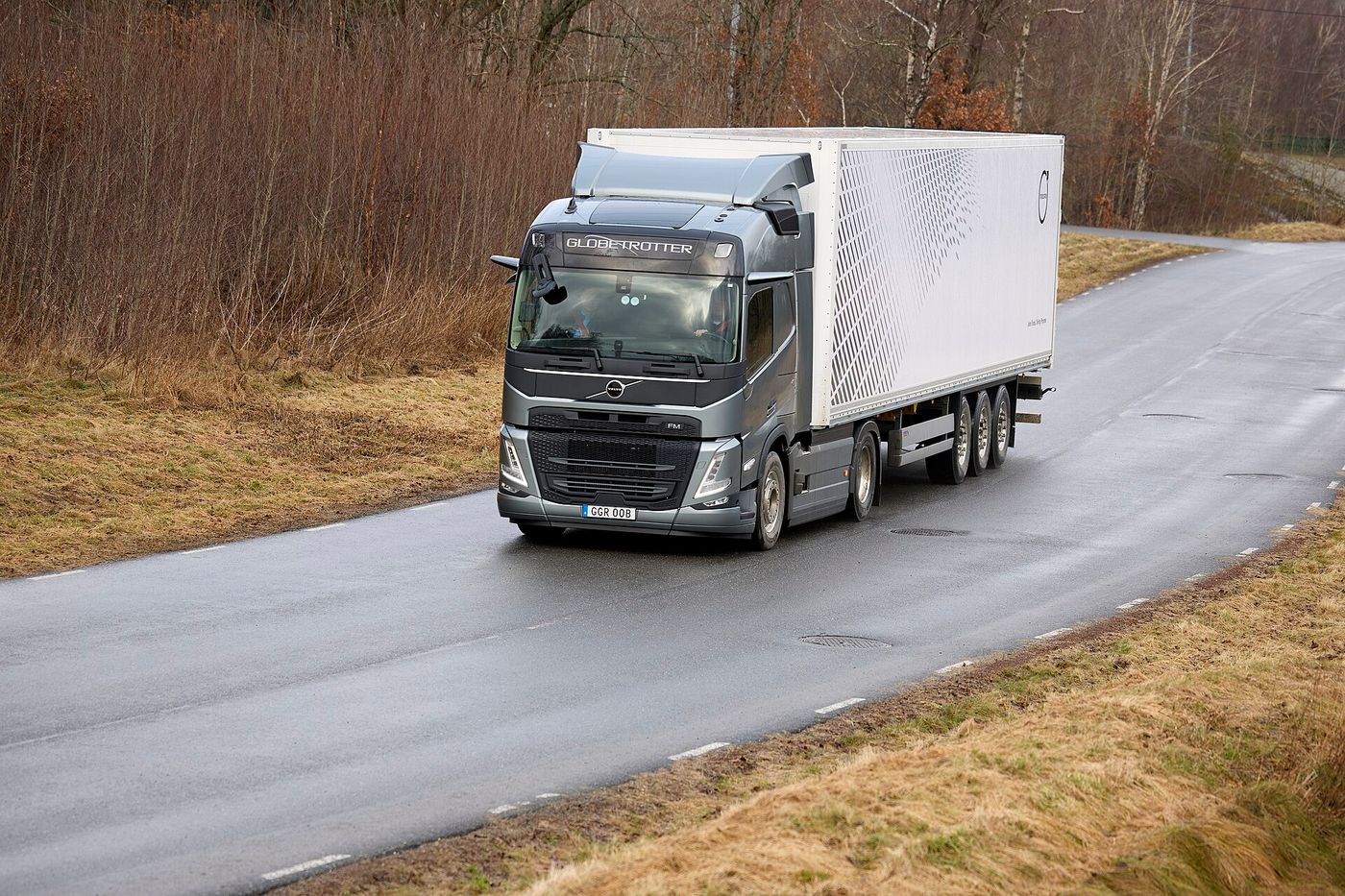
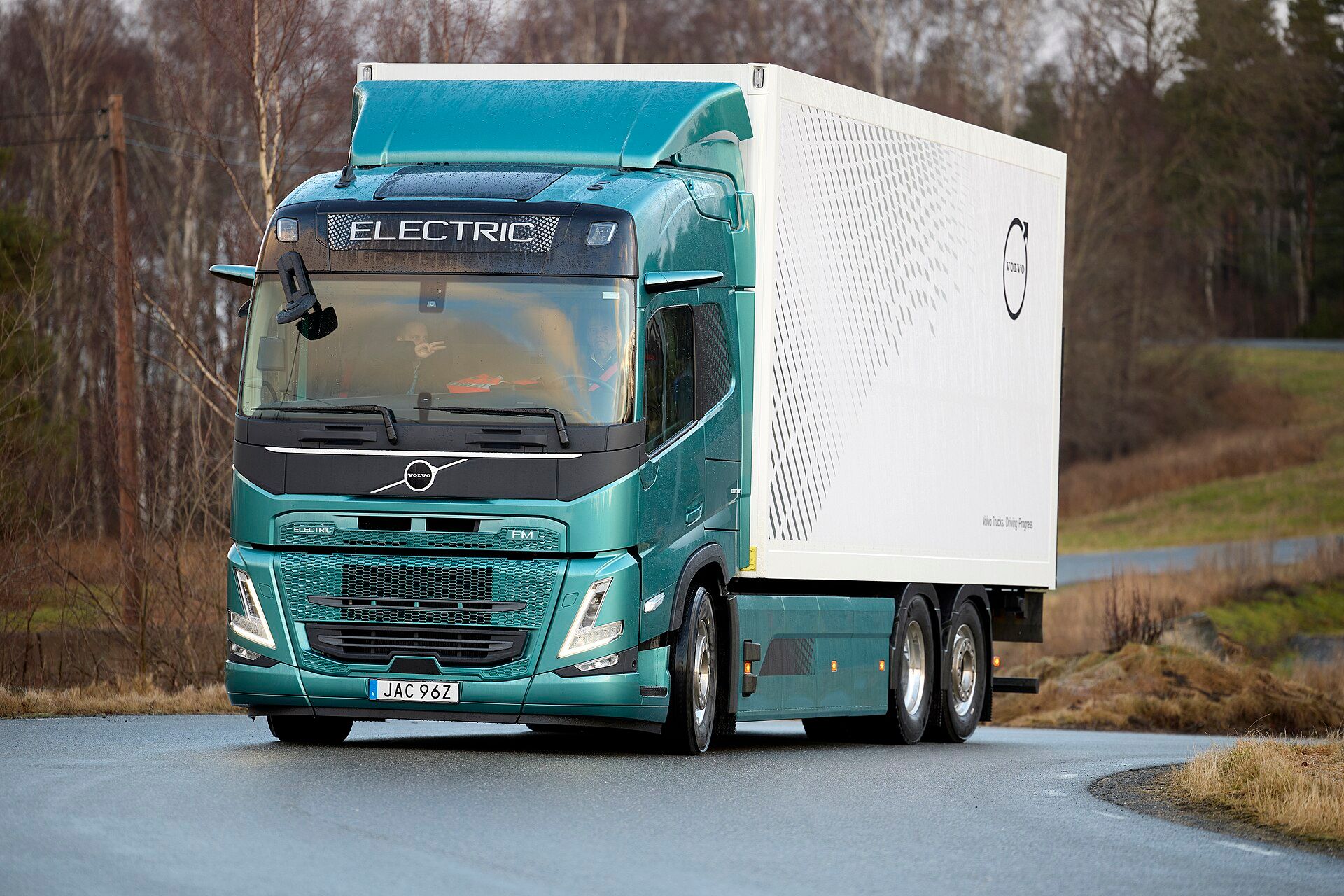
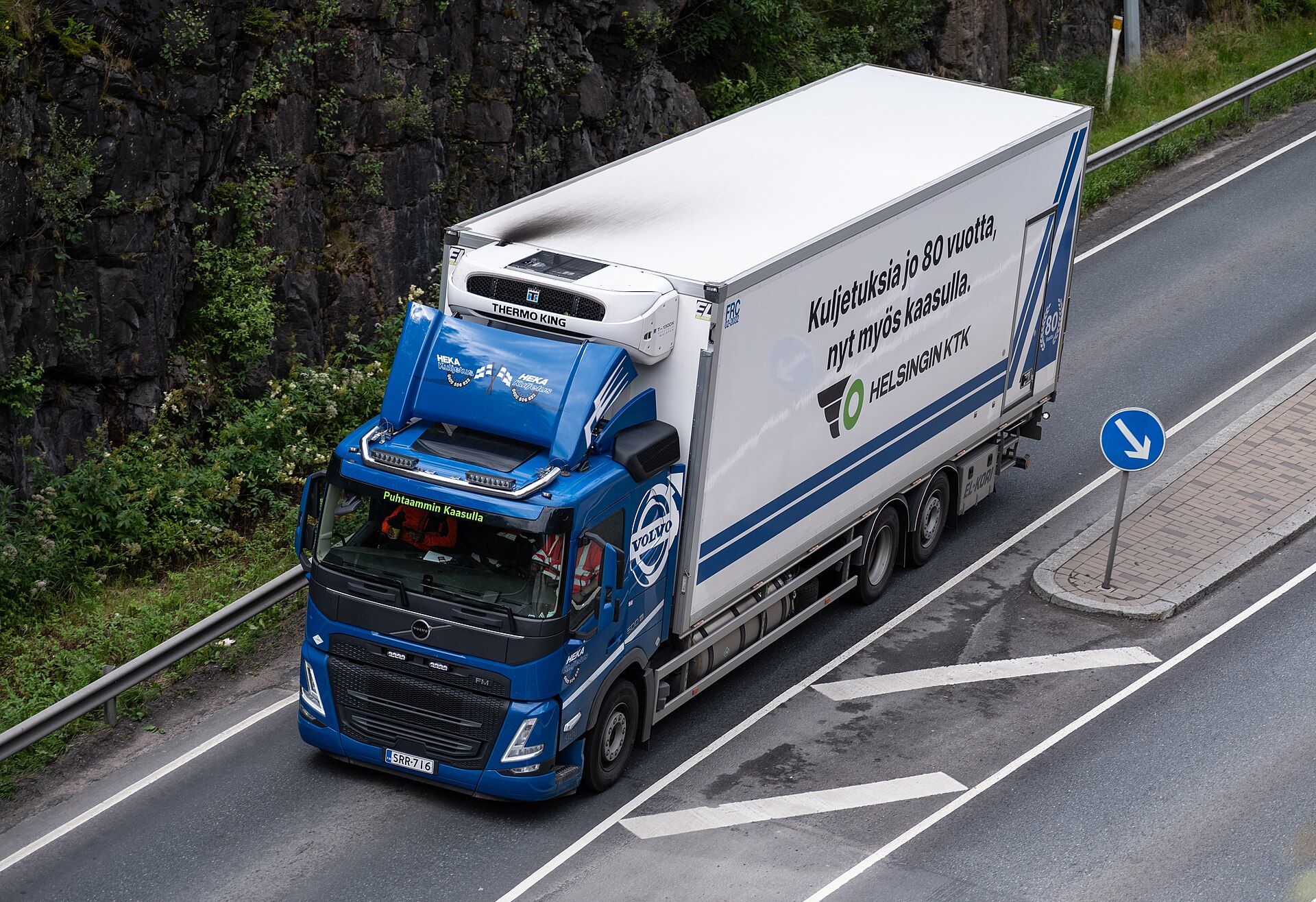
The FM is a Volvo heavy truck sold as a tractor and as a rigid, whose cab design Volvo describes as “low with a driving position close to the ground”; Volvo calls the model “the flexible specialist”. This page describes the current generation, launched on 27 February 2020, with the D11, D13 and G13 engines Volvo Trucks UK lists on its FM specification page, read on 7 October 2026, and the battery-electric FM Electric, which Volvo sells under the same model name. The figures come from that UK page; from the FM infosheet Volvo UK links to, which carries no printed date (its file was created on 24 January 2024); from Great Britain model range data sheets dated 24 February, 25 September and 30 September 2026; from Volvo’s global FM, FM Electric and FM gas-powered pages; and from Volvo press releases, each dated where it is used. The FM shares its cab family and its engines with the Volvo FMX, and its electric driveline with the Volvo FH Electric; where the explanation is the same, those pages carry it.
Overview and generations
Volvo’s history pages date the FM name to the spring of 1998, when Volvo presented an FM family of distribution, construction and multi-purpose trucks as the successors to its low-built F86, F7 and FL7/FL10/FL12: the FM7, FM10 and FM12, with 7-, 10- and 12-litre engines, power ratings “from 250 to 420 bhp in its original executions”, and a day cab, a sleeper cab and a Globetrotter cab. After a major revision in 2001 the series consisted of the FM9, with a new 9-litre engine, and the FM12, with the revised D12D engine. Volvo’s 2000s page then records an FM “introduced together with the FH in 2005”, with the 13-litre engine of the FH and a 9-litre engine, three cabs and Euro 4 compliance, with versions for Euro 5.
AB Volvo announced on 4 March 2013 that a new FM would be launched in Europe on 19 March 2013. Volvo’s press information of 19 March 2013 names Volvo Dynamic Steering among its features and 11- and 13-litre engines meeting Euro 6, and says production for European customers would begin in September 2013. Volvo’s 2010s history page describes the FM of that decade with the 12.8-litre D13 at 420 to 500 horsepower and the 10.8-litre D11 at 330 to 450 hp, six cabs, four chassis heights, and sales “all over the world with the exception of North America”.
The current FM was launched on 27 February 2020 together with new versions of the FH, FH16 and FMX. Volvo’s release gives it a new cab whose raised A-pillars add up to one extra cubic metre of space, a 12-inch instrument display, an optional 9-inch side display and EBS as standard. Its release of 4 March 2021 says the four models were then entering serial production in Sweden, Belgium and Russia, the Tuve plant in Gothenburg first, in March 2021, and that more than 12,000 trucks of the new range had been ordered in 2020. The record dates the start of production to 2021 on that release. The battery-electric FM followed: Volvo started series production of the FH, FM and FMX Electric in September 2022, and on 14 April 2026 announced a new dual-motor driveline for all three, described under FM Electric below. On 12 May 2026 Volvo announced a new 13-litre engine platform for the FM, FMX, FH and FH Aero, described under Engines.
Cabs
Volvo UK’s specification page lists six cabs and gives an interior height for each, measured on the floor and over the engine compartment cover:
| Cab | Code | Interior height | Over the engine cover |
|---|---|---|---|
| Day cab | FM-DAY | 164 cm | 120 cm |
| Low day cab | FM-LDAY | 148 cm | 104 cm |
| Sleeper cab | FM-SLP | 164 cm | 120 cm |
| Low sleeper cab | FM-LSLP | 148 cm | 104 cm |
| Globetrotter cab | FM-HSLP | 201 cm | 157 cm |
| Crew cab | – | 1,590 mm | – |
Volvo says the low day cab “is needed for applications such as mining, refrigerated bodies, pumps and cranes”, that the low sleeper’s lowered roof “provides added load space above the cab”, and that the Globetrotter offers overnight accommodation for up to two people. The two UK pages do not agree on the crew cab: the specification page gives it room for “up to 7 persons”, the UK model page for “a crew of up to nine in total”. The Great Britain data sheets list the cabs by code. The FM 11 4x2 tractor sheet of 24 February 2026 describes each “with steel safety cage design” and “Designed and built to Swedish impact and ECE R29 regulations”; the FM 13 and gas sheets of 25 September 2026 give the cab names only. The sleeper cab is the standard fit on the 4x2 and 6x4 tractor sheets and the day cab on the 8x4 rigid sheet.
Inside, the lower bed measures 70×200 centimetres with a 16-centimetre pocket-spring mattress in soft, semi-firm or firm, and the comfort upper bed 70×190 or 60×190 centimetres. Under the bed of the sleeper and Globetrotter cabs are two large compartments reached from outside and one of 44 litres under the mattress; the day cab can be fitted with 60 litres of storage with jalousie openings, and the space above the windscreen has four ISO slots, two on the low cabs. The roof hatch opens 50 millimetres. The steering wheel is 450 or 500 mm in diameter, adjusts by up to 90 mm in height and 28° in angle, and with the optional neck tilt between -5° and +15°; the driver’s seat adjusts 200 millimetres fore and aft and 100 millimetres vertically. The cab sits on four-point suspension with coil springs and dampers, front coil springs with rear air, or air all round. Volvo lists around 650 colour variants, two exterior trim levels (Basic and Enhanced) and five interior trim levels: Dynamic in textile, Robust in vinyl and textile or in leather, and Progressive in plush or in leather.
Engines
Volvo UK’s specification table lists three engine families for the FM, and the FM infosheet prints the same steps with the same figures. Volvo footnotes the diesel and gas columns “Net output according to: EC 582/2011”, the net basis explained in reading truck power figures.
| Engine | Power | Max power at | Torque | Max torque at |
|---|---|---|---|---|
| D11 330 hp | 246 kW | 1,700 r/min | 1,600 Nm | 877–1,400 r/min |
| D11 380 hp | 279 kW | 1,700 r/min | 1,800 Nm | 938–1,400 r/min |
| D11 430 hp | 317 kW | 1,700 r/min | 2,050 Nm | 1,008–1,400 r/min |
| D11 460 hp | 338 kW | 1,700 r/min | 2,200 Nm | 1,050–1,400 r/min |
| D13 420 hp | 309 kW | 1,404–1,700 r/min | 2,100 Nm | 905–1,400 r/min |
| D13 460 hp | 338 kW | 1,404–1,700 r/min | 2,300 Nm | 945–1,400 r/min |
| D13 500 hp | 368 kW | 1,404–1,700 r/min | 2,500 Nm | 980–1,400 r/min |
| G13 420 hp (gas) | 309 kW | 1,600–1,700 r/min | 2,100 Nm | 905–1,400 r/min |
| G13 460 hp (gas) | 338 kW | 1,600–1,700 r/min | 2,300 Nm | 950–1,400 r/min |
| G13 500 hp (gas) | 368 kW | 1,600–1,700 r/min | 2,550 Nm | 980–1,404 r/min |
The D11 is a 10.8-litre six-cylinder with a 123 mm bore, a 152 mm stroke and an 18.0:1 compression ratio, at 246–338 kW and 1,600–2,200 Nm. Volvo UK gives it an economy-rev band of 1,000–1,500 r/min, an exhaust brake effect of 155 kW and an optional engine brake of 270 kW at 2,300 r/min, a 35-litre oil change including the filter and a 22-litre cooling system. The Great Britain FM 11 data sheets, dated 24 February 2026, call the engines “New D11K”, make the 330 hp step standard and the others options, and list an optional Volvo engine brake with “retardation 300kW”. Volvo UK’s data sheet list, read on 19 October 2026, no longer includes the FM 11 sheets, though the FM 11 4x2 tractor sheet can still be downloaded.
The D13 is a 12.8-litre six-cylinder with a 131 mm bore, a 158 mm stroke and an 18.0:1 compression ratio, at 309–368 kW and 2,100–2,500 Nm in three steps; Volvo UK’s FM page stops at 500 hp, where its FH and FMX pages add a fourth step. Its economy revs are 900–1,400 r/min, its exhaust brake effect 175 kW, its optional engine brake 340 kW at 2,300 r/min, its oil change 35 litres and its cooling system 24 litres. On the Great Britain FM 13 data sheets of 25 September 2026 these three steps, as the D13K420, D13K460 and D13K500, are options, and the standard-fit engine is a 420 hp D13 marked VGT with 2,400 Nm; the optional Volvo Engine Brake, EBR-VEB+, is listed there without an output figure. How exhaust brakes, engine brakes and retarders differ is set out in retarders and engine braking.
The G13 runs on LNG or bio-LNG and shares the D13’s 12.8 litres, bore, stroke and 900–1,400 r/min economy band, at a 17.0:1 compression ratio and 309–368 kW and 2,100–2,550 Nm. Volvo UK gives it a 200 kW exhaust brake, an optional 380 kW engine brake at 2,300 r/min, a 35-litre oil change and a 38-litre cooling system. The gas tanks are covered under Fuel, gas and AdBlue tanks below, and the fuel itself in LNG and bio-LNG trucks.
Volvo UK’s page gives all three families as Euro 6 and names no step. The Great Britain FM 13 data sheets of 25 September 2026 give “Euro VI SCR, EGR and particulate filter” as standard fit, and the gas sheet gives no emission level; the FM 11 4x2 tractor sheet of 24 February 2026 gives “Euro VI step E”, for one vehicle in one market. The page’s fuel prerequisites are sulphur-free diesel to EN590 with at most 10 ppm sulphur and synthetic diesel to EN15940; Volvo’s global page lists diesel, biodiesel or HVO, and the FM 13 data sheets of 25 September 2026 list “Biodiesel engine hardware - up to 100% hardware for FAME EN14214”, as standard fit on the 4x2 and 6x4 tractor and 8x4 rigid sheets and as an option on the 6x2 tag tractor sheet.
Volvo’s documents do not give the same engine speeds. The Great Britain FM 11 4x2 tractor data sheet of 24 February 2026 puts maximum power at 16-1900, 17-1900, 17-1800 and 16-1800 rpm on the four D11 steps, against the 1,700 r/min of the table above, and starts peak torque on the 330 hp D11 at 950 r/min; the FM 13 and gas data sheets of 25 September 2026 give no engine speeds. The data sheet for the gas-powered 4x2 tractor, FM 42T LA2, gives the 500 hp G13 2,500 Nm where the UK page and the infosheet give it 2,550 Nm, and lists all three G13 steps as options, with none as standard fit. The UK page’s own powertrain combination table heads its D11 columns 330, 370, 410 and 450 hp, not the 330, 380, 430 and 460 hp of its power table.
The new 13-litre engines
Volvo’s release of 12 May 2026 announces an all-new 13-litre platform for the FM, FMX, FH and FH Aero: a D13 at 380–560 hp and 1,800–2,900 Nm and a G13 at 420–500 hp and 2,400–2,800 Nm, with sales from the third quarter of 2026 and Europe, Morocco, Turkey and India among the first markets. Volvo’s global and UK FM pages already quote the diesel FM at up to 560 hp and 2,900 Nm, with a 380 hp engine at 1,800 Nm “for assignments with many stops and starts”, and the gas-powered FM at up to 500 hp and 2,800 Nm; the global gas-powered page gives its Volvo Engine Brake 470 kW at 2,300 rpm. Volvo’s Great Britain FM 13 data sheets of 25 September 2026 list a D13 marked VGT at 380 hp and 1,800 Nm, 420 hp and 2,400 Nm, 460 hp and 2,600 Nm, 500 hp and 2,800 Nm, and 560 hp and 2,900 Nm, with the 420 hp step as standard fit. None of these documents gives the new engines’ output in kilowatts, so they are not in the table; the Volvo FH page sets out what the release does and does not say.
Transmission
Every diesel and gas engine on Volvo UK’s page is paired with I-Shift, a 12-speed splitter and range gearbox with automated gear changing that can be fitted with a compact retarder, a power take-off, an emergency power steering pump and an oil cooler, and ordered with crawler gears, ultra-low crawler gears and a reverse multispeed. The page gives each gearbox a GCW approval: the direct-drive AT2412 (2,400 Nm) 44 tonnes, the direct-drive AT2612 and the overdrive ATO2612 (2,600 Nm each) 100 tonnes, and the overdrive I-Shift Dual Clutch SPO2812 (2,800 Nm) 80 tonnes. The combination tables mark the Dual Clutch against the 460 and 500 hp D13 only, and against no gas engine; the AT2412 is not marked against the 500 hp G13. The page lists no Powertronic.
The Great Britain data sheets give other figures. The FM 13 sheets of 25 September 2026 give the standard AT2612 and the optional AT2812 a GCW of 60 tonnes and the optional ATO2612 100 tonnes; they give no GCW for the ATO3112, which they label “FH16 600”, for the I-Shift Dual Clutch SPO2812, which they label “NOT FOR HEAVY HAULAGE”, or for an AT3012 that the UK page does not list. They also offer a Powertronic six-speed automatic, the PT2606, for 2,600 Nm and a maximum permitted GCW of 130,000 kg. The FM 11 sheet offers the PT2106, for 2,100 Nm and 100,000 kg. The sheets give the crawler ratios: 19:1 on a direct-top gearbox and 17:1 on an overdrive one, and 32:1 for the ultra-low crawler.
For bodywork, Volvo UK lists three engine-mounted power take-offs, the EPTT350, EPTT650 and EPTT1000, geared at 1.26:1 and delivering 350, 650 and 1,000 Nm both while driving and standing still, rear-mounted engine PTOs (PTER-DIN, PTER1400, PTER100) and clutch-dependent gearbox PTOs from the PTR-F to the dual-drive PTRD-D2.
Axles, suspension and brakes
The FM infosheet lists five tractor layouts — 4x2, 6x2 with a pusher axle, 6x2 with a tag axle, 6x4 and 8x4 — and ten rigid ones, from 4x2 through 8x2 with dual front axles or as a tridem, and 8x4 with dual front axles or as a pusher or tag tridem, to 10x4 with dual front axles and a tag axle. Volvo UK’s data sheet list runs from the 4x2 to the 6x4 tractor, with no 8x4 tractor sheet, and from the 4x2 to the 10x4 rigid; its 10x4 sheet and the tridem sheets carry a note to contact sales engineering. Volvo UK’s rear axle table footnotes its heaviest bogie “For Volvo FM 4x4”, and its rear suspension table names 6x6, 8x6 and 10x6 against two air-suspension types, but no infosheet row and no data sheet opened describes a driven-front FM, so the record lists none. The notation is explained in axle configurations explained.
The front axle is rated by chassis height: on air suspension 8 tonnes on the X-Low and Low chassis and 10 tonnes on the Med and High; on leaf springs 9 tonnes on the Med and 10 tonnes on the High and X-High; and up to 20 tonnes with dual front axles. The FM 13 8x4 rigid sheet makes a 16-tonne pair (2 x 8 tonnes) standard and offers 18 and 20 tonnes. Pusher axles come fixed or actively steered at 4.5, 7.5 or 9 tonnes; tag axles fixed with single or dual wheels, self-steered or actively steered, at 7.5, 9.5 or 10 tonnes. Tandem Axle Lift, which raises the rearmost drive axle of a tandem bogie when the truck runs unloaded, is available on 6x4 and 8x4 with disc brakes.
Volvo UK’s rear axle table lists single-reduction hypoid axles, RSS solo at 13 tonnes and RTS tandem at 23 tonnes, and hub-reduction axles, RSH solo at 13 tonnes and RTH tandem at 26 to 38 tonnes, with maximum axle torques from 2,600 to 3,800 Nm and GCW approvals from 44 tonnes on the RSS1244 and RSS1344C/E to 150 tonnes on the 38-tonne RTH3815, the FM 4x4 bogie. Across the types listed the ratios run from 2.06:1 to 7.22:1. The data sheets of 25 September 2026 rate their drive axles by GCW: the RSS1344F standard on the 4x2 tractors at 44 tonnes, the RTS2370D standard on the 6x4 tractor at 70 tonnes, the RTS2370A, which the UK table approves to 80, as an option at the same 70 tonnes, and the optional RTH2610B, RTH2610F and RTS2310A at 100 tonnes. The rear suspension table runs from parabolic and multi-leaf springs to air suspension, at axle or bogie loads from 11.5 tonnes (RAD-GR) to 38 tonnes (RADD-TR3).
EBS is standard on every specification, for disc brakes and, on a selected range of configurations and chassis heights, Z-cam drum brakes. The EBS Medium package adds status monitoring, Auto Hold, lining-wear analysis on disc brakes and, with I-Shift, automatic parking-brake release; the FM 13 4x2 tractor data sheet lists EBS Medium with a hill-hold function as standard. Volvo UK lists as additional options a stretch brake, ESC for two- to five-axle vehicles, an emergency brake light that flashes four times a second under panic braking above 50 km/h, and a gearbox-mounted compact hydraulic retarder of up to 440 kW; the FM 13 4x2 tractor sheet has ESC and the emergency brake light as standard.
Dimensions and weights
Volvo UK gives five nominal chassis heights: X-Low, for tractors, at about 810 mm, Low at about 850 mm, Med at about 900 mm, High at about 1,000 mm and X-High at about 1,200 mm. Weights belong to individual data sheets, and each sheet says that “Legal weights can differ from country to country.”
| Data sheet | Wheelbase (mm) | Kerb weight (kg) | GVW plated / design (kg) | GCW plated / design (kg) |
|---|---|---|---|---|
| FM 13 4x2 tractor, rear air (FM 42T 3A) | 3,500–3,800 | 6,680–6,700 | 18,000 / 20,500 | 40,000 / 44,000 |
| FM 11 4x2 tractor, rear air (FM 42T 1A) | 3,500–3,800 | 6,555–6,575 | 18,000 / 20,500 | 40,000 / 44,000 |
| FM 13 6x4 tractor, rear air (FM 64T 3A) | 3,000–3,900 | 8,550–8,630 | 26,000 / 29,000 | 44,000 / 44,000 |
| FM gas-powered 4x2 tractor (FM 42T LA2) | 3,700–3,800 | 7,245–7,250 | 18,000 / 20,100 | 40,000 / 44,000 |
| FM Battery Electric 4x2 tractor (FM 42T E) | 3,950 | 9,795 | 18,000 / 21,500 | 40,000 / 44,000 |
| FM Battery Electric 6x4 tractor (FM 64T E) | 3,950 | 11,990 | 26,000 / 29,500 | 44,000 / 44,000 |
| FM Battery Electric 4x2 rigid (FM 42R E) | 4,200–6,700 | 8,975–9,355 | 18,000 / 21,500 | 0 / 32,000 |
| FM 13 8x4 rigid, rear air (FM 84RF 3A) | 5,100–6,400 | 9,545–9,645 | 32,000 / 37,000 | 35,580 / 44,000 |
The battery-electric rows come from the sheets of 30 September 2026, whose driveline items are set out under FM Electric below; the 4x2 rigid sheet prints a plated GCW of 0 against a design GCW of 32,000 kg. On the FM 13 4x2 tractor the turning circle runs from 12,700 to 13,700 mm kerb to kerb across the four wheelbases. The plated and design figures differ, and neither is a gearbox or axle approval; the terms are set out in truck weights: GVW and GCW. Chassis frames are 266 mm deep as standard on the FM 13 4x2 tractor sheet, with a 300 mm frame as an option.
Fuel, gas and AdBlue tanks
Volvo UK lists aluminium or steel fuel tanks from 150 to 900 litres, with a maximum of 1,510 litres on a 4x2 tractor, and a plastic tank between the front axles on trucks with double front axles; the FM 13 4x2 tractor sheet makes a 330-litre aluminium tank standard. The G13’s LNG tanks come in 155 kg (375 litres), 205 kg (495 litres) and 225 kg (545 litres). The gas-powered 4x2 tractor sheet lists a 170-litre aluminium fuel tank as standard and a left-mounted 205 kg LNG tank as an option. Volvo’s FM pages give the gas-powered FM a range of up to 1,000 km. AdBlue tanks are plastic, from 32 to 112 litres, with the pump integrated in the tank module; 64 litres is standard on the FM 13 4x2 tractor sheet.
FM Electric
Volvo announced on 5 November 2020 that electric FH, FM and FMX trucks would go on sale in Europe in 2021, with volume production in 2022, a range of up to 300 km depending on the battery configuration and a gross combination weight of up to 44 tonnes. Series production began in September 2022, according to Volvo’s release of 14 September 2022. On 14 April 2026 Volvo announced the next generation of the FH, FM and FMX Electric, with a dual-motor driveline, an eight-speed powershift gearbox, up to 540 kW (731 hp), up to 65 tonnes GCW and a payload of up to 23.8 tonnes for a 4x2 tractor, to be “rolled out step by step to markets starting in 2026”. Volvo’s global and UK FM Electric pages carry that driveline, and the Great Britain battery-electric data sheets of 30 September 2026 list its power, gearbox and battery options, set out below; Volvo UK’s FM specification page and the infosheet still describe the earlier one.
| Current (global and UK FM Electric pages) | Earlier (UK specification page, infosheet) | |
|---|---|---|
| Motors and power | 2 motors, 300, 350, 400, 470 or 540 kW | 2 or 3 motors, 330–490 kW continuous |
| Gearbox | Eight-speed powershift in the drive unit | I-Shift |
| Battery | 360–540 kWh, 4–6 batteries; up to 460 kWh usable | 180–540 kWh, 2–6 batteries |
| Range | Up to 470 km | Up to 300 km |
| Charging | CCS, 350 kW, 20–80% in 65 min | Full charge 9.5 h on AC (43 kW), 2.5 h on DC (250 kW) |
| Combination weight | Up to 65 tonnes | Up to 44 tonnes (2020 and 2022 releases) |
The current pages give the FM Electric five cabs — low day, day, low sleeper, sleeper and Globetrotter — and eight layouts: 4x2, 6x2 and 6x4 tractors and 4x2, 6x2, 6x4, 8x2 and 8x4 rigids, all axles air-suspended; the April 2026 release adds that the truck can be specified with twin-drive axles and low gearing. Volvo’s pages put the onboard energy at up to 540 kWh with up to 460 kWh available for use, and charge at up to 350 kW below 750 V; the gap between the installed and usable figures is discussed on the FH Electric page and in installed vs usable battery capacity. The FM Electric page’s opening paragraph speaks of “an I-Shift transmission for electric trucks” where its own drive-unit text names an eight-speed transmission with powershift; its specification table has no gearbox row. Two power take-offs are listed: an electrical one at 30, 60 or 90 kW and a clutch-independent transmission PTO. Among the drivability features the page lists one-pedal driving, Auto Go, which moves the truck off at 1.5 km/h when the brake pedal is released, Change Direction, for switching between forward and reverse at up to 30 km/h, and Active Grip Control.
The Great Britain battery-electric data sheets of 30 September 2026, for the 4x2 and 6x4 tractors and the 4x2 rigid, list a maximum power output of 300 kW as standard and of 350, 400 or 470 kW as options (MP300KW to MP470KW), an “8-Speed Electric Transmission” (EPT1008) as standard, and a total battery energy of 450 kWh as standard and 540 kWh as an option on the tractors and of 360 kWh as standard and 270, 450 or 540 kWh as options on the rigid. They offer a “Maximum Usable Battery Energy” of 340, 410 or 460 kWh, and on the rigid also 120, 190 or 250 kWh. They give no charging power, motor count, range or 540 kW step. The earlier truck is described by Volvo UK’s specification page, at 330 to 490 kW (450 to 666 hp) continuous power with two or three electric motors and an I-Shift gearbox, and by the infosheet, at 490 kW (666 hp) continuous power. Volvo also lists a low-entry FM Electric, the FM Low Entry, as a model of its own; it is not covered here.
Safety and driver-assistance systems
The FM 13 4x2 tractor data sheet of 25 September 2026 lists as standard Electronic Stability Control, forward collision warning with an advanced emergency braking system, lane departure warning, Side Collision Avoidance Support on the passenger and driver sides, Driver Alert Support Warning with driver attention monitoring, an automatic parking brake that applies when the driver leaves the seat, a driver airbag, LED headlights and the emergency brake light. Its options include adaptive cruise control, lane departure warning with Pilot Assist, Emergency Lane Keeping Assist for a tyre blow-out, active side collision support with emergency braking on the passenger side, a camera monitoring system with rear-view cameras in place of the main and wide-angle mirrors, also offered with a nearside passenger corner camera, and the stretch brake. Volvo Dynamic Steering, active steering with torque overlay, is optional there and standard on the battery-electric 4x2 tractor sheet; Volvo UK says it is available for all axle configurations, including dual front axles, and with individual front suspension, and Volvo’s FM page says it helps keep a steady course after a tyre blow-out. The 2020 launch release added adaptive cruise control working down to zero km/h, downhill cruise control and road sign recognition, and Volvo’s FM page names Collision Warning with Emergency Brake, Side Collision Avoidance Support and Door Opening Warning, the last two using radar sensors.
Equipment and options
Climate control is manual (MCC) or automatic (ECC/ECC2), with cab and engine parking heaters as additions. The driver’s and passenger seats come in three levels, Progressive in plush or leather, Dynamic in textile and Robust in vinyl. The air intake sits on the left, high or low, with a front intake as an alternative. Volvo UK’s FM model page describes a Work Remote for controlling the bodywork and powertrain away from the driver’s seat, and factory preparation for bodybuilding with access to the Volvo Bodybuilder Instructions portal.
Source notes
The combination weight above belongs to one named vehicle: the FM 13 6x4 tractor on rear air suspension, plated in Great Britain at 26,000 kg gross vehicle and 44,000 kg gross combination against design figures of 29,000 kg and 44,000 kg. The FM 13 4x2 tractor is plated at 18,000 kg and 40,000 kg (design 20,500 kg and 44,000 kg), and the FM 13 8x4 rigid at 32,000 kg gross vehicle against a design figure of 37,000 kg. Beyond one plate, approved combination weight follows the gearbox and the rear axle: the UK specification page approves the I-Shift gearboxes to 44 to 100 t and its rear axles from 44 t on the RSS1244 and RSS1344C/E to 150 t on the RTH3815, which it footnotes as for the FM 4x4, while the GB data sheets rate two of them, the AT2612 and AT2812, to 60 t. Volvo documents give different engine speeds for the same steps: the UK specification page and the FM infosheet put maximum power at 1,404–1,700 r/min on the D13 and at 1,700 r/min on the D11, the GB FM 11 data sheet between 16-1800 and 17-1900 rpm on the D11, with other peak-torque bands as well, and the GB FM 13 and gas data sheets give no engine speeds, so no rated speed is recorded. The G13 at 500 hp has 2,550 Nm on the UK specification page and the infosheet and 2,500 Nm on the GB gas data sheet FM 42T LA2. The battery and motor figures are those of the FM Electric driveline Volvo announced on 14 April 2026, as Volvo’s global and UK FM Electric pages list them; the UK specification page and the infosheet still describe the earlier truck, with two or three motors of 330 to 490 kW continuous power, 180 to 540 kWh in two to six batteries and an I-Shift gearbox, while the GB battery-electric data sheets of 30 September 2026 list power outputs of 300 to 470 kW and an eight-speed electric transmission. The UK specification page gives the crew cab room for up to 7 persons, the UK model page for up to nine.
Quick answers
- Which engines are available in the Volvo FM?
- The record for the Volvo FM covers these engine families: Volvo D11 (10.8 l), Volvo D13 (12.8 l), Volvo G13 (LNG / bio-LNG) (12.8 l). Output spans 246–368 kW and 1600–2550 Nm.
- What axle configurations does the Volvo FM come in?
- 4x2, 6x2, 6x4, 8x2, 8x4, 10x4.
- What emission standard does the Volvo FM meet?
- Euro VI.
- When did production of the Volvo FM start?
- Production of the Volvo FM started in 2021.
- Which transmission does the Volvo FM use?
- Transmission: Volvo I-Shift automated 12-speed (AT2412, AT2612, ATO2612); I-Shift Dual Clutch SPO2812 with the D13 460 and 500 hp; Powertronic 6-speed (PT2106, PT2606) on the GB data sheets only; FM Electric: eight-speed powershift in the electric drive unit.
- What is the gross combination weight of the Volvo FM?
- Gross combination weight: 44 t (FM 13 6x4 tractor, GB data sheet FM 64T 3A).
- What battery capacity does the Volvo FM have?
- Battery: 460 kWh; Battery installed: 360–540 kWh; Range: 470 km; Charging: 350 kW (CCS).
Volvo models on this site, side by side
| Segment | Produced | Axle configurations | Power | Torque | Gross combination | |
|---|---|---|---|---|---|---|
| Volvo FE | Distribution | 3 configurations | 184–258 kW | 950–1400 Nm | 32 t | |
| Volvo FH | Long-haul tractor | 2021— | 6 configurations | 309–397 kW | 2100–2800 Nm | 44 t |
| Volvo FH16 | Long-haul tractor | 2021— | 6 configurations | 441–574 kW | 3000–3800 Nm | 44 t |
| Volvo FL | Distribution | 2 configurations | 154–235 kW | 800–1200 Nm | 24 t | |
| Volvo FM | Long-haul tractor | 2021— | 6 configurations | 246–368 kW | 1600–2550 Nm | 44 t |
| Volvo FMX | Construction | 2021— | 10 configurations | 246–397 kW | 1600–2600 Nm | 44 t |
Articles that mention the Volvo FM
More Volvo on this site
Sources
- Volvo FM specifications — engines, gearboxes, rear axles, cabs, chassis, data sheets — Volvo Trucks UK
- Volvo FM infosheet (EN-Global) — Volvo Trucks
- FM 13 4x2 Tractor – Rear Air Suspension (data sheet FM 42T 3A, 25 September 2026) — Volvo Trucks, 25 Sept 2026
- FM 11 4x2 Tractor – Rear Air Suspension (data sheet FM 42T 1A, 24 February 2026) — Volvo Trucks, 24 Feb 2026
- FM 13 6x4 Tractor – Rear Air Suspension – N3 or N3G (data sheet FM 64T 3A, 25 September 2026) — Volvo Trucks, 25 Sept 2026
- FM 13 6x2 Tag Tractor – Rear Air Suspension (data sheet FM 62T T3A, 25 September 2026) — Volvo Trucks, 25 Sept 2026
- FM 13 8x4 Rigid – Rear Air Suspension – N3 or N3G (data sheet FM 84RF 3A, 25 September 2026) — Volvo Trucks, 25 Sept 2026
- FM Gas powered 4x2 Tractor – Rear Air Suspension (data sheet FM 42T LA2, 25 September 2026) — Volvo Trucks, 25 Sept 2026
- FM Battery Electric 4x2 Tractor – Full Air Suspension (data sheet FM 42T E, 30 September 2026) — Volvo Trucks, 30 Sept 2026
- FM Battery Electric 6x4 Tractor – Full Air Suspension (data sheet FM 64T E, 30 September 2026) — Volvo Trucks, 30 Sept 2026
- FM Battery Electric 4x2 Rigid – Full Air Suspension (data sheet FM 42R E, 30 September 2026) — Volvo Trucks, 30 Sept 2026
- Volvo FM — model overview — Volvo Trucks
- Volvo FM — model page (UK) — Volvo Trucks UK
- Volvo FM Electric — specifications — Volvo Trucks
- Volvo FM Electric — specifications (UK) — Volvo Trucks UK
- Volvo FM gas-powered — Volvo Trucks
- Volvo Trucks introduces the new Volvo FM (press release, 27 February 2020) — Volvo Trucks, 27 Feb 2020
- Volvo Trucks launches new generation of heavy-duty trucks with the driver in focus (press release, 27 February 2020) — AB Volvo, 27 Feb 2020
- Volvo Trucks launches a complete range of electric trucks starting in Europe in 2021 (press release, 5 November 2020) — Volvo Trucks, 5 Nov 2020
- Serial production starts for Volvo Trucks' new generation of heavy-duty trucks (press release, 4 March 2021) — Volvo Trucks, 4 Mar 2021
- Break-through: Volvo Trucks starts series production of heavy electric trucks (press release, 14 September 2022) — Volvo Trucks, 14 Sept 2022
- Volvo launches new electric trucks — with ranges up to 700 km (press release, 14 April 2026) — Volvo Trucks, 14 Apr 2026
- Volvo Trucks' all-new combustion engine platform (press release, 12 May 2026) — Volvo Trucks, 12 May 2026
- Volvo Trucks to launch new FM (4 March 2013) — AB Volvo, 4 Mar 2013
- The new Volvo FM – the ideal all-round player in Volvo Trucks' model range (press information, 19 March 2013) — Volvo Trucks, 19 Mar 2013
- The 1990s — Volvo Trucks history — Volvo Trucks
- The 2000s — Volvo Trucks history — Volvo Trucks
- The 2010s — Volvo Trucks history — Volvo Trucks