What is HVO? Renewable diesel in trucks and buses
What HVO is, what the EN 15940 standard for paraffinic diesel covers, what Germany's fuel ordinance says about paraffinic diesel, and what truck and bus makers state about HVO.
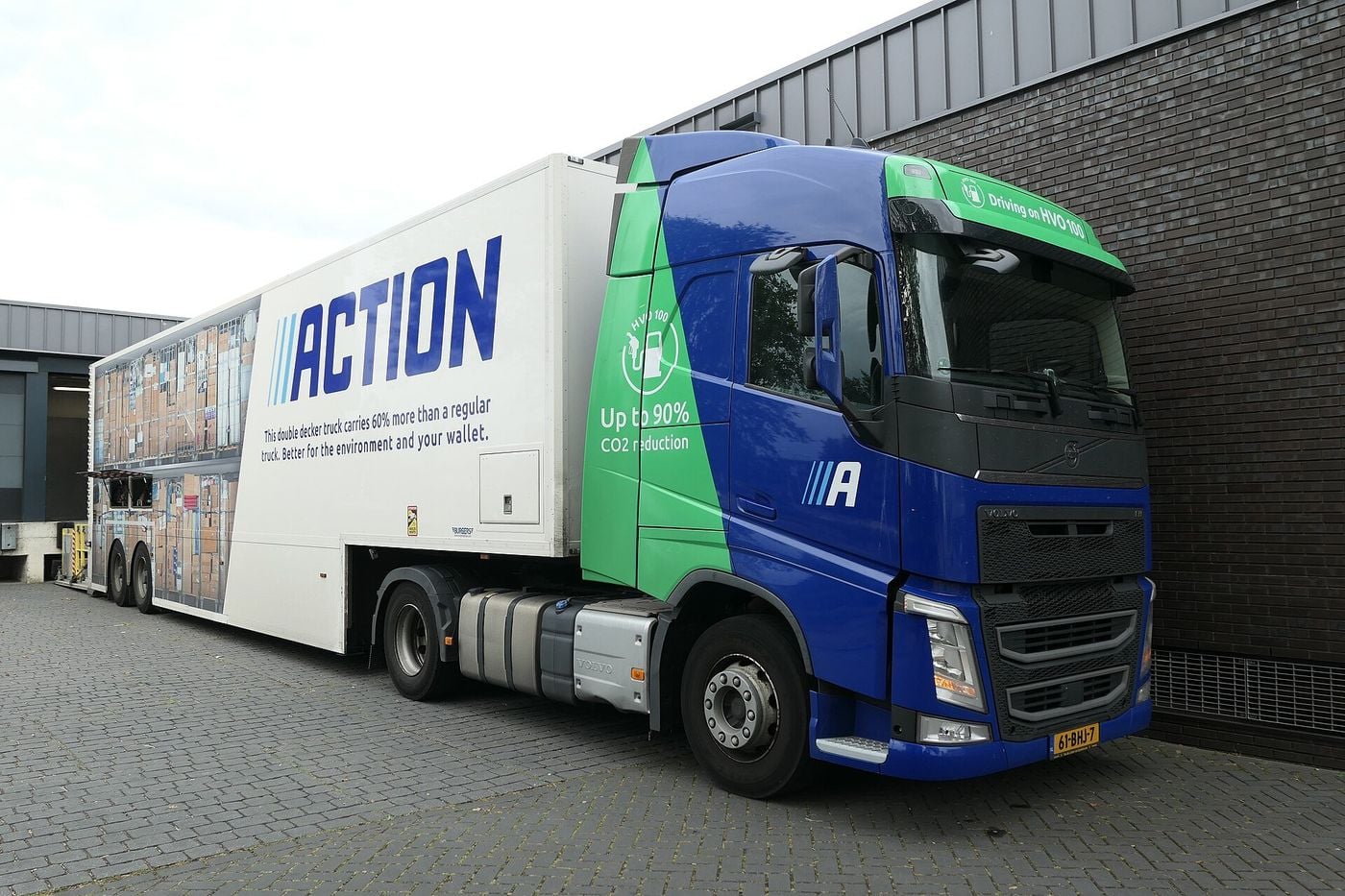
HVO stands for hydrotreated vegetable oil and is also called renewable diesel, according to its supplier Neste, which says HVO fuels can be used pure (100% concentration) or blended in any ratio with fossil diesel. Neste states that its renewable diesel complies with EN 15940, the standard for paraffinic diesel fuel from synthesis or hydrotreatment, and Germany’s fuel ordinance makes DIN EN 15940, the German version of that standard, the condition for selling paraffinic diesel of the quality “XTL” to end consumers.
The sources on this page are of six kinds, and each statement says which: the supplier’s own description (Neste), the catalogue entries of the standard (title and scope only; we did not read the standard itself), German legal texts, the press releases and news pages of truck and bus makers, an advocacy organisation’s page (Transport & Environment) and a trade publication’s report (Sustainable Truck & Van).
What HVO is
Neste writes: “HVO stands for Hydrotreated Vegetable Oil, also known as renewable diesel.” It calls its own product, Neste MY Renewable Diesel, “a so-called HVO or HVO100 diesel”, and its questions and answers page says the fuel can be used “neat (HVO100) or blended at any ratio with fossil diesel”. Volvo Trucks spells the abbreviation out as “hydrotreated vegetable oil” in its press release of 12 May 2026; the Turkish-language news page of Ford Trucks of 5 March 2025 gives it as “Hidrojenle İşlenmiş Bitkisel Yağ” (our translation: vegetable oil processed with hydrogen).
Neste says its renewable diesel “is produced from renewable raw materials, such as used cooking oil and animal fat waste”, and that “Proportions of individual raw materials vary from year-to-year and across regions, depending on their availability, price, and market-specific requirements.” The abbreviation says vegetable oil; the raw materials Neste names as examples are used cooking oil and animal fat waste.
On the process, Neste says the raw materials are “pretreated to remove impurities” and then, with its NEXBTL technology, converted “into a hydrocarbon product with properties and energy density similar to regular fossil diesel”; its product page says the fuel is produced “using hydrotreatment technology”.
On greenhouse gases, Neste’s statement concerns its own product: Neste MY Renewable Diesel sold in the EU and Asia-Pacific fulfils “the EU RED sustainability criteria, including the requirement to provide at least a 50% reduction in greenhouse gas emissions over its life cycle compared to fossil fuel”. Neste says the calculations “follow the well-to-wheels principle”. This page does not extend that figure to other HVO fuels.
EN 15940: the standard for paraffinic diesel
The BSI Knowledge catalogue titles the standard “Automotive fuels. Paraffinic diesel fuel from synthesis or hydrotreatment. Requirements and test methods” and lists its 2023 national edition, BS EN 15940:2023, as “Identical to: EN 15940”. DIN Media lists the German version as “Deutsche Fassung EN 15940:2023”. The scope in the BSI entry says:
- the document describes requirements and test methods for paraffinic diesel fuel “marketed and delivered as such”, containing up to 7.0 % (V/V) fatty acid methyl ester (FAME);
- it is applicable to fuel “for use in diesel engines and vehicles compatible with paraffinic diesel fuel”;
- it specifies two classes of paraffinic diesel fuel, high cetane and normal cetane;
- “Paraffinic diesel fuel originates from synthesis or hydrotreatment processes.”
Note 1 of the scope concerns vehicles. It says that for general diesel engine warranty “the vehicle manufacturer needs to be consulted before use”; that paraffinic automotive diesel fuel “may need a validation step to confirm the compatibility of the fuel with the vehicle”, which “for some existing engines may still need to be done”; and that paraffinic diesel fuel “is extensively available and has been increasingly approved by vehicle manufacturers for usage in vehicles since the first publication of this document”.
Neste’s link to the standard is its own statement: “Neste MY Renewable Diesel complies with the EN15940 specifications for paraffinic diesel fuel.” This page takes only the title and scope from the standard; its values and test methods are not reproduced here. Neste’s “HVO100” describes its product used neat, while the scope allows up to 7.0 % (V/V) FAME in paraffinic diesel fuel marketed as such. This page gives no figure for the HVO share of fuel sold at the pump.
HVO and FAME biodiesel are different fuels
Neste writes that its renewable diesel and FAME biodiesel “are both made from renewable raw materials”, but that “conventional biodiesel, a fatty acid methyl ester (FAME) product, is not a hydrocarbon”, whereas “As a pure hydrocarbon, Neste MY Renewable Diesel has a similar chemical composition to fossil diesel.” The makers quoted below also list them separately: Volvo names “biodiesel/B100, HVO”, Renault “HVO and B100”, Scania “HVO and biodiesel (FAME)”.
Germany’s fuel ordinance, the 10. BImSchV, names a separate standard for each of three diesel qualities in § 4(1) to (3):
| Quality in the ordinance | Standard the ordinance names | Paragraph |
|---|---|---|
| B7 | DIN EN 590, May 2022 edition | § 4(1) |
| B10 | DIN EN 16734, September 2022 edition | § 4(2) |
| Paraffinic diesel fuel, “XTL” | DIN EN 15940, July 2023 edition | § 4(3) |
§ 4(4) refers to B7 as diesel with a maximum FAME content of 7 per cent by volume (our translation), and § 13(1) sentence 1 no. 3 has diesel under DIN EN 590 labelled “Diesel” with the note „Enthält bis zu 7 % Biodiesel“ (contains up to 7 % biodiesel).
Germany: paraffinic diesel (XTL) under the fuel ordinance
The 10. BImSchV is the Verordnung über die Beschaffenheit und die Auszeichnung der Qualitäten von Kraft- und Brennstoffen (our translation: ordinance on the properties and labelling of the qualities of fuels). German passages on this page are given in our translation; where a label or a date is at stake, the German original is quoted too.
The condition for sale. § 4(3) says, in our translation, that paraffinic diesel fuel of the quality “XTL” may be placed on the market commercially or in the course of business activities towards the end consumer only if it meets the requirements of DIN EN 15940, July 2023 edition. German original: „Paraffinischer Dieselkraftstoff der Qualität „XTL“ darf nur dann gewerbsmäßig oder im Rahmen wirtschaftlicher Unternehmungen gegenüber dem Letztverbraucher in den Verkehr gebracht werden, wenn er den Anforderungen der DIN EN 15940, Ausgabe Juli 2023, genügt.“ The ordinance does not use the word HVO.
Where the text comes from. § 4 was recast by the Second Ordinance Amending the ordinance, dated 28 May 2024 and issued in Bonn on 28 May 2024 (BGBl. 2024 I Nr. 169), Article 1 no. 3. The government’s draft of that ordinance, with its reasoning (BMUV; the document carries no date, so we give none), says that paraffinic diesel fuel (XTL) “from synthesis or hydrotreatment processes” is to be included in the 10. BImSchV “as a pure fuel under the standard DIN EN 15940”, and that § 4(3) “opens up the possibility”, through the reference to DIN EN 15940, July 2023 edition, of offering paraffinic diesel fuel with a maximum FAME content of 7 per cent by volume (XTL).
The day. A notice of the Federal Ministry for Digital and Transport (BMDV), BGBl. 2024 I Nr. 171, dated 28 May 2024 and issued on 29 May 2024, is made under § 10 of the Clean Vehicles Procurement Act (Saubere-Fahrzeuge-Beschaffungs-Gesetz). It concerns the day on which, for the first time after 28 May 2024, an amendment of the fuel ordinance takes effect that makes it possible to place fuels under DIN EN 15940, July 2023 edition, on the market “in Reinform” (in pure form), and states: „Dieser Tag ist der 29. Mai 2024.“ (That day is 29 May 2024.) This page states nothing about the position before that day beyond the government’s wording above.
The pump label. § 13(1) sentence 1 no. 5 says paraffinic diesel fuel that meets DIN EN 15940, July 2023 edition, or is equivalent to it under § 11, is labelled with the designation „Paraffinischer Diesel“ and the sign in Annex 7 (titled „Zeichen Paraffinischer Diesel XTL“). Part a of the sign must carry two notes: „Enthält bis zu 7 % Biodiesel“ (contains up to 7 % biodiesel) and „Verträgt Ihr Fahrzeug XTL? Herstellerinformation beachten (z.B. Tankklappe oder Betriebsanleitung)!“ (our translation: can your vehicle tolerate XTL? Note the manufacturer’s information, e.g. fuel flap or operating instructions!). The operator of a dispensing point must make the quality of the fuel clearly visible on the corresponding pumps and nozzles (§ 13(1) sentence 1).
B7 alongside. § 4(4) says, in our translation, that anyone who offers diesel of the quality “B10” with more than 7 per cent by volume of fatty acid methyl ester, or paraffinic diesel fuel of the quality “XTL”, must also offer diesel of the quality “B7” with a maximum FAME content of 7 per cent by volume at the same dispensing point. The government’s reasoning: “This is necessary to ensure the constant supply of vehicles that are not Diesel B10 or XTL compatible with suitable fuel.” § 4(5) says paragraph 4 does not apply to dispensing points at which fewer than 500 cubic metres of diesel fuel under paragraphs 1 to 3 were placed on the market in the two preceding calendar years, and “likewise” not to non-public dispensing points. By its wording paragraph 5 refers to paragraph 4 only, the duty to also offer B7 (our reading); it does not mention paragraph 3.
Public procurement. The Clean Vehicles Procurement Act (SaubFahrzeugBeschG) begins its definition of a “clean heavy commercial vehicle” with “a vehicle of class M3, N2 or N3”. It then says, in our translation, that a vehicle does not count as one if it is operated with, among other things, “paraffinic diesel fuels made from fossil raw materials” or “electricity-based paraffinic diesel fuels made from fossil raw materials or with fossil energy”, and that for vehicles operated with liquid biofuels, synthetic or paraffinic fuels, “these fuels may not be mixed with conventional fossil fuels”. The government’s draft gives the reason: to avoid an unintended promotion of fossil paraffinic diesel fuels XTL, they are excluded from counting towards the minimum targets for procuring heavy commercial vehicles or services that use clean heavy commercial vehicles. By § 10(3), § 2 sentence 1 no. 5 with sentences 2 to 6 applies only from the day in the BMDV notice, 29 May 2024. The act’s text does not use the word HVO, and this page draws no conclusion from it about whether a bus on any given fuel counts as a clean vehicle. The European side of clean-vehicle procurement is set out in bus fleet operating costs.
What truck and bus makers state
The wording in the table is each maker’s own, and each statement is limited to the engine or powertrain it names. This page does not restate any of them as an approval or a certification.
| Maker | Engine or powertrain named | The maker’s wording | Source date |
|---|---|---|---|
| Ford Trucks | Ecotorq GEN2 engine | “HVO (Hidrojenle İşlenmiş Bitkisel Yağ) yakıt tipine uyumlu Ecotorq GEN2 motoru” (our translation: Ecotorq GEN2 engine compatible with the HVO fuel type) | 5 March 2025 |
| Renault Trucks | New powertrain with the DE13 R engine and a new generation of Optidriver gearboxes, T, T High, C and K ranges | “Compatible with HVO and B100 renewable fuels, this new powertrain also improves vehicle performance and driving comfort.” | 4 June 2026 |
| Scania | Super 11 powertrain for people transport; the release calls it suitable for operations within both the Urban and Travel segments | “Like all Scania engines, the new Super 11 is compatible with the renewable fuels HVO and biodiesel (FAME).” | 27 April 2026 |
| Volvo Trucks | All-new combustion engine platform, to be offered in the Volvo FM, FMX, FH and FH Aero models | “The new engine platform is ready for alternative fuels such as biodiesel/B100, HVO, biogas/bio-LNG and green hydrogen” | 12 May 2026 |
Scania’s sentence begins “Like all Scania engines”; it is Scania’s statement about Scania engines and is not applied here to any other maker.
Model pages on this site quote each maker’s own fuel wording: Ford Trucks F-MAX, IVECO Crossway, IVECO S-Way, MAN TGL, Mercedes-Benz Actros L, Otokar Kent, Scania S-series and Scania XT. The gas route to renewable fuel is covered in LNG and bio-LNG trucks, and bus propulsion more widely in city bus propulsion.
Limits the sources name
These are the limits the sources themselves state, each with its source and no verdict of ours.
- Consulting the manufacturer. Note 1 of the standard’s scope is quoted above. Neste says “A majority of the leading vehicle manufacturers have approved the use of HVO fuels, such as Neste’s renewable diesel, for all their diesel engines” and that the switch “does not require any modifications to vehicles or new fueling infrastructure”. Its OEM approvals page adds “you should always check with your manufacturer for current approval status” and “Warranty coverage may be denied if you use a fuel that is not approved by the OEM manufacturer and you encounter a problem that can be definitively traced to the fuel.”
- The label question and the B7 duty. The German pump label asks „Verträgt Ihr Fahrzeug XTL?“, and the government’s reason for the duty to also offer B7 is the supply of vehicles that are not compatible with B10 or XTL (both above).
- Origin. The scope of EN 15940 names synthesis or hydrotreatment processes as the origin of paraffinic diesel fuel. The government’s draft speaks of “fossil paraffinic diesel fuels XTL”, and the procurement act excludes paraffinic diesel fuels made from fossil raw materials. In our reading, being paraffinic diesel under EN 15940 does not by itself say what raw material a fuel was made from, so this page makes no CO2 or “neutral” claim of its own; the only greenhouse gas figure it carries is Neste’s, above.
- Raw material supply. Transport & Environment, an advocacy organisation, writes on its biofuels page (last updated 3 September 2026) about used cooking oil (UCO) biofuels: “consumption of UCO biofuels more than doubled between 2015 and 2022”, “Europe’s ability to collect waste oil is being outpaced by demand”, and “The continent is now reliant on imports from Asia for 80% of its UCO.” The sentences concern UCO biofuels in general and do not mention HVO; Neste names used cooking oil among the raw materials of its renewable diesel.
- Cost. Sustainable Truck & Van, a trade publication, reports an ICCT study on 20 November 2023: “Trucks running on 100% HVO will record a better TCO than those powered by e-diesel and bio-CNG, but they would still be 20% to 30% more expensive than battery electric trucks.” It says “The TCO includes the costs of truck acquisition, European-average fuel prices, maintenance, and European-average road tolls, taxes, and levies.” We did not open the ICCT report itself; the figure is the trade publication’s report of it.
Quick answers
- What is HVO fuel, and what does HVO stand for?
- HVO stands for hydrotreated vegetable oil, which its supplier Neste also calls renewable diesel. Neste says HVO fuels can be used pure (100% concentration) or blended in any ratio with fossil diesel, and that its own renewable diesel complies with EN 15940. The scope of EN 15940, in the BSI catalogue entry, covers paraffinic diesel fuel that 'originates from synthesis or hydrotreatment processes' and contains up to 7.0 % (V/V) fatty acid methyl ester (FAME). Neste names used cooking oil and animal fat waste as examples of the raw materials of its renewable diesel.
- What does 'HVO 100' mean?
- In Neste's usage the 100 in HVO100 refers to 100% concentration: the company writes that HVO fuels can be used pure (100% concentration), and calls its product 'a so-called HVO or HVO100 diesel'. That is Neste's description of its own product. The scope of EN 15940 allows up to 7.0 % (V/V) FAME in paraffinic diesel fuel marketed as such, and the German pump label for paraffinic diesel carries the note „Enthält bis zu 7 % Biodiesel“ (contains up to 7 % biodiesel). This page gives no figure for the HVO share of fuel sold at the pump.
- Since when can HVO be sold at German filling stations?
- 29 May 2024 is the day that a notice of the Federal Ministry for Digital and Transport (BGBl. 2024 I Nr. 171) gives as the day on which an amendment of the fuel ordinance, the 10. BImSchV, takes effect that makes it possible to place fuels under DIN EN 15940, July 2023 edition, on the market in pure form. The ordinance does not use the word HVO: its § 4(3) speaks of paraffinic diesel fuel of the quality „XTL“, which may be placed on the market to end consumers only if it meets DIN EN 15940, July 2023 edition. We state nothing about the position before that day.
- Is HVO the same as biodiesel?
- Not in Neste's account: it says its renewable diesel and FAME biodiesel are both made from renewable raw materials, but that conventional biodiesel, a fatty acid methyl ester (FAME) product, 'is not a hydrocarbon', while its renewable diesel is 'a pure hydrocarbon'. German fuel law also names separate standards: B7 under DIN EN 590, B10 under DIN EN 16734 and paraffinic diesel of the quality XTL under DIN EN 15940. Scania lists 'HVO and biodiesel (FAME)' as two renewable fuels its Super 11 is compatible with.
- What are the drawbacks of HVO?
- The sources we read name limits, not a verdict. The scope of EN 15940 says the vehicle manufacturer 'needs to be consulted before use' for general diesel engine warranty, and that for some existing engines a validation step 'may still need to be done'; Neste says warranty coverage 'may be denied' if a fuel not approved by the manufacturer is used and a problem 'can be definitively traced to the fuel'; the German pump label asks „Verträgt Ihr Fahrzeug XTL?“ (can your vehicle tolerate XTL?). Transport & Environment, an advocacy organisation, writes that Europe relies on imports from Asia for 80% of its used cooking oil, and a report on an ICCT study says trucks running on 100% HVO would be 20% to 30% more expensive in total cost of ownership than battery electric trucks.
Models in this article
Sources
- BS EN 15940:2023 Automotive fuels. Paraffinic diesel fuel from synthesis or hydrotreatment. Requirements and test methods (catalogue entry, scope) — BSI Knowledge
- DIN EN 15940:2023-07 Kraftstoffe - Paraffinischer Dieselkraftstoff aus Synthese oder Hydrierungsverfahren - Anforderungen und Prüfverfahren (catalogue entry) — DIN Media
- 10. BImSchV — Verordnung über die Beschaffenheit und die Auszeichnung der Qualitäten von Kraft- und Brennstoffen (§ 4 and § 13) — Bundesministerium der Justiz (gesetze-im-internet.de)
- Zweite Verordnung zur Änderung der Verordnung über die Beschaffenheit und die Auszeichnung der Qualitäten von Kraft- und Brennstoffen, BGBl. 2024 I Nr. 169 (28 May 2024) — Bundesgesetzblatt (recht.bund.de)
- Bekanntmachung nach § 10 des Saubere-Fahrzeuge-Beschaffungs-Gesetzes, BGBl. 2024 I Nr. 171 (dated 28 May 2024, issued 29 May 2024) — Bundesgesetzblatt (recht.bund.de)
- Zweite Verordnung zur Änderung der 10. BImSchV — Verordnung der Bundesregierung mit Begründung — Bundesministerium für Umwelt, Naturschutz, nukleare Sicherheit und Verbraucherschutz (BMUV)
- Saubere-Fahrzeuge-Beschaffungs-Gesetz (SaubFahrzeugBeschG) — § 2 and § 10 — Bundesministerium der Justiz (gesetze-im-internet.de)
- What is HVO? (supplier statement) — Neste
- Neste MY Renewable Diesel (supplier statement) — Neste
- Questions and answers about Neste MY Renewable Diesel (supplier statement) — Neste
- OEM approvals (supplier statement) — Neste
- Ecotorq GEN2 motor (5 March 2025) — Ford Trucks
- New Renault Trucks powertrain: boosting fuel efficiency by up to 4% (press release, 4 June 2026) — Renault Trucks
- Scania launches 11-litre Super powertrain for people transport operations (press release, 27 April 2026) — Scania
- Volvo Trucks' all-new combustion engine platform: Superior fuel efficiency and ready for a wide range of alternative fuels (press release, 12 May 2026) — Volvo Trucks
- Biofuels (advocacy; page last updated 3 September 2026) — Transport & Environment (T&E)
- The latest ICCT study on TCO in freight transportation (20 November 2023; secondary report of an ICCT study) — Sustainable Truck & Van