Scania
Scania XT
Six engine families on Scania's UK page, two V8 power ladders, twenty wheel formulas and rear-axle-gear weight capacities but no model weight — how to read a Scania XT specification.
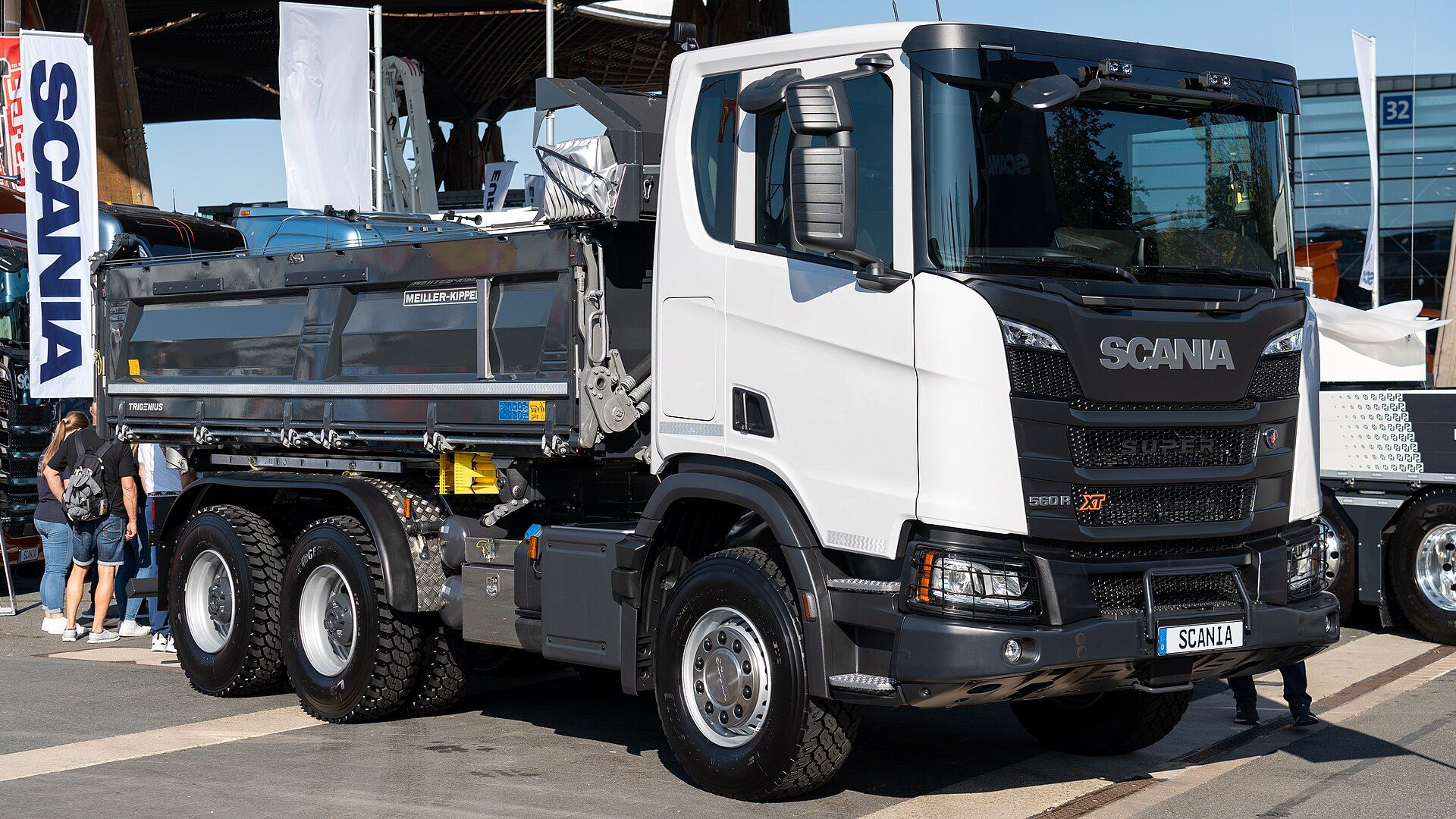
.jpg)
Model overview
Axle configurations: 4x2 · 4x4 · 6x2 · 6x2/2 · 6x2 pusher · 6x2/4 · 6x2 twin-steer · 6x2*4 · 6x4 · 6x6 · 8x2 · 8x2*6 · 8x2 rear-steer · 8x2/4 · 8x2 twin-steer · 8x4 · 8x4*4 · 8x4 rear-steer · 10x4*6 · 10x4 rear-steer
Engine families
- Power
- 309–412 kW
- Torque
- 2300–2800 Nm
- Rated speed
- 1800 rpm
- Power
- 272–397 kW
- Torque
- 1900–2700 Nm
- Power
- 390–566 kW
- Torque
- 2800–3700 Nm
- Power
- 382–478 kW
- Torque
- 2700–3300 Nm
- Rated speed
- 1900 rpm
- Power
- 206–265 kW
- Torque
- 1350–1700 Nm
- Rated speed
- 1900 rpm
- Power
- 162–206 kW
- Torque
- 1000–1200 Nm
- Rated speed
- 1900 rpm
Scania introduced XT on 4 September 2017 as the face of its construction trucks, and its own documents use several words for it: the launch release calls it a model, a version, a design and a range, the 2018 UK construction brochure an execution and a range, and the group and UK websites a range. What all of them say is that XT is applied across Scania’s cab and engine programme — though, as the cab section below shows, not always to the same cabs. Its foundation, in the launch release, is a heavy-duty bumper that protrudes 150 millimetres in front of the cab, with a skid plate, headlamp protection mesh and a towing bolt at the centre classified for 40 tonnes. The 2018 brochure gives the same 40 tonnes for the front tow pin.
That shapes this record. Scania UK’s XT specifications page gathers the range in one place, but it states output in horsepower and torque in newton-metres only. The kilowatts, displacements and rated speeds in the table above come from dated Scania brochures, press releases and data sheets, named family by family below, and where those documents disagree the disagreement is recorded rather than smoothed. The XT joins the Mercedes-Benz Arocs, the Volvo FMX, the MAN TGS and the Iveco T-Way in the construction records here. The other Scania record on the site is the S-series, whose cab the UK page leaves out of XT.
Six engine tables on the UK page, and where each figure comes from
The Euro 6 tab of the UK page carries six engine tables — 16-litre, Super 13-litre, Super 11-litre, 13-litre, 9-litre and 7-litre — each with output, torque, fuel, emission technology and engine PTO columns. Five of those families are in the table above, the V8 in two rows. The Super 11 has a section of its own, because no Scania document opened for this page gives it a kilowatt figure.
The Super 13-litre runs in four steps, 420, 460, 500 and 560 hp, at 2,300 to 2,800 Nm. Scania’s Super 13-litre brochure, Edition 2021.10, gives the same four steps and torques, 12.74 litres, six cylinders in line, 309 to 412 kW, and a rated 1,800 rpm on all four. It and the Super 11 are the two families the UK page lists with Twin SCR.
The 13-litre has five diesel steps — 370, 410, 450, 500 and 540 hp, 1,900 to 2,700 Nm — and a 410 hp gas engine at 2,000 Nm in the same table. Scania’s press information of August 2019 gives 12.7 litres, six cylinders and 272 to 397 kW for the five diesel steps. No rated speed is shown, because the documents do not give one for the family as the UK page groups it. The 2019 press information and the Euro 6 engine data sheets on Scania’s French bodybuilder documentation, dated 19 October 2020, give 1,800 r/min for the diesel steps under the designations DC13 162 to 166. Scania’s release of 7 December 2017 gives 1,900 r/min for the 370, 410, 450 and 500 hp steps under other designations, DC13 149, 141, 148 and 155, and the 2018 UK brochure also gives 1,900. The 2020 data sheets rate a 410 hp gas engine, OC13 101, and a 410 hp ethanol engine, DC13 157, at 1,900 r/min. The UK page names no designation at all.
The 9-litre lists 280, 320 and 360 hp on diesel and 280 and 340 hp on gas, at 1,350 to 1,700 Nm; the lower figure is the 280 hp gas engine’s. The diesel steps’ 206, 235 and 265 kW at 1,900 rpm are stated identically in the December 2017 release, the 2018 brochure and the 2020 data sheets, and the two gas steps, 206 and 250 kW at the same speed, in the brochure and the data sheets. The release and the data sheets give 9.3 litres and five cylinders.
The 7-litre is a six-cylinder at 220, 250 and 280 hp and 1,000 to 1,200 Nm, rated at 1,900 rpm in all three of those documents, with 6.7 litres in the release and the data sheets. One cell does not agree. The 220 hp step is 162 kW in the December 2017 release and the 2020 data sheets and 164 kW in the 2018 brochure. Where these documents give different figures for the same engine, this page follows the latest of them, the 2020 data sheets, so the range here starts at 162 kW, and the other figure is on the record. Why the kilowatt figure, not the horsepower on the badge, is the one type approval uses is set out in how truck power figures are measured.
Two V8 ladders, and no Scania word for the difference
The UK page’s 16-litre table lists seven steps in one column — 770, 660, 650, 590, 580, 530 and 520 hp — without saying which are current or how they relate. They are two ladders, and they are kept as two rows here rather than blended into one span.
- 530, 590, 660 and 770 hp, at 2,800, 3,050, 3,300 and 3,700 Nm. Scania’s V8 brochure, Edition 2025.02, gives 390, 434, 485 and 566 kW and 16.4 litres, rated at 1,900 r/min on the lower three steps and 1,800 r/min at 770 hp, so the row shows no single rated speed. The 2020 data sheets give the same.
- 520, 580 and 650 hp, at 2,700, 3,000 and 3,300 Nm, all at 1,900 r/min. The December 2017 release and the 2018 UK brochure give 382, 427 and 479 kW. The 2020 data sheets, the latest of the three, give 382, 427 and 478 kW, and 16.4 litres where the December 2017 release says 16.3. The row follows the 2020 data sheets, as the 7-litre does, and the earlier figures are recorded here.
The 2025 brochure has only the first ladder. In August 2019, announcing the 540 hp 13-litre, Scania described its V8 engines as starting at 520 hp. The 2020 data sheets list both ladders side by side, as DC16 116, 117 and 118 for 520, 580 and 650 hp and DC16 120, 121, 122 and 123 for 530, 590, 660 and 770 hp. The closest a Scania document comes to comparing them is the 2025 brochure’s “up to 6%” fuel-saving graphic. It lists 2 percent from an “updated engine”, 1 percent from the Opticruise gearbox and 3 percent from cruising in direct drive with a faster rear axle gear. Only that last item carries a footnote, which sets 580 hp with a GRSO gearbox and a 3.08 axle ratio against 590 hp with a G33CM and 2.59; the graphic does not say what the 2 percent for the engine is measured against. No Scania document opened for this page calls either ladder a previous generation, and this page does not.
A 730 hp V8 — 537 kW and 3,500 Nm in the December 2017 release, the 2018 brochure and the 2020 data sheets — is not on the UK XT page, and it is not in the table here.
The Super 11 is on the UK page but not in the table
Scania announced the Super 11 on 20 May 2025, available for purchase from June 2025. The UK page lists it at 350 hp and 1,800 Nm, 390 hp and 2,000 Nm, and 430 hp and 2,200 Nm — the three pairs the release gives — and describes a five-cylinder design sharing 85 percent of its architecture with the 13-litre. The release gives the share as 85 percent of components and names the Super 13 as the engine they are shared with, and says the Super 11 is 85 kg lighter than it. The release and Scania’s Super 11 page both say it meets Euro 4, 5 and 6; the UK XT page shows it under its Euro 6 tab only, with no Super 11 table on the Euro 5 or Euro 4 tabs.
None of those three documents gives a kilowatt figure, a displacement — “11-litre” is the engine’s name, not a measurement — or a rated speed. The table on this page needs a kilowatt figure for every engine family it shows, and one converted here from horsepower would be this site’s arithmetic presented as a Scania rating, so the Super 11 is described in this section instead of being given a row.
Two more things Scania says about it are worth reading closely. For engine braking it gives up to 344 kW, which the release credits to the Variable Valve Brake and the Super 11 page lists as the high setting of a Compression Release Brake, beside a 230 kW standard setting. And it compares the Super 11’s fuel efficiency with the 9-litre, up to 7 percent better — a 9-litre the release calls current and the UK page and the Super 11 page call previous, while the same UK page still lists it in its Euro 6 tab.
Fuels, and the electric XT that has no row
The group XT page says the range can be specified to run on HVO up to 770 hp, biodiesel up to 590 hp, FAME up to 500 hp and gas up to 410 hp, and the UK page’s fuel column bears that out: its highest biodiesel step is the 590 hp V8, its highest FAME step the 500 hp Super 13, and its highest gas step the 410 hp 13-litre. The Super 11 page adds that on Euro 6 the Super 11 takes FAME at 390 and 430 hp only, which is how the UK table marks it.
The same group page says an XT can be specified as a fully electric truck, and gives its continuous output only as an approximate horsepower figure. That is not a figure this record can hold, so there is no electric row.
No weight for the model — ceilings for the rear axle
Scania publishes no gross vehicle or gross combination weight for the XT, and both fields are empty. What the UK page gives instead is a ceiling for each type of rear axle gear, stated as gross vehicle and train weight:
- single driven, single reduction: up to 78 tonnes, gear ratios from 1.95 to 5.57;
- single driven, hub reduction: up to 80 tonnes, ratios from 3.80 to 7.18;
- tandem driven, single reduction, the RB662 + R660 tandem gear: up to 80 tonnes, ratios from 2.92 to 4.88;
- tandem driven, hub reduction: up to 210 tonnes, ratios from 3.52 to 7.63.
These are what Scania says each axle gear can master or manage, not the plated weight of any XT. The plate on the individual vehicle is the weight that applies to it — the distinction set out in gross vehicle and gross combination weight — and the ratio side of the choice is in axle ratios and final drive.
Cabs: the list depends on the document
- The launch release of 4 September 2017 says in its summary that the XT design “can be combined with all cabs and engines”, and in its text that XT can be chosen for all cab versions of P, G, R and S-cabs, regardless of engine option.
- The 2018 UK construction brochure calls XT an execution applicable on the entire cab range, chassis and engine programme, and the same brochure’s cab pages show the S, R, G, P and L series.
- The group XT page says XT is available on most of the cab range in one paragraph and applicable on the entire cab range in another.
- The UK XT specifications page says XT is applicable on the entire cab range except the S-series, and its XT cab section shows the G, P, R and L series.
So the S-series is in the launch release’s list and out of the current UK one. The L-series is in the UK list and not in the launch release’s, but it came later: Scania’s news of 8 December 2017, three months after that release, calls the L-series its newly developed cab series for urban transport. This page does not choose between the lists; for a given market the dealer’s order specification is the answer. What separates the cabs themselves is in truck cabs explained.
Euro 6 in the table, Euro 5, 4 and 3 on the page
The engine rows follow the UK page’s Euro 6 tab, and the emission class is given as Euro 6 because that is all the tab says — no sub-step, which matters for the reasons in Euro 6 and Euro 7 explained. The same page carries three more tabs. Euro 5 has 13-, 9- and 7-litre tables, Euro 4 has 13- and 9-litre tables, and Euro 3 has 13- and 9-litre tables marked without SCR. The page does not say where those are offered, and this record does not guess.
They matter to anyone reading a badge. The Euro 5 and Euro 4 13-litre tables list 380 hp at 1,975 Nm and 440 hp at 2,300 Nm, outputs the Euro 6 tab does not have. The Euro 3 13-litre table lists 460 hp at 2,250 Nm — the same output the Euro 6 tab gives the Super 13 at 2,500 Nm. The emission level, not the number on the grille, separates two such trucks.
Gearboxes and power take-off
Opticruise G25, G33 and G38 head the UK page’s gearbox section: a 14-speed gear range including super-crawler and overdrive options, and the option of up to eight reverse gears, which a planetary gear makes usable at speeds up to 30 km/h — the page’s own example is a tipper reversing a long way. The retarder on the G33 delivers 4,700 Nm at a propeller shaft speed below 600 rpm. Beside them sit range-change boxes with 8 and 8+1 speeds and range-splitter boxes with 12 and 12+2, the 12+2 also in overdrive versions. The 2025 V8 brochure adds that the G33 and G38 come in a CM version for regular road use and a CH version for extra heavy-duty conditions. How the automation works is in automated manual transmissions, and the braking side in retarders and engine braking.
For bodywork, the UK page’s engine PTO column gives 800 Nm on every V8 step, up to 1,000 Nm on the Super 13 and the Super 11, and 600 Nm on the 13-, 9- and 7-litre, and the page describes a PTO programme for Opticruise with nine performance steps.
Wheel configurations
The UK page lists nine tractor wheel formulas and twenty rigid ones, by our count, and every tractor formula also appears in the rigid list, so the record carries the rigid list: 4x2 to 10x4, with pusher, twin-steer and rear-steer variants among them. The page spells one of them “8x4 rear-stear”; it is recorded as rear-steer, the spelling the page uses for the 8x2 and the 10x4. Chassis heights are given per formula, from extra low to high on the 4x2 tractor. The notation is explained in axle configurations explained.
Buying used
Ask for the engine designation, not the badge. A 460 badge can be a Super 13 or, on a Euro 3 truck, a 13-litre without SCR; a 580 and a 590 V8 belong to different ladders; and the 13-litre’s documents give different rated speeds under different designations. The build record settles all three.
Get the rear axle type and the plated weights in writing, since Scania publishes no weight for the model, only what each type of rear axle gear can handle; the plate on the vehicle is the limit that applies. Confirm the emission level from the vehicle’s documents rather than from the grille. And check what the XT specification actually brought on the truck in question: the launch release describes the bumper, skid plate and headlamp protection mesh as the XT front, and two optional XT equipment packages, exterior and interior, whose content may differ by market. The rest belongs to the standard used-truck checks and to roadworthiness and roadside checks.
Where it sits against its rivals
The Arocs, the FMX and the TGS answer the same construction brief, and each record here is built on its maker’s own documents. No scored comparison is offered, because the four makers do not publish on a common basis. Scania’s case is particular: one UK page carries the engine, gearbox, axle and wheel-formula range together, but in horsepower only, so the kilowatts have to be brought in from documents of different years — which is exactly where the disagreements recorded on this page come from.
Quick answers
- Which engines are available in the Scania XT?
- The record for the Scania XT covers these engine families: Scania Super 13-litre (12.74 l), Scania 13-litre (12.7 l), Scania 16-litre V8 · 530/590/660/770 hp (16.4 l), Scania 16-litre V8 · 520/580/650 hp (16.4 l), Scania 9-litre (9.3 l), Scania 7-litre (6.7 l). Output spans 162–566 kW and 1000–3700 Nm.
- What axle configurations does the Scania XT come in?
- 4x2, 4x4, 6x2, 6x2/2, 6x2 pusher, 6x2/4, 6x2 twin-steer, 6x2*4, 6x4, 6x6, 8x2, 8x2*6, 8x2 rear-steer, 8x2/4, 8x2 twin-steer, 8x4, 8x4*4, 8x4 rear-steer, 10x4*6, 10x4 rear-steer.
- What emission standard does the Scania XT meet?
- Euro 6.
Compared with
- Mercedes-Benz Arocs
- Volvo FMX
- MAN TGS
Sources
- XT specifications — engines by emission level, gearboxes, rear axle gears, axle configurations, cab range — Scania
- XT is the face of Scania's toughest trucks (press release, 4 September 2017) — Scania
- XT Truck range — for tough challenges — Scania
- Construction: technical specifications and options — tailored strength for heavy duty (UK brochure, Edition 2018.01) — Scania
- Scania Super 13-litre engine (brochure, Edition 2021.10) — Scania
- Scania adds a 540 hp version to its 13-litre engine range (press info, 16 August 2019) — Scania
- The Scania V8 Range (brochure, Edition 2025.02) — Scania
- Scania introduces a 7-litre family for improved efficiency and reduced weight (press release, 7 December 2017, with technical data for the DC07, DC09, DC13 and DC16 Euro 6 engines) — Scania
- Moteurs Euro 6 NTG — engine data sheets dated 19/10/2020 (Scania bodybuilder documentation, France) — Scania
- Scania unveils the Super 11 engine (press release, 20 May 2025) — Scania
- Super 11-litre engine — Scania
- Lowering threshold for urban deliveries (news, 8 December 2017, introducing the L-series cab) — Scania