Scania 13-litre engine (DC13, OC13, Super 13): versions, fuels and ratings
Scania's 12.7-litre six-cylinder in-line engine: the DC13 diesel, the OC13 gas engine and the Super 13 of 2021, with their fuels, Euro 6 aftertreatment and ratings.
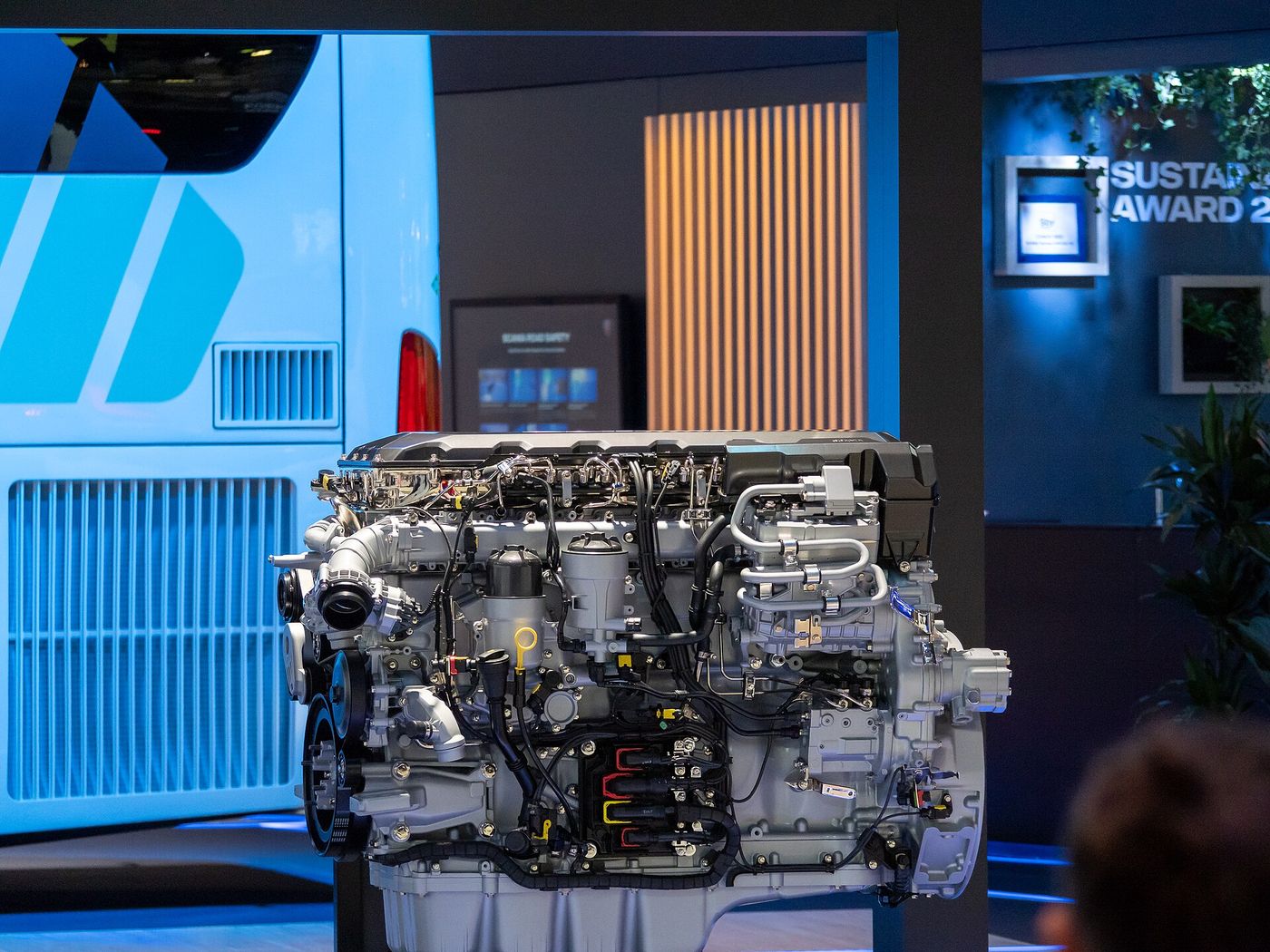
The Scania 13-litre is the six-cylinder in-line engine of 12.7 litres that Scania CV AB of Södertälje, Sweden, builds for its heavy trucks and its coaches. In Scania’s documents the diesel versions carry DC13 designations and the gas versions OC13; the Super 13-litre is the engine of the Scania Super powertrain, which Scania has used in trucks since 2021 and has since also put into coaches. The DC13 and the Super run on diesel and HVO, several ratings also on biodiesel, and the OC13 runs on gas. Scania’s documents give the DC13, the OC13 101 and the Super as Euro 6 engines; its P-series page also lists 13-litre ratings for Euro 5, Euro 4 and Euro 3. On this site it is the 13-litre engine of the Scania G-, P-, R- and S-series and the Scania XT.
Status as of 26 October 2026. Scania’s Super 13-litre engine brochure (edition 2021.10), its press releases of 21 September 2016, 4 September 2017 and 7 December 2017 (two), its OC13 101 data sheet, Scania UK’s biogas engine release of December 2023, Scania Singapore’s launch news of 1 April 2021, Scania’s Super Powertrain page, its P-series and UK S-series specification pages and its news article of 22 January 2026 on the Super 13-litre for coaches were read on 26 October 2026. Each figure is given in the units its document uses, mostly hp and Nm, with kW where Scania gives them; how the units relate is explained in kW, hp and Nm: how to read a truck’s power figures.
What the 13-litre is
Scania names each version by family and number. Its release of 21 September 2016 lists the Euro 6 diesels DC13 141, DC13 148 and DC13 155; its release of 4 September 2017 adds the DC13 149; the Super 13-litre brochure lists the DC13 173, 174, 175 and 176; Scania UK’s S-series page lists the DC13 163, 164, 165 and 166; and the gas engines are the OC13 101, OC13 103 and OC13 104. The documents read do not explain the numbering.
The base data below are those Scania prints in each document; a dash means that document does not give the item.
| Item | DC13 diesel (releases of 2016 and 2017) | OC13 gas (releases of 2017 and 2023) | Super 13-litre (brochure, edition 2021.10) |
|---|---|---|---|
| Cylinders | 6, inline six | 6, inline | 6 inline |
| Displacement | 12.7 litres | 12.7 litres (12.74 dm³ on the OC13 101 data sheet) | 12.74 litres (swept volume) |
| Bore x stroke | 130 x 160 mm | 130 x 160 mm | — |
| Valves per cylinder | 4 | 4 | — |
| Firing order | 1-5-3-6-2-4 | 1-5-3-6-2-4 | — |
| Compression ratio | 19.4:1 (2016 release: DC13 141, 148 and 155) | 12.6:1 | — |
| Fuel injection | Scania XPI | Bosch (OC13 101); Bosch + CEM1 (OC13 103 and 104) | — |
| Ignition | — | Spark plugs, Otto principle | — |
| Emission control | Scania SCR (2016: Scania FGT, DOC, DPF, SCR) | Scania EGR and three-way catalytic converter | Twin SCR |
| Exhaust or engine brake | Exhaust brake 256 kW at 2,400 rpm | — | Optional compression release brake, up to 350 kW |
The OC13 101 data sheet gives the same 12.74 dm³ with a cylinder bore of 130 mm and a piston stroke of 140 mm; Scania’s releases of 2017 and 2023 give the gas engine’s bore and stroke as 130 x 160 mm, the figures of the DC13. The data sheet calls the engine a “Straight 6-cylinder gas engine with EGR.”
For the Super 13-litre, Scania’s S-series page says “Dual overhead camshafts are introduced to enhance gas exchange”, and the brochure describes the new cylinder head that carries them and the compression release brake, which it says weighs 7 kg. What an engine brake is, and how the law groups it with retarders, is explained in What is a retarder?
Fuels
Diesel and HVO. Scania’s release of 21 September 2016 quotes its truck division on “HVO, which can already be used in all our Euro 6 engines, regardless of the truck generation”. Its release of 4 September 2017 says that all of Scania’s Euro 5 and Euro 6 engines “can run on a mixture of up to 100% hydro-treated vegetable oil (HVO) and any proportion of diesel and HVO, regardless of engine family”, and the P-series page reads today: “The entire Scania Euro 6 engine range is approved to run on up to 100% HVO.” What HVO is is set out in What is HVO?
Biodiesel. The 2017 release says: “All of Scania’s Euro 6 diesel engines are already certified for a mixture of up to 10 percent biodiesel in their basic configuration”. Scania’s specification pages give the fuel of each DC13 rating: “Diesel/HVO/Biodiesel” for the 410, 450 and 500 hp engines, “Diesel/HVO” for the 370 and 540 hp engines. For the Super 13-litre, the brochure says the range “delivers compatibility with a range of low-emission HVO fuels and biodiesel/FAME fuels”, with HVO “Available across the entire Scania Super performance range” and biodiesel “Available on Scania Super 460 and 500 horsepower engines”; Scania’s specification pages list “Diesel/HVO/FAME” for the 460 and 500 hp Super and “Diesel/HVO” for the 420 and 560 hp. Scania Singapore’s launch news of 2021 describes the new engine platform “with inherent capability to handle HVO and FAME biodiesel alternative fuels”, and Scania’s article of January 2026 says of the coach version that “the Super Powertrain is ready for Euro 7 and compatible with all biofuels”.
Ethanol. Under its Euro 6 tab, Scania’s P-series page lists one 13-litre rating for ethanol: 410 hp with 2150 Nm, with SCR.
Gas. The OC13 is a gas engine. Scania’s release of 7 December 2017 says it “runs on gas using the Otto principle, with spark plugs and complete combustion”, describes Scania’s gas engines as “based on stoichiometric combustion – i.e., complete combustion of both fuel and oxygen”, and says that “Both LNG tanks (for liquefied natural gas) and CNG tanks (for compressed natural gas) can be ordered directly from Scania.” Scania calls the OC13 103 and OC13 104 of 2023 its “13-litre biogas engines”. Gas trucks and their fuels are covered in LNG and bio-LNG trucks.
Emission class and aftertreatment
Scania’s documents give the DC13, the OC13 101 and the Super 13-litre as Euro 6 engines; Scania UK’s 2023 release on the OC13 103 and OC13 104 names no emission class. The steps of the standard are explained in Euro VI (Euro 6) and Euro 7 for trucks.
DC13: SCR only. Scania’s release of 21 September 2016 says: “All of Scania’s 13-litre engines from the new 500-horsepower version down now rely exclusively on SCR for aftertreatment.” Its release of 4 September 2017 says that, with a few exceptions, Scania now uses “only selective catalytic reduction (SCR) for exhaust gas after-treatment”, and describes the engines as built “with a fixed geometry turbocharger, and without exhaust gas recirculation in the form of an EGR system”. The 2016 release lists the 13-litre’s emissions system as Scania FGT, DOC, DPF and SCR.
Super 13-litre: Twin SCR. The Super uses what Scania calls the Scania Twin SCR system; its Super Powertrain page describes it as introducing “dual dosing of AdBlue” in the aftertreatment. How SCR and AdBlue work is explained in SCR and AdBlue.
OC13: EGR and a three-way catalyst. Scania’s data for the OC13 101, OC13 103 and OC13 104 give the emission control as Scania EGR and a three-way catalytic converter.
Euro 5, Euro 4 and Euro 3. Scania’s P-series specifications page has tabs for Euro 6, Euro 5, Euro 4 and Euro 3, and lists 13-litre ratings under each; the Euro 5 and Euro 4 ones with SCR, the Euro 3 ones “Without SCR” (see the ratings below).
Euro 7. Scania’s article of 22 January 2026 says the Super 13-litre powertrain for coaches has been prepared for “future emission and noise regulations, including Euro 7”. The documents read give no Euro 7 rating or approval for the engine.
Generations and versions
Euro 6 DC13 in Scania’s new truck generation (2016). Scania’s release of 21 September 2016, for the IAA that year, announces “a new version of Scania’s inline 13-litre engine for Euro 6” with 500 hp and lists three 13-litre engines for the new truck range: DC13 141 (410 hp), DC13 148 (450 hp) and DC13 155 (500 hp). It says all Euro 6 engines in the new range “feature new engine management systems”.
DC13 149 (2017). Scania’s release of 4 September 2017 says the 13-litre range “has been complemented by a 370 horsepower version”, and its DC13 table lists the DC13 149 (370 hp) with the DC13 141, 148 and 155.
OC13 101 gas engine (releases of December 2017). Scania’s release of 7 December 2017 says Scania introduced its 13-litre gas engine “at the Italian trade fair Ecomondo” and describes the OC13 as based on Scania’s 13-litre engines but newly developed for gas. The engine “always runs in combination with Scania Opticruise”, Scania’s automated gearbox. The OC13 101 data sheet is marked “Valid from: 11/8/2017” and is filed with Scania’s K-chassis coach pages.
Super 13-litre (2021). Scania Singapore’s news of 1 April 2021 announces “an all-new engine platform for Euro 6 vehicles” with “13-litre engines for 420-560 horsepower” and says “The 13-litre engine is part of the new powertrain called Scania Super”. Scania’s brochure, edition 2021.10, lists the DC13 173 to 176 from 420 to 560 hp.
OC13 103 and OC13 104 biogas engines (December 2023). Scania UK’s release, dated 8 December 2023 and datelined Södertälje, 7 December 2023, launches two 13-litre biogas engines of 420 and 460 hp. “First teased at last year’s IAA show in Hanover, Germany”, they “utilise components from the latest generation Super diesel powertrain”, and Scania describes them as “a refinement of the previous generation 13-litre gas units”, with “preparation to meet future legal demands”.
Super 13-litre for coaches (article of January 2026). Scania’s article of 22 January 2026 presents “Scania’s Super 13-litre powertrain for coaches” and says: “The Super Powertrain shares some 90 percent of its components with the 13-litre engine that has been used on trucks since 2021”.
DC13 163 to 166 (current UK tables). Scania UK’s S-series specifications page lists four DC13 engines by engine ID: DC13 163 (410 hp), DC13 164 (450 hp), DC13 165 (500 hp) and DC13 166 (540 hp). The documents read do not say when these IDs were introduced or how they relate to the DC13 141, 148 and 155 of 2016.
Ratings as Scania states them
| Engine | Maximum power | Maximum torque | Fuel (S-series page) |
|---|---|---|---|
| DC13 176 | 420 hp (309 kW) at 1,800 rpm | 2,300 Nm at 900–1,280 rpm | Diesel/HVO |
| DC13 175 | 460 hp (338 kW) at 1,800 rpm | 2,500 Nm at 900–1,290 rpm | Diesel/HVO/FAME |
| DC13 174 | 500 hp (368 kW) at 1,800 rpm | 2,650 Nm at 900–1,320 rpm | Diesel/HVO/FAME |
| DC13 173 | 560 hp (412 kW) at 1,800 rpm | 2,800 Nm at 900–1,400 rpm | Diesel/HVO |
The brochure says the Super produces “full torque from 900 rpm”. Scania’s P-series page lists the Super 13-litre for the P-series at 420, 460 and 500 hp; the UK S-series page lists all four ratings.
| Engine | Maximum power | Maximum torque | Fuel | Document |
|---|---|---|---|---|
| DC13 149 | 370 hp (272 kW) at 1,900 rpm | 1,900 Nm at 1,000–1,300 rpm | — | Release, 4 September 2017 |
| DC13 141 | 410 hp (302 kW) at 1,900 rpm | 2,150 Nm at 1,000–1,300 rpm | — | Releases, 21 September 2016 and 4 September 2017 |
| DC13 148 | 450 hp (331 kW) at 1,900 rpm | 2,350 Nm at 1,000–1,300 rpm | — | Releases, 21 September 2016 and 4 September 2017 |
| DC13 155 | 500 hp (368 kW) at 1,900 rpm | 2,550 Nm at 1,000–1,300 rpm | — | Releases, 21 September 2016 and 4 September 2017 |
| DC13 163 | 410 hp | 2150 Nm | Diesel/HVO/Biodiesel | UK S-series page |
| DC13 164 | 450 hp | 2350 Nm | Diesel/HVO/Biodiesel | UK S-series page |
| DC13 165 | 500 hp | 2550 Nm | Diesel/HVO/Biodiesel | UK S-series page |
| DC13 166 | 540 hp | 2700 Nm | Diesel/HVO | UK S-series page |
Scania’s P-series page lists, without engine IDs, its Euro 6 13-litre at 370 hp with 1900 Nm (Diesel/HVO), 410 hp with 2150 Nm (Diesel/HVO/Biodiesel and, as a separate row, Ethanol), 450 hp with 2350 Nm and 500 hp with 2550 Nm. Scania UK’s S-series page also has a 370 hp, 1900 Nm row for Diesel/HVO with SCR, which it labels OC13 101, the ID it also gives its 410 hp gas engine.
| Engine | Maximum power | Maximum torque | Document |
|---|---|---|---|
| OC13 101 | 410 hp (302 kW) at 1,900 rpm | 2,000 Nm at 1,100–1,400 rpm | Release, 7 December 2017; OC13 101 data sheet |
| OC13 103 | 420 hp (311 kW) at 1,900 rpm | 2,100 Nm at 1,000–1,300 rpm | Scania UK release, 8 December 2023 |
| OC13 104 | 460 hp (340 kW) at 1,900 rpm | 2,300 Nm at 1,000–1,300 rpm | Scania UK release, 8 December 2023 |
Scania UK’s S-series page lists the OC13 101 at 410 hp and 2000 Nm, with the fuel “Gas” and EGR.
| Emission level | Power and torque | Fuel | Emission technology |
|---|---|---|---|
| Euro 5 | 380 hp, 1975 Nm; 410 hp, 2150 Nm; 440 hp, 2300 Nm; 450 hp, 2350 Nm | Diesel/HVO/Biodiesel | Selective catalytic reduction (SCR) |
| Euro 4 | 380 hp, 1975 Nm; 410 hp, 2150 Nm; 440 hp, 2300 Nm; 450 hp, 2350 Nm | Diesel/HVO/Biodiesel | Selective catalytic reduction (SCR) |
| Euro 3 | 360 hp, 1800 Nm; 410 hp, 2050 Nm; 460 hp, 2250 Nm | Diesel/HVO/Biodiesel | Without SCR |
Braking and power take-off. For the Super 13-litre, Scania’s S-series page gives “auxiliary engine braking capacity up to 350 kW” through the optional compression release brake, and the Super Powertrain page lists two new optional engine-driven PTOs with torque “up to 1000Nm” and power output “up to 238kW”. For the DC13, the releases of 2016 and 2017 give an exhaust brake of 256 kW at 2,400 rpm, and Scania’s specification pages list an engine PTO of 600 Nm.
Trucks and buses on this site with the Scania 13-litre (DC13, OC13, Super 13)
Five model pages on this site carry the Scania 13-litre in their engine records, all of them trucks; no bus on this site records the engine. The Scania L-series page names a 13-litre only in its Euro 4 and Euro 3 engine tables and has no engine record for it. The figures below are those of each model’s own page and of the Scania source that page cites, in kilowatts and newton-metres as the site’s records keep them; they are not the engine-level tables above.
| Model | Engine as recorded | Power (kW) | Torque (Nm) |
|---|---|---|---|
| Scania G-series | Scania Super 13-litre | 309–412 | 2,300–2,800 |
| Scania G-series | Scania 13-litre | 272–397 | 1,900–2,700 |
| Scania P-series | Scania Super 13-litre | 309–368 | 2,300–2,650 |
| Scania P-series | Scania 13-litre | 272–368 | 1,900–2,550 |
| Scania P-series | Scania 13-litre gas · OC13 101 | 302 | 2,000 |
| Scania R-series | Scania Super 13-litre | 309–412 | 2,300–2,800 |
| Scania R-series | Scania 13-litre | 272–397 | 1,900–2,700 |
| Scania R-series | Scania 13-litre gas · OC13 101 | 302 | 2,000 |
| Scania R-series | Scania 13-litre gas · OC13 103 / OC13 104 | 311–340 | 2,100–2,300 |
| Scania S-series | Scania Super 13-litre | 309–412 | 2,300–2,800 |
| Scania S-series | Scania 13-litre | 272–397 | 1,900–2,700 |
| Scania S-series | Scania 13-litre gas · OC13 101 | 302 | 2,000 |
| Scania XT | Scania Super 13-litre | 309–412 | 2,300–2,800 |
| Scania XT | Scania 13-litre | 272–397 | 1,900–2,700 |
Quick answers
- What is the displacement of the Scania 13-litre engine?
- 12.7 litres. Scania's releases give the DC13 diesel and the OC13 gas engine as six-cylinder in-line engines of 12.7 litres with a bore and stroke of 130 x 160 mm. The Super 13-litre brochure gives a swept volume of 12.74 litres, and the OC13 101 data sheet a displacement of 12.74 dm³.
- What are the Scania DC13, OC13 and Super 13?
- Versions of Scania's 13-litre engine. DC13 is the designation of the diesel versions, such as the DC13 141 (410 hp) of 2016. OC13 is the gas version, which runs on the Otto principle with spark plugs: the OC13 101 (410 hp), in Scania's releases of December 2017, then the OC13 103 (420 hp) and OC13 104 (460 hp) of December 2023. The Super 13-litre is the engine of the Scania Super powertrain, launched in 2021, which Scania's brochure lists as DC13 173 to DC13 176 with Twin SCR.
- How much power and torque does the Scania Super 13-litre have?
- 420 to 560 hp. Scania's Super 13-litre brochure lists four Euro 6 ratings: 420 hp (309 kW) with 2300 Nm, 460 hp (338 kW) with 2500 Nm, 500 hp (368 kW) with 2650 Nm and 560 hp (412 kW) with 2800 Nm, each at 1800 rpm, with full torque from 900 rpm. For the earlier Euro 6 DC13, Scania's 2017 release lists 370 hp (272 kW) with 1900 Nm up to 500 hp (368 kW) with 2550 Nm, and Scania UK's S-series page lists a DC13 166 of 540 hp with 2700 Nm.
- Can the Scania 13-litre run on HVO or biodiesel?
- Yes, on Scania's account. Its 2017 release says all its Euro 5 and Euro 6 engines “can run on a mixture of up to 100% hydro-treated vegetable oil (HVO) and any proportion of diesel and HVO, regardless of engine family”. For the Super 13-litre the brochure gives HVO for the whole range and biodiesel/FAME for the 460 and 500 hp engines. Scania's specification pages list diesel, HVO and biodiesel for the 410, 450 and 500 hp DC13, and the P-series page lists a 410 hp 13-litre for ethanol.
- Which emission standard does the Scania 13-litre meet?
- Euro 6 for the DC13, the OC13 101 and the Super 13-litre in Scania's documents; Scania UK's 2023 release on the OC13 103 and OC13 104 names no emission class. The DC13 and the Super 13-litre use SCR only, the Super with Scania's Twin SCR and its dual dosing of AdBlue; the OC13 gas engine uses EGR with a three-way catalytic converter. Scania's P-series page also lists 13-litre ratings under Euro 5, Euro 4 and Euro 3, the Euro 3 ones without SCR, and Scania says its Super 13-litre powertrain for coaches is ready for Euro 7.
Models in this article
Sources
- Scania Super 13-litre engine (brochure, edition 2021.10) — Scania CV AB
- Scania's new powertrain cuts fuel bills by three percent (press release, 21 September 2016, IAA 2016, with Euro 6 engine data) — Scania, 21 Sept 2016
- Powertrains for all requirements and applications (press release, 4 September 2017, with DC13 technical data) — Scania, 4 Sept 2017
- Scania's 13-litre engine – a breakthrough for gas in long-distance transport (press release, 7 December 2017, with OC13 101 technical data) — Scania, 7 Dec 2017
- Scania extends its gas offering with powerful 13-litre gas trucks for sustainable solutions (press release, 7 December 2017) — Scania, 7 Dec 2017
- OC13 101 / 410 hp / 2000 Nm / Euro6 (engine data sheet, valid from 11/8/2017, Scania K-chassis coach pages) — Scania
- Scania launches new powertrain and major updates to its trucks in Singapore (news, 1 April 2021) — Scania Singapore, 1 Apr 2021
- High Five: Scania's new biogas engines have just got greener (press release, 8 December 2023, with data for OC13 103 and OC13 104) — Scania UK, 8 Dec 2023
- Super Powertrain (product page, read 26 October 2026) — Scania Group
- P-series specifications — engines by emission level (read 26 October 2026) — Scania Group
- S-series specifications — engine tables with engine IDs (read 26 October 2026) — Scania UK
- Inside Scania's Super 13-litre powertrain (news on the Super 13-litre for coaches, 22 January 2026) — Scania Group, 22 Jan 2026