Scania
Scania L-series
Scania's L-series low-entry city cab: three day-cab heights, a kneeling function, City Safe Window and City Door, 7- to 13-litre diesel engines, 9-litre gas and the electric L.
- 7 configurations
- Euro 6

Model overview
- Segment
- Distribution
- Axle configurations
- 7 (4x2…)
- Emission
- Euro 6
- Transmission
- Allison 6-speed fully automatic, with or without retarder; Scania Opticruise G25 / G33 range-splitter 12+2-speed (14 speeds with crawler and overdrive), four reverse gears; Scania Retarder available
Axle configurations: 4x2 · 6x2 · 6x4 · 6x2*4 · 6x2/4 · 8x4*4 · 8x2/*4
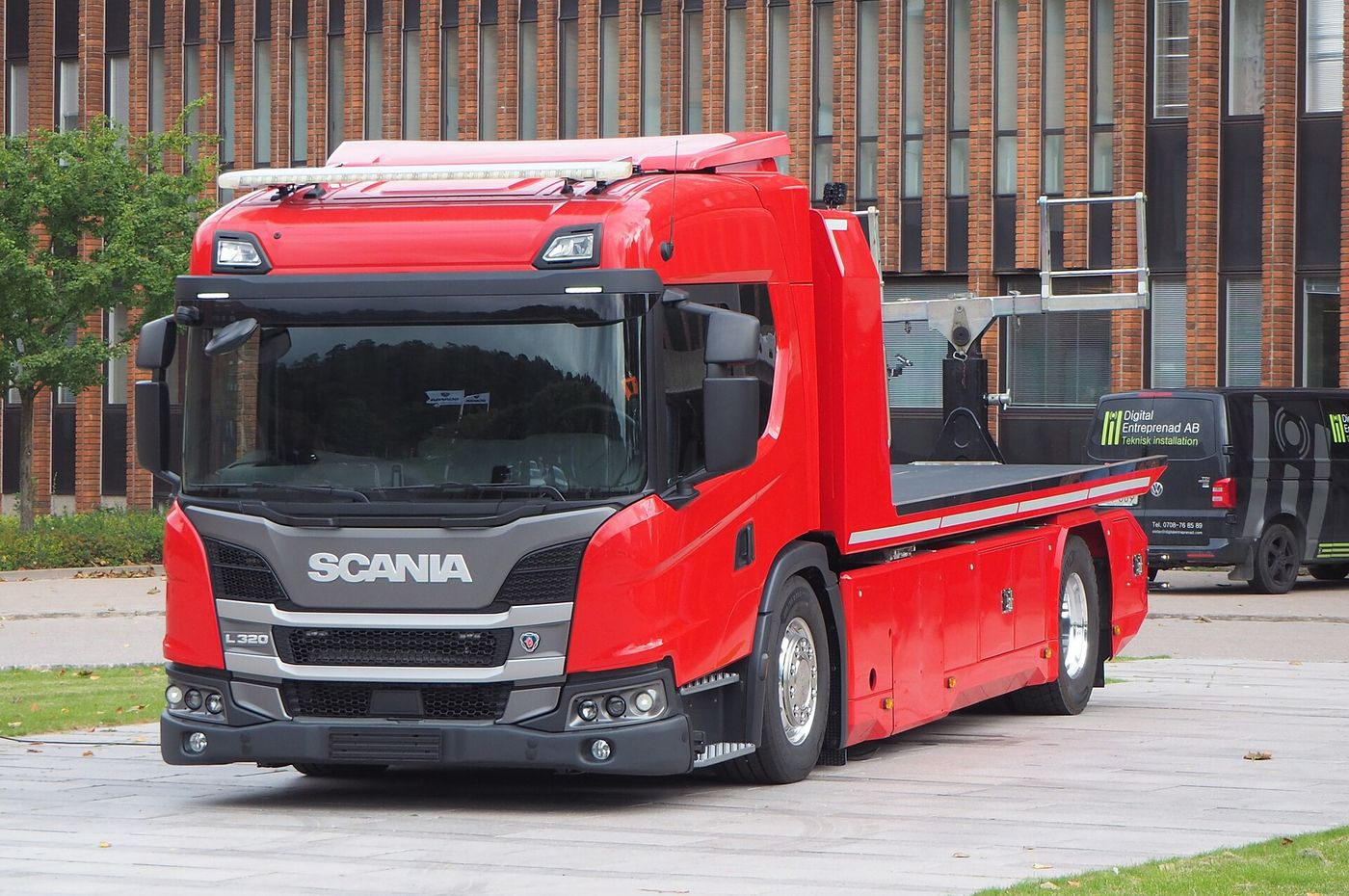
The L-series is the low-entry cab of Scania’s truck range, presented on Scania UK’s L-series page as “Low-entry cab trucks tailored for urban operations”. The cab sits low and far forward on the chassis, with the driver at the same height as the traffic around the vehicle, and Scania offers it in three day-cab heights, “fully integrated into Scania’s modular system”. Scania’s specifications page for the cab names distribution and other applications that operate mainly in urban environments with heavy traffic. Scania UK’s truck pages list the L-series beside the G-, P-, R- and S-series cabs, the CrewCab and the XT range; the Scania P-series, R-series, S-series and XT have pages of their own.
The figures on this page come from two Scania UK pages for the Great Britain market, both read on 26 October 2026: the L-series page, with the cab options and the access and visibility features, and the L-series specifications page, with engines by emission level, the electric drive, gearboxes, rear axle gears and axle configurations. In the specifications page’s metadata, its text blocks and tables were last modified on 30 September 2026, apart from the table headed “9-litre CBG/CNG”, last modified on 19 June 2023. No document opened gives a launch date for the L-series or describes earlier generations of the cab.
Cab
Scania’s UK L-series page lists three cab options, all day cabs without a bed. Cab heights are given without air deflectors, and each cab card gives a powertrain of 280–430 hp.
| Cab | Cab height | Bed | Powertrain | Scania’s description |
|---|---|---|---|---|
| L-day cab low | 2,700 mm | no | 280–430 hp | the lowest cab in the range, for low total height, for example to enter and leave a garage or when operating at airports |
| L-day cab normal | 3,040 mm | no | 280–430 hp | the middle-sized cab; two additional seats can be mounted on the engine tunnel, so that three passengers can be carried |
| L-day cab high | 3,300 mm | no | 280–430 hp | a more spacious cab with extra room for storage and additional headroom for the crew |
With the cab low and far forward on the chassis and the engine tunnel, in the page’s words, “out of the way”, the driver can climb in and out on either side of the vehicle. The boarding steps are 790 mm wide, combined with what Scania calls “a very generous door opening angle”. A kneeling function, standard in one-step versions and an option for two-step versions, lowers the suspension by 100 mm when the parking brake is applied. The L-series can be fitted with up to three passenger seats, two of them in the centre of the cab, for four people in the cab in all.
Scania says its cabs and cab suspension are designed to reduce noise and vibrations, and the driver seat and steering wheel are adjustable. The page names no cab width, cab length, engine tunnel height or standing height. How low-entry cabs differ from day and sleeper cabs in general is set out in truck cabs explained.
Visibility and safety
Scania’s UK L-series page describes the cab as designed for tight urban environments and optimised for the working environment and direct vision, “without compromising on crash certification”. Scania describes a lower driving position that places the driver at the same height as the other traffic around the vehicle, and says a lower dashboard and windowsill, compact mirror housings and narrow A-pillars improve driver visibility by 12 percent.
The City Safe Window is a low-level window in the door that gives the driver a view of nearby pedestrians and cyclists. The City Door swings inward, so that the crew can leave the cab on the passenger side on busy roads or in tight spaces, for example when the truck is parked close to a wall or fence; Scania describes it for operations in which staff frequently exit and enter during their workday. Neither page opened names driver-assistance systems for the L-series. London’s permit scheme for the direct view from HGV cabs is described in London Direct Vision Standard.
Engines
Scania UK’s L-series specifications page lists its powertrains under five tabs: Electric, Euro 6, Euro 5, Euro 4 and Euro 3. The diesel tables are below; the gas and electric versions follow.
| Engine (page heading) | Tabs | Output / torque, as listed | Fuel | Emission technology | Engine PTO |
|---|---|---|---|---|---|
| 7-litre | Euro 6, Euro 5 | 220 hp / 1,000 Nm · 250 / 1,100 · 280 / 1,200 | Diesel/HVO/Biodiesel; Diesel/HVO for 220 hp on the Euro 5 tab | SCR | 600 Nm |
| 9-litre | Euro 5, Euro 4, Euro 3 | 280 hp / 1,400 Nm · 320 / 1,600 · 360 / 1,700 | Diesel/HVO/Biodiesel | SCR | 600 Nm |
| Super 11 | Euro 6, Euro 5, Euro 4 | 350 hp / 1,800 Nm · 390 / 2,000 · 430 / 2,200 | Diesel/HVO/FAME; Diesel/HVO for 350 hp | Twin SCR | up to 1,000 Nm |
| 13-litre | Euro 4, Euro 3 | 380 hp / 1,975 Nm · 410 / 2,150 · 440 / 2,300 · 450 / 2,350 | Diesel/HVO/Biodiesel | SCR | 600 Nm |
On the Euro 6 tab, the table headed “9-litre” repeats the three rows of the 7-litre table, 280, 250 and 220 hp with 1,200, 1,100 and 1,000 Nm, and the table headed “9-litre CBG/CNG” holds an electric row, described under Battery-electric L below. The cab cards give a powertrain of 280 to 430 hp, while the tables run from 220 hp on the 7-litre to 450 hp on the 13-litre. The page names no Euro 6 sub-step and does not say where the Euro 5, Euro 4 and Euro 3 tabs apply.
The 7-litre engines are, in Scania’s description, lightweight six-cylinder units of 220 to 280 hp that can run on HVO without modification and can be equipped with the ED70P PTO.
The 9-litre diesel versions have, according to the page’s text, 280 to 360 hp and can run on FAME/biodiesel or HVO without modification.
The Super 11-litre is a compact, lightweight five-cylinder engine that Scania says shares 85% of its architecture with the 13-litre, with up to 7% lower fuel consumption than the previous Scania 9-litre. The page gives it at 350, 390 and 430 hp, with Twin SCR.
The 13-litre appears only in the tables of the Euro 4 and Euro 3 tabs, at 380 to 450 hp; the page has no text block on it.
No document opened gives the kilowatt ratings, exact displacements or rated speeds of these engines. The fuel is described in what is HVO fuel.
Gas
The page’s text block “9-litre CBG/CNG engine” describes straight five-cylinder gas engines that are Euro 6 certified, with two power outputs: 280 hp with 1,350 Nm and 340 hp with 1,600 Nm. Scania offers various gas tank solutions, which make axle distances as short as 3,350 mm possible. Neither gas output appears in a table on the page.
Battery-electric L
The specifications page describes a “2-4 speed Electric machine”: a two-speed electric machine with a continuous output from 210 kW (290 hp) to 330 kW (440 hp), and an e-PTO whose design the bodybuilder can tailor to the type of bodywork, with the bodybuilder suggesting the inverter for driving a specific external system. The Electric tab lists five steps with two- and four-speed gearboxes:
| Continuous power | Regeneration power (peak) | Gearbox speeds | Installed battery | Charging power, max | PTO types |
|---|---|---|---|---|---|
| 210 kW | 294 kW | 2 | 356 / 445 / 535 / 624 kWh | 375 / 750 kW | EL, EM, EC |
| 240 kW | 294 kW | 2 | 356 / 445 / 535 / 624 kWh | 375 / 750 kW | EL, EM, EC |
| 270 kW | 410 kW | 4 | 356 / 445 / 535 / 624 kWh | 375 / 750 kW | EL, EM, EC |
| 300 kW | 410 kW | 4 | 356 / 445 / 535 / 624 kWh | 375 / 750 kW | EL, EM, EC |
| 330 kW | 410 kW | 4 | 356 / 445 / 535 / 624 kWh | 375 / 750 kW | EL, EM, EC |
Beneath the table the page explains EL as an electric PTO at 650 V DC, EM as electromechanical at 60 kW and EC as mechanical in various options. The battery column gives installed capacity; the difference from usable capacity is explained in installed vs usable battery capacity.
On the Euro 6 tab, the table headed “9-litre CBG/CNG”, last modified on 19 June 2023 according to the page’s metadata, gives a single electric row: 230 kW and 1,300 Nm, both continuous, electricity as the fuel, “N.a.” for emission technology, a 60 kW e-PTO, a battery capacity of 165/300 kWh and a charging power of 139 kW. Neither page gives a range for the electric L.
Transmission
The page gives the gearbox range as 6-speed Allison fully automatic gearboxes and 12- and 14-speed gearboxes with Scania Opticruise, available with the Scania Retarder. The fully automatic offer includes a number of different 6-speed gearboxes, with an oil cooler as standard, with or without retarder and with power take-offs for a wide range of applications.
The range-splitter gearboxes, listed as 12+2-speed, are the G25 and G33, with 14 speeds including a crawler and an overdrive gear and four reverse gears as standard. Scania says their light design saves 60 to 75 kg, that they take 2,500 and 3,300 Nm of engine torque, and that their total gear ratio range is 26.81, from 20.81 on the crawler to 0.78 for the overdrive. A lay shaft brake shortens the time needed to change up and the engagement time of the PTO and of the reverse and crawler gears. The electric L has two- or four-speed gearboxes, as the Electric tab above shows.
Axles, suspension and brakes
The specifications page lists front and rear axles and fixed and steered tag axles, and gives the wheel formulas with their chassis heights. Tractors: 4x2 (normal or low), 6x2 (normal or low), 6x4 (normal) and 6x2/4 (normal). Rigids: 4x2 (normal or low), 6x2 (normal or low), 6x4 (normal), 6x2*4 (normal or low), 6x2/4 (normal), 8x4*4 (normal) and 8x2/*4, marked S-Order (normal). How such codes are built is explained in truck axle configurations.
All rear axle gears are offered with differential locks. Their capacities are stated as gross vehicle and train weights: up to 78 tonnes for single driven single reduction (ratios 2.35 to 5.57), 80 tonnes for single driven hub reduction (3.80 to 7.18), 80 tonnes for the RB662 + R660 tandem driven single reduction (2.92 to 4.88) and 210 tonnes for tandem driven hub reduction (3.52 to 7.63).
The kneeling function lowers the suspension by 100 mm with the parking brake applied; a quotation on the L-series page, with no speaker named, says the front air suspension drops 100 millimetres. Apart from the kneeling function, the cab suspension and the Scania Retarder option, the pages give no suspension or brake data.
Dimensions and weights
Neither page opened gives a gross vehicle or gross combination weight for the L-series as a model; the rear axle gear capacities above are ratings for the axles. The pages give the three cab heights, the 790 mm boarding steps, the 100 mm kneeling travel and, for the gas versions, axle distances as short as 3,350 mm. No document opened gives an overall length, width, wheelbase range or fuel, AdBlue or gas tank capacity.
Equipment, bodywork and power take-off
The engine PTO column gives 600 Nm for the 7-, 9- and 13-litre engines and up to 1,000 Nm for the Super 11; the 7-litre can take the ED70P PTO, the 6-speed automatic gearboxes include power take-offs, and the electric L takes electric, electromechanical or mechanical PTO. For uses, the cab cards name garages and airports for the low cab, and the L-series page tells of WIKAB, a Swedish company working with road safety, which chose a Scania low-entry cab for its TMA truck.
Source notes
The two Scania UK pages opened give no weight for the L-series as a model. The UK L-series specifications page gives rear axle gear capacities as gross vehicle and train weights: up to 78 t single driven single reduction, 80 t single driven hub reduction, 80 t tandem driven single reduction and 210 t tandem driven hub reduction. The UK L-series page gives three day cabs without a bed, with cab heights without air deflectors of 2,700 mm (L-day cab low), 3,040 mm (L-day cab normal) and 3,300 mm (L-day cab high), and a powertrain of 280-430 hp for each. The two pages give the combustion engines in hp and Nm and no kilowatt figure. The electric drive is given in kW: 210 to 330 kW continuous, with 356 to 624 kWh of installed battery capacity and a maximum charging power of 375 or 750 kW.
Quick answers
- What axle configurations does the Scania L-series come in?
- 4x2, 6x2, 6x4, 6x2*4, 6x2/4, 8x4*4, 8x2/*4.
- What emission standard does the Scania L-series meet?
- Euro 6.
- Which transmission does the Scania L-series use?
- Transmission: Allison 6-speed fully automatic, with or without retarder; Scania Opticruise G25 / G33 range-splitter 12+2-speed (14 speeds with crawler and overdrive), four reverse gears; Scania Retarder available.