Scania 9-litre engine (DC09, OC09): versions, fuels and ratings
Scania's 9.3-litre five-cylinder in-line engine: the DC09 diesel and the OC09 gas versions, their fuels, Euro 6 after-treatment and ratings, and the trucks that use it.
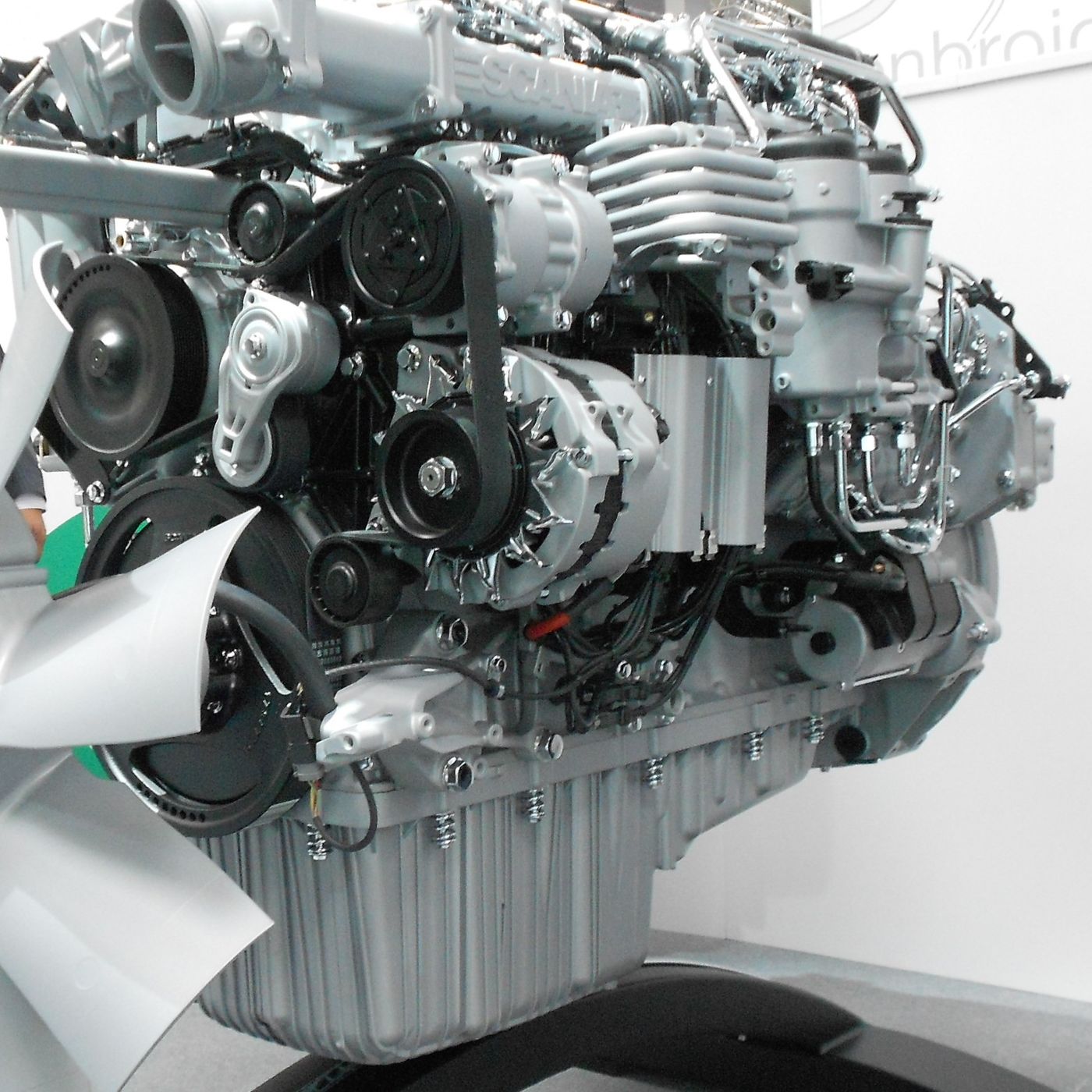
The Scania 9-litre is Scania’s five-cylinder in-line engine of 9.3 litres, built in two versions: the DC09 diesel and the OC09 gas engine. Scania’s release of 7 December 2017 names the 9-litre as one of the three engine families on which the Euro 6 engines of its new truck generation had been based until then, and lists the DC09 130, DC09 126 and DC09 127 at 280, 320 and 360 hp. Scania France’s body-builder data sheets of 19 October 2020 list the diesels DC09 139, DC09 140 and DC09 141, labelled 280, 320 and 360 ch, and the gas engines OC09 104 and OC09 105, labelled 280 and 340 ch. Scania’s P-series specification pages list 9-litre ratings under Euro 6, Euro 5, Euro 4 and Euro 3 tabs. The diesels run on diesel and HVO, the Euro 6 versions of 320 and 360 hp also on biodiesel, and use SCR, apart from the Euro 3 ratings, listed “Without SCR”; the gas engines run on compressed or liquefied natural gas and appear in Scania’s P-series tables with exhaust gas recirculation (EGR). On this site it is the 9-litre engine of the Scania P-series, the Scania R-series and the Scania XT.
Status as of 26 October 2026. Scania’s press release of 7 December 2017 with its technical data for the DC09, Scania France’s body-builder engine data sheets “Moteurs Euro 6 NTG” (No 1-V10, dated 19 October 2020), Scania’s news of 17 October 2019 and 7 December 2020 on its city buses, Scania UK’s bus range brochure (edition 2021.09), and Scania’s P-series specification pages (Scania Group and Scania UK), gas truck page and bus power-graph page were read on 26 October 2026. Each figure is given in the units its document uses, mostly hp, kW and Nm, with the ch of the French data sheet; how the units relate is explained in kW, hp and Nm: how to read a truck’s power figures.
What the 9-litre is
Scania names each version by family and number: the diesels carry DC09 designations and the gas engines OC09. Scania’s release of 7 December 2017 calls the diesel the “five-cylinder DC09 family” and lists the DC09 130, DC09 126 and DC09 127 in its technical data. Scania France’s data sheet of 19 October 2020 lists the DC09 139, DC09 140 and DC09 141 under “Moteur 9 litres SCR” and the OC09 104 and OC09 105 under “Moteurs 9 litres Gaz”, and Scania UK’s P-series page uses the same five IDs in its Euro 6 table. The documents read do not explain the numbering or say how the IDs of 2017 relate to those of 2020.
The base data below are those Scania prints in each document: the release of 7 December 2017 for the DC09 130, 126 and 127, and Scania France’s data sheet of 19 October 2020, which has one page for the diesel and one for the gas engine. A dash means that document does not give the item.
| Item | DC09 diesel, release of 7 December 2017 | DC09 diesel, data sheet of 19 October 2020 | OC09 gas, data sheet of 19 October 2020 |
|---|---|---|---|
| Cylinders | 5, inline | 5 in line, water-cooled | 5 in line, water-cooled |
| Displacement | 9.3 litres | 9.3 litres | 9.3 litres |
| Bore x stroke | 130 x 140 mm | 130 x 140 mm | 130 x 140 mm |
| Valves per cylinder | 4 | 4 | 4 |
| Cylinder heads | — | 5, one per cylinder | 5, one per cylinder |
| Firing order | 1-2-4-5-3 | — | — |
| Compression ratio | 19.0:1 | 20:1 | 12.6:1 |
| Fuel injection | Scania XPI | XPI: direct common-rail injection, electronically managed | Multipoint, 2 injectors per cylinder |
| Ignition | — | — | Electronic, with a separate spark plug and ignition coil for each cylinder |
| Turbocharger | — | Fixed geometry | Fixed geometry |
| Emission control | Scania SCR | Scania SCR and a continuously regenerating diesel particulate filter | — |
| Exhaust brake | 190 kW at 2,400 rpm | 183 kW (248 ch) at 2,400 rpm | — |
For the DC09, the release of 2017 and the data sheet of 2020 print different compression ratios, 19.0:1 and 20:1, and different exhaust-brake ratings, 190 kW and 183 kW, both at 2,400 rpm; the documents read do not explain the difference. The gas page of the data sheet describes the OC09 as a “Moteur à allumage commandé et injection indirecte multipoint”, a spark-ignition engine with indirect multipoint injection.
Fuels
Diesel and HVO. Scania France’s data sheet gives the fuel compatibility of the DC09 139 as “Diesel / xTL*” and of the DC09 140 and DC09 141 as “Diesel / xTL* / Biodiesel”, and defines xTL as hydrotreated vegetable oil (HVO). Scania UK’s P-series page lists the DC09 139 for “Diesel/HVO” and the DC09 140 and DC09 141 for “Diesel/HVO/Biodiesel”. Scania Group’s P-series page reads: “The entire Scania Euro 6 engine range is approved to run on up to 100% HVO.” HVO itself is explained in What is HVO?
Biodiesel. In Scania’s release of 7 December 2017, a footnote to the DC09 126 and DC09 127, the 320 and 360 hp engines, reads: “Also available in a version using up to 100 percent biodiesel such as FAME”. Under the Euro 5, Euro 4 and Euro 3 tabs of Scania’s P-series pages, every 9-litre row carries the fuel “Diesel/HVO/Biodiesel”.
Sulphur. On its diesel page, Scania France’s data sheet states that Scania’s Euro 6 engines require fuel with a sulphur content of at most 10 ppm.
Gas. The OC09 104 and OC09 105 are gas engines. Scania’s gas truck page says: “Scania’s gas trucks use 9-litre or 13-litre Otto-cycle engines which burn methane as fuel. The engines are available for compressed or liquefied gas”. Scania France’s data sheet calls the OC09 a “Moteur gaz Scania GNC / GNL”, for compressed natural gas (GNC) and liquefied natural gas (GNL), and Scania UK’s P-series page lists both gas engines for “Gas (CNG/LNG)”. Scania UK’s bus range brochure gives “Compressed natural gas/Biogas” as the fuel of its gas-fuelled double-deck bus with a 9-litre engine (see below). Gas trucks and their fuels are covered in LNG and bio-LNG trucks.
Emission class and after-treatment
Scania’s data sheet, its 2017 release and its bus documents give the 9-litre as a Euro 6 engine; its P-series pages also list Euro 5, Euro 4 and Euro 3 ratings (below). Scania France’s data sheet states that the engines comply with “EURO6 (627/2014D)”, Scania UK’s bus range brochure lists a “9-litre 250hp Euro 6 engine” and a “9-litre 280hp Euro 6 engine”, and Scania’s bus power-graph page lists the 9-litre diesel and gas ratings under Euro 6. The steps of the standard are explained in Euro VI (Euro 6) and Euro 7 for trucks.
DC09: SCR. Scania’s release of 7 December 2017 gives the emission control of the DC09 130, 126 and 127 as Scania SCR. Scania France’s data sheet describes the DC09’s system as Scania SCR with a continuously regenerating diesel particulate filter for Euro 6 exhaust emissions, and Scania UK’s P-series page lists “Selective catalytic reduction (SCR)” for the DC09 139, 140 and 141. Scania Group’s P-series page says: “Scania’s entire 7-, 9- and 13-litre engine range features SCR-only technology”. What the law makes an SCR system detect about its AdBlue is explained in SCR and AdBlue.
OC09: EGR. Under the Euro 6 tab, Scania UK’s P-series page gives the emission technology of the OC09 104 and OC09 105 as “Exhaust gas recirculation (EGR)”, and Scania Group’s P-series page lists its two 9-litre “GAS” rows the same way. That differs from the same Group page’s sentence on SCR-only technology for the 7-, 9- and 13-litre range; the documents read do not reconcile the two. The gas page of the French data sheet names no after-treatment system.
Euro 5, Euro 4 and Euro 3. Scania’s P-series specification pages, Group and UK, have tabs for Euro 6, Euro 5, Euro 4 and Euro 3 and list 9-litre ratings under each: under Euro 5 and Euro 4 with SCR, under Euro 3 “Without SCR” (see the ratings below). The pages do not say in which markets each tab applies.
Euro 7. The documents read give no Euro 7 version or rating of the 9-litre.
Generations and versions
Euro 6 diesels of the new truck generation (by December 2017). Scania’s release of 7 December 2017 says that the Euro 6 engines introduced so far in its new truck generation were “based on three different engine families (9, 13 and 16 litres)”, and its technical data list the DC09 130 (280 hp), DC09 126 (320 hp) and DC09 127 (360 hp). The documents read give no introduction date for the 9-litre family or for its first Euro 6 versions.
Euro 5, Euro 4 and Euro 3 ratings (undated). Scania’s P-series pages keep 9-litre tables under these tabs, without engine IDs or dates: 280, 320 and 360 hp under Euro 5 and Euro 4, and 250 and 310 hp under Euro 3.
City buses (17 October 2019 and 7 December 2020). Scania’s news of 17 October 2019 on its new city and suburban bus range describes a “side-mounted engine placement of both the 7- and 9-litre engine” on 12-metre low-floor city buses. Its news of 7 December 2020 on the new city-bus generation says: “The 9-litre engine has been revised to reduce internal friction and has a higher compression ratio”, and that the 9-litre gas engine has been given “more torque at low revs”. Neither item names engine IDs.
Data sheet of 19 October 2020. Scania France’s “Moteurs Euro 6 NTG” sheets, for the New Truck Generation, No 1-V10 dated 19/10/2020, list the diesels DC09 139, DC09 140 and DC09 141 as “Moteur 9 litres SCR” and the gas engines OC09 104 and OC09 105 as “Moteurs 9 litres Gaz”. The documents read do not say when these IDs were introduced.
Bus brochure (edition 2021.09). Scania UK’s bus range brochure lists the “Engine DC09 139, 9 litre 280hp (206kW) and 1400Nm torque” for the Scania Fencer f1 single-deck bus on the Scania K 4x2 LB chassis. For double-deck buses on the Scania NUD low-floor chassis it lists a “9-litre 250hp Euro 6 engine” in the Scania ADL Enviro400, with diesel and HVO as fuel options, and a “9-litre 280hp Euro 6 engine” in the gas-fuelled Scania ADL Enviro400CBG, for compressed natural gas or biogas. The power options on its chassis page give, for diesel and HVO, 9-litre engines of 250 hp with 1,250 Nm and of 280 hp with 1,400 Nm, and, for biogas and compressed natural gas, a 9-litre of 280 hp with 1,350 Nm.
Current specification pages (read 26 October 2026). Scania Group’s P-series page says: “Our 9-litre engine is available with 280, 320, 340 and 360 hp depending on your choice of fuel.” Scania UK’s P-series page lists the five Euro 6 engine IDs, DC09 139, 140 and 141 and OC09 104 and 105, and Scania’s bus power-graph page lists graphs for the “9-litre diesel engine” at 280, 320 and 360 hp and for the “9-litre gas engine” at 280 and 340 hp under Euro 6. In its text on the Super 11-litre engine, Scania UK’s P-series page refers to “the previous Scania 9-litre”. The documents read give no end date for the 9-litre.
Ratings as Scania states them
| Engine | Data sheet label | Maximum power | Maximum torque | Fuel (data sheet) |
|---|---|---|---|---|
| DC09 139 | 280 ch | 206 kW at 1,900 rpm | 1,400 Nm at 1,000–1,400 rpm | Diesel / xTL |
| DC09 140 | 320 ch | 235 kW at 1,900 rpm | 1,600 Nm at 1,050–1,400 rpm | Diesel / xTL / Biodiesel |
| DC09 141 | 360 ch | 265 kW at 1,900 rpm | 1,700 Nm at 1,050–1,475 rpm | Diesel / xTL / Biodiesel |
| OC09 104 | 280 ch | 206 kW at 1,900 rpm | 1,350 Nm at 1,000–1,400 rpm | GNC / GNL |
| OC09 105 | 340 ch | 250 kW at 1,900 rpm | 1,600 Nm at 1,100–1,400 rpm | GNC / GNL |
The data sheet marks xTL with an asterisk and defines it as hydrotreated vegetable oil (HVO); GNC and GNL are its terms for compressed and liquefied natural gas.
| Engine | Maximum power | Maximum torque |
|---|---|---|
| DC09 130 | 280 hp (206 kW) at 1,900 rpm | 1,400 Nm at 1,000–1,350 rpm |
| DC09 126 | 320 hp (235 kW) at 1,900 rpm | 1,600 Nm at 1,050–1,350 rpm |
| DC09 127 | 360 hp (265 kW) at 1,900 rpm | 1,700 Nm at 1,050–1,350 rpm |
The release and the data sheet give the same power and torque for each of the three diesel steps; their torque bands end at different engine speeds.
| Engine ID | Output | Torque | Fuel | Emission technology | Engine PTO |
|---|---|---|---|---|---|
| DC09 141 | 360 Hp | 1700 Nm | Diesel/HVO/Biodiesel | Selective catalytic reduction (SCR) | 600 Nm |
| OC09 105 | 340 Hp | 1600 Nm | Gas (CNG/LNG) | Exhaust gas recirculation (EGR) | 600 Nm |
| DC09 140 | 320 Hp | 1600 Nm | Diesel/HVO/Biodiesel | Selective catalytic reduction (SCR) | 600 Nm |
| DC09 139 | 280 Hp | 1400 Nm | Diesel/HVO | Selective catalytic reduction (SCR) | 600 Nm |
| OC09 104 | 280 Hp | 1350 Nm | Gas (CNG/LNG) | Exhaust gas recirculation (EGR) | 600 Nm |
| Emission level | Power and torque | Fuel | Emission technology | Engine PTO |
|---|---|---|---|---|
| Euro 5 | 280 hp, 1400 Nm; 320 hp, 1600 Nm; 360 hp, 1700 Nm | Diesel/HVO/Biodiesel | Selective catalytic reduction (SCR) | 600 Nm |
| Euro 4 | 280 hp, 1400 Nm; 320 hp, 1600 Nm; 360 hp, 1700 Nm | Diesel/HVO/Biodiesel | Selective catalytic reduction (SCR) | 600 Nm |
| Euro 3 | 250 hp, 1250 Nm; 310 hp, 1550 Nm | Diesel/HVO/Biodiesel | Without SCR | 600 Nm |
Braking and power take-off. Scania France’s data sheet gives the DC09’s exhaust brake (“Ralentisseur moteur”) as 183 kW (248 ch) at 2,400 rpm, a braking power that, in the sheet’s footnote, meets the endurance-brake requirements of ADR for a gross combination weight of 44 t; it gives no such figure for the OC09. Scania’s P-series pages list an engine PTO of 600 Nm for every 9-litre row. What an endurance brake is, and how the law groups engine brakes with retarders, is explained in What is a retarder?
Trucks and buses on this site with the Scania 9-litre
Three model pages on this site carry the Scania 9-litre in their engine records, all of them trucks; no bus on this site records the engine. The Scania G-series and Scania L-series pages name the 9-litre in the engine tables they quote from Scania but have no engine record for it. The figures below are those of each model’s own page and of the Scania source that page cites, in kilowatts and newton-metres as the site’s records keep them; they are not the engine-level tables above.
| Model | Engine as recorded | Power (kW) | Torque (Nm) |
|---|---|---|---|
| Scania P-series | Scania 9-litre | 206–265 | 1,350–1,700 |
| Scania R-series | Scania 9-litre | 206–265 | 1,350–1,700 |
| Scania XT | Scania 9-litre | 206–265 | 1,350–1,700 |
Quick answers
- What is the displacement of the Scania 9-litre engine?
- 9.3 litres. Scania's release of 7 December 2017 and Scania France's body-builder data sheet of 19 October 2020 give the 9-litre as a five-cylinder in-line engine of 9.3 litres with a bore and stroke of 130 x 140 mm and four valves per cylinder. The data sheet adds five separate cylinder heads and gives a compression ratio of 20:1 for the DC09 diesel and 12.6:1 for the OC09 gas engine; the 2017 release gives 19.0:1 for the DC09.
- What are the Scania DC09 and OC09?
- The diesel and the gas versions of Scania's 9-litre engine. Scania France's data sheet of 19 October 2020 lists the diesels DC09 139 (206 kW, 1,400 Nm), DC09 140 (235 kW, 1,600 Nm) and DC09 141 (265 kW, 1,700 Nm), labelled 280, 320 and 360 ch, and the gas engines OC09 104 (206 kW, 1,350 Nm) and OC09 105 (250 kW, 1,600 Nm), labelled 280 and 340 ch, all with maximum power at 1,900 rpm. Scania UK's P-series page gives the same five IDs in hp: 280, 320 and 360 hp for the diesels, 280 and 340 hp for the gas engines. Scania's release of 7 December 2017 lists the diesel IDs DC09 130, DC09 126 and DC09 127 at 280, 320 and 360 hp.
- Can the Scania 9-litre run on HVO, biodiesel or gas?
- Depending on the version. Scania UK's P-series page lists the DC09 139 for Diesel/HVO and the DC09 140 and DC09 141 for Diesel/HVO/Biodiesel, and Scania's P-series page says: “The entire Scania Euro 6 engine range is approved to run on up to 100% HVO.” The OC09 104 and OC09 105 are gas engines, listed for “Gas (CNG/LNG)”; Scania's gas truck page says its gas trucks use 9-litre or 13-litre Otto-cycle engines which burn methane and are available for compressed or liquefied gas. On its diesel page, Scania France's data sheet states that Scania's Euro 6 engines require fuel with at most 10 ppm of sulphur.
- Which emission standard does the Scania 9-litre meet?
- Euro 6 in Scania's documents. The DC09 diesels use Scania SCR, with a continuously regenerating diesel particulate filter on the 2020 data sheet. Scania's P-series tables list the OC09 gas engines with exhaust gas recirculation (EGR), although the Group P-series page also says that Scania's 7-, 9- and 13-litre range “features SCR-only technology”. The P-series pages also list 9-litre diesel ratings under Euro 5 and Euro 4 tabs, with SCR, and under a Euro 3 tab “Without SCR”. The documents read give no Euro 7 version.
- Which trucks and buses use the Scania 9-litre?
- On this site, the Scania P-series, R-series and XT, all trucks, carry the 9-litre in their engine records at 206 to 265 kW and 1,350 to 1,700 Nm. Scania UK's bus range brochure, edition 2021.09, lists the DC09 139 of 280hp for the Scania Fencer f1 single-deck bus, a 9-litre of 250hp for the double-deck Scania ADL Enviro400 and a 9-litre of 280hp for the gas-fuelled Scania ADL Enviro400CBG, both on the Scania NUD chassis.
Models in this article
Sources
- Scania introduces a 7-litre family for improved efficiency and reduced weight (press release P171204EN, 7 December 2017, with technical data for the DC07, DC09, DC13 and DC16 Euro 6 engines) — Scania, 7 Dec 2017
- Moteurs Euro 6 NTG (body-builder engine data sheets, No 1-V10, 19 October 2020) — Scania France, 19 Oct 2020
- P-series specifications — engines by emission level (read 26 October 2026) — Scania Group
- P-series specifications — engine tables with engine IDs (read 26 October 2026) — Scania UK
- Gas trucks (read 26 October 2026) — Scania Group
- Buses and coaches — power and torque graphs, Euro 6 (read 26 October 2026) — Scania Group
- Scania unveils new generation city and suburban range (news, 17 October 2019) — Scania Group, 17 Oct 2019
- Scania’s new powertrain improves fuel consumption in city buses (news, 7 December 2020) — Scania Group, 7 Dec 2020
- Scania bus range (brochure, edition 2021.09) — Scania (Great Britain) Limited